World’s excess heat going largely into the Southern Oceans
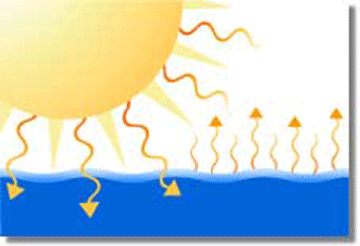 Southern oceans play major role in absorbing world’s excess heat, study finds February 3, Peter Hannam Environment Editor, The Sydney Morning Herald The world’s oceans are heating at the rate of two trillion 100-watt light bulbs burning continuously, providing a clear signal of global warming, according to new study assessing data from a global fleet of drifting floats.
The research, published on Tuesday in the journal Nature Climate Change, used data collected from the array of about 3500 Argo buoys from 2006-13 to show temperatures were warming at about 0.005 degrees a year down to a depth of 500 metres and 0.002 degrees between 500-2000 metres.
Oceans south of the 20-degree latitude accounted for two-thirds to 98 per cent of the heat gain during the period studied, with three giant gyres in the southern Pacific, Indian and Atlantic oceans largely responsible for drawing down the extra warmth.
“The global ocean heat content right now is the most reliable metric of that radiation imbalance” between the energy received from the sun and what is radiated back to space, said Susan Wijffels, an oceans expert at the CSIRO and one of the report’s authors………..
“The ocean is just vertically transferring the heat away from the surface to the depth,” Dr Wijffels said. “The ‘hiatus’ is not meaningful.”
Even with the relative slowdown in surface temperature increases, 14 of the world’s 15 warmest years on record have been in the 21st century, the World Meteorological Organisation said on Monday.
The United Nations body also confirmed that 2014 was the hottest year, edging out 2010 and 2005. The readings were based in part on United States agencies, including NASA which last month also declared 2014 as its warmest year.
John Church, another of the paper’s authors and also from the CSIRO, said the temperatures in the atmosphere – which accounts for just 1 per cent of the planet’s heat uptake – would rise sharply if oceans absorbed less of the heat……..
As it is, warming oceans are swelling in volume, lifting sea levels, and also affecting ecosystems, he said.
“If we want to avoid the worst impacts of climate change then we need to start taking some mitigation action,” Dr Church said. This included cutting carbon emissions and lifting renewable energy targets at home and overseas.
Future Argo missions will extend coverage to higher latitudes, including sea-ice zones, and reach depths of 6000 metres.
However, Dr Wijffels said Australia’s contribution is in doubt with about half of its Argo budget tied up with the Abbott government’s stalled higher education reform bills. Those funds run out “in a few months”, she said.
The Nature study was led by Dean Roemmich of the California-based Scripps Institution of Oceanography. http://www.smh.com.au/environment/climate-change/southern-oceans-play-major-role-in-absorbing-worlds-excess-heat-study-finds-20150202-133j2p.html
No comments yet.
1 This Month



Tell the Ukrainian Government to Drop Prosecution of Peace Activist Yurii Sheliazhenko

Petition to revoke the licensing of the Near Surface Nuclear Disposal Facility (NSDF) at Chalk River. https://www.ourcommons.ca/petitions/en/Petition/Details?Petition=e-7247


of the week – STOP SMALL MODULAR REACTORS IN CANADA
To see nuclear-related stories in greater depth and intensity – go to https://nuclearinformation.wordpress.com
-
Archives
- March 2026 (212)
- February 2026 (268)
- January 2026 (308)
- December 2025 (358)
- November 2025 (359)
- October 2025 (376)
- September 2025 (258)
- August 2025 (319)
- July 2025 (230)
- June 2025 (348)
- May 2025 (261)
- April 2025 (305)
-
Categories
- 1
- 1 NUCLEAR ISSUES
- business and costs
- climate change
- culture and arts
- ENERGY
- environment
- health
- history
- indigenous issues
- Legal
- marketing of nuclear
- media
- opposition to nuclear
- PERSONAL STORIES
- politics
- politics international
- Religion and ethics
- safety
- secrets,lies and civil liberties
- spinbuster
- technology
- Uranium
- wastes
- weapons and war
- Women
- 2 WORLD
- ACTION
- AFRICA
- Atrocities
- AUSTRALIA
- Christina's notes
- Christina's themes
- culture and arts
- Events
- Fuk 2022
- Fuk 2023
- Fukushima 2017
- Fukushima 2018
- fukushima 2019
- Fukushima 2020
- Fukushima 2021
- general
- global warming
- Humour (God we need it)
- Nuclear
- RARE EARTHS
- Reference
- resources – print
- Resources -audiovicual
- Weekly Newsletter
- World
- World Nuclear
- YouTube
-
RSS
Entries RSS
Comments RSS
 nuclear-news
Leave a comment