Danger for India in weakening Liability law, and no benefit to India in USA nuclear deal
The most baffling feature of the current agreement is that it holds no tangible benefits for India. The United States has offered to sell two reactor designs — both of which are expensive and untested.
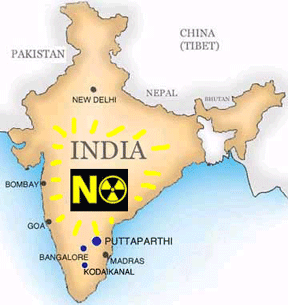 Last week, the residents of Mithi Virdi wrote an open letter to Mr. Obama and Mr. Modi reminding them that the “gram panchayats of four most-affected villages … [have] passed a resolution declaring the entire … region as [a] nuclear free zone.” The leaders of the “world’s largest democracies” face a clear choice. They can channel billions of dollars into nuclear corporations by sacrificing safety and economic prudence. Or they can heed the democratic voices from Mithi Virdi and cancel these unnecessary deals.
 Nuclear deal no cause for celebration THE HINDU, SUVRAT RAJUM. V. RAMANA 31 Jan 15 Any understanding between Narendra Modi and Barack Obama on circumventing the Indian nuclear liability law to protect American reactor suppliers should be a matter of concern
At their recent meeting, Prime Minister Narendra Modi and President Barack Obama discussed methods of circumventing the Indian nuclear liability law to protect American reactor suppliers from the consequences of accidents caused by design defects. Although public details are scarce, if they have indeed reached an understanding on the issue, then this is not a cause for celebration; it should be a matter of deep concern.
The importance of supplier liability is illustrated by the Fukushima nuclear disaster in 2011. When the reactors were hit by the tsunami that year, the weakness of the General Electric (GE) Mark I design was cruelly exposed. The reactors’ inadequate containment was unable to prevent the spread of radioactivity when the cooling systems failed and pressure built up inside the reactors. Although this design defect was first noted about 40 years ago, just as the Fukushima reactors were commissioned, the industry resisted regulatory changes that could have ameliorated the disaster.
Framework of impunity
The Japan Center for Economic Research estimated that the cost of cleanup at Fukushima may reach $200 billion. A 2013 expert study “Accounting for long-term doses in worldwide health effects of the Fukushima Daiichi nuclear accident” published in the journal Energy and Environmental Science estimated that the disaster may lead to about a thousand excess deaths due to cancer. However, it is unlikely that GE will ever be held accountable for its poor design choice. Under Japanese law, the supplier is indemnified from liability for an accident. This is the framework of impunity under which nuclear suppliers like to operate.
Legal indemnity for suppliers creates a “moral hazard”— encouraging suppliers to take excessive risks since they don’t have to pay for the consequences. The case of GE not strengthening the Mark I containment is not an exception. The Presidential commission appointed to study the 1979 Three Mile Island disaster, which saw a partial nuclear meltdown, pointed out that the supplier, Babcock and Wilcox, was already aware of design defects that contributed to the accident, but never bothered to resolve them.
Nevertheless, suppliers have ferociously defended their privilege of being free of liability, and they exerted tremendous pressure on the Indian government when the Civil Liability for Nuclear Damage Act was framed in 2010. Contrary to the industry’s propaganda, this is not a “tough” law. Indeed, several clauses in the law were directly lifted from an annex to the “Convention on Supplementary Compensation,” created by the U.S. government to benefit its nuclear industry……..
No tangible benefits
The most baffling feature of the current agreement is that it holds no tangible benefits for India. The United States has offered to sell two reactor designs — both of which are expensive and untested. The Westinghouse AP1000, which has been chosen for Mithi Virdi (Gujarat) is not in commercial operation anywhere and has encountered difficulties wherever it is being built. At Plant Vogtle, in the U.S. state of Georgia, Westinghouse and its partner Georgia Power have sued each other for a billion dollars over cost increases and delays. Even in China, the AP1000 has been delayed by about two years because of problems with reactor coolant pumps.
Even less can be said for GE’s Economic Simplified Boiling Water Reactor (ESBWR), selected for Kovvada (Andhra Pradesh). After years of questions about ESBWR’s steam dryer, the design obtained regulatory approval from the U.S. Nuclear Regulatory Commission — the first step before construction can commence — only in September 2014. There are no firm orders for the ESBWR.
The Vogtle plants were initially estimated to cost about $7 billion apiece. Even accounting for lower construction costs in India we showed — in a detailed study “Cost of Electricity from the Jaitapur Nuclear Power Plant” published in the Economic and Political Weekly — could translate into electricity tariffs that are as high as Rs. 15 per unit. If the government is looking for cheap electricity to promote development, importing American reactors hardly seems like a smart choice.
Last week, the residents of Mithi Virdi wrote an open letter to Mr. Obama and Mr. Modi reminding them that the “gram panchayats of four most-affected villages … [have] passed a resolution declaring the entire … region as [a] nuclear free zone.” The leaders of the “world’s largest democracies” face a clear choice. They can channel billions of dollars into nuclear corporations by sacrificing safety and economic prudence. Or they can heed the democratic voices from Mithi Virdi and cancel these unnecessary deals.
(Suvrat Raju and M.V. Ramana are physicists with the Coalition for Nuclear Disarmament and Peace) http://www.thehindu.com/opinion/op-ed/nuclear-deal-no-cause-for-celebration/article6839852.ece
No comments yet.
1 This Month

of the week – Shut Down Drone Warfare!


Tell the Ukrainian Government to Drop Prosecution of Peace Activist Yurii Sheliazhenko

Petition to revoke the licensing of the Near Surface Nuclear Disposal Facility (NSDF) at Chalk River. https://www.ourcommons.ca/petitions/en/Petition/Details?Petition=e-7247
To see nuclear-related stories in greater depth and intensity – go to https://nuclearinformation.wordpress.com
-
Archives
- March 2026 (237)
- February 2026 (268)
- January 2026 (308)
- December 2025 (358)
- November 2025 (359)
- October 2025 (376)
- September 2025 (257)
- August 2025 (319)
- July 2025 (230)
- June 2025 (348)
- May 2025 (261)
- April 2025 (305)
-
Categories
- 1
- 1 NUCLEAR ISSUES
- business and costs
- climate change
- culture and arts
- ENERGY
- environment
- health
- history
- indigenous issues
- Legal
- marketing of nuclear
- media
- opposition to nuclear
- PERSONAL STORIES
- politics
- politics international
- Religion and ethics
- safety
- secrets,lies and civil liberties
- spinbuster
- technology
- Uranium
- wastes
- weapons and war
- Women
- 2 WORLD
- ACTION
- AFRICA
- Atrocities
- AUSTRALIA
- Christina's notes
- Christina's themes
- culture and arts
- Events
- Fuk 2022
- Fuk 2023
- Fukushima 2017
- Fukushima 2018
- fukushima 2019
- Fukushima 2020
- Fukushima 2021
- general
- global warming
- Humour (God we need it)
- Nuclear
- RARE EARTHS
- Reference
- resources – print
- Resources -audiovicual
- Weekly Newsletter
- World
- World Nuclear
- YouTube
-
RSS
Entries RSS
Comments RSS
 nuclear-news
Leave a comment