USA persuades India to weaken its nuclear liability law – double standards here
Under pressure from GE and Westinghouse, the two American nuclear vendors hoping to sell billions of dollars worth of reactors to India, the Obama administration has demanded that Section 17(b) and Section 46 of the Indian liability law be deleted or amended.
Double standards? The irony is that American nuclear suppliers operate under a domestic liability regime that allows operators to sue them for recovery of damages in the event of an accident. That is how Metropolitan Edison, the operator of the Three Mile Island nuclear plant, sued Babcock Wilcox after the infamous 1979 accident.
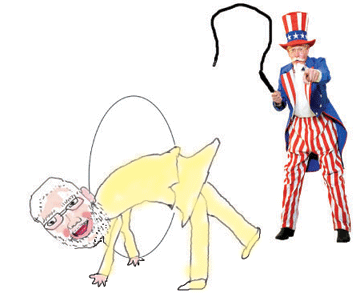 Why India should say no to US demand to dilute its nuclear liability law The Modi government should resist pressure from Barack Obama, who landed in New Delhi on Sunday morning, to change key provisions to favour foreign supplier of reactors. Siddharth Varadarajan Scroll.in 26 Jan 15
With the issue of nuclear liability emerging as an obstacle in the relationship between India and the US, the Modi government is under pressure to dilute the law in favour of foreign reactor suppliers. Without this, we are told, it will not be possible to operationalise the US-India nuclear agreement and provide the country with the electricity its people need.
In the event of a major nuclear accident in India, one which damages lives and property, what does the law say about how liability is to be apportioned? Under the terms of the Civil Liability for Nuclear Damage Act, 2010, the operator of the nuclear plant is liable regardless of the proximate cause of the accident up to an amount of Rs 1,500 crore. This “no-fault liability” is strict and absolute, and means victims do not have to worry about whose door to knock or against whom to prove a case of culpability.
Having absorbed this blow, however, the operator is entitled under Section 17(b) of the Act to exercise a “right of recourse” if the accident was caused by an act of the supplier or his employee, including the “supply of equipment or material with patent or latent defects or sub-standard services.” This right of recourse is for the maximum amount of Rs 1,500 crore that the operator might have to pay as part of its no-fault liability.
But what happens if the damage caused by a nuclear accident is more than Rs 1,500 crore? The Act makes the Central government liable for damages in excess of that amount but there is a conflict of interest built into the process because it is the Central government itself, acting through a Claims Commissioner it has appointed, which fixes the quantum of damages.
Large claims
The question is this: What happens if the victims suffer losses in excess of Rs 1,500 crore, which the Claims Commissioner or the government refuses to compensate them for? Or if the government, for political reasons, is keen to impose a Bhopal-type settlement for a paltry sum?
Section 46 provides victims with tort remedies: “The provisions of this Act shall be in addition to, and not in derogation of, any other law for the time being in force, and nothing contained herein shall exempt the operator from any proceeding which might, apart from this Act, be instituted against such operator.”
While an operator may have paid up to Rs 1,500 crore on the basis of no-fault liability, the law does not exempt him from fault liability or criminal proceedings, as the case may be. Indeed, Section 5(2) makes it clear that the amount paid as no-fault liability “shall not have the effect of reducing the amount of his liability in respect of any other claim for damage under any other law…”
Since the liability Act does not derogate from any other law, victims are free to file tort claims against the reactor supplier too if they think the accident was the fault of the supplier and they are confident of providing the courts with evidence of this. In addition, an Indian operator could also file a tort case against his supplier, and so could the government.
Under pressure from GE and Westinghouse, the two American nuclear vendors hoping to sell billions of dollars worth of reactors to India, the Obama administration has demanded that Section 17(b) and Section 46 of the Indian liability law be deleted or amended.
Flawed arguments……….
Double standards?
The irony is that American nuclear suppliers operate under a domestic liability regime that allows operators to sue them for recovery of damages in the event of an accident. That is how Metropolitan Edison, the operator of the Three Mile Island nuclear plant, sued Babcock Wilcox after the infamous 1979 accident.
The Price-Anderson Act in the US sets a cap on the total liability for an accident with the government committed to stepping in after that. However, the federal government can subsequently move to recover those monies from the operator, who in turn can act against his supplier, thus creating a post-accident litigation scenario that is not very different from that allowed by Sections 17 (b) and 46 of the Indian liability law……….
No comments yet.
1 This Month



Tell the Ukrainian Government to Drop Prosecution of Peace Activist Yurii Sheliazhenko

Petition to revoke the licensing of the Near Surface Nuclear Disposal Facility (NSDF) at Chalk River. https://www.ourcommons.ca/petitions/en/Petition/Details?Petition=e-7247


of the week – STOP SMALL MODULAR REACTORS IN CANADA
To see nuclear-related stories in greater depth and intensity – go to https://nuclearinformation.wordpress.com
-
Archives
- March 2026 (219)
- February 2026 (268)
- January 2026 (308)
- December 2025 (358)
- November 2025 (359)
- October 2025 (376)
- September 2025 (258)
- August 2025 (319)
- July 2025 (230)
- June 2025 (348)
- May 2025 (261)
- April 2025 (305)
-
Categories
- 1
- 1 NUCLEAR ISSUES
- business and costs
- climate change
- culture and arts
- ENERGY
- environment
- health
- history
- indigenous issues
- Legal
- marketing of nuclear
- media
- opposition to nuclear
- PERSONAL STORIES
- politics
- politics international
- Religion and ethics
- safety
- secrets,lies and civil liberties
- spinbuster
- technology
- Uranium
- wastes
- weapons and war
- Women
- 2 WORLD
- ACTION
- AFRICA
- Atrocities
- AUSTRALIA
- Christina's notes
- Christina's themes
- culture and arts
- Events
- Fuk 2022
- Fuk 2023
- Fukushima 2017
- Fukushima 2018
- fukushima 2019
- Fukushima 2020
- Fukushima 2021
- general
- global warming
- Humour (God we need it)
- Nuclear
- RARE EARTHS
- Reference
- resources – print
- Resources -audiovicual
- Weekly Newsletter
- World
- World Nuclear
- YouTube
-
RSS
Entries RSS
Comments RSS
 nuclear-news
Leave a comment