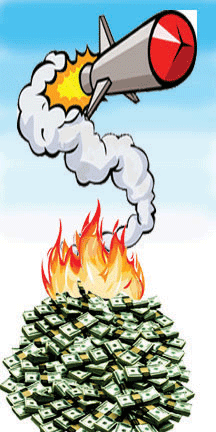
America’s $trillion nuclear weapons industry – now too big to succeed?

 Rebranding the nuclear weapons complex won’t reform it, Bulletin of the Atomic Scientists Robert Alvarez, 18 Jan 15
“…………Lab overcapacity, in particular, contributes to an inflated weapons complex cost structure, within which the average full time employee is two to three times as expensive as in the private sector. Since 2006, when management of the weapons labs was transferred from the nonprofit University of California to for-profit entities,administrative fees have jumped by 650 percent at Los Alamos. The bloat in the weapons complex is hardly limited to the national labs; the Y-12 nuclear weapons plant in Tennessee has excess capacity that is comparable, in size, to two auto assembly plants.
The Obama administration should establish a commission—one, this time, that is not dominated by the very contractors that run the nuclear weapons complex—to analyze and downsize the redundant elements of that complex. The Defense Department accomplished such a downsizing over the past 20 years; it’s long past time for the Energy Department to begin shedding its surplus capacity. Given that weapons facilities dominate the wage and benefit structures of large areas in several states, such streamlining will no doubt meet stiff congressional resistance. Still, the downsizing sword could eliminate redundant facilities and free up funding to rebuild those that are truly needed.
- Too big to succeed. Perhaps the most significant aspect of management reform in the nuclear weapons complex is coming to terms with its size. From the start, this newest review panel was directed to place the thorny problem of downsizing the weapons complex—an issue raised by several expert panels over some 20 years—off the table. By focusing on organizational boxes, Congress made sure that the panel would not tackle a most obvious problem: The nuclear weapons production and laboratory system is simply too large for the nation’s current needs.
- Finally, the most recent study of the weapons complex raises a fundamental question: Could it be that the “orphan” status of nuclear weapons in the United States reflects not presidential and congressional inattention, but changing priorities in the real world of international security? When the president spoke last year of “reducing the role of nuclear weapons in our security strategy,” he seemed to unequivocally answer this question.
- By rebranding the Energy Department in a way that gives nuclear weapons production equal status with the whole of US energy policy, the congressional panel has tried to impose on the government a Cold War urgency that does not reflect the actual relevance of nuclear weaponry in the 21st century. Some estimates have puta trillion-dollar price tag on replacing our decaying nuclear deterrent. With the stakes so high, is it really in the nation’s interest to rely on a panel dominated by the interests of weapons contractors for advice on managing the problems of the weapons complex? http://thebulletin.org/rebranding-nuclear-weapons-complex-wont-reform-it7935

No comments yet.
1 This Month

of the week – Shut Down Drone Warfare!


Tell the Ukrainian Government to Drop Prosecution of Peace Activist Yurii Sheliazhenko

Petition to revoke the licensing of the Near Surface Nuclear Disposal Facility (NSDF) at Chalk River. https://www.ourcommons.ca/petitions/en/Petition/Details?Petition=e-7247
To see nuclear-related stories in greater depth and intensity – go to https://nuclearinformation.wordpress.com
-
Archives
- April 2026 (103)
- March 2026 (251)
- February 2026 (268)
- January 2026 (308)
- December 2025 (358)
- November 2025 (359)
- October 2025 (376)
- September 2025 (257)
- August 2025 (319)
- July 2025 (230)
- June 2025 (348)
- May 2025 (261)
-
Categories
- 1
- 1 NUCLEAR ISSUES
- business and costs
- climate change
- culture and arts
- ENERGY
- environment
- health
- history
- indigenous issues
- Legal
- marketing of nuclear
- media
- opposition to nuclear
- PERSONAL STORIES
- politics
- politics international
- Religion and ethics
- safety
- secrets,lies and civil liberties
- spinbuster
- technology
- Uranium
- wastes
- weapons and war
- Women
- 2 WORLD
- ACTION
- AFRICA
- Atrocities
- AUSTRALIA
- Christina's notes
- Christina's themes
- culture and arts
- Events
- Fuk 2022
- Fuk 2023
- Fukushima 2017
- Fukushima 2018
- fukushima 2019
- Fukushima 2020
- Fukushima 2021
- general
- global warming
- Humour (God we need it)
- Nuclear
- RARE EARTHS
- Reference
- resources – print
- Resources -audiovicual
- Weekly Newsletter
- World
- World Nuclear
- YouTube
-
RSS
Entries RSS
Comments RSS
 nuclear-news
Leave a comment