UK tax-payer landed with the astronomic costs of Sellafield nuclear facility
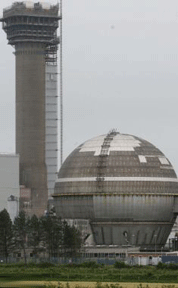
 Why Sellafield costs us all a bomb Telegraph UK 17 Jan 15 After a private consortium tried, and failed, to rescue the power station from decades of neglect, it is back in the arms of the public sector once again It’s like being in a timewarp, stuck back in the bad old days when the taxpayers’ bottomless purse was casually mined to prop up failing industries. For, amazingly, such spending has been going on – even in these post-Thatcher, austerity-driven times – in a small, if controversial, corner of Cumbria.
That corner, is of course, home to Sellafield – Europe’s biggest and most hazardous nuclear complex. This week, the Government abruptly dismissed the consortium that has been running it for the past six years, after what Parliament’s Public Accounts Committee (PAC) identified as “big delays” and “huge cost overruns, rising to astonishing levels”.
Sellafield has largely dropped out of the headlines in recent years, after decades of bad publicity about radioactive accidents, managerial incompetence and business boondoggles. And that is where it likes to be, for secrecy, combined with bureaucratic bungling, has long been one of its specialities……
It was, indeed, where weapons-grade plutonium was separated from used nuclear fuel by “reprocessing”, reason enough for the secrecy if not the ineptitude. But the culture continued as the site converted overwhelmingly to civilian purposes. The plutonium – one gram of which contains as much energy as a tonne of oil – was seen as a modern philosopher’s stone, able to power “fast breeder” reactors that could produce more useful fuel than they burned.
But such reactors never worked, and were abandoned 20 years ago. Reprocessing became a technology whose time would never come, but the state-owned site and successive governments persisted in almost theological thrall to it.
They even spent £1.4 billion on a plant where the plutonium would be mixed with uranium to make fuel for ordinary reactors, but – as widely predicted – that didn’t work either: designed to produce 120 tonnes of fuel a year, it managed only 15 in a decade before closing. This was only one in a whole series of eye-wateringly expensive plants that failed to perform as expected.
As a result, nearly 130 tonnes of highly dangerous, useless, plutonium are stored onsite, at a cost of £40 million a year. More than a quarter of a ton was discharged in to the Irish Sea, much to see what would happen. Worst of all, though, as the consortium – Nuclear Management Partners – has admitted, “there is a mass of very hazardous (nuclear) waste onsite in storage conditions that are extraordinarily vulnerable, and in facilities that are well past their designated life”.
The National Audit Office (NAO) says this poses “significant risks to people and the environment”. One official review concluded that, at worst, an explosive release could kill two million Britons and require the evacuation of an area reaching from Glasgow to Liverpool.
Following the legacy of decades of nationalised neglect, it’s no wonder that in 2008 ministers, belatedly, turned to private enterprise. The consortium – comprising British, French and US companies – received up to £1.8 billion a year on a “cost reimbursement contract” that left the risk with the taxpayer. ……http://www.telegraph.co.uk/news/earth/environment/11351587/Why-Sellafield-costs-us-all-a-bomb.html
No comments yet.
1 This Month


Tell the Ukrainian Government to Drop Prosecution of Peace Activist Yurii Sheliazhenko

Petition to revoke the licensing of the Near Surface Nuclear Disposal Facility (NSDF) at Chalk River. https://www.ourcommons.ca/petitions/en/Petition/Details?Petition=e-7247


of the week – STOP SMALL MODULAR REACTORS IN CANADA
To see nuclear-related stories in greater depth and intensity – go to https://nuclearinformation.wordpress.com
-
Archives
- March 2026 (163)
- February 2026 (268)
- January 2026 (308)
- December 2025 (358)
- November 2025 (359)
- October 2025 (376)
- September 2025 (258)
- August 2025 (319)
- July 2025 (230)
- June 2025 (348)
- May 2025 (261)
- April 2025 (305)
-
Categories
- 1
- 1 NUCLEAR ISSUES
- business and costs
- climate change
- culture and arts
- ENERGY
- environment
- health
- history
- indigenous issues
- Legal
- marketing of nuclear
- media
- opposition to nuclear
- PERSONAL STORIES
- politics
- politics international
- Religion and ethics
- safety
- secrets,lies and civil liberties
- spinbuster
- technology
- Uranium
- wastes
- weapons and war
- Women
- 2 WORLD
- ACTION
- AFRICA
- Atrocities
- AUSTRALIA
- Christina's notes
- Christina's themes
- culture and arts
- Events
- Fuk 2022
- Fuk 2023
- Fukushima 2017
- Fukushima 2018
- fukushima 2019
- Fukushima 2020
- Fukushima 2021
- general
- global warming
- Humour (God we need it)
- Nuclear
- RARE EARTHS
- Reference
- resources – print
- Resources -audiovicual
- Weekly Newsletter
- World
- World Nuclear
- YouTube
-
RSS
Entries RSS
Comments RSS
 nuclear-news
Leave a comment