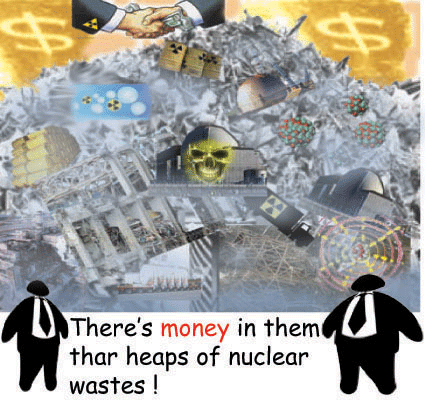
Plenty of work for nuclear clean-up firms

 U.S. nuclear cleanup specialist goes from Hanford to Fukushima LEDGER INQUIRER BY ROB HOTAKAINENMcClatchy Washington BureauJanuary 18, 2015 “……After working at the Hanford nuclear site in Washington state for 12 years, he’s helping to lead the cleanup at the Fukushima Daiichi nuclear plant, which melted down in March 2011……… it’s the work that drives him, using American technology to help the Japanese people deal with the catastrophe at Fukushima.
McCormick works for Kurion Inc., a company headquartered in Irvine, Calif., that focuses on managing nuclear and hazardous waste. The company built a mobile processing system that’s helping to remove radioactive strontium from 400,000 tons of contaminated water stored near the Fukushima Daiichi plant. McCormick said the company was the only U.S. firm to win a contract from the Tokyo Electric Power Co., which is overseeing the entire cleanup project.
Choosing to do the initial work in a nuclear-free environment, Kurion designed and built the treatment system in Washington state’s Tri-Cities area and shipped it to Japan on a cargo plane. It arrived in July and began operating in October, after a series of tests.
“Our contract was to build it in America, using American nuclear standards that are equivalent to the Japanese standards,” McCormick said.
As McCormick does his work, he’s avoiding the public debate over whether Japan should restart some of the 48 nuclear plants that were shut down after the Fukushima disaster………
a recent poll found that most Japanese citizens want the plants to remain closed, fearing another catastrophe.
“We don’t even know the final disposal place of the Fukushima waste. We should discuss this after we decide where to dispose of the waste,” said Hatsuhiko Aoki, an artist from Gifu Prefecture. Yoshitaka Mukohara, the president of a publishing company and the secretary-general of the Anti-Nuclear Kagoshima Network, said the Abe administration was acting irresponsibly. “There are some places that are not decontaminated, but the government is sending people back,” Mukohara said. “What they are doing is acting like nothing ever happened.”
McCormick has no interest in weighing in on the controversy.
“It’s really a decision that the Japanese people have to make, in terms of how they get their energy,” McCormick said. “I’ve been focused on the cleanup.”
But McCormick said part of the work in Japan would involve building public support for the cleanup and convincing people that it was a long-term project.
It’s a skill he used at Hanford, lobbying Congress to include cleanup money in annual appropriation bills.
“The cleanup of Fukushima, if you compare it to Hanford, is on the same scale: tens of billions of dollars,” McCormick said. “And it’s going to take many decades to complete.” http://www.ledger-enquirer.com/2015/01/18/3520793/us-nuclear-cleanup-specialist.html
No comments yet.
1 This Month
Chernobyl: The Lost Tapes – A good documentary on Chernobyl on SBS available On Demand for the next 3 weeks– https://www.sbs.com.au/ondemand/tv-program/chernobyl-the-lost-tapes/2352741955560

of the week–London Campaign for Nuclear Disarmament

Tell the Ukrainian Government to Drop Prosecution of Peace Activist Yurii Sheliazhenko
To see nuclear-related stories in greater depth and intensity – go to https://nuclearinformation.wordpress.com
-
Archives
- April 2026 (114)
- March 2026 (251)
- February 2026 (268)
- January 2026 (308)
- December 2025 (358)
- November 2025 (359)
- October 2025 (376)
- September 2025 (257)
- August 2025 (319)
- July 2025 (230)
- June 2025 (348)
- May 2025 (261)
-
Categories
- 1
- 1 NUCLEAR ISSUES
- business and costs
- climate change
- culture and arts
- ENERGY
- environment
- health
- history
- indigenous issues
- Legal
- marketing of nuclear
- media
- opposition to nuclear
- PERSONAL STORIES
- politics
- politics international
- Religion and ethics
- safety
- secrets,lies and civil liberties
- spinbuster
- technology
- Uranium
- wastes
- weapons and war
- Women
- 2 WORLD
- ACTION
- AFRICA
- Atrocities
- AUSTRALIA
- Christina's notes
- Christina's themes
- culture and arts
- Events
- Fuk 2022
- Fuk 2023
- Fukushima 2017
- Fukushima 2018
- fukushima 2019
- Fukushima 2020
- Fukushima 2021
- general
- global warming
- Humour (God we need it)
- Nuclear
- RARE EARTHS
- Reference
- resources – print
- Resources -audiovicual
- Weekly Newsletter
- World
- World Nuclear
- YouTube
-
RSS
Entries RSS
Comments RSS
 nuclear-news
Leave a comment