“Blind Faith” – book reveals the toxic nuclear legacy in Port Hope
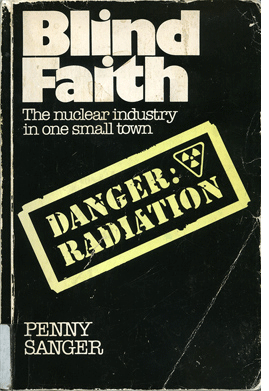
 Blind Faith: The Nuclear History of Port Hope, Ontario http://www.mintpressnews.com/MyMPN/author/driches/ January 15, 2015 By Dennis Riches
Radiation is invisible, and it has always been imbued with a diverse range of magical powers in science fiction. Ironically, in a very real sense, radiation does make people invisible. Once groups of people have become victims of a radiological contamination, they are, in addition to being poisoned (or being traumatized by the possibility that they have been poisoned), marginalized and forgotten. Their traditions and communities are fragmented, and they are shamed into concealing their trauma. When contamination occurs, there is a strong impulse even among many victims to not admit that they have been harmed, for they know the fate that awaits them if they do.
Thus it is that hibakusha (the Japanese word for radiation victims) become invisible. When a new group of people become victims, such as in Fukushima in 2011, they feel that they have experienced a unique new kind of horror. For them, for their generation, it is new, but for those who know the historical record, it is a familiar replay of an old story. The people of Fukushima should know by now that they are bit players who have been handed down a tattered script from the past.
A case in point is “Blind Faith,” the superb 1981 book by journalist Penny Sanger, about the small irradiated Canadian town of Port Hope on the shores of Lake Ontario. In the 1970s, it faced (and more often failed to face) the toxic legacy of processing first radium, then uranium for nuclear weapons and nuclear power plants.
No comments yet.
1 This Month
Chernobyl: The Lost Tapes – A good documentary on Chernobyl on SBS available On Demand for the next 3 weeks– https://www.sbs.com.au/ondemand/tv-program/chernobyl-the-lost-tapes/2352741955560

of the week–London Campaign for Nuclear Disarmament

Tell the Ukrainian Government to Drop Prosecution of Peace Activist Yurii Sheliazhenko
To see nuclear-related stories in greater depth and intensity – go to https://nuclearinformation.wordpress.com
-
Archives
- April 2026 (114)
- March 2026 (251)
- February 2026 (268)
- January 2026 (308)
- December 2025 (358)
- November 2025 (359)
- October 2025 (376)
- September 2025 (257)
- August 2025 (319)
- July 2025 (230)
- June 2025 (348)
- May 2025 (261)
-
Categories
- 1
- 1 NUCLEAR ISSUES
- business and costs
- climate change
- culture and arts
- ENERGY
- environment
- health
- history
- indigenous issues
- Legal
- marketing of nuclear
- media
- opposition to nuclear
- PERSONAL STORIES
- politics
- politics international
- Religion and ethics
- safety
- secrets,lies and civil liberties
- spinbuster
- technology
- Uranium
- wastes
- weapons and war
- Women
- 2 WORLD
- ACTION
- AFRICA
- Atrocities
- AUSTRALIA
- Christina's notes
- Christina's themes
- culture and arts
- Events
- Fuk 2022
- Fuk 2023
- Fukushima 2017
- Fukushima 2018
- fukushima 2019
- Fukushima 2020
- Fukushima 2021
- general
- global warming
- Humour (God we need it)
- Nuclear
- RARE EARTHS
- Reference
- resources – print
- Resources -audiovicual
- Weekly Newsletter
- World
- World Nuclear
- YouTube
-
RSS
Entries RSS
Comments RSS
 nuclear-news
Leave a comment