Renewable energy in USA cost competitive – can triple by 2030
 US can more than triple its renewable energy says IRENA report, Renewable Energy
  Magazine Robin Whitlock, 15 January 2015 27 percent renewable energy is both technically possible and cost-effective by 2030 according to the International Renewable Energy Agency (IRENA). The US can increase its renewable energy capacity from 7.5 percent of the energy mix in 2010 to 27 percent by 2030 according to a new report by the International Renewable Energy Agency (IRENA) entitled Renewable Energy Prospects: United States of America released this week on Monday 12th January. The report, which is part of IRENA’s ongoing REmap 2030 study, also says the US can increase its use of renewable energy in power generation from 14 percent to almost 50 percent by 2030, thereby making the country the world’s second largest renewable energy user after China.
“As the second largest energy consumer in the world, the US must continue to play a leading role in the global transition to a sustainable energy future” said Adnan Z. Amin, Director-General of IRENA. “The recent agreement between the US and China to reduce greenhouse gas emissions is a ground-breaking step, but this report aims even higher, showing that more can be done at limited cost.”
Current policies in place in the US would only enable the share of renewable energy to reach 10 percent by 2030. REmap 2030 estimates that an annual investment of $86 billion would be required between now and 2030 to enable this figure to rise to 27 percent, an increase of $38 billion annually beyond business-as-usual. The higher renewable share will result in annual savings of $30 billion to $140 billion by 2030 when accounting for factors such as human health and reduced emissions.
“REmap 2030 shows that the US could install significantly higher amounts of renewables – and that it can do so affordably” added Mr. Amin. “Even in a country with cheap shale gas like the US, renewable energy is still cost competitive and reduces air pollution, enhances energy security, benefits the economy, and plays a leading role in fighting climate change.”……….http://www.renewableenergymagazine.com/article/us-can-more-than-triple-its-renewable-20150115
Prime Minister Narendra Modi’s ally backs anti-nuclear movement to stop Jaitapur nuclear power project
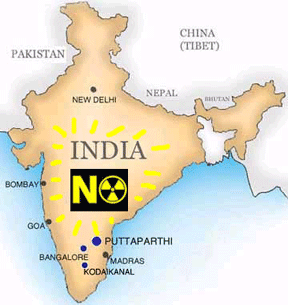 Notwithstanding PM’s nuke push, Sena to oppose Jaitapur plant Indian Express -By: Press Trust of India | Mumbai January 12, 2015 Notwithstanding Prime Minister Narendra Modi’s strong push for nuclear energy which he wants trebled by 2024, ally Shiv Sena today said it will continue to back those opposed to the 9,900 MW Jaitapur nuclear power project in Maharashtra.
“It has been our stand that Shiv Sena will support the locals of Jaitapur who have been opposing the plant. If there is an opposition, then why should we go against the will of the locals. After all, we are working for the development of the people,” senior Shiv Sena leader and state’s Industries Minister Subhash Desai told reporters.
Locals and anti-nuclear activists have been holding protests against the proposed plant over “scientific and environmental” concerns and Shiv Sena has been actively backing them.
“We (Shiv Sena) believe that if the need for power (for Maharashtra) is sufficed by other sources of energy including conventional and non-conventional resources, then why set up a destructive project,” he said.
Shiv Sena is a partner in BJP-led governments both at the Centre and in Maharashtra.The project is proposed to be set up in collaboration with French company Areva in the coastal Jaitapur village in Ratnagiri district. It will have six units of 1650 MW each built with Areva’s European Pressurised Reactor technology. JNPP would be one of the costliest nuclear power plant projects considering its sheer size and the new technology. – See more at: http://indianexpress.com/article/india/india-others/notwithstanding-pms-nuke-push-sena-to-oppose-jaitapur-plant/#sthash.aXD0KlPZ.dpuf
Video: Nigeria’s push for renewable energy
Nigeria’s push for renewable energy (Video) http://www.dw.de/nigerias-push-for-renewable-energy/av-18193145, 15 Jan 15 In a few weeks, Nigerians will head to the polls for general elections. On the agenda will be the country’s ongoing electricity crisis. Nigeria is the biggest oil producer and home to the largest economy on the African continent. Yet 100 million Nigerians continue to live in the dark. Now, some see alternative energies as key to reducing poverty and ensuring environmental sustainability.
Large-scale wave energy systems reliable – could spur economic growth in the Pacific Northwest
Wave energy integration costs should compare favorably to other energy sources, Energy Central Jan 14 – Energy Weekly News A new analysis suggests that large-scale wave energy systems developed in the Pacific Northwest should be comparatively steady, dependable and able to be integrated into the overall energy grid at lower costs than some other forms of alternative energy, including wind power.
The findings, published in the journal Renewable Energy, confirm what scientists have expected – that wave energy will have fewer problems with variability than some energy sources and that by balancing wave energy production over a larger geographic area, the variability can be even further reduced……….
Another strength of wave energy, the study suggested, is that its short-term generation capacity can be predicted with a high degree of accuracy over a time scale ranging from minutes to hours, and with some accuracy even seasonally or annually.
The Pacific Northwest has some of the nation’s best wave energy resources, and as a result is home to the Northwest National Marine Renewable Energy Center, supported by the U.S. Department of Energy .
Wave energy in the region is expected to spur economic growth, help diversify the energy portfolio, reduce greenhouse gas emissions and reduce transmission losses, the study noted,,,,,,,,,,,, http://www.energycentral.com/generationstorage/futureandalternativegeneration/news/en/34894133/Wave-energy-integration-costs-should-compare-favorably-to-other-energy-sources
1 This Month
Chernobyl: The Lost Tapes – A good documentary on Chernobyl on SBS available On Demand for the next 3 weeks– https://www.sbs.com.au/ondemand/tv-program/chernobyl-the-lost-tapes/2352741955560

of the week–London Campaign for Nuclear Disarmament

Tell the Ukrainian Government to Drop Prosecution of Peace Activist Yurii Sheliazhenko
To see nuclear-related stories in greater depth and intensity – go to https://nuclearinformation.wordpress.com
-
Archives
- April 2026 (127)
- March 2026 (251)
- February 2026 (268)
- January 2026 (308)
- December 2025 (358)
- November 2025 (359)
- October 2025 (376)
- September 2025 (257)
- August 2025 (319)
- July 2025 (230)
- June 2025 (348)
- May 2025 (261)
-
Categories
- 1
- 1 NUCLEAR ISSUES
- business and costs
- climate change
- culture and arts
- ENERGY
- environment
- health
- history
- indigenous issues
- Legal
- marketing of nuclear
- media
- opposition to nuclear
- PERSONAL STORIES
- politics
- politics international
- Religion and ethics
- safety
- secrets,lies and civil liberties
- spinbuster
- technology
- Uranium
- wastes
- weapons and war
- Women
- 2 WORLD
- ACTION
- AFRICA
- Atrocities
- AUSTRALIA
- Christina's notes
- Christina's themes
- culture and arts
- Events
- Fuk 2022
- Fuk 2023
- Fukushima 2017
- Fukushima 2018
- fukushima 2019
- Fukushima 2020
- Fukushima 2021
- general
- global warming
- Humour (God we need it)
- Nuclear
- RARE EARTHS
- Reference
- resources – print
- Resources -audiovicual
- Weekly Newsletter
- World
- World Nuclear
- YouTube
-
RSS
Entries RSS
Comments RSS
 nuclear-news