Renewable energy making the news now, as the nuclear industry stumbles

Christina Macpherson’s websites & blogs
I feel that I should be apologising to readers. This site is supposed to be all about nuclear news. But today I put up no less than 8 news posts about renewable energy. And, believe me, there were plenty more available..
The problem is – renewable energy is where it is all happening – Scotland, Egypt, Pakistan, USA, China – with advancing technologyy, feed-in tariffs, grid connection to decentralised solar power – etc. (Not happening in my country – Australia – but that’s because we have a complete dickhead for a Prime Minister, and he’ll soon be kicked out)
I’d love to put up more news posts about nuclear power, rather than mainly opinion posts. Especially about those silly little mini reactors they keep hyping about. But they are just not happening, the Small Modular Nuclear Reactors (SMRs) are all hype, but no action..
As Japan struggles to get the big nuclear restart happening, and as UK goes a bit silent on its very troubled Hinkley nuclear project, and USA nukes go broke – we wait for the next episode in the world’s sorry nuclear saga – and not very good prospects for the industry in 2015
USA’s nuclear industry’s future in doubt – as shown in the costs of Exelon’s New York reactor
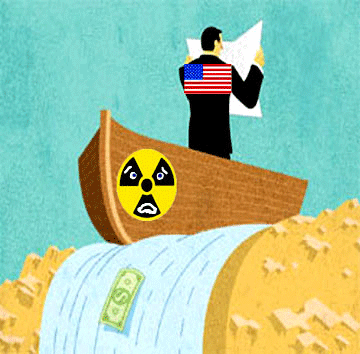 Troubled New York reactor’s costs test the future of nuclear power Tulsa World 6 Jan 15 NEW YORK — Exelon Corp., the biggest U.S. owner of nuclear reactors, needs to almost double power prices to keep a New York plant running in a move that promises to show just how far regulators will go to keep uneconomic plants operating.
After recording losses that exceeded $100 million from 2011 to 2013, Exelon will need to charge about 83 percent more than wholesale prices to earn a profit at its Ginna plant, based on company cost estimates. State regulators have set a Jan. 15 deadline for a new power contract that’s rich enough to keep the Rochester-area plant running.
Last month, Entergy Corp. shut Vermont’s only operating reactor citing low power prices. Ginna is one of 10 other nuclear plants that can’t compete in current markets, Moody’s Investors Service said in November. Retiring the reactors, which account for 10 percent of the nation’s nuclear output, would undercut a push to produce power without greenhouse gases as renewables such as wind and solar are just emerging……..
Exelon isn’t alone in its struggle with at-risk plants. Four U.S. nuclear reactors were shut in 2013 because they weren’t profitable or needed repairs that owners decided were too costly. Entergy’s Vermont Yankee was closed after it failed to find a buyer. ……
A single-unit reactor like Ginna needs as much as $71 a megawatt-hour to earn an 11 percent return and $56 to $64 to break even, based on 2016 forecasts, Exelon said. http://www.tulsaworld.com/washingtonpost/business/troubled-new-york-reactor-s-costs-test-the-future-of/article_dc3a470f-42d8-5bfb-9a27-14706b30cadb.html
Journalists’ self-censorship – avoiding hard topics for fear of government surveillance
Survey respondents also voiced concern that surveillance by the U.S. government and “Five Eyes” partner countries (which include Australia, the United Kingdom, Canada, and New Zealand) has damaged their reputation abroad and thus their ability to champion free expression and other human rights around the world
 Fear of Government Spying ‘Chilling’ Writers’ Speech Worldwide ‘If writers avoid exploring topics for fear of possible retribution, the material available to readers—particularly those seeking to understand the most controversial and challenging issues facing the world today—may be greatly impoverished.‘ Common Dreams, by Lauren McCauley, staff writer 5 Jan 15
The report, Global Chilling: The Impact of Mass Surveillance on International Writers (pdf),found that more than half of the 800 writers surveyed think that mass government surveillance has “significantly damaged U.S. credibility as a global champion of free expression for the long term.”
Further, according to the survey, writers living in countries defined as “Free” by U.S.-based NGO watchdog Freedom House expressed an almost equal level of concern about surveillance as those living in countries defined as “Not Free” (75% and 80%, respectively), prompting notable levels of self-censorship.
“The levels of self-censorship reported by writers living in liberal democracies are astonishing, and demonstrate that mass surveillance programs conducted by democracies are chilling freedom of expression among writers,” the report notes. According to the survey, 34 percent of writers living in liberal democracies admitted to self-censoring, compared with 61 percent of writers living in authoritarian countries, and 44 percent in semi-democratic countries.
“Writers are reluctant to speak about, write about, or conduct research on topics that they think may draw government scrutiny. This has a devastating impact on freedom of information as well: If writers avoid exploring topics for fear of possible retribution, the material available to readers—particularly those seeking to understand the most controversial and challenging issues facing the world today—may be greatly impoverished.”
Survey respondents also voiced concern that surveillance by the U.S. government and “Five Eyes” partner countries (which include Australia, the United Kingdom, Canada, and New Zealand) has damaged their reputation abroad and thus their ability to champion free expression and other human rights around the world…….
“Surveillance is insidious,” said Suzanne Nossel, Executive Director of PEN American Center. “While governments may intend these bulk collection programs to be used only to detect terrorist wrongdoing, people under surveillance change their behavior to avoid triggering scrutiny. Because the programs are so broad, they could affect billions of people whose sense of privacy and creative freedom is curtailed.”
The survey, conducted by non-partisan research firm the FDR Group, comes in advance of a full report to be released this spring. PEN hopes these results will inform public and Congressional debates on the future of mass surveillance. The group is calling for “the right to be free of unwarranted surveillance” to be made a “cornerstone of U.S. surveillance policy and practice.” In addition, PEN American proposes a number of legislative reforms, including allowing provisions of the Patriot Act to expire and ending surveillance programs carried out under Section 702 of the FISA Amendments Act and Executive Order 12333. http://www.commondreams.org/news/2015/01/05/fear-government-spying-chilling-writers-speech-worldwide
The nuclear dangers in Ukraine energy wars: don’t miss the full article!
What’s profitable for the nuclear industry in the US and Japan is toxic for the EU, particularly its more environmental and anti-nuclear member-nations including Germany and Austria, which will have no choice but to accept this legal precedent for continent-wide fracking and a revival of nuclear power.

|
Ukraine Energy Wars Are Leading To A Fukushima-Chernobyl Debacle In Europe
|
|
By Yoichi Shimatsu. Rense1-5-15
|
| full article at http://www.rense.com/general96/ukraineenenerg.html |
| Clashes over energy in Ukraine between the West and Russia could prompt another Chernobyl-type accident or a catastrophe on the order of a Fukushima that will complete the nuclear devastation of the Northern Hemisphere. As news media fixate on conflicts over pipelines that supply Europe with Russian gas, another energy war is erupting over control of Ukraine’s nuclear-power industry, which generates half that nation’s electricity.Prime Minister Arseniy Yatsenuk’s campaign for “energy independence” from Russian-sourced natural gas and nuclear fuel is not a study in cost control, economic security or even national sovereignty. His corporate-giveaway policies are actually a concession to Western energy interests in return for their influence over the EU, which can provide loans to avert an imminent default on Kiev’s debt to the IMF and World Bank. With an annual budget shortfall of $15 billion and a currency collapse, Ukraine is staggering under external sovereign debt estimated at between $140 and $200 billion.
The IMF and World Bank have halted further transfers of loan tranches to Kiev, which is now unable to make payments on its gas imports from Russia. Kiev policymakers are therefore desperately looking to expand their nuclear industry. Unfortunately two recent accidents at its largest nuclear-power plant highlight the serious risks to a nation still grappling with the long-term effects of the 1986 Chernobyl meltdown. ………. |

USS Calhoun County and the dumping at sea of atomic waste
“Nuclear Waste Dumping Diary.”
Jan. 20 1957: “371 tons atomic waste.”
Feb. 7, 1957: “368 tons atom waste.”
Nov. 13, 1957: “299 (tons) poison gas (and) A.W.”
One of Albernaz’s last entries was on June 12, 1958: “200 tons. Spec. weapons,” or special weapons. That was the day, Albernaz later told his wife, that he helped dispose of an atomic bomb.
none of the men who served on theCalhoun County are eligible for automatic VA benefits for radiation illnesses because they did not participate in underwater or atmospheric atomic tests and related activities, the government says.
Thus, the crewmen do not meet their country’s definition of “Atomic Veteran.”
USS Calhoun County sailors dumped thousands of tons of radioactive waste into ocean, Tampa Bay Times , 20 Dec 2013 William R. Levesque, Times Staff Writer They asked the dying Pasco County man about his Navy service a half-century before. He kept talking about the steel barrels. They haunted him, sea monsters plaguing an old sailor.
“We turned off all the lights,” George Albernaz testified at a 2005 Department of Veterans Affairs hearing, “and … pretend that we were broken down and … we would take these barrels and having only steel-toed shoes … no protection gear, and proceed to roll these barrels into the ocean, 300 barrels at a trip.”

Not all of them sank. A few pushed back against the frothing ocean, bobbing in the waves like a drowning man. Then shots would ring out from a sailor with a rifle at the fantail. And the sea would claim the bullet-riddled drum.
Back inside the ship, Albernaz marked in his diary what the sailors dumped into the Atlantic Ocean. He knew he wasn’t supposed to keep such a record, but it was important to Albernaz that people know he had spoken the truth, even when the truth sounded crazy.
For up to 15 years after World War II, the crew of Albernaz’s ship, the USS Calhoun County, dumped thousands of tons of radioactive waste into the Atlantic Ocean, often without heeding the simplest health precautions, according to Navy documents and Tampa Bay Times interviews with more than 50 former crewmen………. Continue reading
Nuclear policy: the big divide in Japanese society
Consensus-building process needed for nuclear policy decisions The Asahi Shimbun, Jan. 6 “……………The No. 1 and No. 2 reactors at Kyushu Electric Power Co.’s Sendai nuclear power plant in Kagoshima Prefecture, which have passed the Nuclear Regulation Authority’s safety screenings in line with stricter regulations, are expected to resume operation as early as this spring. The nuclear safety watchdog has also given the green light to a plan to restart the No. 3 and No. 4 reactors at Kansai Electric Power Co.’s Takahama plant in Fukui Prefecture.
Applications for the NRA’s safety reviews have also been submitted for 17 other reactors at 12 nuclear power stations. These reactors are waiting in the wings for the NRA’s approval.
DIVIDED PUBLIC OPINION
To bring an offline reactor on stream again, the operator also needs to win the consent of the prefecture and municipalities where the reactor is located.
In the case of the Sendai plant, the local assemblies of Kagoshima Prefecture and the city of Satsuma-sendai voted last autumn to support the plan to restart the reactors. The Kagoshima governor and the mayor of the city have also decided to approve it. The will of the local communities concerned has been made clear according to formal procedures.
But the will of the nation as a whole concerning the issue is different.
In a survey The Asahi Shimbun conducted in November, 56 percent of the respondents expressed opposition to restarting reactors, against 28 percent who supported the move. We have been asking similar questions since our survey in June 2013, and all the polls showed that a majority of the people were cautious about the idea of bringing reactors back online.
The opinions of the local governments concerned represent the popular will, as do the results of opinion polls.
If the will of the people concerning other reactor restarts is represented in the same way as in the case of the Sendai plant, the desire of many Japanese to see an end to nuclear power generation in this nation could be ignored as the NRA accelerates its safety screenings of the reactors. Is that acceptable?…….
MANY ISSUES DEMAND BROAD CONSENSUS
The division of public opinion over nuclear energy is not limited to the one between the will of the nation as a whole versus the will of local governments concerned.
Since the Fukushima disaster, there have been disagreements among local governments over the scope of “local communities” that should be involved in the decision-making process on such issues as whether to approve construction of a nuclear power plant and a restart of an offline reactor.
In April last year, Hakodate, Hokkaido, sued the state and Electric Power Development Co., or J-Power, to halt construction of the Oma nuclear power plant in Oma, Aomori Prefecture, which is located across the Tsugaru Strait.
Hakodate is located within 30 kilometers of the plant, and its citizens would be exposed to serious threats to their health if a severe accident were to occur there.
Hakodate’s legal action is based on the notion that its vicinity to the nuclear plant should qualify it for involvement in decisions on whether to approve construction.
A heap of issues related to nuclear power generation should be settled through broad consensus and agreement. They include the program to provide state subsidies to local governments hosting nuclear plants, storage of spent nuclear fuel and disposal of radioactive waste.
Public opinion will be divided in various ways over all these issues. If there is no effective system to build consensus on such contentious issues by overcoming wide disagreements, the government will have to repeat the futile choice of either forcibly executing or postponing its decisions………
If the government is concerned that the traditional approach to policymaking may not work with this challenge, it should change the way it makes decisions now.
What is the best way to measure people’s views and opinions and integrate them into the decision-making process? The issue of nuclear power generation raises this fundamental question about the way policy decisions are made. http://ajw.asahi.com/article/views/editorial/AJ201501060058
Environmental problems remain after the Fukushinma nuclear disaster
 Environmental Issues Remain in Spotlight Following Fukushima Nuclear Disaster Institute for International JournalismBy: William Hoffman Produced & Edited By: Zainab Kandeh Tuesday, December 9, 2014
When three of the six nuclear reactors at the Fukushima power plant went into meltdown after the 2011 tsunami hit, radioactive material started spilling into the water and land and became the largest nuclear disaster since Chernobyl.
Families and businesses are still suffering from the effects of this disaster and it has caused an upheaval of environmental issues and a focus on a new green movement in Japan that has consequences in many different facets of East Asian environmental issues: radiation, agriculture, social responsibility and sustainability in business.
One of the areas that has been most affected by the disaster is agriculture and fishery markets. Mari Takenouchi, an independent journalist in Japan, has followed the effects of the disaster, and found the government is doing a lot to hide some of the radiation’s effects.
She speculates strontium 90 and yttrium 90 radiant raise the incidence of leukemia, diabetes, suppressed immune systems, damage of nervous systems and developmental damage to unborn babies. However, the government was slow to include these radiant in its initial reports.
“Since the Japanese government acknowledged the severe danger of strontium 90, they are doing their best to avoid this topic,” Takenouchi said. “Since there is no scientists who do the research on this in Japan, nobody can say the negative impacts for sure, but I think it is already happening.”
Radiation Effects More Than General Area
These effects can travel far when the fish are affected by this radiation, Takenouchi said, yet canned pacific fish are still being exported to countries such as Cambodia, Ghana, Senegal, the Congo and Sri Lanka. While no connection to the radiation can definitively be made, Takenouchi said the reports of adverse health effects come from school children out of that country are cause to stop exportation of pacific fish to these developing countries……..http://scrippsiij.blogspot.ie/
Ginna nuclear plant would have to double its charges to consumes, to be profitable
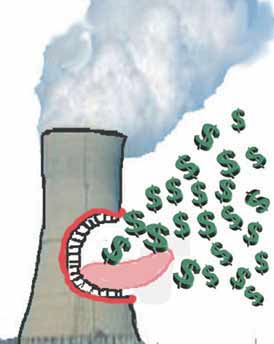
 US Nuclear Plant Would Have To Charge Double To Stay Profitable, Simply Info January 6th, 2015 Bloomberg has an interesting article about the major problem for US nuclear reactors. The economics are killing them. They blame subsidies other power generation gets (conveniently avoiding mention of the considerable subsidies nuclear power receives) and other (cheaper) power sources.
What was so startling in this Bloomberg article is that Ginna nuclear plant would have to charge consumers double the current retail power rates in order to turn a profit. This was vs. all other power sources (gas, coal, renewables)……….http://www.fukuleaks.org/web/?p=14282
Entergy can’t afford, for decades, to dismantle Vermont Yankee Nuclear Plant
Vermont Yankee Nuclear Plant Begins Slow Process of Closing, NYT By JESS BIDGOODJAN. 4, 2015 “………..The Entergy Corporation, a Louisiana-based energy company that operates nuclear plants around the country, purchased Vermont Yankee in 2002. The plant had withstood opposition from activists since it opened, but from 2007 to 2010, the collapse of a cooling tower, radioactive tritium leaks and misstatements from plant executives that had preceded them further eroded public confidence in the company.
State legislators tried to close the plant, but a judge ruled in 2012 that they could not. Shortly after that decision was upheld, in August 2013, Entergy announced it would nevertheless close the plant, citing economics.
“It became pretty clear that we could not, this would not be a financially viable resource going forward,” said Bill Mohl, the president of Entergy Wholesale Commodities, which owns the plant, last week. He cited the plant’s small size, the low cost of natural gas for producing electricity and other issues with the market.
“This plant, this area, ranks right up there with the highest antinuke sentiment across the entire country,” said Mr. Farabaugh, who worked in five other plants around the nation before coming to Vermont Yankee.
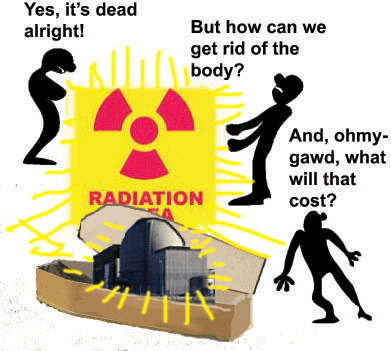 Entergy projects it will cost $1.2 billion to decommission Vermont Yankee, but its trust fund has about half of that, so the full dismantling of the plant will not begin for decades. Meanwhile, the operators will turn to the mammoth task of cooling, storing and securing the spent fuel there.
Federal law requires the government to develop a long-term storage facility for nuclear waste, but there is currently no plan in place. So the spent fuel at Vermont Yankee, like at closed nuclear facilities around the country, will stay on site, and officials say it will be safe.
The prospect of the plant’s future as a nuclear storage facility worries many of the area’s activists, like Clay Turnbull, the president of the New England Coalition on Nuclear Pollution, which is based in Brattleboro.
Radiation may account for poor resistance of some Japanese to flesh-eating bacteria”
TV: Record level of “flesh-eating bacteria” cases in Japan — Spike began around 2011 Fukushima disaster — Now at 400% normal rate — US Gov’t: Radiation from nuclear accident greatly reduces ability to fight this infection — Officials: We don’t know what’s triggering it; Seek immediate help if symptoms develop (PHOTOS & VIDEO)http://enenews.com/tv-flesh-eating-bacteria-record-levels-japan-spike-began-2011-400-previous-average-govt-radiation-exposure-after-nuclear-accidents-greatly-reduces-ability-fight-infection-video?utm_source=feedburner&utm_medium=email&utm_campaign=Feed%3A+ENENews+%28Energy+News%29 6 Jan 15
New studies by scientists from Fukushima Institute of Public Health and others:Yomiuri Shimbun, Dec. 24, 2014 (emphasis added): Patients with ‘flesh-eating bacteria’ hit record — A record high 263 patients are suffering from streptococcal toxic shock-like syndrome (STSS), a deadly infection… National Institute of Infectious Diseases (NIID) is calling on people to visit a doctor… immediately after a possible STSS symptom is detected, such as a severe sore throat… [A] maximum of 100 patients suffered from the disease annually until 2010… This year, that number reached 263 as of Dec. 14, topping the previous worst record of 242 in 2012… Tokyo ranked first with 41… The infection is mainly caused by Group A Streptococcus… but details remain unclear. It is unknown what triggers the disease… The condition may lead to a state of shock, multiple organ failure and other results in a few days… It is also called “flesh-eating bacteria” [affecting] tissues such as on limbs and the face… NIID official said [to] “seek immediate treatment… should STSS symptoms appear.”
- Increased prevalence of group A streptococcus isolates in streptococcal toxic shock syndrome cases in Japan from 2010 to 2012, published 2014: Streptococcal toxic shock syndrome (STSS) is a severe invasive infection characterized by the sudden onset of shock, multi-organ failure, and high mortality… STSS is mainly caused by group A streptococcus (GAS). Although an average of 60–70 cases of GAS-induced STSS are reported annually, 143 cases were recorded in 2011. [We examine] the reason behind this marked increase… mefA-positive emm1 isolates has escalated since 2011.
- Evaluation of streptococcal toxic shock-like syndrome caused by group B streptococcus[GBS] in adults in Japan between 2009 and 2013, published 2014: In recent years, [Streptococcus infection] is an important cause of morbidity and mortality among adults… disease similar to streptococcal toxic shock syndrome have recently been reported… underlying disease was present in 47.4% of the patients.
US Dept. of Defense, 2012: (Photo – “Crew member is checked for radiation [in] Japan… March 2011″); Ch. 5 – Therapy for Bacterial Infections following Ionizing Radiation Injury… [C]oncerns about nuclear disasters have… shifted to emphasize the low-dose acute and low-dose–rate chronic irradiation scenarios of nuclear accidents… nonlethal doses of ionizing radiation enhance susceptibility to exogenous bacterial infections… The predominant bacteria isolated from wounds included… b-hemolytic [and] a-hemolytic Streptococcus… [I]mmune responses are greatly diminished within a few days after irradiation…individuals should be monitored continually for… symptoms of infection [which] aredifficult to treat effectively in those who receive whole-body ionizing radiation.
Al Jazeera: What does Polonium do to a person?… An amount equivalent to the size of a particle of dust is lethal. After being taken into the body… it bombards people’s cells with millions of radioactive alpha particles [and] damages the intestines, causing toxic shock syndrome.
Dr. Nick Priest, toxicology professor at Middlesex Univ.: If polonium is ingested [it] will travel through the gut… Destruction of the inner gut wall will lead to… toxic shock syndrome.
Nuclear industry braces for an even tougher year in 2015
| 2015 maybe prove more difficult for US nuclear industry than 2014 /05 Jan 2015 Before the Fukushima Daiichi nuclear disaster in 2011 the nuclear energy industry in the United States was optimistic about the future. Nearly four years later, the industry is sinking from its own economic weight and more nuclear power plants risk getting shut down — not because of opposition from environmental organizations, but rather due to a combination of financial losses from diminished electricity demand, low market energy prices, stricter environmental standards and increased regulations that force licensees to make additional financial investments to remain in compliance.
It is difficult to imagine that there will be any significant or major expansion of nuclear energy in the United States, but the industry is struggling to ensure that it isn’t forced to undergo a major retraction…………http://enformable.com/2015/01/united-states-2015-maybe-prove-difficult-nuclear-industry-2014
|

.
The ever more costly clean-up of Pennsylvania nuclear site
 Pennsylvania nuclear site cleanup cost balloons to $350M, from $44M, Leigh Valley Live, 6 Jan 15 By Associated Press The U.S. Army Corps of Engineers plans to spend at least $350 million more over 10 years to dig up and haul away nuclear waste from a dump site about 35 miles northeast of Pittsburgh.
The Army Corps halted the cleanup — originally estimated to cost $44.5 million — after crews discovered unanticipated amounts of “complex” materials, like uranium and plutonium, at the Parks Township site in 2011.
The site was once owned by Nuclear Materials and Equipment Corp., which operated fuel plants for nuclear submarines in Parks and nearby Apollo. NUMEC owned the dump site from 1957 until the 1980s, but Babcock & Wilcox Co. most recently owned the land.
The Army Corps already spent $62 million on the cleanup, meaning the final cost will be $412 million — nearly 10 times the original amount.
“Presuming that this this goes forward — and barring any other sidesteps at the political or legal levels — I am hoping that all agencies that are involved will work in concert to effectuate a safe and comprehensive cleanup of this site,” said Patricia Ameno, a 63-year-old local environmental activist who has led the fight to clean up the related waste dump since 1988.
Ameno spearheaded litigation over airborne pollution from the nuclear plants that has led to $92 million in legal settlements from Atlantic Richfield Co. (NUMEC’s parent for part of the time the plants operated) and Babcock & Wilcox, for scores of nearby residents who claimed they developed cancer.
But Ameno, who has had two brain tumors and growths on her breast and cervix, has concentrated her fight in recent years on uncovering the truth about what was dumped at the site and by whom — both of which remain mysteries.
U.S. Sen. Bob Casey, D-Pa, has joined that fight in recent years and, after the cleanup was halted by the discovery of the more serious, complex pollutants, pushed for the Nuclear Regulatory Commission’s Office of Inspector General to investigate the site and how the NRC had handled the cleanup.
That report, issued in March, concluded the companies that operated the nuclear plants and later maintained the dump kept shoddy records and that the NRC and Army Corps couldn’t be sure what’s there as a result……….http://www.lehighvalleylive.com/breaking-news/index.ssf/2015/01/pennsylvania_nuclear_site_clea.html
North Korea nvesting in miniaturising nuclear warheads

 North Korea ‘close to miniaturising nuclear warheads’, Telegraph UK, 6 Jan 15 South Korea believes Pyongyang’s scientists close to making the regime’s missiles capable of carrying nuclear warheads North Korea has achieved “a significant level” of the technology required to miniaturise nuclear warheads in order to mount them on ballistic missiles, according to South Korea’s ministry of defence.
In a white paper released on Tuesday, the ministry added that North Korea is believed to have obtained more than 88lbs of weapons-grade plutonium by repeatedly reprocessing spent nuclear fuel rods.
Additional efforts are also being made to produce highly-enriched uranium, the report stated.
An official of the ministry told Yonhap News that there was no solid evidence that North Korean scientists have perfected the technique of miniaturising a nuclear warhead, but the North is known to have invested heavily in the process………http://www.telegraph.co.uk/news/worldnews/asia/northkorea/11327412/North-Korea-close-to-miniaturising-nuclear-warheads.html
Top renewable energy investment trends for 2015

 UK watch: Tracking renewable energy investment trends, Renewable Energy Focus 05 January 2015 KATHARINE EARLEY As we head into 2015, Renewable Energy Focus contributor Katharine Earley speaks to Triodos Bank about investment trends, including crowd-funding, community-owned energy and businesses opting for on-site energy generation.
With renewable energy set to be one of the key winners to emerge from the EU’s new three-year, £250bn investment plan, 2015 could be a promising year for renewables. We caught up with ethical investment pioneer Triodos Bank to understand what trends it foresees for the year ahead.
“We could see some real strides forward for renewable energy in Europe, particularly if the EU’s investment plan focuses on grid infrastructure,” Matthew Clayton, executive director of Triodos Renewables, explained. “As we move from centralised power plants to smaller, distributed energy generation, government investment could really help to address this important systems issue. Coupled with private investment in energy efficiency and generation, such a move could lead to more rapid progress.”
For Triodos’ part, its renewables company, owned by some 5,000 shareholders, operates 11 onshore wind and hydroelectric projects across the UK with a capacity of 53MW, enough electricity to power 34,200 homes. Founded in 1994, the company has seen a 35% increase in shareholders and a 50% increase in generating capacity in the past three years. Its projects generated more than 100m kWh of clean electricity in 2013. Having already raised £2m from its latest share offer, it is now extending the offer until 30th January 2015.
So what does Clayton see as the reasons for this prosperity?
“Investor confidence has grown as the nature of the projects become more robust,” he explained. “The technology is proven and is also decreasing gradually in price. Interestingly, we’re seeing interest from a wide range of investors, from individuals through to institutional investors. And we want to make investing in renewables accessible – that’s why we’re inviting minimum investments of £50 through our current share offer………..
1. More projects will be developed to supply a business
“We’ll see more projects developed with a direct supply of renewable electricity to a business,” Bazin stated. “This helps the developer to achieve a better price for the power and reduces electricity losses during transmission. Meanwhile, the business purchasing the energy benefits from greater security of supply, lower cost compared to using major utilities and a boost to its efforts to reduce its environmental footprint.”
According to Bazin, this direct supply of electricity will be a key component of roof-mounted solar projects, which are high on the UK government’s agenda in 2015. This type of direct supply model also helps to raise awareness of the positive impact of renewable energy among building users, he confirms.
2. Community-owned energy will gather momentum
In 2014 Scotland had a massive success in renewable energy, especially wind power

 Scotland Saw A “Massive Year” Of Renewable Energy http://cleantechnica.com/2015/01/06/scotland-saw-massive-year-renewable-energy/ January 6th, 2015 by Joshua S Hill That Scotland saw impressive records broken last year is of no real surprise to those who followed news of their monthly wind energy generation numbers. New numbers published early January have only confirmed that sense of record breaking, with another record month and a “massive year” in total.
WWF Scotland provided the information, by way of WeatherEnergy, and found that for December, wind energy provided 164% of Scottish household electrical needs — a massive record, well up on what had already seemed to be a mammoth record, set in October, when wind energy provided 126% (though, as it turns out, before Scotland’s performance was brought to my attention, they hit 163% in February). Specifically, wind energy delivered 1,279,150MWh of electricity to the National Grid, enough for 3.96 million homes.
In fact, wind energy generated enough energy to supply over 100% of Scottish household needs on 25 out of the 31 days of December.
“December turned out to a record-breaking month for wind power, with enough green energy generated to supply a record 164% of Scottish households with the electricity they need,” said WWF Scotland’s director Lang Banks. “Even on calmer days, wind still supplied the equivalent of over a third of electricity needs of every home.”
For 2014 as a whole, wind energy delivered an estimated 8,958,130MWh of electricity to the National Grid, or an average of 746,510MWh each month. That’s enough to supply the electrical needs of 98% of all Scottish households.
Without doubt, 2014 was a massive year for renewables, with wind turbines and solar panels helping to ensure millions of tonnes of climate-wreaking carbon emissions were avoided,” added Banks. “With 2015 being a critical year for addressing climate change internationally, it’s vital that Scotland continues to press ahead with plans to harness even greater amounts of clean energy.”
Solar power did relatively well throughout the year for Scotland, though it’s hard to come close to the country’s wind energy industry. Homes fitted with solar PV panels generated enough energy to supply homes in Aberdeen, Edinburgh, Glasgow, and Inverness with an estimated 100% or more of their electricity needs throughout June and July, and 60% or more across the same four cities during March, April, May, August, and September.
“For 2014 as a whole, on average, wind power generated enough to supply the electrical needs of 98% of Scottish households, with six months where the amount was greater that 100%,” Banks continued. “And, in the tens of thousands of Scottish households that have installed solar panels saw them meet two-thirds or more of their electricity or hot water needs from the sun during several months of the year, helping those homes to reduce their reliance on coal, gas, or even oil.”
Karin Robinson of WeatherEnergy also commented on the remarkable year-that-was for Scotland: “We’re famous in the UK for our obsession with the weather, but how often do we see it in a positive light? At a time when the world is desperately looking for low-carbon sources of energy, the data show that clean renewables are already playing a significant and growing role in Scotland’s, and the rest of the UK’s, overall energy mix. We just need to blow their trumpet a bit more.
The news came just a few days before WWF published another report, this time based upon technical analysis conducted by international energy and engineering consultancy DNV GL, which found that Scotland could be a renewable energy powerhouse by 2030, completely decarbonised and delivering renewable energy enough for all the country’s electricity needs.
“It’s great to see the vision for a secure, renewables-based future for Scotland independently tested and proven,” said WWF Scotland’s Climate and Energy Policy Officer, Gina Hanrahan. “It’s clear that Scotland doesn’t have to generate electricity from coal, gas or nuclear to ensure security of supply.”
Keep up to date with all the hottest cleantech news by subscribing to our (free) cleantech newsletter, or keep an eye on sector-specific news by getting our (also free) solar energy newsletter, electric vehicle newsletter, or wind energy newsletter.
1 This Month


Tell the Ukrainian Government to Drop Prosecution of Peace Activist Yurii Sheliazhenko

Petition to revoke the licensing of the Near Surface Nuclear Disposal Facility (NSDF) at Chalk River. https://www.ourcommons.ca/petitions/en/Petition/Details?Petition=e-7247


of the week – STOP SMALL MODULAR REACTORS IN CANADA
To see nuclear-related stories in greater depth and intensity – go to https://nuclearinformation.wordpress.com
-
Archives
- March 2026 (204)
- February 2026 (268)
- January 2026 (308)
- December 2025 (358)
- November 2025 (359)
- October 2025 (376)
- September 2025 (258)
- August 2025 (319)
- July 2025 (230)
- June 2025 (348)
- May 2025 (261)
- April 2025 (305)
-
Categories
- 1
- 1 NUCLEAR ISSUES
- business and costs
- climate change
- culture and arts
- ENERGY
- environment
- health
- history
- indigenous issues
- Legal
- marketing of nuclear
- media
- opposition to nuclear
- PERSONAL STORIES
- politics
- politics international
- Religion and ethics
- safety
- secrets,lies and civil liberties
- spinbuster
- technology
- Uranium
- wastes
- weapons and war
- Women
- 2 WORLD
- ACTION
- AFRICA
- Atrocities
- AUSTRALIA
- Christina's notes
- Christina's themes
- culture and arts
- Events
- Fuk 2022
- Fuk 2023
- Fukushima 2017
- Fukushima 2018
- fukushima 2019
- Fukushima 2020
- Fukushima 2021
- general
- global warming
- Humour (God we need it)
- Nuclear
- RARE EARTHS
- Reference
- resources – print
- Resources -audiovicual
- Weekly Newsletter
- World
- World Nuclear
- YouTube
-
RSS
Entries RSS
Comments RSS
 nuclear-news