China’s distributed power grid will revolutionise renewable energy
 China as a model renewable energy economy Ft.com By Li Hejun, China New Energy Chamber of Commerce and Hanergy Holding Group 31 Dec 14 “……..Even more exciting than falling costs are the new ways in which China will use and transmit power. China is now intent on developing a distributed power grid that will rely on the interconnection of thousands of rooftop and building-integrated solar installations generating power close to the point of consumption. This is a drastic departure from the current centralised power system that relies on goliath, coal-burning power plants and costly, inefficient power transmission over hundreds, or even thousands of kilometres. This new, smart grid will help eliminate pollution, slash costs, and increase reliability.
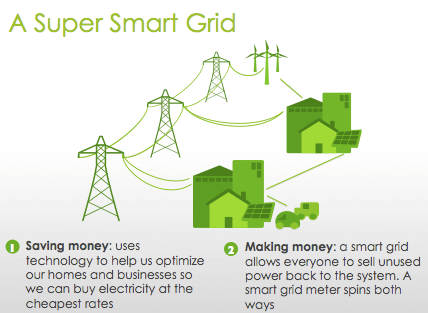
In addition to making the distributed grid possible, new forms of solar technology are ushering in an era of mobile energy in which customers can take power with them wherever they go.
At present, around 90 per cent of the world’s solar power output is geared towards first-generation crystalline silicon panels, which for a long time were the most efficient technology available. But traditional silicon panels are hard, opaque and heavy, while thin film solar technology can be can be lightweight, flexible, and translucent, making it ideal for a wide variety of applications, from curved automobile rooftops and building integration to consumer clothing and portable power stations.
In recent years, thin-film technology has caught up with, and even surpassed, crystalline silicon in terms of both conversion efficiency and cost. Furthermore, producing thin-film cells requires just a fraction of the material and energy necessary to make crystalline silicon, conserving resources, cutting costs, and reducing pollution.
In the coming years, technologies will continue to improve, and prices will continue to fall. Two of the most promising technologies now are solar cells made from CIGS (Copper, Indium, Gallium, Selenide) and those from GaAs (Gallium-Arsenide), with maximum conversion efficiencies topping 20 percent, and 30 percent, respectively. As these are further developed and brought to market on a mass scale, solar panels will transform into something capable of being integrated into nearly every fabric, product, and structure at a reasonable cost……..
Li Hejun is Director of the China New Energy Chamber of Commerce, and CEO of multinational clean energy company Hanergy Holding Group. http://blogs.ft.com/beyond-brics/2014/12/31/guest-post-china-as-a-model-renewable-energy-economy/
No comments yet.
1 This Month

of the week – Shut Down Drone Warfare!


Tell the Ukrainian Government to Drop Prosecution of Peace Activist Yurii Sheliazhenko

Petition to revoke the licensing of the Near Surface Nuclear Disposal Facility (NSDF) at Chalk River. https://www.ourcommons.ca/petitions/en/Petition/Details?Petition=e-7247
To see nuclear-related stories in greater depth and intensity – go to https://nuclearinformation.wordpress.com
-
Archives
- April 2026 (114)
- March 2026 (251)
- February 2026 (268)
- January 2026 (308)
- December 2025 (358)
- November 2025 (359)
- October 2025 (376)
- September 2025 (257)
- August 2025 (319)
- July 2025 (230)
- June 2025 (348)
- May 2025 (261)
-
Categories
- 1
- 1 NUCLEAR ISSUES
- business and costs
- climate change
- culture and arts
- ENERGY
- environment
- health
- history
- indigenous issues
- Legal
- marketing of nuclear
- media
- opposition to nuclear
- PERSONAL STORIES
- politics
- politics international
- Religion and ethics
- safety
- secrets,lies and civil liberties
- spinbuster
- technology
- Uranium
- wastes
- weapons and war
- Women
- 2 WORLD
- ACTION
- AFRICA
- Atrocities
- AUSTRALIA
- Christina's notes
- Christina's themes
- culture and arts
- Events
- Fuk 2022
- Fuk 2023
- Fukushima 2017
- Fukushima 2018
- fukushima 2019
- Fukushima 2020
- Fukushima 2021
- general
- global warming
- Humour (God we need it)
- Nuclear
- RARE EARTHS
- Reference
- resources – print
- Resources -audiovicual
- Weekly Newsletter
- World
- World Nuclear
- YouTube
-
RSS
Entries RSS
Comments RSS
 nuclear-news
Leave a comment