Less radiation for breast cancer makes sense for some patients
 For Some, Less Radiation for Breast Cancer Makes Sense Live Science Dr. Lucille Lee, North Shore-LIJ Cancer Institute | December 18, 2014 Dr. Lucille Lee is an attending physician in the Department of Radiation Medicine at North Shore-LIJ’s Cancer Institute and is a board-certified radiation oncologist specializing in the treatment of breast and prostate cancer. She specializes in multiple techniques including partial breast irradiation and breast hypofractionation. She contributed this article to Live Science’s Expert Voices: Op-Ed & Insights.
Once physicians are accustomed to practicing in a certain way, changing that paradigm can be difficult to embrace — even when scientific evidence increasingly supports the change.
That’s likely what’s holding back more radiation oncologists in the United States from implementing a shorter course of radiation therapy for early-stage breast cancer patients who’ve undergone breast-sparing lumpectomy surgery. New research published in the Journal of the American Medical Association indicates that two-thirds of these U.S. patients are still receiving six to seven weeks of radiation therapy after a lumpectomy instead of a shorter course of radiation that’s been shown to be just as effective………
How can early-stage breast cancer patients find out they’re eligible for the shorter course? Increasingly educated on medical matters, patients need to speak up and ask their doctors. And physicians themselves need to accept that feeling comfortable about how they have practiced medicine for so long doesn’t justify holding on to outdated ideas.
In this case, it’s quite clear that fewer radiation treatments can be just as effective for early-stage breast cancer patients as the “traditional” longer course. When patients receive more therapy than they actually need, it’s no longer therapeutic — it’s simply overdone. http://www.livescience.com/49180-doctors-should-prescribe-less-radiation-for-breast-cacner-treatment.html
Warming of oceans brings hottest year on record
 Warm oceans keep world on course for hottest year December 16, 2014 Peter Hannam Environment Editor, The Sydney Morning Herald Ongoing record warmth in the world’s oceans has increased the likelihood that 2014 will be declared the hottest year since reliable data began more than a century ago, US and Japanese agencies say.
The warmth comes as conditions in the Pacific remain conducive to an El Nino event forming in coming months, Australia’s Bureau of Meteorology said.
Surface temperatures have exceeded El Nino threshold levels for several weeks, and the bureau estimates there is a greater than 70 per cent chance of such an event soon.
The first 11 months of the year were the warmest on record, with combined global land and sea-surface temperatures running 1.22 degrees above the 20th-century average, the US National Oceanic and Atmospheric Administration said.
This year will be the hottest on record – eclipsing 2005 and 2010 – provided December is at least 0.76 degrees above average, NOAA said…………http://www.smh.com.au/environment/climate-change/warm-oceans-keep-world-on-course-for-hottest-year-20141216-1287l2.html
Heating of Arctic oceans may cause dangerous solar radiation feedback loop
Rapid warming of Arctic may trigger dangerous solar radiation feedback loop http://www.sciencerecorder.com/news/rapid-warming-of-arctic-may-trigger-dangerous-solar-radiation-feedback-loop/ Delila James | Science Recorder | December 18, 2014 NASA scientists at the fall meeting of the American Geophysical Union in San Francisco presented what is just the latest dire prediction about the runaway effects of climate change.
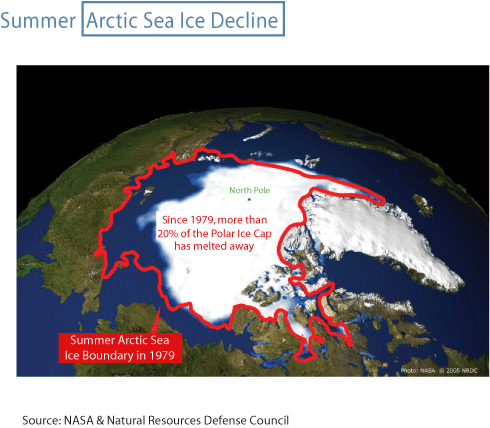
The researchers discussed a map created by satellites’ heat-sensing instruments showing the rate of solar radiation change in the Arctic, where the rate of heat absorption per square meter since 2000 has increased by more than 10 Watts of energy, according to a report by Wired. In some regions, such as the Beaufort Sea north of Alaska, the rate has increased as much as 45 Watts of energy per square meter.
For the past decade-and-a-half, NASA has been using satellite sensors called CERES to calculate how much solar energy is being absorbed by planet Earth as opposed to being reflected back into space. Every year the Arctic ice cap shrinks in the summer and grows in the winter. But because of the record loss of sun-reflecting sea ice in the Arctic seen in recent years, much of the winter ice cover now is thin—less than 6 feet thick, according to Wired.
So, when warm weather returns to the Arctic, the thin ice cover melts rapidly, causing the oceans to heat up. This then causes more ice to melt in a solar radiation feedback loop, in which the thinner the ice cover, the earlier in the summer it melts, which warms the ocean, which melts the ice, and so on.
Compared to 30 years ago, the annual summer melt in the Arctic comes seven days earlier, the Wired report said.
Atmospheric scientist Jennifer Kay of the University of Colorado, who collaborated in the research, said in a statement that CERES, which has only been collecting Arctic solar energy data since 2000, cannot be used to predict any long-term trends.
“Climate is usually considered to be a 30-year average,” Kay said.
British public not really “fed up with wind farms”
Are the British public really ‘fed up with wind farms’?Adam Boult for Metro.co.uk Thursday 18 Dec 2014 Earlier this week David Cameron stated that the British public are ‘fed up’ with onshore wind farms, and called for them to stop receiving state subsidies. Speaking to MPs, the Prime Minister said it was time to ditch funding for new turbines: ‘Let’s get rid of the subsidy, put them into the planning system. If they can make their case, they will make their case.’
We asked Metro readers what they thought of Cameron’s remarks – and here are a selection of responses received so far.
MORE: Poll: Are you fed up with wind farms?
We’re NOT fed up with wind farms
‘Wind farms are better than chimneys and also look better than a smokey sky.’ Mark Ulyatt
‘When me and my daughter are out in the car, we look for them. My daughter likes watching them go round, just as I do. I find them quite relaxing to watch.’ Kirsty Winfield
‘Well we could look at it this way. We could marvel at the ever improving technology using an almost infinite resource to help power our throwaway lifestyles. Or we could go like China and have pollution so bad you have to wear a mask if you go outside. If you ask me? Wind power, all the way.’ Chris Xryzoa Tempest …….
Religions unite in speaking out for nuclear disarmament, at Vienna conference
 Faiths United Against Nuclear Weapons TruthOut , 15 December 2014 By Julia Rainer, Inter Press Service | Report Vienna – “Never was there a greater need than now for all the religions to combine, to pull their wisdom and to give the benefit of that combined, huge repository of wisdom to international law and to the world.”
The words are those of Christopher Weeramantry, former judge at the International Court of Justice (ICJ) and its vice-president from 1997 to 2000, who was addressing a session on faiths united against nuclear weapons at the civil society forum organised by the International Campaign to Abolish Nuclear Weapons (ICAN) on Dec. 6 and 7 in the Austrian capital.
Weeramantry strongly criticised the argument of those who claim that nuclear weapons have saved the world from another world war in the last 50 years.
He pointed to the ever-present danger represented by these weapons and said that on many occasions it had been luck that had prevented catastrophic nuclear accidents or the breaking out of a devastating nuclear war.
Noting that nuclear weapons “offend every single principle of religion,” Weeramantry was joined on the panel by a number of different religious leaders, including Mustafa Ceric, Grand Mufti of Bosnia and Herzegovina, Ela Gandhi, granddaughter of Mahatma Gandhi and peace activist, as well as Akemi Bailey-Haynie, national women’s leader of the Buddhist organisation Soka Gakkai International-USA……………….
Desmond Tutu, Nobel Peace Laureate and former Anglican Bishop, sent a video message to participants to express his deep solidarity and support for ICAN’s civil society forum initiative.
He argued that the best way to honour the victims of the incidents in Hiroshima and Nagasaki was to negotiate a total ban on nuclear weapons to ensure that nothing comparable could ever happen again.
Two of the session’s speakers, Ela Gandhi and Mustafa Ceric, also attended the Dec. 8-9 Vienna Conference on the Humanitarian Impact of Nuclear Weapons.
There, Ela Gandhi delivered a speech in the spirit of her grandfather who, she said, would have joined the movement to abolish nuclear weapons if still alive.
As Gandhi had dedicated his life to teaching humanity that there is a non-violent way of dealing with conflict, he even condemned nuclear weapons himself in 1946 when he said: “The atom bomb mentality is immoral, unethical, addictive and only evil can come from it.”
Pointing out that the mere existence of nuclear weapons leads to similar armament of rival countries, Ela Gandhi warned that these nuclear arsenals could destroy a chance for future generations to survive and have a prosperous life………
Religion played an important role at the conference, where many lobbying groups had religious backgrounds, and the opening ceremony was addressed by Pope Francis.
“I am convinced that the desire for peace and fraternity, planted deep in the human heart, will bear fruit in concrete ways to ensure that nuclear weapons are banned once and for all, to the benefit of our common home,” aid Pope Francis, expressing his hope that “a world without nuclear weapons is truly possibly.”
In a statement on behalf of faith communities to the final session, Kimiaki Kawai, Program Director for Peace Affairs at Soka Gakkai International (SGI), said: “The elimination of nuclear weapons is not only a moral imperative; it is the ultimate measure of our worth as a species, as human beings.”
He said that “acceptance of the continued existence of nuclear weapons stifles our capacity to think more broadly and more compassionately about who we are as human beings, and what our potential is. Humanity must find alternative ways of dealing with conflict.”http://www.truth-out.org/news/item/28004-faiths-united-against-nuclear-weapons
Britain’s Hinkley Point C nuclear power project “at very serious risk of collapse”

Russia boasts of The Right To Put Nuclear Weapons In Crimea
 Russia: We Have The Right To Put Nuclear Weapons In Crimea Business Insider JEREMY BENDER Russia announced on Monday that it believes it has the full right to deploy nuclear weapons in the recently annexed Crimean peninsula.
Russian Foreign Minister Sergei Lavrov told the Interfax news agency that since Crimea was now a part of Russia, Moscow had full rights to deploy nuclear weapons into the region.
Lavrov argues that Crimea can be treated just like any other part of Russia and can therefore host nuclear infrastructure. “Now Crimea has become part of a state which possesses such weapons in accordance with the Nuclear Nonproliferation Treaty,” says Lavrov. “In accordance with international law, Russia has every reason to dispose of its nuclear arsenal … to suit its interests and international legal obligations.”………
Technically, neither the US nor Russia can move strategic nuclear forces without verifying the deployment with the other country due to the 2010 New START treaty, which set a timeline for mutual cuts to the countries’ nuclear stockpiles. Any Russian movement of strategic nuclear weapons into Crimea (long-range, high-yield weapons, as opposed to tactical or battlefield nuclear warheads) without prior notification to the US would result in Russia violating the treaty. http://www.businessinsider.com.au/russia-we-can-put-nuclear-weapons-in-crimea-2014-12
USA Air Force’s past and future dreams of Nuclear-Armed Drone Bombers

 America Almost Had a Nuclear-Armed Drone Bomber, Medium.com, Adam Rawnsley
on Dec 16 2014 Air Force wanted to remove the pilots from B-47s Long before the CIA began sending missile-armed drones to attack Taliban and Al Qaeda operatives in Afghanistan, U.S. Air Force officials mulled sending robotic aircraft against the Soviet Union.
Carrying nuclear bombs.
Starting in late 1949, Air Force officials kicked off what would become Project Brass Ring, an attempt to turn long-range B-47 Stratojet bombers into remotely-piloted nuclear-weapons delivery vehicles.
We learned about the Air Force’s quest to build an unmanned nuclear bomber—which the flying branch ultimately abandoned—from A History of the Air Force Atomic Energy Program: 1943–1953, a series of declassified internal studies on the Air Force’s early nuclear history………
the Air Force opted to end the research.
Until recently. Today the Air Force is shopping around for a new nuclear-capable Long Range Strike Bomber. There’s speculation that the plane could wind up being “optionally-manned”—that is, robotic with the flip of a switch. Much like Brass Ring’s B-47 six decades ago. https://medium.com/war-is-boring/america-almost-had-a-nuclear-armed-drone-bomber-e494e2e9a286
Nuclear power is a distraction from the urgent task of tackling climate change

 Nuclear damages attempts to tackle climate change nuClear News Dec 14 It is now almost 15 years since Tony Blair asked the Number Ten Performance and Innovation Unit (PIU) to carry out a thorough review of energy policy. That review ultimately led to the 2003 Energy White Paper which concluded that the current economics of nuclear power make it an unattractive option, and that there are still important issues about nuclear waste which need to be resolved.
USA and other countries struggle to market their nuclear technology to China
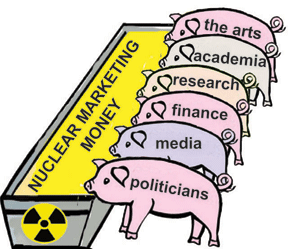
 China Wants its Nuclear Reactors ‘Made in China’ WSJ 16 Dec 14 When a unit of North Carolina’s Curtiss-Wright Corp. won a roughly $300 million deal in 2007 to supply components for new reactors in China, industry officials trumpeted China’s nuclear boom as good for U.S. business.
Today, Chinese companies are competing for that business—and foreign companies risk getting left out. Meanwhile, Curtiss-Wright’s contract is caught up in a legal dispute, while Chinese authorities blame the company in part for the delay of a landmark nuclear project. As the WSJ’s Brian Spegele reports:
U.S. and other foreign companies are now struggling to keep their hold in China, the industry’s biggest growth market and a rare bright spot more than three years after the Fukushima disaster in Japan put many of the world’s nuclear projects on hold. Yet China is increasingly turning to local companies to build crucial parts for multibillion-dollar nuclear projects, a result of Chinese industrial nationalism and frustration over U.S. supplier problems………http://blogs.wsj.com/chinarealtime/2014/12/16/china-wants-its-nuclear-reactors-made-in-china/
Alarming government report on deteriorating nuclear waste tanks at Hanford
Gov’t report sounds alarm on Hanford’s nuclear waste tanks http://www.king5.com/story/news/local/hanford/2014/12/16/hanford-nuclear-waste-tanks-gao-report-december-2014/20489933/ Gary M Chittim, December 16, 2014 Tanks holding millions of gallons of nuclear and chemical waste at the Hanford Nuclear Reservation are deteriorating at a faster rate than previously thought, according to a new report from the U.S. Government Accountability Office (GAO).
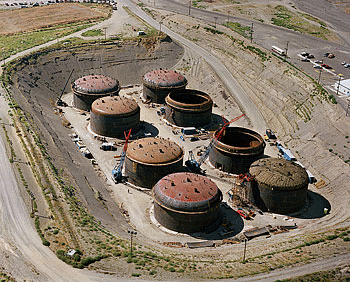
The GAO report was released today by Sen. Ron Wyden (D-Ore.), who is demanding the Department of Energy (DOE) develop a plan to address leaks and other tank issues. He said the DOE must act on the recommendations in the report instead of acknowledging them and then doing nothing, as it has done in the past.
“Agreeing to recommendations is one thing, implementing them is another thing entirely,” Wyden said. “The DOE’s ‘watch-and-wait’ strategy for these tanks leaking nuclear waste into the soil is completely unacceptable. I’m asking for a schedule and a plan of action within 90 days to implement the GAO’s recommendations at Hanford.”
Highlights of the report include new information on the number of older, single-shell tanks (SSTs) at Hanford that are experiencing what’s called water intrusion – 14 as of the fall of 2014. Rain or ground water entering the tanks can cause a host of problems, including mobilizing the waste and giving monitors undependable levels of waste in the tank, making it difficult to detect leaks.
In addition, one of the SSTs (T-111) is leaking at a much higher rate than thought, some 640 gallons per year.
There are concerns the waste, which is leftover from decades of plutonium production at the 586-square-mile reservation in southeastern Washington, could leak through the aging tanks into the groundwater and the nearby Columbia River.
The report also found that several of the newer double-shell tanks (DSTs) share the same design flaws blamed for leaking in the interior wall of AY-102 – a DST found to be leaking in 2012. DOE is in the process of developing a plant that can convert the radioactive waste into stable glass that can be safely stored for hundreds of years. That plant is years behind schedule, billions of dollars over budget and plagued by unresolved design and safety issues.
Critics, including Wyden, have demanded DOE develop a plan for dealing with the stored waste while those issues are resolved. The governors of Oregon and Washington have urged DOE to build additional storage tanks to hold the waste until the treatment plant is finished. The GAO report notes that DOE estimates building new tanks would take eight years and require $800 million in funding.
The DOE’s acting assistant secretary for environmental management, Mark Whitney, responded to the report by saying DOE already has a plan to constantly monitor the tanks and respond to suspected leaks.
“This program includes the use of robotic ultrasound devices, corrosion monitoring probes, and remote video cameras for the DST,” said Whitney in a written response to the report.
Read the full report and the Department of Energy’s response.
Vogtle nuclear power project running a year late, escalating the costs
 Watchdog: 1-year delay possible at Ga. nuke plant http://www.wrdw.com/home/headlines/Watchdog-1-year-delay-possible-at-Ga-nuke-plant-285994561.html Tuesday, Dec. 16, 2014
ATLANTA (AP) — A public watchdog says the construction of a nuclear power plant in Georgia is running a year late, a lag that could trigger big expenses.
Utility analyst Steven Roetger testified Tuesday that construction of two nuclear reactors at Plant Vogtle could run a year longer than expected. The first new reactor was supposed to be running by late 2017, followed by the second in late 2018.
Southern Co. subsidiary Georgia Power was originally authorized to spend $6.1 billion on its share of the project. However, the building schedule has already suffered delays and costs have increased. The latest company estimates put the cost at $6.7 billion.
That pricetag does not reflect the cost of additional delays or resolving ongoing litigation between the plant’s builders and owners.
Investment banks downgrading centralised energy, as decentralised solar and wind get cheaper
 Nuclear damages attempts to tackle climate change nuClear News Dec 14
US government planning to spend $1 trillion on upgrading nuclear weapons
 The nuclear money pit, The Economist Does America really need a new plutonium production line? Dec 15th 2014 | LOS ANGELES THE RECENT sabre rattling by Vladimir Putin may have unwittingly done what the United States Congress has failed to do for decades: refocus attention—and billions of additional dollars—on overhauling America’s nuclear arsenal. The $585 billion defence bill for the next fiscal year sailed through the House of Representatives last week with broad bipartisan support, and then did the same in the Senate on December 12th, despite all the fractious squabbling over the $1.1 trillion government funding measure.
More pertinently, the $11.7 billion request for the National Nuclear Security Administration (NNSA), a branch of the Department of Energy that oversees nuclear weapons, naval reactors and nonproliferation activities on behalf of the military, represents a 4% increase over the previous year. The biggest chunk of that—covering work on modernising the country’s nuclear weapons—is to increase by 7%. All this at a time when mandated “sequestration” cuts are supposed to be reducing military spending.
All told, the federal government intends allocating up to $1 trillion to upgrade the country’s missiles, bombers and submarines over the coming decades. Continue reading
As Fukushima’s radioactive water mounts, Japan’s election result promotes nuclear restart
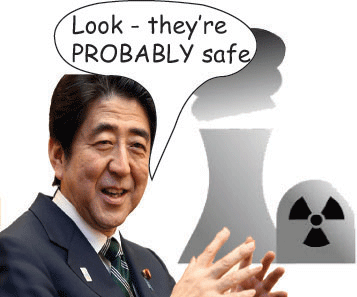 Shinzo Abe reelection increases chance of Japan relying more on nuclear power and less on LNG Straght.com by CHARLIE SMITH on DEC 14, 2014 “……….The election results have strengthened Abe’s hand as he pushes to restart more nuclear reactors in the wake of the 2011 earthquake and tsunami that crippled a power plant in Fukushima, spewing radiation across the Pacific Ocean.
The governor of Kagoshima prefecture has already approved firing up two reactors at the Sendai nuclear plant next year, rejecting calls from protesters to keep the facility closed…………….
In 2013, Abe told International Olympic Committee delegates that problems at the Fukushima plant were under control.
This was despite the calculations by Georgia Straight contributor Alex Roslin that about 800 people worldwide would develop cancer from Japanese fish eaten at the time of his article in October 2013.
Meanwhile, Japan News recently reported that a South Korean team will visit the Fukushima power plant and conduct tests on Japanese fish products.
South Korea has maintained a ban on importing fish from eight prefectures, including Fukushima.
The South Korean investigation will occur just as Japan’s nuclear watchdog is calling for the release of contaminated water from the Fukushima plant.
According to an article in the Asahi Shimbun newspaper, Nuclear Regulation Authority chairman Shunichi Tanaka said officials will need to gain the consent of local residents.
“I was overwhelmed by the sheer number of tanks (holding water tainted with radioactive substances),” Tanaka told journalists. “We have to dispose of the water.” http://www.straight.com/news/789111/shinzo-abe-reelection-increases-chance-japan-relying-more-nuclear-power-and-less-lng
1 This Month
26 April – Chernobyl: Inside the Meltdown airs on National Geographic on Sunday 26th April from 4pm

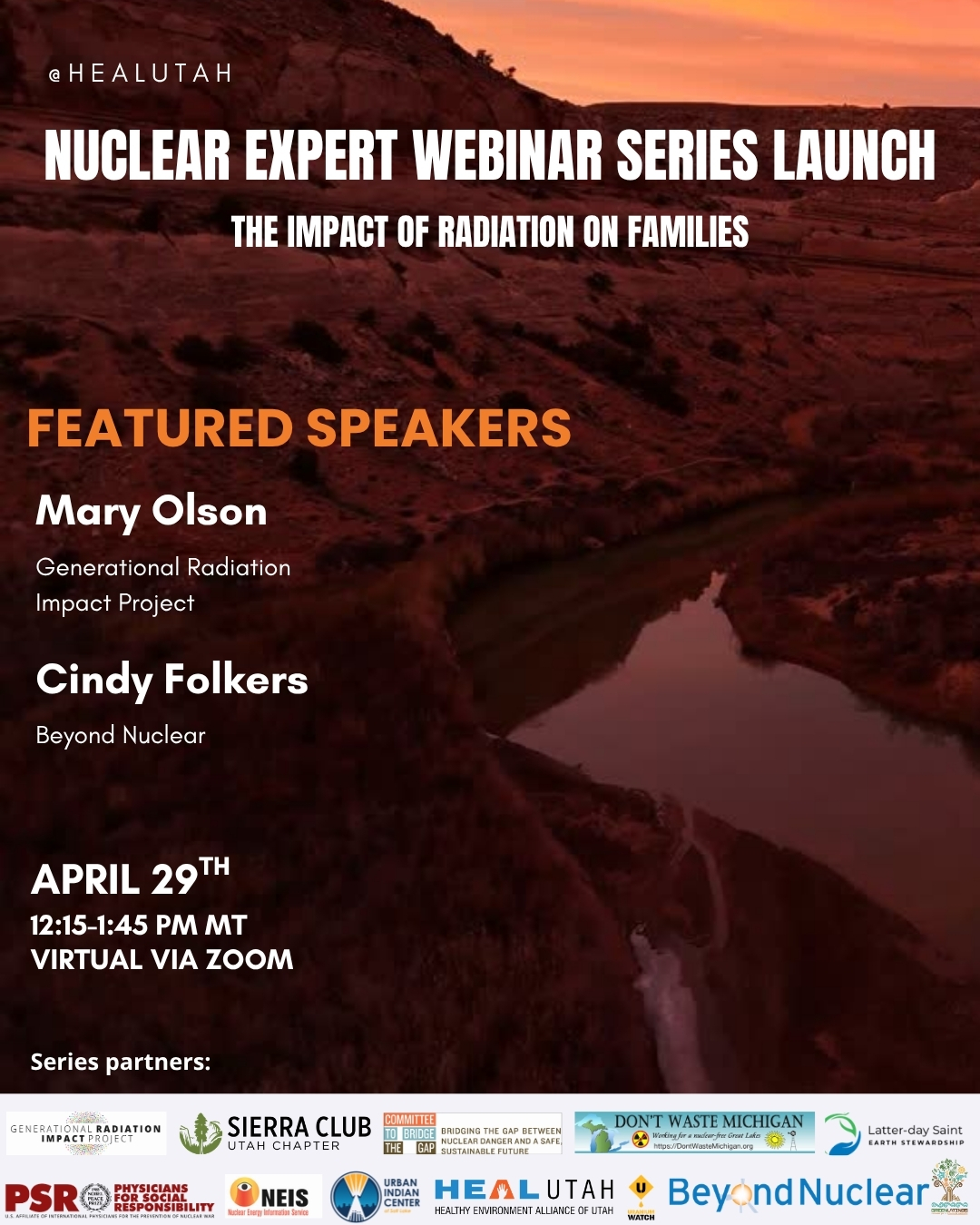
29 April – Nuclear Expert Webinar #1 – Radiation Impacts on Families with Mary Olson and Cindy Folkers
- 12:15 PM MT – 1:45 PM MT
- Location: Virtual – REGISTER TODAY

4 May -West Suburban Peace Coalition to discuss Iran war at May Educational Forum
Monday, May 4, 7:00 – 8:00 PM Central Standard Time
Title: : How Trump’s Narrative Tries to Shape the Reality of the War on Iran.
Contact Walt Zlotow, zlotow@hotmail.com 630 442 3045 for further information
14 May – online event From Bombs to Data Centres: the Face of Nuclear Colonialism
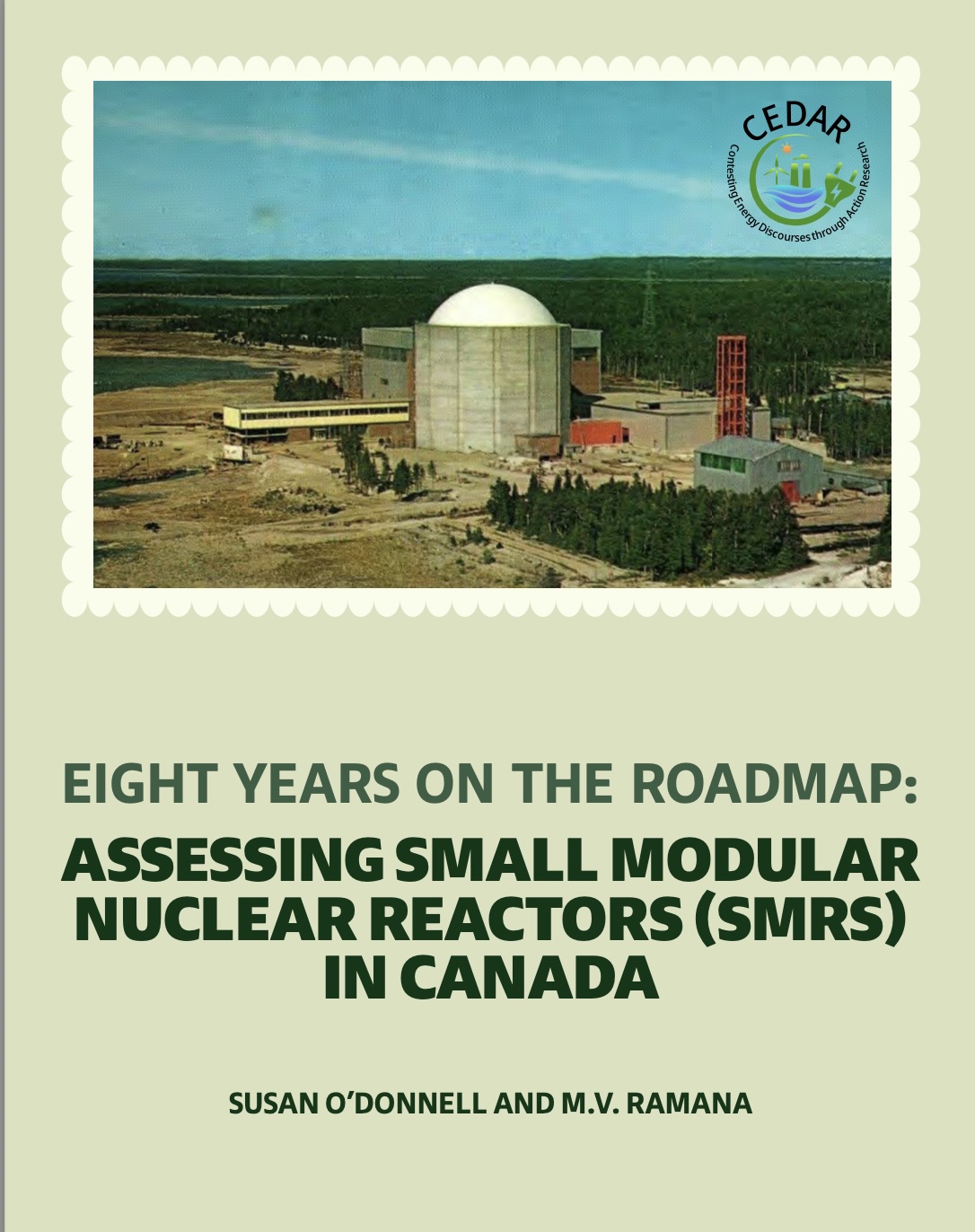

Pine Ridge Uranium is the real threat, not Tehran- Tell Burgum: Stop the Extraction.
Chernobyl: The Lost Tapes – A good documentary on Chernobyl on SBS available On Demand for the next 3 weeks– https://www.sbs.com.au/ondemand/tv-program/chernobyl-the-lost-tapes/2352741955560
To see nuclear-related stories in greater depth and intensity – go to https://nuclearinformation.wordpress.com
-
Archives
- April 2026 (288)
- March 2026 (251)
- February 2026 (268)
- January 2026 (308)
- December 2025 (358)
- November 2025 (359)
- October 2025 (376)
- September 2025 (257)
- August 2025 (319)
- July 2025 (230)
- June 2025 (348)
- May 2025 (261)
-
Categories
- 1
- 1 NUCLEAR ISSUES
- business and costs
- climate change
- culture and arts
- ENERGY
- environment
- health
- history
- indigenous issues
- Legal
- marketing of nuclear
- media
- opposition to nuclear
- PERSONAL STORIES
- politics
- politics international
- Religion and ethics
- safety
- secrets,lies and civil liberties
- spinbuster
- technology
- Uranium
- wastes
- weapons and war
- Women
- 2 WORLD
- ACTION
- AFRICA
- Atrocities
- AUSTRALIA
- Christina's notes
- Christina's themes
- culture and arts
- Events
- Fuk 2022
- Fuk 2023
- Fukushima 2017
- Fukushima 2018
- fukushima 2019
- Fukushima 2020
- Fukushima 2021
- general
- global warming
- Humour (God we need it)
- Nuclear
- RARE EARTHS
- Reference
- resources – print
- Resources -audiovicual
- Weekly Newsletter
- World
- World Nuclear
- YouTube
-
RSS
Entries RSS
Comments RSS
 nuclear-news