Money is not the only self-seeking motive for promoting nuclear power

Christina Macpherson’s websites & blogs
Capt D has pointed out how political leaders can become beholden to the nuclear lobby . So, indeed, can academics who are paid for pro nuclear views and research. So, of course, many writers are already benefiting financially from promoting nuclear power.
But it’s not that simple, especially in Australia. There are other motivations – such as being seen as important, as a leader, even if there is not, at present, any financial gain from promoting the nuclear industry. For example, I’m pretty sure that Barry Brook gains no financial return from the industry, for his extensive pro nuclear lobbying. But he does gain the importance of being almost certainly the only Australian climate scientist who devotes himself to the nuclear cause. Definitely a leader – of sorts!
Then there are the academic and other sheepies – who note all this pro nuclear stuff, and, without much scrutiny of the full issue, decide to go on the “nuclear fixes climate change” bandwagon. After all, the trend is for scientists to be concerned about climate change (and rightly so – plenty of evidence there). So they now seem to adopt the (much more dubious) trend that nuclear power is the cure for climate change.

Then there are the thorium nuclear wannabees – who like to enthusiastically jump on a new bandwagon – be part of the “latest” gee-whiz thing – again , that’s a motive that need not involve financial gain – but does involve some sort of glory by association with the new thorium nuclear companies.
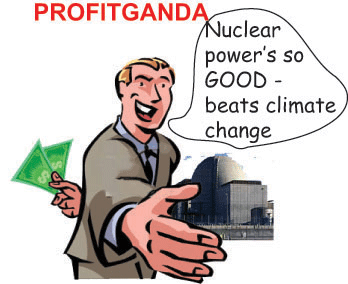
“Profitganda” – a new way to sell nuclear power to the masses
 Capt D 27 Dec 14 The reality is that in Japan and many other “civilized” countries the nuclear “lobby” is so powerfully that they in essence control not only the Government but also what forms of energy are used by the people of that country.
I have coined the term “Energy Slavery” as describing how many people are forced to buy their “Energy” from a Utility that does not provide the types of generation that the ratepayers want because it would not benefit the Utilities shareholders as much.
This will become ever more prevalent as Solar (of all flavors) cost continues to decline while Nuclear generation continues to increase in cost. Most new reactors that will be built will result in generating very high cost energy, which local ratepayers will be forced to pay, thanks to agreements being forced upon ratepayers in order to get these same nuclear reactors built.
I predict that history will show that the Leaders supporting these BIG reactor projects will themselves be enriched by these ☢ Energy deals, in what I call Profitganda*
http://www.urbandictionary.com/define.php?term=Profitganda
Profitganda is the use of phony “feel good” information to sell an idea, product or concept to the masses.
USA’s Environment Protection Agency finding it hard to assess nuclear power’s greenhouse emissions

 E.P.A. Wrestles With Role of Nuclear Plants in Carbon Emission Rules By MATTHEW L. WALD NYT DEC. 25, 2014 WASHINGTON — Trying to write a complicated formula to cut carbon emissions, the Environmental Protection Agency thinks it has found a magic number: 5.8.
The agency is trying to complete a rule governing carbon emissions from power plants, and among the most complicated and contentious issues is how to treat existing nuclear power plants. Many of them are threatened with shutdowns because cheap natural gas has made their reactors uncompetitive.
The agency’s proposal gave an odd mathematical formula for evaluating nuclear plants’ contribution to carbon emissions. It said that 5.8 percent of existing nuclear capacity was at risk of being shut for financial reasons, and thus for states with nuclear reactors, keeping them running would earn a credit of 5.8 percent toward that state’s carbon reduction goal.
Since receiving tens of thousands of comments on the proposal, the agency is now reviewing the plan. It must evaluate all comments before it sets a final rule, which it hopes to do by June. That rule, however, is likely to be challenged in court. Continue reading
France’s nuclear maintenance inadequate, costly: EDF shares slump
 France failing to keep up with nuclear reactor maintenance http://enformable.com/2014/09/france-failing-keep-nuclear-reactor-maintenance/ Lucas W Hixson Website According to the head of the French Nuclear Safety Authority, Electricite de France SA (EDF) – the largest generator of nuclear power in the world, is unable to keep up with maintenance needs at aging nuclear reactors in its fleet. The state-controlled EDF operates 58 nuclear reactors at 20 nuclear facilities and nearly 85% of its electrical production comes from nuclear energy.
After the Fukushima Daiichi nuclear disaster, EDF was forced to conduct repairs and safety improvements at its nuclear power stations, but according to Pierre-Franck Chevet, head of the Nuclear Safety Authority in France, “There are delays and complications and some could affect safety.”
EDF has estimated that it will need to spend at least $71 billion to improve safety at its nuclear power plants before 2025.
EDF shares have fallen as much as 4.2% since June 19th.
Three South Korean workers died after accident at nuclear plant construction site
The accident at the construction site in the southeastern city of Ulsan came as the state-run Korea Hydro and Nuclear Power Co was on high alert over a series of threats by hackers who claim they can disable the control systems of its plants.
Newly made public: testimonies of Fukushima nuclear disaster
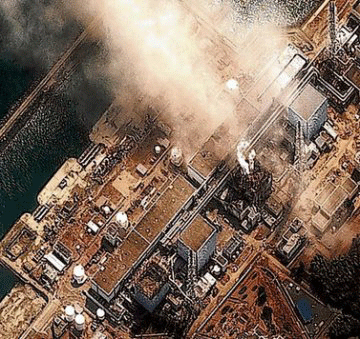 Govt. releases more accounts of Fukushima disaster http://www3.nhk.or.jp/nhkworld/english/news/20141226_03.html NHK Wrld, 25 Dec 14 The Japanese government has released more interview accounts of the 2011 nuclear accident.
772 interviews were conducted in 2011 and 2012 by a government committee that investigated the disaster.
The testimonies came mainly from government officials and staff from Tokyo Electric Power Company, which operates the crippled Fukushima Daiichi plant.
Some testimonies including those from then prime minister Naoto Kan, and then plant chief Masao Yoshida have already been released.
An additional 127 were made public on Thursday after receiving consent from interviewees.
Among those newly released is one from a worker at Tokyo Electric headquarters. He analyzed conditions inside the reactors in early April 2011 when the effects of the disaster began to unfold.
The official said he thought the upper half of the nuclear fuel rods at the No.1 reactor core must have completely melted. Cooling water was covering only the lower half of the rods.
But the employee added he remembered his company refrained from using the word “meltdown” in news briefings as much as possible. He said he heard TEPCO feared that a misunderstanding could occur as there was no exact definition for the term. Nuclear fuel melted at the No.1, 2 and 3 reactors. But Tokyo Electric admitted the possibility of meltdowns only in May 2011.
Success still eludes TEPCO, in trying to deal with Fukushima radioactive wastewater
New method for contaminated water may be failing http://www3.nhk.or.jp/nhkworld/english/news/ 20141226_37.htmlTokyo Electric Power Company has indicated that a new method aimed at tackling a large volume of highly radioactive wastewater at the Fukushima Daiichi nuclear power plant has not been entirely successful.
TEPCO gave a progress report on its work to a panel of experts at the Nuclear Regulation Authority on Friday.
The utility last month began pouring cement into underground tunnels filled with the contaminated water from the reactor buildings to stop the water inflow. The water is believed to be leaking into the sea.
TEPCO officials told the panel that workers have completely filled the U-shaped tunnels except for 4 vertical pits that connect the tunnels to the ground surface. They removed 2,500 tons of radioactive water.
But the officials said that when they pumped water up from one of the pits, the water level at another pit changed. That suggests that gaps exist in the concrete-filled tunnels. The officials argued that they can stop the water from flowing into the tunnels once the 4 vertical pits are filled. But panel members and authority commissioners said more thorough inspections are needed.
TEPCO plans to monitor water levels for a month, look for gaps, and study more effective ways to block the water.
The utility initially planned to freeze wastewater at the end of the tunnel to stop inflow from the reactor buildings and remove the water. But the plan did not work.
Central government was too slow to order Fukushima evacuation, claims former Governor
Fukushima ex-governor slams government for tardy radiation evacuation orders, Japan Times 26 Dec 14 JIJI Former Fukushima Gov. Yuhei Sato had criticized the central government for failing to issue evacuation orders in a timely manner in March 2011 after the Fukushima No. 1 nuclear plant suffered three reactor core meltdowns and spewed radioactive fallout, according to records disclosed Thursday.
The central government at first did not provide any information about the meltdowns at Tokyo Electric Power Co.’s Fukushima No. 1 nuclear plant, the records quoted Sato as saying.
“Because we received various information from local communities, I decided to issue an evacuation order,” Sato said.
The prefectural government issued an evacuation order on its own to people living within 2 km of the plant soon after the disaster started.
“An evacuation order from the central government came afterward,” the records quoted Sato as saying……….http://www.japantimes.co.jp/news/2014/12/26/national/fukushima-ex-governor-slams-government-tardy-radiation-evacuation-orders/#.VJ8d2sA8
1 This Month

of the week – Shut Down Drone Warfare!


Tell the Ukrainian Government to Drop Prosecution of Peace Activist Yurii Sheliazhenko

Petition to revoke the licensing of the Near Surface Nuclear Disposal Facility (NSDF) at Chalk River. https://www.ourcommons.ca/petitions/en/Petition/Details?Petition=e-7247
To see nuclear-related stories in greater depth and intensity – go to https://nuclearinformation.wordpress.com
-
Archives
- April 2026 (91)
- March 2026 (251)
- February 2026 (268)
- January 2026 (308)
- December 2025 (358)
- November 2025 (359)
- October 2025 (376)
- September 2025 (257)
- August 2025 (319)
- July 2025 (230)
- June 2025 (348)
- May 2025 (261)
-
Categories
- 1
- 1 NUCLEAR ISSUES
- business and costs
- climate change
- culture and arts
- ENERGY
- environment
- health
- history
- indigenous issues
- Legal
- marketing of nuclear
- media
- opposition to nuclear
- PERSONAL STORIES
- politics
- politics international
- Religion and ethics
- safety
- secrets,lies and civil liberties
- spinbuster
- technology
- Uranium
- wastes
- weapons and war
- Women
- 2 WORLD
- ACTION
- AFRICA
- Atrocities
- AUSTRALIA
- Christina's notes
- Christina's themes
- culture and arts
- Events
- Fuk 2022
- Fuk 2023
- Fukushima 2017
- Fukushima 2018
- fukushima 2019
- Fukushima 2020
- Fukushima 2021
- general
- global warming
- Humour (God we need it)
- Nuclear
- RARE EARTHS
- Reference
- resources – print
- Resources -audiovicual
- Weekly Newsletter
- World
- World Nuclear
- YouTube
-
RSS
Entries RSS
Comments RSS
 nuclear-news