Steep costs, constant uncertainty, make nuclear power an impractical answer to climate chnage
 Nuclear: Carbon Free, but Not Free of Unease NYT, By HENRY FOUNTAIN DEC. 22, 2014 “………The industry’s recent struggles represent something of a reversal from the previous decade, when there was talk of a nuclear revival in the United States after nearly 30 years without any new reactor construction permits being issued. Even then, however, some experts questioned just how much nuclear power could grow in the United States and abroad, and how much it could contribute to the effort to reduce carbon emissions.
In a report she prepared in 2009, Ms. Squassoni wrote that in light of steep construction costs, only a handful of new reactors would come on line by 2015, even in the best of circumstances.
“If you really wanted to reduce carbon emissions through nuclear, it was going to be incredibly expensive,” she said. “You’d have to build an incredible number of power plants.”
Now plants are even more expensive, in part because of new safety requirements in the wake of Fukushima. So-called small modular reactorshave been proposed as a lower-cost alternative. There are many different designs — at least one is meant to run on waste fuel — but the federal Department of Energy has provided significant development money only for two designs that are smaller variations of the most common kind of reactor.
Ashley Finan, an analyst with the Clean Air Task Force, which focuses on technologies to fight climate change, said that the Nuclear Regulatory Commission had not made it easy for alternative designs to win backing from private investors.
“There’s a lack of a clear and predictable regulatory pathway,” Dr. Finan said. “You’re really not able to attract funding without a clear regulatory process.”
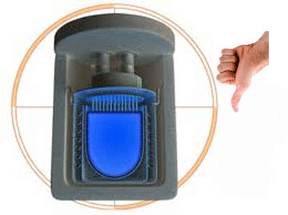 As a result, small modular reactors are many years from reality in the United States. Overseas, there are only a few isolated small-reactor projects underway, including one under construction in China………
Peter A. Bradford, a former member of the Nuclear Regulatory Commission, said that in discussions of adding more nuclear power to help curb emissions and fight climate change, the issue of safety takes on a new dimension.
“You can’t rationally bet a big part of your climate change abatement plan on a technology that you may suddenly find you don’t want to use anymore,” Mr. Bradford said. A major accident, for example, might force the entire industry to shut down, at least temporarily. “There’s no other low-carbon alternative with the potential to develop a large hole like that.”……http://www.nytimes.com/2014/12/23/science/nuclear-carbon-free-but-not-free-of-unease-.html?_r=0
No comments yet.
1 This Month

of the week – Shut Down Drone Warfare!


Tell the Ukrainian Government to Drop Prosecution of Peace Activist Yurii Sheliazhenko

Petition to revoke the licensing of the Near Surface Nuclear Disposal Facility (NSDF) at Chalk River. https://www.ourcommons.ca/petitions/en/Petition/Details?Petition=e-7247
To see nuclear-related stories in greater depth and intensity – go to https://nuclearinformation.wordpress.com
-
Archives
- April 2026 (79)
- March 2026 (251)
- February 2026 (268)
- January 2026 (308)
- December 2025 (358)
- November 2025 (359)
- October 2025 (376)
- September 2025 (257)
- August 2025 (319)
- July 2025 (230)
- June 2025 (348)
- May 2025 (261)
-
Categories
- 1
- 1 NUCLEAR ISSUES
- business and costs
- climate change
- culture and arts
- ENERGY
- environment
- health
- history
- indigenous issues
- Legal
- marketing of nuclear
- media
- opposition to nuclear
- PERSONAL STORIES
- politics
- politics international
- Religion and ethics
- safety
- secrets,lies and civil liberties
- spinbuster
- technology
- Uranium
- wastes
- weapons and war
- Women
- 2 WORLD
- ACTION
- AFRICA
- Atrocities
- AUSTRALIA
- Christina's notes
- Christina's themes
- culture and arts
- Events
- Fuk 2022
- Fuk 2023
- Fukushima 2017
- Fukushima 2018
- fukushima 2019
- Fukushima 2020
- Fukushima 2021
- general
- global warming
- Humour (God we need it)
- Nuclear
- RARE EARTHS
- Reference
- resources – print
- Resources -audiovicual
- Weekly Newsletter
- World
- World Nuclear
- YouTube
-
RSS
Entries RSS
Comments RSS
 nuclear-news
Leave a comment