Hole in ozone layer lingers – with deadly effects

Australian scientists have now found the radiation is having much wider effects. “Ecosystem impacts documented so far include changes to growth rates of South American and New Zealand trees, decreased growth of Antarctic mosses and changing biodiversity in Antarctic lakes,” say Sharon Robinson, of Wollongong University in NSW, and David Erickson, from the Oak Ridge National Laboratory in Tennessee.
Because it is no longer absorbing UV light, the stratosphere has cooled, which is reducing air pressure over the South Pole and sucking the southern jetstream southwards, along with its associated weather systems.
That has helped cool the Antarctic and direct more extreme weather towards Australia.http://www.theaustralian.com.au/news/world/the-ozone-hole-is-rewriting-earths-
In South Korea, worries mount about nuclear safety, as prosecutors probe data leak
South Korea investigating data leak at nuclear power plants, Globe and Mail SOHEE KIM AND MEEYOUNG CHO SEOUL — Reuters, Dec. 21 2014 Seoul prosecutors have launched an investigation into a leak of non-critical data at South Korea’s nuclear power operator, the prosecutors’ office said on Sunday, as worries mount about nuclear safety and potential cyber attacks from North Korea.
An official with the prosecutors’ office confirmed media reports that they had traced the location of an IP address linked to the leak and had dispatched investigators to the site…………… http://www.theglobeandmail.com/news/world/south-korea-investigating-data-leak-at-nuclear-power-plants/article22171029/
No to Canadian Nuclear Association: nuclear energy is not sustainable
Nuclear energy is not sustainable http://www.thestar.com/opinion/letters_to_the_editors/2014/12/21/nuclear_energy_is_not_sustainable.html Kevin Farmer, Toronto Re: Nuclear power still needed, Letter Dec. 14
In his defence of nuclear power, John Barrett, president of the Canadian Nuclear Association, offers a tired talking point, a false dichotomy and a specious assurance, all of which beg for rebuttal.
Yes, the sun does not always shine and the wind does not always blow. Therefore, Mr. Barrett concludes that we will always need a backup energy source to compensate for “supply gaps inherent in renewable energy.” Another solution would be better storage media to hold excess capacity during peak generation that can be brought online during lulls.
There is also the revolutionary technology of conservation. But we don’t seem to talk about that anymore even though energy efficiency is better than free since it pays for itself over time and then yields ongoing benefits.
Also, Mr. Barrett makes the bizarre assertion that “the nuclear industry is the only energy provider held fully accountable for its waste, safely stored on site and controlled by professionals — a sharp contrast to emissions from fossil fuel generation.” How exactly is the nuclear industry “accountable” for its waste? Does this accountability make the waste any less radioactive or shorten its radioactive half-life? Nuclear waste, like all of the products of human industry, is already in our environment. It is simply a matter of time before we notice the effects. We cannot impound toxic materials forever and no amount of “accountability” or alleged “control” can change this. We need to realize that we will live sustainably on Earth or not at all. Nuclear energy is not sustainable.
Off Fukushima coast – an earthquake, again
Earthquake strikes off Fukushima Prefecture; no tsunami warning issued, Japan Times, STAFF REPORT DEC 20, 2014 An earthquake with an intensity of 4 on the Japanese scale to 7 rattled the Hamadori area of eastern Fukushima Prefecture at 6:31 p.m. Saturday, the Meteorological Agency said.
The earthquake measured 3 in the Nakadori district of Fukushima as well as in northern, central and southern areas of adjacent Miyagi Prefecture, and in pars of Ibaraki Prefecture further to the north, the agency said on its website……..http://www.japantimes.co.jp/news/2014/12/20/national/science-health/moderate-quake-rattles-eastern-fukushima-prefecture/#.VJidisA9
Scrutiny on the misleading spin about the health effects of Fukushima nuclear disaster being “tolerable”
 Fukushima and the institutional invisibility of nuclear disaster, Ecologist, John Downer 20th December 2014 “………..Two: the accident was tolerable
The second basic narrative through which accounts of Fukushima have kept the accident from undermining the wider nuclear industry rests on the claim that its effects were tolerable – that even though the costs of nuclear accidents might look high, when amortised over time they are acceptable relative to the alternatives.
The ‘accidents are tolerable’ argument is invariably framed in relation to the health effects of nuclear accidents. Continue reading
United against uranium mining: Aboriginal people of Quebec at Montreal hearings
 The Aboriginal peoples of Quebec stand together against uranium at the final hearings of the BAPE in Montreal theturtleislandnews.com/daily/mailer_stories/dec162014/The-Aboriginal-peoples-of-Quebec-stand-together-against-uranium-at-the-final-hearings-of-the-BAPE-in-Montreal-pr1121614.html MONTREAL, Dec. 15, 2014 – At the final public hearings of the Bureau d’audiences publiques sur l’environnement (BAPE) on the uranium industry in Quebec, to be held today in Montreal, the James Bay Cree Nation will deliver a resounding and united message of opposition to uranium development in their territory, Eeyou Istchee. The Cree Nation, which has led the charge against uranium development, has been joined in this position by the Assembly of First Nations of Quebec and Labrador and the Inuit of northern Quebec, who will also make presentations to the BAPE today.
“A powerful message has been sent by all of the Aboriginal peoples of Quebec. Together, we have said NO to uranium,” said Matthew Coon Come, the Grand Chief of the James Bay Cree Nation. “Today, we show that the Cree Nation speaks in one voice – united with the other Aboriginal peoples of Quebec – when we insist that our lands remain free of uranium mining and uranium waste.”
The Cree Nation Youth Council’s StandAgainstUranium march, which began in Mistissini on November 23, arrived in Montreal today to attend the BAPE hearings. The marchers have travelled on foot over 850 km in 23 days, to share the Cree Nation’s message and to encourage other Quebeckers to stand with them against uranium development. Overwhelmingly, those they met along the way have agreed that uranium mining should be banned in Quebec.
Youth Grand Chief Joshua Iserhoff has led the StandAgainstUranium march and will be making submissions to the BAPE on behalf of the Youth Council. “One of our community’s favourite fishing spots, Gobanji, is on Mistissini Lake, downstream from Strateco’s Matoush project. My grandma’s goose camp is there too,” reflected Youth Chief Iserhoff. “I’ve had lots of time on this walk to think about how important this land is to me, my family and our entire community. I will be telling the Commissioners, on behalf of Cree Youth, that uranium mining, and the radioactive and hazardous waste it will leave behind, are not welcome in Eeyou Istchee.”
“The courage and resolution shown by the StandAgainstUranium marchers over the last few weeks speaks in a powerful way to the determination of our people to protect Eeyou Istchee from the risks of uranium mining and uranium waste, today and for future generations. We give our thanks to the First Nations who offered support and encouragement along the way,” noted Grand Chief Coon Come. “We have been gratified to see that as they learn the facts about uranium, Quebeckers are joining with us in our stand.”
The BAPE’s final hearings will be held in the Salle Ovation at the Hyatt Regency Montreal, at 1pm and 7pm. The evening sessions will be co-chaired by the BAPE Commission, the James Bay Advisory Committee on the Environment and the Kativik Environmental Advisory Committee.
More information about uranium and the Cree Nation’s position can be found at www.StandAgainstUranium.com, on Facebook (James Bay Cree Against Uranium) or on Twitter (@JBCAUranium). SOURCE The Grand Council of the Crees (Eeyou Istchee)
At COP 20 in Lima: The Buzz about Renewable Energy Union of Concerned Scientists, Rachel Cleetus, senior climate economist, Climate and Energy“…..at the annual United Nations climate talks, or COP 20. Even as negotiators labor over “non-papers” and “elements of draft negotiating text,” the real buzz here is about the incredible opportunity to drive down global emissions by investing in renewable energy and energy efficiency. What makes this a particularly exciting time is that the costs of renewable energy are falling dramatically. The clean energy transition has never been more affordable – or, frankly, more urgently needed.
Global progress on renewable energy
Renewable energy is growing by leaps and bounds worldwide. In 2013, renewables accounted for more than 56 percent of net additions to global power capacity. Recent data from Bloomberg New Energy Finance (BNEF) shows that global clean energy investment in the first three quarters of 2014 added up to $175 billion, 16 percent higher than in the same period of 2013.
This post is part of a series on theUN Climate Change Conference in Lima (COP 20).
Solar energy, in particular, has experienced tremendous growth. In 2013, for the first time, global growth in solar photovoltaic (PV) outpaced new wind capacity. Annual growth in global solar PV capacity has averaged almost 55 percent over the past five years.
Recent news stories have highlighted that investment banks are also increasingly recognizing the financial benefits of investments in renewable energy. For example, Goldman Sachs has committed to $40 billion in existing and planned renewables investments, including in BrightSource Energy, which designed the solar thermal system for Ivanpah, the largest solar plant in the world.
However, to scale up clean energy even more rapidly to help meet climate goals, we need strong policy support, such as renewable energy and energy efficiency standards and incentives; investments in transmission infrastructure to integrate higher levels of renewable energy; investments in research and development; and a price on carbon. The rapid growth of renewables, their falling costs, and the urgent need to reduce carbon emissions makes a weak extension of the production tax credit by the U.S. Congress —an effective federal incentive that supports business development of wind and other renewable energy sources— seem all the more misguided.
The dramatically falling costs of renewable energy
Renewable energy costs are falling worldwide. In the U.S., for example, the national average cost of wind power has dropped more than 60 percent since 2009, making it competitive with new fossil fuel plants in many regions. Solar PV system costs fell by about40 percent from 2008 to 2012 and by another 15 percent in 2013.
Looking ahead, the two trends of improved technologies and reduced costs are expected to continue, according to research from BNEF, the International Renewable Energy Agency (IRENA), and the National Renewable Energy Laboratory (NREL), U.S. Department of Energy.
A race to the top
In a joint climate announcement with the U.S., China set a goal of achieving a 20 percent share of non-fossil energy in total primary energy by 2030. Renewable Energy Prospects: China, a recent report from IRENA and the China Renewable Energy Centre, shows that China can meet and exceed that goal affordably. The analysis shows that China can increase its renewable share of energy from 13 to 26 percent by 2030, and the share of renewables in the power sector to 40 percent by 2030. This pathway would also help deliver tremendous public health benefits to a country plagued by pollution from its dependence on coal-fired power.
The U.S. has announced a draft Clean Power Plan to limit carbon emissions from power plants, the single largest source of those emissions in the country. Analysis by UCS shows that the draft plan can be strengthened to raise emission reductions from 30 to 40 percent below 2005 levels by 2030 simply by increasing the contribution from renewable energy. Other elements of the President’s Climate Action Plan, including increasing fuel economy standards and implementing methane regulations, can cut emissions further.
What’s also striking is that the top two countries competing neck and neck in renewable energy deployment are China and the United States, also the world’s two biggest carbon emitters currently. Germany, Spain, Italy, and India round out the list of the top six countries in terms of non-hydro renewable energy capacity.
While all major emitting countries clearly can and should do more, these are promising times for catalyzing ambitious global climate action.
Renewable energy and energy efficiency are essential to meet climate goals
A number of global research efforts are underway to show the feasibility and affordability of deep cuts in emissions. IRENA has recently launched the ReMap 2030 project to analyze global pathways for doubling the share of renewable energy in the world’s energy mix by 2030. The Deep Decarbonization Pathways project, a joint initiative of the Sustainable Development Solutions Network (SDSN) and the Institute for Sustainable Development and International Relations (IDDRI), shows how individual countries can contribute to a global goal of limiting temperature increases to no more than 2°C. The IEA’s World Energy Outlook also provides analysis to back a 450ppm CO2equivalent global pathway.
The common theme of all these reports, written by experts from all over the world, is thatit is feasible to jump start a clean energy transition and that we cannot achieve our climate goals without a very ambitious ramp-up in renewable energy and energy efficiency.
What’s more, many studies are also pointing out that this transition is affordable and beneficial for the global economy and for public health….. http://blog.ucsusa.org/at-cop-20-in-lima-the-buzz-about-renewable-energy-756
Investment analyst Morgan Stanley points to rooftop solar energy
Morgan Stanley’s Renewable Energy Stock Picks For 2015 Wayne Duggan, Benzinga Staff Writer , 21 Dec 14 A recent Morgan Stanley report focused on the future of renewable energy. Analysts discussed long-term changes that will come about in the sector in the coming years…………
 Solar Strength

The report indicated that rooftop solar should provide a major source of demand in the future. The cost of rooftop solar panels for both houses and businesses is becoming less cost-prohibitive, and installation of solar panels is becoming more realistic for the average family’s budget.
Analyst Stephen Byrd explains that solar customers around the world are able to reap the benefits of a favorable regulatory environment. “In Australia, Europe, the US, Brazil, and Japan, residential and commercial customers are able to avoid some portion or all of their utility bills by installing solar panels.” http://www.benzinga.com/analyst-ratings/analyst-color/14/12/5095151/morgan-stanleys-renewable-energy-stock-picks-for-2015#ixzz3Mewb6m9k
The myth of the “safety” of new nuclear power designs
 Fukushima and the institutional invisibility of nuclear disaster, Ecologist, John Downer 20th December 2014 “………….Complex systems’ ability to keep on surprising
Finally, and most fundamentally, there are many a priori reasons to doubt that any reactor design could be as safe as risk analyses suggest. Observers of complex systems have outlined strong arguments for why critical technologies are inevitably prone to some degree of failure, whatever their design.
The most prominent such argument is Perrow’s Normal Accident Theory (NAT), with its simple but profound probabilistic insight that accidents caused by very improbable confluences of events (that no risk calculation could ever anticipate) are ‘normal’ in systems where there are many opportunities for them to occur.
From this perspective, the ‘we-found-the-flaw-and-fixed-it’ argument is implausible because it offers no way of knowing how many ‘fateful coincidences’ the future might hold.
‘Lesson 1’ of the IAEA’s preliminary report on Fukushima is that the ” … design of nuclear plants should include sufficient protection against infrequent and complex combinations of external events.”
NAT explains why an irreducible number of these ‘complex combinations’ must be forever beyond the reach of formal analysis and managerial control.
A different way of demonstrating much the same conclusion is to point to the fundamental epistemological ambiguity of technological knowledge, and to how the significance of this ambiguity is magnified in complex, safety-critical systems due to the very high levels of certainty these systems require.
Judgements become more significant in this context because they have to be absolutely correct. There is no room for error bars in such calculations . It makes little sense to say that we are 99% certain a reactor will not explode, but only 50% sure that this number is correct.
Perfect safety can never be guaranteed
Viewed from this perspective, it becomes apparent that complex systems are likely to be prone to failures arising from erroneous beliefs that are impossible to predict in advance, which I have elsewhere called ‘Epistemic Accidents’.
This is essentially to say that the ‘we-found-the-flaw-and-fixed-it’ argument cannot guarantee perfect safety because it offers no way of knowing how many new ‘lessons’ the future might hold………
The reliability myth
This is all to say, in essence, that it is misleading to assert that an accident of Fukushima’s scale will not re-occur. For there are credible reasons to believe that the reliability required of reactors is not calculable, and there are credible reasons to believe that the actual reliability of reactors is much lower than is officially calculated.
These limitations are clearly evinced by the actual historical failure rate of nuclear reactors. Even the most rudimentary calculations show that civil nuclear accidents have occurred far more frequently than official reliability assessments have predicted.
The exact numbers vary, depending on how one classifies ‘an accident’ (whether Fukushima counts as one meltdown or three, for example), but Ramana (2011) puts the historical rate of serious meltdowns at 1 in every 3,000 reactor years, while Taebi et al. (2012: 203fn) put it at somewhere between 1 in every 1,300 to 3,600 reactor years.
Either way, the implied reliability is orders of magnitude lower than assessments claim………..http://www.theecologist.org/News/news_analysis/2684383/fukushima_and_the_institutional_invisibility_of_nuclear_disaster.html
Russia-India nuclear deal no big deal, really
Russia India Nuclear Deal Not As Exciting As Previously Thought By Ag Metal Miner |By Sohrab Darabshaw Sun, 21 December 2014 The initial euphoria over Russia agreeing to build at least 12 nuclear reactors in India by 2035 has died down as sector experts get around to analyzing the Russian move vis-à-vis India’s ongoing nuclear power program.
The agreement, one of 20, was inked during Russian President Vladimir Putin’s summit meeting in New Delhi last week. Both Indian Prime Minister Narendra Modi and Putin pledged to take ties between the 2 nations to a “new degree of closeness,” with cooperation in nuclear energy acting as the linchpin. A report by Indian news agency Press Trust of India said both nations would strive to complete the construction and commissioning of not less than 12 nuclear units in the next 2 decades, according to a strategic vision document.
That makes it great propaganda material for official press releases and for the official summit photographs, but going behind the scenes, as many Indian analysts and media following the nuclear program and India’s power sector have done, it emerges that the agreement is merely old wine in a new bottle……….http://oilprice.com/Latest-Energy-News/World-News/Russia-India-Nuclear-Deal-Not-As-Exciting-As-Previously-Thought.html
World’s safety depends on USA – Russia co-operation
Russia and the U.S. Need to Get Along. The World’s Safety Depends on It. New republic 21 Dec 14 By Josh Cohen It is impossible to overstate the danger that nuclear proliferation posed to the world after the collapse of the Soviet Union. Throughout the newly independent states, nuclear weapons, as well as their components and storage sites, frequently layunguarded—sometimes because starving interior ministry troops left their posts to search for food. Highly enriched uranium (HEU) was stolen from a submarine base in 1993. Managers of top Russian defense plants offered to sell enriched plutonium to visiting foreign scientists. And a visiting White House official once discovered that enough HEU to build several nuclear bombs was being stored in simple school-like lockers at an institute in Moscow.
That’s why the U.S. implemented the Cooperative Threat Reduction (CTR) program, under which the U.S. spent billions of dollars to help Moscow secure its nuclear facilities and fissile material. From the removal of 600 kilograms of weapons-grade HEU from an unguarded warehouse in northern Kazakhstan to the construction of a highly secure storage facility near Chelyabinsk, Russia, that holds the equivalent of fissile material from 25,000 nuclear warheads, CTR has been an unambiguous post–Cold War success story.
With relations chilly again due to the crisis in Ukraine, first the U.S. and now Russia have taken steps that threaten to undo decades of nuclear cooperation. We need to be firm with Russia over its incursions in Ukraine, but nothing should be done to jeopardize our cooperation over the greater risks of nuclear proliferation and nuclear terrorism.
Our nation’s safety is at stake. Here’s what we should do to protect it………….. http://www.newrepublic.com/article/120609/russia-us-nuclear-weapons-proliferation-cooperation-deteriorating
Small solar appliance makes drinking water clean
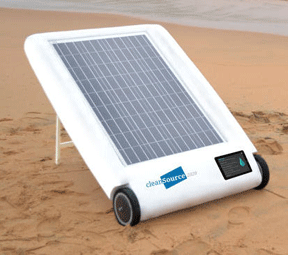 All It Takes For The Desolenator To Make Clean Drinking Water Is A Little Sunlight Fast Coexist, 21 Dec 14 Polluted or salty water becomes drinking water for a small family.Turning saltwater into clean drinking water is usually an expensive and energy-intensive process—a new desalination plant under construction in San Diego has a price tag of $1 billion, and smaller devices can cost as much as $30,000. But a new solar-powered device could make the process affordable for the millions of people around the world who don’t have running water.
“Other devices produce more water, but they are significantly more expensive, and they require quite a bit of maintenance and consumables,” says Desolenator‘s CEO William Janssen. “On the other side you have the solar still, the traditional solution—but that unit only produces half a gallon of water per day. Our solution can produce 3 to 4 gallons a day, enough for drinking and cooking.”
It’s designed for the hundreds of millions of people around the world who lack easy access to drinking water but happen to live near polluted rivers, lakes, or coastlines.
“If you look around the equatorial belt of the world, there are many countries that are very densely populated where water resources are very stressed,” says Janssen. “It will get worse—by 2025, close to 3 billion people will deal with water scarcity daily. We want to give them something that’s an affordable, family-sized device.”…………..http://www.fastcoexist.com/3039870/all-it-takes-for-the-desolenator-to-make-clean-drinking-water-is-a-little-sunlight#1
1 This Month

of the week – Shut Down Drone Warfare!


Tell the Ukrainian Government to Drop Prosecution of Peace Activist Yurii Sheliazhenko

Petition to revoke the licensing of the Near Surface Nuclear Disposal Facility (NSDF) at Chalk River. https://www.ourcommons.ca/petitions/en/Petition/Details?Petition=e-7247
To see nuclear-related stories in greater depth and intensity – go to https://nuclearinformation.wordpress.com
-
Archives
- April 2026 (79)
- March 2026 (251)
- February 2026 (268)
- January 2026 (308)
- December 2025 (358)
- November 2025 (359)
- October 2025 (376)
- September 2025 (257)
- August 2025 (319)
- July 2025 (230)
- June 2025 (348)
- May 2025 (261)
-
Categories
- 1
- 1 NUCLEAR ISSUES
- business and costs
- climate change
- culture and arts
- ENERGY
- environment
- health
- history
- indigenous issues
- Legal
- marketing of nuclear
- media
- opposition to nuclear
- PERSONAL STORIES
- politics
- politics international
- Religion and ethics
- safety
- secrets,lies and civil liberties
- spinbuster
- technology
- Uranium
- wastes
- weapons and war
- Women
- 2 WORLD
- ACTION
- AFRICA
- Atrocities
- AUSTRALIA
- Christina's notes
- Christina's themes
- culture and arts
- Events
- Fuk 2022
- Fuk 2023
- Fukushima 2017
- Fukushima 2018
- fukushima 2019
- Fukushima 2020
- Fukushima 2021
- general
- global warming
- Humour (God we need it)
- Nuclear
- RARE EARTHS
- Reference
- resources – print
- Resources -audiovicual
- Weekly Newsletter
- World
- World Nuclear
- YouTube
-
RSS
Entries RSS
Comments RSS
 nuclear-news