Warming of oceans brings hottest year on record
 Warm oceans keep world on course for hottest year December 16, 2014 Peter Hannam Environment Editor, The Sydney Morning Herald Ongoing record warmth in the world’s oceans has increased the likelihood that 2014 will be declared the hottest year since reliable data began more than a century ago, US and Japanese agencies say.
The warmth comes as conditions in the Pacific remain conducive to an El Nino event forming in coming months, Australia’s Bureau of Meteorology said.
Surface temperatures have exceeded El Nino threshold levels for several weeks, and the bureau estimates there is a greater than 70 per cent chance of such an event soon.
The first 11 months of the year were the warmest on record, with combined global land and sea-surface temperatures running 1.22 degrees above the 20th-century average, the US National Oceanic and Atmospheric Administration said.
This year will be the hottest on record – eclipsing 2005 and 2010 – provided December is at least 0.76 degrees above average, NOAA said…………http://www.smh.com.au/environment/climate-change/warm-oceans-keep-world-on-course-for-hottest-year-20141216-1287l2.html
Heating of Arctic oceans may cause dangerous solar radiation feedback loop
Rapid warming of Arctic may trigger dangerous solar radiation feedback loop http://www.sciencerecorder.com/news/rapid-warming-of-arctic-may-trigger-dangerous-solar-radiation-feedback-loop/ Delila James | Science Recorder | December 18, 2014 NASA scientists at the fall meeting of the American Geophysical Union in San Francisco presented what is just the latest dire prediction about the runaway effects of climate change.
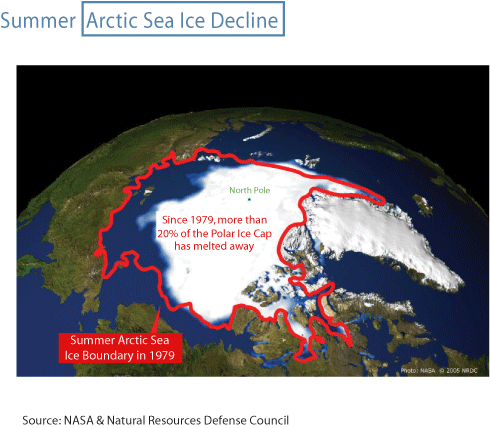
The researchers discussed a map created by satellites’ heat-sensing instruments showing the rate of solar radiation change in the Arctic, where the rate of heat absorption per square meter since 2000 has increased by more than 10 Watts of energy, according to a report by Wired. In some regions, such as the Beaufort Sea north of Alaska, the rate has increased as much as 45 Watts of energy per square meter.
For the past decade-and-a-half, NASA has been using satellite sensors called CERES to calculate how much solar energy is being absorbed by planet Earth as opposed to being reflected back into space. Every year the Arctic ice cap shrinks in the summer and grows in the winter. But because of the record loss of sun-reflecting sea ice in the Arctic seen in recent years, much of the winter ice cover now is thin—less than 6 feet thick, according to Wired.
So, when warm weather returns to the Arctic, the thin ice cover melts rapidly, causing the oceans to heat up. This then causes more ice to melt in a solar radiation feedback loop, in which the thinner the ice cover, the earlier in the summer it melts, which warms the ocean, which melts the ice, and so on.
Compared to 30 years ago, the annual summer melt in the Arctic comes seven days earlier, the Wired report said.
Atmospheric scientist Jennifer Kay of the University of Colorado, who collaborated in the research, said in a statement that CERES, which has only been collecting Arctic solar energy data since 2000, cannot be used to predict any long-term trends.
“Climate is usually considered to be a 30-year average,” Kay said.
British public not really “fed up with wind farms”
Are the British public really ‘fed up with wind farms’?Adam Boult for Metro.co.uk Thursday 18 Dec 2014 Earlier this week David Cameron stated that the British public are ‘fed up’ with onshore wind farms, and called for them to stop receiving state subsidies. Speaking to MPs, the Prime Minister said it was time to ditch funding for new turbines: ‘Let’s get rid of the subsidy, put them into the planning system. If they can make their case, they will make their case.’
We asked Metro readers what they thought of Cameron’s remarks – and here are a selection of responses received so far.
MORE: Poll: Are you fed up with wind farms?
We’re NOT fed up with wind farms
‘Wind farms are better than chimneys and also look better than a smokey sky.’ Mark Ulyatt
‘When me and my daughter are out in the car, we look for them. My daughter likes watching them go round, just as I do. I find them quite relaxing to watch.’ Kirsty Winfield
‘Well we could look at it this way. We could marvel at the ever improving technology using an almost infinite resource to help power our throwaway lifestyles. Or we could go like China and have pollution so bad you have to wear a mask if you go outside. If you ask me? Wind power, all the way.’ Chris Xryzoa Tempest …….
1 This Month



Tell the Ukrainian Government to Drop Prosecution of Peace Activist Yurii Sheliazhenko

Petition to revoke the licensing of the Near Surface Nuclear Disposal Facility (NSDF) at Chalk River. https://www.ourcommons.ca/petitions/en/Petition/Details?Petition=e-7247


of the week – STOP SMALL MODULAR REACTORS IN CANADA
To see nuclear-related stories in greater depth and intensity – go to https://nuclearinformation.wordpress.com
-
Archives
- March 2026 (222)
- February 2026 (268)
- January 2026 (308)
- December 2025 (358)
- November 2025 (359)
- October 2025 (376)
- September 2025 (258)
- August 2025 (319)
- July 2025 (230)
- June 2025 (348)
- May 2025 (261)
- April 2025 (305)
-
Categories
- 1
- 1 NUCLEAR ISSUES
- business and costs
- climate change
- culture and arts
- ENERGY
- environment
- health
- history
- indigenous issues
- Legal
- marketing of nuclear
- media
- opposition to nuclear
- PERSONAL STORIES
- politics
- politics international
- Religion and ethics
- safety
- secrets,lies and civil liberties
- spinbuster
- technology
- Uranium
- wastes
- weapons and war
- Women
- 2 WORLD
- ACTION
- AFRICA
- Atrocities
- AUSTRALIA
- Christina's notes
- Christina's themes
- culture and arts
- Events
- Fuk 2022
- Fuk 2023
- Fukushima 2017
- Fukushima 2018
- fukushima 2019
- Fukushima 2020
- Fukushima 2021
- general
- global warming
- Humour (God we need it)
- Nuclear
- RARE EARTHS
- Reference
- resources – print
- Resources -audiovicual
- Weekly Newsletter
- World
- World Nuclear
- YouTube
-
RSS
Entries RSS
Comments RSS
 nuclear-news