Heating of Arctic oceans may cause dangerous solar radiation feedback loop
Rapid warming of Arctic may trigger dangerous solar radiation feedback loop http://www.sciencerecorder.com/news/rapid-warming-of-arctic-may-trigger-dangerous-solar-radiation-feedback-loop/ Delila James | Science Recorder | December 18, 2014 NASA scientists at the fall meeting of the American Geophysical Union in San Francisco presented what is just the latest dire prediction about the runaway effects of climate change.
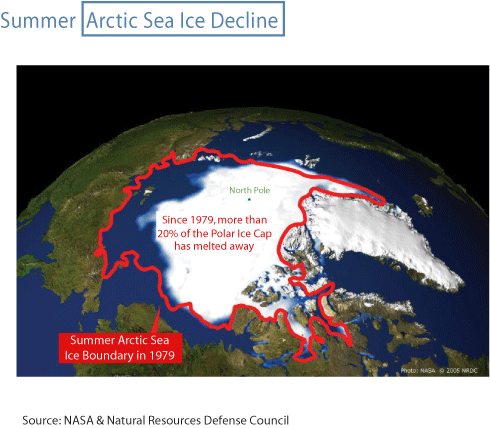
The researchers discussed a map created by satellites’ heat-sensing instruments showing the rate of solar radiation change in the Arctic, where the rate of heat absorption per square meter since 2000 has increased by more than 10 Watts of energy, according to a report by Wired. In some regions, such as the Beaufort Sea north of Alaska, the rate has increased as much as 45 Watts of energy per square meter.
For the past decade-and-a-half, NASA has been using satellite sensors called CERES to calculate how much solar energy is being absorbed by planet Earth as opposed to being reflected back into space. Every year the Arctic ice cap shrinks in the summer and grows in the winter. But because of the record loss of sun-reflecting sea ice in the Arctic seen in recent years, much of the winter ice cover now is thin—less than 6 feet thick, according to Wired.
So, when warm weather returns to the Arctic, the thin ice cover melts rapidly, causing the oceans to heat up. This then causes more ice to melt in a solar radiation feedback loop, in which the thinner the ice cover, the earlier in the summer it melts, which warms the ocean, which melts the ice, and so on.
Compared to 30 years ago, the annual summer melt in the Arctic comes seven days earlier, the Wired report said.
Atmospheric scientist Jennifer Kay of the University of Colorado, who collaborated in the research, said in a statement that CERES, which has only been collecting Arctic solar energy data since 2000, cannot be used to predict any long-term trends.
“Climate is usually considered to be a 30-year average,” Kay said.
No comments yet.
1 This Month



Tell the Ukrainian Government to Drop Prosecution of Peace Activist Yurii Sheliazhenko

Petition to revoke the licensing of the Near Surface Nuclear Disposal Facility (NSDF) at Chalk River. https://www.ourcommons.ca/petitions/en/Petition/Details?Petition=e-7247


of the week – STOP SMALL MODULAR REACTORS IN CANADA
To see nuclear-related stories in greater depth and intensity – go to https://nuclearinformation.wordpress.com
-
Archives
- March 2026 (218)
- February 2026 (268)
- January 2026 (308)
- December 2025 (358)
- November 2025 (359)
- October 2025 (376)
- September 2025 (258)
- August 2025 (319)
- July 2025 (230)
- June 2025 (348)
- May 2025 (261)
- April 2025 (305)
-
Categories
- 1
- 1 NUCLEAR ISSUES
- business and costs
- climate change
- culture and arts
- ENERGY
- environment
- health
- history
- indigenous issues
- Legal
- marketing of nuclear
- media
- opposition to nuclear
- PERSONAL STORIES
- politics
- politics international
- Religion and ethics
- safety
- secrets,lies and civil liberties
- spinbuster
- technology
- Uranium
- wastes
- weapons and war
- Women
- 2 WORLD
- ACTION
- AFRICA
- Atrocities
- AUSTRALIA
- Christina's notes
- Christina's themes
- culture and arts
- Events
- Fuk 2022
- Fuk 2023
- Fukushima 2017
- Fukushima 2018
- fukushima 2019
- Fukushima 2020
- Fukushima 2021
- general
- global warming
- Humour (God we need it)
- Nuclear
- RARE EARTHS
- Reference
- resources – print
- Resources -audiovicual
- Weekly Newsletter
- World
- World Nuclear
- YouTube
-
RSS
Entries RSS
Comments RSS
 nuclear-news
Leave a comment