 Iran’s President Pledges to Face Down Forces Opposing a Nuclear Deal, NYT, By THOMAS ERDBRINK DEC. 15, 2014 TEHRAN — Risking his political standing, Iran’s president stressed on Monday that he was determined to cinch a nuclear deal and prepared to take on the conservative forces who would prefer not to see an agreement with the West, even if that means continued economic sanctions on Iran.
“Some people may not like to see the sanctions lifted,” the president, Hassan Rouhani, said as Iranian negotiators and their United States counterparts resumed talks in Geneva. “Their numbers are few, and they want to muddy the waters.”
A deadline for those talks was extended by seven months after the parties failed to conclude a deal in November. Mr. Rouhani is continuing to maintain that a deal will be concluded. His foreign minister, Mohammad Javad Zarif, said last month that an agreement could be reached in a matter of “weeks.”
Both men have tied their political future to the deal, analysts say. Despite the setbacks in the talks, Mr. Rouhani stays on message on what he says isIran’s bright future……..http://www.nytimes.com/2014/12/16/world/middleeast/irans-president-pledges-to-face-down-forces-opposing-a-nuclear-deal.html?_r=0
December 17, 2014
Posted by Christina Macpherson |
Iran, politics international |
Leave a comment
Nuclear damages attempts to tackle climate change nuClear News Dec 14 “………Nuclear’s contribution is too small. Too much of the energy debate focuses on electricity. To read some of the media you might be
left with the impression that energy and electricity are two words which are interchangeable.
But electricity actually only supplies 18% of our energy needs, so nuclear power is an even
smaller proportion – about 3.6%.
To tackle climate change we need to deal with emissions from all sectors including transport
and heat, as well as electricity.
For instance if we look at energy consumption in buildings – and almost half of the UK’s carbon
emissions are caused by buildings – we can see that more than two thirds of the energy used is
for heating. We could, of course, convert all our heating to electric heating systems, but
whatever way you look at it this argues for a much greater effort to be directed at energy
efficiency.
Every pound spent needs to be spent on the most cost effective carbon abatement
measures.
Clearly, even if we were in the middle of an economic boom, we don’t have unlimited supplies of
money. So we have to spend what we do have in a way which maximises the carbon savings
achieved for every pound spent. Although nuclear might appear to be cheaper than some of the
other forms of low carbon energy, experience tells us that nuclear costs are likely to rise,
whereas renewable costs are falling rapidly.
The New York Times reports (3) that the cost ofproviding electricity from wind and solar power plants has plummeted over the last five years, so much so that in some markets renewable generation is now cheaper than coal or natural gas.
Utility executives say the trend has accelerated this year, with several companies signing
contracts for solar or wind at prices below that of natural gas.
In the UK nuclear is expecting to continue receiving subsidies, under the new Contracts for
Difference system, for 35 years after reactors open, whereas renewables will only receive
subsidies for ten years.
Offshore wind is one of the most expensive renewables at the moment, but its costs are
predicted to fall quite quickly over the next decade. Onshore wind costs are falling rapidly too,
and solar will be cheaper than nuclear before Hinkley Point C opens.
But if the Government continues to attack onshore wind and continues to reduce support for
offshore wind then we will fail to capitalise on the gains already made and costs won’t be able to
continue falling
The cheapest low carbon option is not to use the energy in the first place. In fact many efficiency
measures can be installed at negative cost. And efficiency is not just about loft insulation.
Investment in LED lighting for instance can generate returns of up to 10%………….
December 17, 2014
Posted by Christina Macpherson |
2 WORLD, business and costs |
Leave a comment
Namibia: Uranium and Zinc Industries Perform Poorly All Africa News, 16 Dec 14 Windhoek — Bank of Namibia Governor, Ipumbu Shiimi says the local uranium and zinc industries performed poorly over the last 10 months, compared to other sectors such as construction, diamond mining, manufacturing and wholesale/retail.
December 17, 2014
Posted by Christina Macpherson |
general |
Leave a comment
Nuclear damages attempts to tackle climate change nuClear News Dec 14
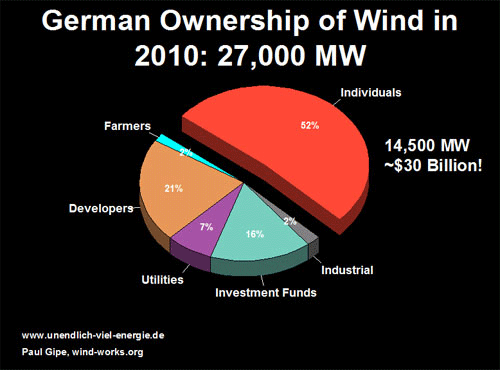
“……….Former Labour MP, Alan Simpson points out that we have forgotten in this country that, until
1947, most local authorities earned 50 per cent of their income from the work of their localised
utilities. Germany already has 180 local authorities taking their energy grids back into public
ownership, why can’t we. Already, 50 per cent of Germany’s electricity generating capacity
comes from renewables but only 5 per cent of this generating capacity is owned by the big
utilities. (11)
Recently local authorities across the UK have started to develop an energy policy. A number of
local authorities have been developing what are being called either Local Authority Energy
Service Trusts (LAEST‟s) or Energy Service Companies (ESCO’s). These exciting developments
are a clear sign of interest from Councils in taking a more active role in energy policy, to
alleviate local fuel poverty and promote a low carbon future. Though these policies are at an
early stage at present, such developments are part of a growing move in local government to
develop more comprehensive energy policies. To some extent, they are influenced by the
positive role local government plays in countries like Germany, Denmark and Austria in
developing ambitious local, community owned renewable energy projects. Let us hope we see
more advances in this area in 2015. (12)
Catherine Mitchell, Professor of Energy Policy at Exeter University, and another former member
of the PIU team, says global energy systems are going through a time of rapid technological
change, which has implications for the conventional utility model. This is leading to two types of
countries – those that are enabling, or at least not constraining, the change in energy systems;
and those which, for various reasons, are ignoring or attempting to constrain it. While
constraining change may slow it down, countries cannot stop it completely – and the question is
whether by constraining change in the energy system countries are setting themselves up for a
very disruptive time at some point in the future with a wider loss of innovation within their
economies, as opposed to a more managed transformation. Whatever, happens 2015 will see
December 17, 2014
Posted by Christina Macpherson |
ENERGY, UK |
Leave a comment

 Iran says nuclear talks with U.S. proceed in good atmosphere DUBAI Tue Dec 16, 2014 (Reuters) – Iran said on Tuesday bilateral nuclear talks with the United states were proceeding in a good atmosphere despite lingering gaps over key issues such as Tehran’s uranium enrichment capacity and how fast economic sanctions should be lifted.
U.S. and Iranian diplomats began a two-day meeting in Geneva on Monday to pave the way for resuming broader negotiations involving Iran and six world powers there on Wednesday.
They are aimed at resolving a 12-year stand-off over Iran’s disputed nuclear aspirations that has wrought heavy economic sanctions on the Islamic Republic and fears of a new Middle East war unless the dispute can be settled diplomatically soon…………(Reporting by Mehrdad Balali; Editing by Mark Heinrich) http://www.reuters.com/article/2014/12/16/us-iran-nuclear-usa-idUSKBN0JU12Q20141216
December 17, 2014
Posted by Christina Macpherson |
general |
Leave a comment
 Renewable energy-powered vehicles can save lives http://economictimes.indiatimes.com/industry/auto/news/auto-technology/renewable-energy-powered-vehicles-can-save-lives/articleshow/45533794.cmsBy IANS | 16 Dec, 2014,NEW YORK: Driving vehicles that use electricity from renewable energy instead of gasoline could reduce the resulting deaths due to air pollution by 70 percent, says a study.
The researchers from University of Minnesota also found that vehicles running on corn ethanol or powered by coal-based or “grid average” electricity are worse for health.
Switching from gasoline to those fuels would increase the number of resulting deaths due to air pollution by 80 percent or more.
“These findings demonstrate the importance of clean electricity, such as from natural gas or renewable sources of energy, in substantially reducing the negative health impacts of transportation,” said study co-author Chris Tessum from University of Minnesota, US.
Air pollution increases rates of heart attack, stroke, and respiratory disease.
The researchers estimated how concentrations of two important pollutants – particulate matter and ground-level ozone – change as a result of using various options for powering vehicles. They looked at liquid biofuels, diesel, compressed natural gas, and electricity from a range of conventional and renewable sources.
Their analysis included not only the pollution from vehicles, but also emissions generated during production of the fuels or electricity that power them.
“Our work highlights the importance of looking at the full life cycle of energy production and use, not just at what comes out of tail pipes,” co-author of the study Jason Hill pointed out.
The study was published in the journal Proceedings of the National Academy of Sciences.
December 17, 2014
Posted by Christina Macpherson |
renewable, UK |
Leave a comment
 Hinkley Point C – A Review of the Year, nuClear News Dec 14
 “……..Meanwhile a new report from Forum for the Future, Nottingham Trent University and Farmers’ Weekly estimates that UK farms could have a generating capacity of 20GW by 2020 compared with Hinkley’s 3.2GW capacity which won’t be available until 2023 at the very earliest. (30)
Now former Government Chief Scientist, Professor Sir David King who was instrumental in
persuading Tony Blair to ditch the 2003 Energy White Paper, which argued against supporting
nuclear power and go for new reactors now says we might be able to do without them if we can
develop energy storage. (31) He obviously knows a dead horse when he sees one.
On 8th October 2014 following the European Commission’s decision to approve subsidies to
Hinkley, Allan Jeffrey a spokesperson for the Stop Hinkley Campaign appealed to EDF Energy
and the UK Government to examine in detail the flurry of recent reports from investment and
energy analysts predicting a bright future for solar energy and other renewables as well as
energy storage. (32)
“The technology proposed for Hinkley Point C is well past its sell-by-date. It’s time for Somerset to
look to the future and develop a locally-controlled sustainable energy industry which doesn’t
involve leaving a toxic legacy for our grandchildren’s children and which can tackle climate
change and fuel poverty in a much more cost effective way.”
The reports highlighted by the group suggest that the old centralised utility model is becoming
increasingly redundant and decentralised energy supply will become increasingly important in
the future.
Former Labour MP Alan Simpson says the place which scares the Big 6 energy companies the
most is Germany. Already, 50 per cent of Germany’s electricity generating capacity comes from
renewables. But big energy companies only own about 5 per cent of this generating capacity
95% is owned by farmers, small businesses, local authorities, community co-operatives and
individuals. Overall 50% is owned by citizens. And now local authorities are beginning to take
back control of the grid to help this energy revolution along. (33)
The question for 2015 is whether South-west England will join the renewables revolution or
December 17, 2014
Posted by Christina Macpherson |
decentralised, Reference, UK |
Leave a comment
 Nuclear damages attempts to tackle climate change nuClear News Dec 14
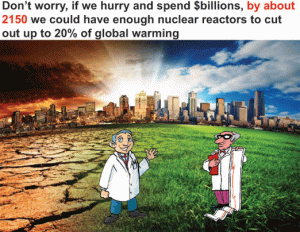
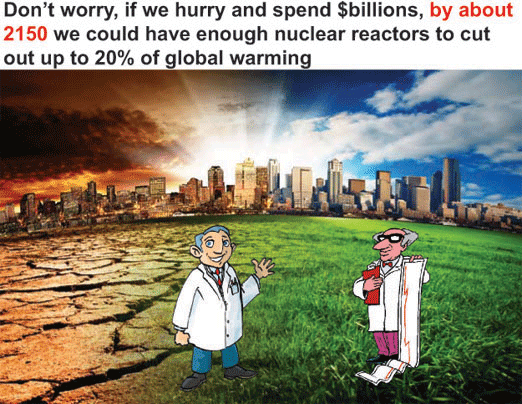
 “……….You might say “well climate change is urgent, so why don’t we do nuclear as well as all the other
stuff”. But there is a limited supply of funds and the way the Government has organised thesubsidy schemes at the moment it looks as though nuclear will use up all of those funds.
The Treasury’s so-called Levy Control Framework limits the amount of money which can be
collected from consumers’ bills. This year the pot of money available will be £3.5bn. This will
increase to £6.45bn by 2018/9. But because subsidies to low carbon energy are an ongoing
commitment, £3.55bn of that will go to projects already running and only £2.9bn will be
available to new schemes. The total pot will go up to £7.6bn in 2020/21, an increase of just over
£1bn. We don’t know the exact figure for 2023/24, but we do know that Hinkley will require
around £1bn, so it will probably use up all the money for new projects. (4)
And there isn’t expected to be any more money for new projects until 2027, by which time
Sizewell C could be ready to start gobbling up cash.
Nuclear is too slow
The sooner we make carbon savings the greater the cumulative impact by, say, 2025. Nuclear
takes a long time to build. Hinkley is expected to take about eight years, so there won’t be any
carbon savings until at least 2023. The two other reactors being built in Europe at the moment
are both late – Olkiluoto in Finland is 7 years late and Flamanville in France is 4 years late.
Hinkley might save a million tonnes of carbon per year in eight years time, whereas a re-booted
energy efficiency programme could have already saved 14 million tonnes by then. (5)
Centralised utilities – a dying model
Former Government Chief Scientist, Professor Sir David King who was instrumental in
persuading Tony Blair to ditch the 2003 Energy White Paper and go for new reactors now says
we might be able to do without them if we can develop energy storage. (6)
He’s probably been reading the financial press. The 21st November might go down as the day the
nuclear renaissance finally died in Britain. Look at UK Nuclear News for that day and you will
discover that:
Consumers could be on the hook for £37bn worth of undiscounted subsidies to Hinkley over its
lifetime.
The cost of Hinkley has gone up from £9bn in 2011 to £24.5bn now.
Reactor builder – Areva – which was expected to take a 10% stake in Hinkley is in the midst of a
financial crisis.
December 17, 2014
Posted by Christina Macpherson |
climate change, Reference, UK |
Leave a comment
 Iran’s President Pledges to Face Down Forces Opposing a Nuclear Deal, NYT, By THOMAS ERDBRINK DEC. 15, 2014 TEHRAN — Risking his political standing, Iran’s president stressed on Monday that he was determined to cinch a nuclear deal and prepared to take on the conservative forces who would prefer not to see an agreement with the West, even if that means continued economic sanctions on Iran.

 Iran says nuclear talks with U.S. proceed in good atmosphere DUBAI Tue Dec 16, 2014 (Reuters) – Iran said on Tuesday bilateral nuclear talks with the United states were proceeding in a good atmosphere despite lingering gaps over key issues such as Tehran’s uranium enrichment capacity and how fast economic sanctions should be lifted.
 Renewable energy-powered vehicles can save lives http://economictimes.indiatimes.com/industry/auto/news/auto-technology/renewable-energy-powered-vehicles-can-save-lives/articleshow/45533794.cmsBy IANS | 16 Dec, 2014,NEW YORK: Driving vehicles that use electricity from renewable energy instead of gasoline could reduce the resulting deaths due to air pollution by 70 percent, says a study.
 Hinkley Point C – A Review of the Year, nuClear News Dec 14 “……..Meanwhile a new report from Forum for the Future, Nottingham Trent University and Farmers’ Weekly estimates that UK farms could have a generating capacity of 20GW by 2020 compared with Hinkley’s 3.2GW capacity which won’t be available until 2023 at the very earliest. (30)
 Nuclear damages attempts to tackle climate change nuClear News Dec 14





 nuclear-news