Nuclear too slow to be effective, and will soak up all the UK climate change funds
 Nuclear damages attempts to tackle climate change nuClear News Dec 14
 “……….You might say “well climate change is urgent, so why don’t we do nuclear as well as all the other
stuff”. But there is a limited supply of funds and the way the Government has organised thesubsidy schemes at the moment it looks as though nuclear will use up all of those funds.
The Treasury’s so-called Levy Control Framework limits the amount of money which can be
collected from consumers’ bills. This year the pot of money available will be £3.5bn. This will
increase to £6.45bn by 2018/9. But because subsidies to low carbon energy are an ongoing
commitment, £3.55bn of that will go to projects already running and only £2.9bn will be
available to new schemes. The total pot will go up to £7.6bn in 2020/21, an increase of just over
£1bn. We don’t know the exact figure for 2023/24, but we do know that Hinkley will require
around £1bn, so it will probably use up all the money for new projects. (4)
And there isn’t expected to be any more money for new projects until 2027, by which time
Sizewell C could be ready to start gobbling up cash.
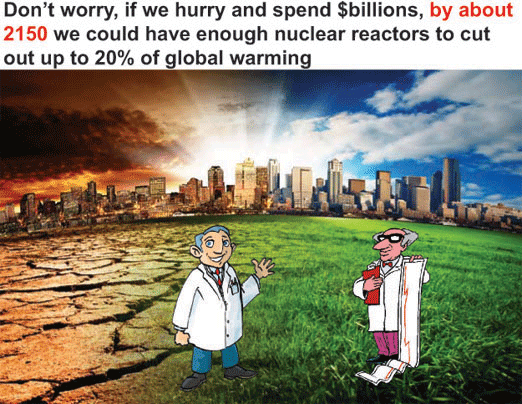
Nuclear is too slow
The sooner we make carbon savings the greater the cumulative impact by, say, 2025. Nuclear
takes a long time to build. Hinkley is expected to take about eight years, so there won’t be any
carbon savings until at least 2023. The two other reactors being built in Europe at the moment
are both late – Olkiluoto in Finland is 7 years late and Flamanville in France is 4 years late.
Hinkley might save a million tonnes of carbon per year in eight years time, whereas a re-booted
energy efficiency programme could have already saved 14 million tonnes by then. (5)
Centralised utilities – a dying model
Former Government Chief Scientist, Professor Sir David King who was instrumental in
persuading Tony Blair to ditch the 2003 Energy White Paper and go for new reactors now says
we might be able to do without them if we can develop energy storage. (6)
He’s probably been reading the financial press. The 21st November might go down as the day the
nuclear renaissance finally died in Britain. Look at UK Nuclear News for that day and you will
discover that:
Consumers could be on the hook for £37bn worth of undiscounted subsidies to Hinkley over its
lifetime.
The cost of Hinkley has gone up from £9bn in 2011 to £24.5bn now.
Reactor builder – Areva – which was expected to take a 10% stake in Hinkley is in the midst of a
financial crisis.
The Treasury is re-examining the Hinkley project.No2Nuclear http://www.no2nuclearpower.org.uk/nuclearnews/NuClearNewsNo69.pdf
No comments yet.
1 This Month



Tell the Ukrainian Government to Drop Prosecution of Peace Activist Yurii Sheliazhenko

Petition to revoke the licensing of the Near Surface Nuclear Disposal Facility (NSDF) at Chalk River. https://www.ourcommons.ca/petitions/en/Petition/Details?Petition=e-7247


of the week – STOP SMALL MODULAR REACTORS IN CANADA
To see nuclear-related stories in greater depth and intensity – go to https://nuclearinformation.wordpress.com
-
Archives
- March 2026 (222)
- February 2026 (268)
- January 2026 (308)
- December 2025 (358)
- November 2025 (359)
- October 2025 (376)
- September 2025 (258)
- August 2025 (319)
- July 2025 (230)
- June 2025 (348)
- May 2025 (261)
- April 2025 (305)
-
Categories
- 1
- 1 NUCLEAR ISSUES
- business and costs
- climate change
- culture and arts
- ENERGY
- environment
- health
- history
- indigenous issues
- Legal
- marketing of nuclear
- media
- opposition to nuclear
- PERSONAL STORIES
- politics
- politics international
- Religion and ethics
- safety
- secrets,lies and civil liberties
- spinbuster
- technology
- Uranium
- wastes
- weapons and war
- Women
- 2 WORLD
- ACTION
- AFRICA
- Atrocities
- AUSTRALIA
- Christina's notes
- Christina's themes
- culture and arts
- Events
- Fuk 2022
- Fuk 2023
- Fukushima 2017
- Fukushima 2018
- fukushima 2019
- Fukushima 2020
- Fukushima 2021
- general
- global warming
- Humour (God we need it)
- Nuclear
- RARE EARTHS
- Reference
- resources – print
- Resources -audiovicual
- Weekly Newsletter
- World
- World Nuclear
- YouTube
-
RSS
Entries RSS
Comments RSS
 nuclear-news
Leave a comment