Nuclear power discourages local business: UK local councils consider renewable energy
Nuclear damages attempts to tackle climate change nuClear News Dec 14
“……….Former Labour MP, Alan Simpson points out that we have forgotten in this country that, until
1947, most local authorities earned 50 per cent of their income from the work of their localised
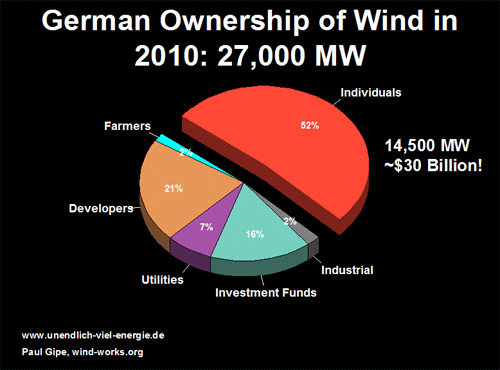
utilities. Germany already has 180 local authorities taking their energy grids back into public
ownership, why can’t we. Already, 50 per cent of Germany’s electricity generating capacity
comes from renewables but only 5 per cent of this generating capacity is owned by the big
utilities. (11)
Recently local authorities across the UK have started to develop an energy policy. A number of
local authorities have been developing what are being called either Local Authority Energy
Service Trusts (LAEST‟s) or Energy Service Companies (ESCO’s). These exciting developments
are a clear sign of interest from Councils in taking a more active role in energy policy, to
alleviate local fuel poverty and promote a low carbon future. Though these policies are at an
early stage at present, such developments are part of a growing move in local government to
develop more comprehensive energy policies. To some extent, they are influenced by the
positive role local government plays in countries like Germany, Denmark and Austria in
developing ambitious local, community owned renewable energy projects. Let us hope we see
more advances in this area in 2015. (12)
Catherine Mitchell, Professor of Energy Policy at Exeter University, and another former member
of the PIU team, says global energy systems are going through a time of rapid technological
change, which has implications for the conventional utility model. This is leading to two types of
countries – those that are enabling, or at least not constraining, the change in energy systems;
and those which, for various reasons, are ignoring or attempting to constrain it. While
constraining change may slow it down, countries cannot stop it completely – and the question is
whether by constraining change in the energy system countries are setting themselves up for a
very disruptive time at some point in the future with a wider loss of innovation within their
economies, as opposed to a more managed transformation. Whatever, happens 2015 will see
the battle between the old and the new entered in earnest http://www.no2nuclearpower.org.uk/nuclearnews/NuClearNewsNo69.pdf
No comments yet.
1 This Month



Tell the Ukrainian Government to Drop Prosecution of Peace Activist Yurii Sheliazhenko

Petition to revoke the licensing of the Near Surface Nuclear Disposal Facility (NSDF) at Chalk River. https://www.ourcommons.ca/petitions/en/Petition/Details?Petition=e-7247


of the week – STOP SMALL MODULAR REACTORS IN CANADA
To see nuclear-related stories in greater depth and intensity – go to https://nuclearinformation.wordpress.com
-
Archives
- March 2026 (222)
- February 2026 (268)
- January 2026 (308)
- December 2025 (358)
- November 2025 (359)
- October 2025 (376)
- September 2025 (258)
- August 2025 (319)
- July 2025 (230)
- June 2025 (348)
- May 2025 (261)
- April 2025 (305)
-
Categories
- 1
- 1 NUCLEAR ISSUES
- business and costs
- climate change
- culture and arts
- ENERGY
- environment
- health
- history
- indigenous issues
- Legal
- marketing of nuclear
- media
- opposition to nuclear
- PERSONAL STORIES
- politics
- politics international
- Religion and ethics
- safety
- secrets,lies and civil liberties
- spinbuster
- technology
- Uranium
- wastes
- weapons and war
- Women
- 2 WORLD
- ACTION
- AFRICA
- Atrocities
- AUSTRALIA
- Christina's notes
- Christina's themes
- culture and arts
- Events
- Fuk 2022
- Fuk 2023
- Fukushima 2017
- Fukushima 2018
- fukushima 2019
- Fukushima 2020
- Fukushima 2021
- general
- global warming
- Humour (God we need it)
- Nuclear
- RARE EARTHS
- Reference
- resources – print
- Resources -audiovicual
- Weekly Newsletter
- World
- World Nuclear
- YouTube
-
RSS
Entries RSS
Comments RSS
 nuclear-news
Leave a comment