Japan’s Fukushima Plant Cleanup Workers -their harsh and dangerous life
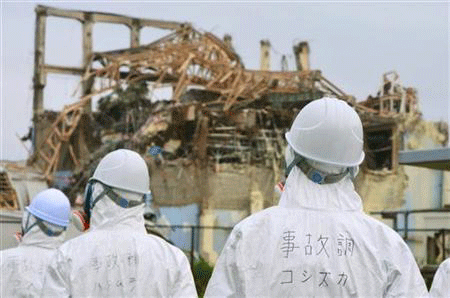 Japanese Nation Forgetting Fukushima Plant Cleanup Workers http://sputniknews.com/asia/20141210/1015704138.html As snap elections are nearing, the Fukushima Nuclear power plant workers are urging people to understand the harsh circumstances they work under, risking their life by exposing themselves to radiation every single day. MOSCOW, December 10 (Sputnik) – As elections are nearing in Japan, many of the people working toward the decommissioning of the crippled Fukushima No. 1 nuclear plant say they want voters to know about their harsh working conditions, insufficient pay and worries of radiation exposure, reports The Japan Times.
There are around 6,000 people a day working in the decommissioning process at the plant and it is expected to take 30 to 40 years to complete.
“I’m single, so I can somehow manage with the pay if I don’t go out to amuse myself, but I don’t think you can make a living if you have a family,” said a man in his fifties who has worked in the plant for three years. He has been eradicating debris and setting up tanks to store radioactive water, and is now in charge of removing contaminated water from the reactor building basements. He works for a third-tier subcontractor and makes a monthly salary of less than ¥200,000 ($1650 USD).
As The Japan Times reports, due to high radiation exposure, workers must wear heavy protective clothing and a mask that covers the whole face. It is difficult for them to work more than an hour and a half at a time. The workers start at around 5 a.m. because of the time it takes to get to the plant which is about 40 kilometers away, pass entrance checks and change clothing.
According to one worker his most recent monthly radiation dosage was 1.8 millisieverts. The law states that a nuclear worker’s radiation dosage should not exceed 100 millisieverts in five years and 50 millisieverts in a year. Since the reference mark in the plant is 20 millisieverts a year, the man’s dosage is nearing its limit.
“I feel that people are gradually forgetting about the nuclear accident,” he said. “From now, our work will become even harsher because we will have to go inside the reactor buildings, where the radiation level is even higher. I want people to recognize that there are such workplaces,” he told The Japan Times.
No comments yet.
1 This Month



Tell the Ukrainian Government to Drop Prosecution of Peace Activist Yurii Sheliazhenko

Petition to revoke the licensing of the Near Surface Nuclear Disposal Facility (NSDF) at Chalk River. https://www.ourcommons.ca/petitions/en/Petition/Details?Petition=e-7247


of the week – STOP SMALL MODULAR REACTORS IN CANADA
To see nuclear-related stories in greater depth and intensity – go to https://nuclearinformation.wordpress.com
-
Archives
- March 2026 (212)
- February 2026 (268)
- January 2026 (308)
- December 2025 (358)
- November 2025 (359)
- October 2025 (376)
- September 2025 (258)
- August 2025 (319)
- July 2025 (230)
- June 2025 (348)
- May 2025 (261)
- April 2025 (305)
-
Categories
- 1
- 1 NUCLEAR ISSUES
- business and costs
- climate change
- culture and arts
- ENERGY
- environment
- health
- history
- indigenous issues
- Legal
- marketing of nuclear
- media
- opposition to nuclear
- PERSONAL STORIES
- politics
- politics international
- Religion and ethics
- safety
- secrets,lies and civil liberties
- spinbuster
- technology
- Uranium
- wastes
- weapons and war
- Women
- 2 WORLD
- ACTION
- AFRICA
- Atrocities
- AUSTRALIA
- Christina's notes
- Christina's themes
- culture and arts
- Events
- Fuk 2022
- Fuk 2023
- Fukushima 2017
- Fukushima 2018
- fukushima 2019
- Fukushima 2020
- Fukushima 2021
- general
- global warming
- Humour (God we need it)
- Nuclear
- RARE EARTHS
- Reference
- resources – print
- Resources -audiovicual
- Weekly Newsletter
- World
- World Nuclear
- YouTube
-
RSS
Entries RSS
Comments RSS
 nuclear-news
Leave a comment