Renewed rush for nuclear weaponry
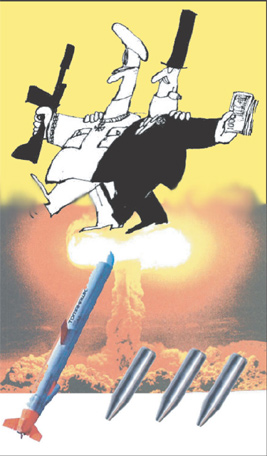 New nuclear arms race underway, World Socialist Website, By Mark Blackwood and Paul Mitchell 6 December 2014 Nearly five years ago, at the 2010 Nuclear Non-proliferation Treaty Review Conference, the nuclear powers restated their commitment to a “diminishing role for nuclear weapons in security policies to minimize the risk that these weapons ever be used and to facilitate the process of their total elimination.”
US President Barack Obama and then-Russian President Dmitry Medvedev signed the New START treaty, promising to reduce their stockpiles of nuclear missiles and launchers.
However, this year’s right-wing coup in Ukraine, organised by the US and European Union, followed by a campaign of sanctions and war threats against Russia, combined with the Obama administration’s “pivot to Asia” aimed at asserting US control over the Asia-Pacific, are provoking a new nuclear arms race.
According to Hugh Chalmers, an analyst at the London-based Royal United Services Institute, “All nuclear states are undergoing some form of nuclear modernization at the moment, or will very soon be going through that process… You can look around the world and see new missiles being developed, new submarines, new cruise missiles…”
Shortly before he was fired last week, US Defense Secretary Chuck Hagel used two separate Pentagon studies, arising out of the drugs and academic cheating scandal at nuclear bases, to authorise the US Department of Defense to request a further 10 percent increase in funding to upgrade its nuclear infrastructure every year for the next five years.
The nuclear arm of the military will be given a higher profile, with the commander of the US Air Force Global Strike Command promoted from a three-star to a four-star general, and the head of the service’s nuclear integration elevated from two-star to three-star rank………
Any belief that a nuclear war is impossible because modern governments would not risk catastrophe is disproved by the rapid modernisation of nuclear weapons and their delivery systems. Beset by mounting economic and social problems for which they have no progressive solution, the ruling elites are increasingly inclined to see war as a risk worth taking.https://www.wsws.org/en/articles/2014/12/06/nucl-d06.html
VOX charts the rise and fall of nuclear power
 The rise and fall of nuclear power, in 6 charts, Vox Brad Plumer on August 1, 2014, @bradplumer brad@vox.com Nuclear power is slowly going out of style. Back in 1996, atomic energy supplied 17.6 percent of the world’s electricity. Today that’s down to just 10.8 percent — and it could drop even further in the years ahead.
MANY REACTORS ARE CLOSING — AND NEW REACTORS HAVE BEEN BOGGED DOWN BY DELAYSThat’s according to the World Nuclear Industry Status Report 2014, which charts the rise and fall of nuclear power over time.
The upshot is that significantly fewer nuclear reactors are in operation today than was the case in 2010 — in large part due to the shutdown of 48 reactors in Japan after the Fukushima disaster. On the flip side, only China currently has plans to massively ramp up reactor construction. And new reactors in many countries, from Finland to Vietnam, are falling victim to delays and cost overruns.
That’s not encouraging news for efforts to tackle global warming. The proportion of energy that the world gets from carbon-free sources has stagnated since 1999 — in part because of the nuclear industry’s struggles. And the Intergovernmental Panel on Climate Change has warned that reducing emissions will be significantly more expensive if nuclear power’s not available.
Here are six key charts from the report:
1) Nuclear energy production has been falling since 2006……..
2) There are 388 nuclear reactors in operation — down from 438 a decade ago…….
4) There were 67 reactors “under construction” in 2014 — but delays are a problem……..
All told, the report notes that 49 of those reactors under construction have met with significant delays, ranging from several months to several years. Nuclear reactors are expensive and take a long time to build. They can face all sorts of obstacles in the meantime — from cost overruns to complex licensing processes to regulatory hurdles to popular opposition (the latter recently blocked construction of two reactors in Taiwan).
“Past experience shows that simply having an order for a reactor, or even having a nuclear plant at an advanced stage of construction, is no guarantee for grid connection and power production,” the report notes.
5) Just 14 countries have plans to build new nuclear reactors……..
6) Without further action, nuclear power could vanish in 50 years……..
In 1920s fruit fly experiments showed the insidious harm done by ionising radiation
 Miningawareness, 8 Dec 14 The fruit fly experiments showed that it was dangerous in the 1920s! They were damning enough. It showed that it took multiple generations for the genetic damage to show up, because it was often recessive! But, they knew it was dangerous for people from the advent of x-rays and radium a couple of decades prior. They did human nuclear experiments too. In the 1950s or 60s scientists started worrying about what if radiation impacted intelligence more than fertility so that there was a prolific, dumb population. Is this why no one wonders this anymore? They also worried about radiation damaged DNA of nuclear workers merging into the general population. Why do few wonder anything intelligent anymore? Corrupt academia or damaged DNA, damaged intelligence? Ravens have more sense than the pro-nuclear lobby. Ravens look before they cross the road.
The Professor of Dodgy Pro Nuclear Arguments – Wade Allison
 Oxford Professor in Japan: Well so what if Fukushima had triple meltdown? People enjoy effects of radioactive contamination; Sunshine is much more dangerous; Effect of radiation same as oxygen — Former WHO Official: “The man is dangerous… He’s a crank” (VIDEOS)
Wade Allison, Emeritus Professor of Physics at Oxford University, Foreign Correspondents Club of Japan, Dec 3, 2014 (emphasis added):
- 7:30 — Nuclear protestors have no good arguments for saying that nuclear is dangerous, this is demonstrated by what happened at Fukushima.
- 19:30 – The scientific question is, ‘Why is radiation so safe?‘ Because it is very powerful and so that’s very surprising… That’s the job biology does… Any life form that did not look after the effects of radiation and oxygen, which does the same kind of thing, would fail.
- 27:30 — On holiday… we should take [children] around a nuclear power station.
- 31:00 — What can we do to explain… to people and shove under their noses?
- 39:15 – That excellent film Pandora’s Promise, anybody who hasn’t seen that should.
- 45:00 — [Bury the used nuclear fuel] anywhere, anywhere… Fission products [have a] half-life is 30 years or so… it quickly becomes the same activity as the stuff that you dig out of the ground. You need a mine or a hole in the ground which is going to contain stuff for 500 years — but it doesn’t have to be perfect. Here in Japan, people go to Onsen, and enjoy the effects of radioactive contamination of groundwater…everybody’s very happy to do that. That’s what they do on holiday.
- 47:30 — Triple meltdown? Where did you get those words from? Hollywood? What do you mean by a triple meltdown? So what? I’m telling you — so nothing, very much…Triple meltdown, well so what?… It wasn’t a tragedy.
- 52:45 — The sunshine… that’s much more dangerous… than nuclear radiation.
- 1:01:45 — We need people’s confidence. We need to talk to children in school.
- 1:04:45 — The idea that special precautions have to be taken just doesn’t wash,nuclear is not especially dangerous. It’s not as dangerous as fire.
Allison at the Institute of Physics: New safety levels for human radiation exposure are suggested… 100 mSv in total in any month; 5,000 mSv as a total of whole-of-life exposure.
Keith Baverstock, head of the World Health Organization’s Radiation Protection Program for Europe (1991-2003), Foreign Correspondents Club of Japan, Nov 20, 2014:
- 20:00 — Question: My name is Hiroyuki Fujita, [inaudible] Shimbun editor/writer… According to [Dr. Wade Allison], so called low dose radiation, 100 mSv or less, not so bad for human health… all the scientific knowledge is rooted on the experience of the fruit fly.
- 21:00 – Wade Allison, do you know what his scientific expertise is? Physics… not public health, not medicine, not biology… I did a review of [his] book… I said his book is highly entertaining… it is fiction… We don’t have to rely on fruit flies to know what the effects of radiation are. We know what they are on human health. We have a lot of epidemiological information — which he ignores. I think the man is dangerous, I think you are putting yourself in a dangerous position if you believe him… He’s a crank.
Watch Allison’s FCCJ presentation here | Watch Baverstock’s FCCJ presentation here
Ontario’s Bruce Power Nuclear Deal under scrutiny – needs full public review
 9 good reasons why we need a public review of a Bruce Nuclear deal
The Ontario Power Authority and Bruce Power are secretly negotiating a multi-billion dollar deal to rebuild four aging reactors at the Bruce B Nuclear Station. Here are 9 good reasons why Premier Kathleen Wynne should send any agreement to the Ontario Energy Board (OEB) for a full public review:
1. |
The Bruce B contract would be the largest private sector contract ever signed by an Ontario government, worth $60-$111 billion that householders and businesses would pay. Is Bruce B the cheapest available power? |
2. |
Electricity demand in Ontario is falling. Since 2005 Ontario’s total annual electricity demand has fallen by 10%, despite the fact that our GDP has grown by 8.5%, and it appears likely that our electricity demand will continue to fall as our electricity productivity continues to rise. Will we need Bruce B power? |
3. |
Ontario has a rising supply of renewable and gas-fired generation, including the TransCanada gas-fired power plant in Napanee. Will Bruce B power be needed? |
4. |
Ontario already has a surplus baseload problem. Bruce Power claims its nuclear units are now capable of cutting back generation when demand falls. But in reality the company is running its reactors full tilt, either venting the excess steam into Lake Huron or producing unneeded power and exporting it to the US at a loss. Will a Bruce B deal make these problems worse? |
5. |
The cost overruns on nuclear projects have always been passed on to electricity consumers and taxpayers. Despite government assurances that nuclear projects must minimize “commercial risk on the part of ratepayers and government”, 93% of the work on the proposed Darlington re-build project is not subject to fixed price contracts, with the provincial treasury and ratepayers liable for inevitable cost overruns. Will it be any different at Bruce where ratepayers have already picked up billions of dollars in cost overruns on previous projects? |
6. |
We can meet some or all of our electricity needs at a lower cost with additional investments in energy conservation and efficiency. According to the government’s Conservation First policy, Ontario will pursue all cost-effective energy conservation and efficiency resources beforeinvesting in new supply. |
7. |
We can meet our electricity needs at a lower cost with water power imports from Quebec. The cost of upgrading transmission infrastructure to fully exploit Quebec imports would be a fraction of the cost of re-building nuclear reactors. |
8. |
According to the Long-Term Energy Plan, the existing Bruce B reactors will not come to the end of their lives until 2022 and beyond. There is a very good chance that renewable energy options like wind, solar, biogas and biomass will be lower cost electricity supply options by 2022. Quebec’s existing hydro-electric storage capacity could also be used to transform wind and solar from intermittent to “firm” base-load electricity resources. Is this the right time to commit to Bruce B power? |
9. |
We don’t know by how much a Bruce B contract would cause our electricity rates to rise. Surely we should know this before a deal is signed. |
 Please send Premier Wynne a message urging her to follow through on her commitment to run “the most open and transparent government in Canada” by sending any Bruce deal to the OEB for review.
These are important questions that the Ontario Energy Board’s procedures are designed to answer — before any contract is signed.
You can also read our open letter to Premier Wynne outlining our questions about a Bruce deal.
Disturbing information about Rosatom’s nuclear reactors – a warning to Finland

 Writer warns MPs about nuclear contractor Rosatom, YLE UUTISET, 5 DEc 14, Finnish author Risto Isomäki issued a warning letter about the Russian nuclear contractor Rosatom to MPs as they prepared to vote on granting a new permit for a nuclear power project in the country’s northwest. The missive paints a disturbing picture about a nuclear plant constructed by Rosatom in India. Environmentalist and science fiction writer Risto Isomäki’s letter to MPs centres on Rosatom’s turnkey nuclear power plant project in India and has been reproduced in the Social Democratic Party organ, Demari, as well as in social media.
According to Isomäki the first reactor of a nuclear power facility constructed by Rosatom in Kudankulam in India has suffered 14 spontaneous power outages in the year since it has been completed. It has also been taken offline five times for repair and maintenance work in the same one-year period, he writes. The author claimed that according to his information the reactor has now been shut down because it has not passed final commissioning tests.
One of the recipients of the letter was National Coalition Party MP, Harri Jaskari, who also sits on the Parliament’s Finance Committee. Jaskari said that the claims made by Isomäki about the Indian facility were not previously known to committee members……..http://yle.fi/uutiset/writer_warns_mps_about_nuclear_contractor_rosatom/7673069
Green energy now big business in Canada, bigger employer than tar sands is

 Canada’s Green Energy Sector Now Employs More People Than Its Tar Sands, Climate Progress BY JEFF SPROSS DECEMBER 2, 2014 BETWEEN 2009 AND 2013, EMPLOYMENT IN CANADA’S CLEAN ENERGY SECTOR INCREASED BY 37 PERCENT — MEANING IT NOW SUPPLIES MORE JOBS THAN THE COUNTRY’S INFAMOUS TAR SANDS, ACCORDING TO A NEW REPORT.
“Clean energy has moved from being a small niche or boutique industry to really big business in Canada,” said Merran Smith, the director of Clean Energy Canada.
Green energy tends to be more labor intensive than energy from fossil fuels, meaning that every unit of energy produced by green sources tends to employ more people than those sources that come along with carbon emissions. In America, research suggests green jobs are more accessible to workers without a college education, that green sectors grow a bit faster than the economy as a whole, and that they more successfully weathered the 2008 recession.
The report also noted that Canada’s energy generation capacity in wind, solar, and other renewable sources has grown 93 percent over the past five years, and investors have pumped $25 billion into green energy in the country over that same time period………..http://thinkprogress.org/climate/2014/12/02/3598312/canada-green-energy-tar-sands/
1 This Month


Tell the Ukrainian Government to Drop Prosecution of Peace Activist Yurii Sheliazhenko

Petition to revoke the licensing of the Near Surface Nuclear Disposal Facility (NSDF) at Chalk River. https://www.ourcommons.ca/petitions/en/Petition/Details?Petition=e-7247


of the week – STOP SMALL MODULAR REACTORS IN CANADA
To see nuclear-related stories in greater depth and intensity – go to https://nuclearinformation.wordpress.com
-
Archives
- March 2026 (204)
- February 2026 (268)
- January 2026 (308)
- December 2025 (358)
- November 2025 (359)
- October 2025 (376)
- September 2025 (258)
- August 2025 (319)
- July 2025 (230)
- June 2025 (348)
- May 2025 (261)
- April 2025 (305)
-
Categories
- 1
- 1 NUCLEAR ISSUES
- business and costs
- climate change
- culture and arts
- ENERGY
- environment
- health
- history
- indigenous issues
- Legal
- marketing of nuclear
- media
- opposition to nuclear
- PERSONAL STORIES
- politics
- politics international
- Religion and ethics
- safety
- secrets,lies and civil liberties
- spinbuster
- technology
- Uranium
- wastes
- weapons and war
- Women
- 2 WORLD
- ACTION
- AFRICA
- Atrocities
- AUSTRALIA
- Christina's notes
- Christina's themes
- culture and arts
- Events
- Fuk 2022
- Fuk 2023
- Fukushima 2017
- Fukushima 2018
- fukushima 2019
- Fukushima 2020
- Fukushima 2021
- general
- global warming
- Humour (God we need it)
- Nuclear
- RARE EARTHS
- Reference
- resources – print
- Resources -audiovicual
- Weekly Newsletter
- World
- World Nuclear
- YouTube
-
RSS
Entries RSS
Comments RSS
 nuclear-news