Nuclear energy is definitively not the solution to climate change
 The narrative of nuclear being good, carbon-free and safe needs to be countered, or nuclear plants could start proliferating.
Nuclear energy is definitively not the solution
Phase out Fossils. Phase in Nuclear? http://adoptanegotiator.org/phase-out-fossils-phase-in-nuclear/Anna Pérez Català December 3, 2014
Second day of the COP20, and the plenary is full of delegates discussing the Ad Hoc Working Group on the Durban Platform for Enhanced Action (ADP). The atmosphere is really hot, like if we could feel the 2 degrees temperature rise due to climate change, and delegates are discussing the beginning of the draft and how it would look in a screen.
The ADP document is very important, because it aims to define the new climate agreement in 2015 and foster greenhouse gas reduction. This fits into climate science and its latest outputs: during this last year, IPCC asked for a phase out on greenhouse gas emissions by end century, and UNEP for 2070. This would make accomplish Article 2 of the convention, and ‘prevent dangerous anthropogenic interference with the climate system’. But how this will be done has yet to be decided in the two coming long weeks.
The ADP draft text mentions the strong necessity of reaching carbon neutrality.
Phase in and phase out – what does the COP say? Article 3 suggests a ‘40–70 per cent reduction in global greenhouse gas emissions below 2010 levels by 2050 and near zero emissions of CO2 and other long-lived greenhouse gases by the end of the century’.
A part from that, there are parties that are thinking about their individual contribution to a carbon-free world. Some countries like Ethiopia, Finland, Switzerland, Costa Rica, Norway, France and Georgia, committed to carbon neutrality. In fact, Costa Rica recently made reference to a possible goal of zero emissions by 2050. Initiatives from cities, communities and individuals can also be found all over the world, trying to contribute to this urgent necessity of making greenhouse gas emissions disappear.
The phase out target is great, but negotiators of the ADP text should consider including something even more relevant: a phase in target: a serious promotion of renewable energies and a cut on fossil fuel investments.
Worryingly, there are country pledges that consider nuclear as a nice way of creating a transition from fossil to renewable energies, or just a way of diversifying their energy mix and having more energy security. The narrative of nuclear being good, carbon-free and safe needs to be countered, or nuclear plants could start proliferating.
Nuclear energy is definitively not the solution
Nuclear power is increasingly appearing in conversations related to climate change. For instance, the last big US-China agreement includes nuclear and green caoal as low carbon sources that China will promote. Furthermore, Julie Bishop Australia’s prime minister said that nuclear power could boost Australian economy, and is re-opening the nuclear debate in the country, due to its uranium potential. And the European Union is not better than that, with France having 58 nuclear plants which produce 73% of its electricity, followed by Belgium (52%), Slovakia (51%) and Hungary (50%). Greenpeace recently published a list of the most dangerous nuclear plants in Europe due to its age, especially pointing Spain that has extended the life of some of them. Sadly, this week begins the trial of 17 activist of this same organisation that were protesting against nuclear power in Spain, and now are facing jail.
Nuclear energy is not only dangerous, it is also unjust and polluting. There are reports that demonstrate that, with high quality ores, the CO2 produced by the full nuclear life cycle is about one half to one third of an equivalent sized gas-fired power station. Therefore, nuclear energy does contribute to climate change by producing greenhouse gas emissions. Furthermore, nuclear energy perpetuates a very polluting and unjust mining industry. Numerous reports of international organisations denounce the impacts of uranium mining on the environment (air, soil, water) and the effects that can have on people’s health. Apparently we are not listening to that, and just recently China made some moves on buying part of uranium mines, such as Langer Heirich in the Namib desert.
Maybe there is still hope, and renewable energies will boom these coming years. We have seen great signals from Germany, which just announced that wants to cut emissions by 40% by 2020, a much ambitious goal than the UE package proposed. Furthermore, Spain had 43% of energy generation based on renewable energy this November, despite this obsession that they seem to have cutting finance to renewable energies and promoting energy industries based on nuclear.
But hoping is not enough, negotiators need to promote a phase-in discourse in the ADP text, so we ensure that we are building a future that is powered by renewable energies.
U.S. should shrink nuclear arsenal says Senator
Sen. Dianne Feinstein: Generals agree: U.S. should shrink nuclear arsenal DIANNE FEINSTEIN | U.S. senator, D- Calif. 4 Dec 14 During the Cold War, the United States and the Soviet Union were mired in an arms race. The antagonism led each side to stockpile more than 30,000 nuclear weapons to prevent the other from gaining an advantage.
Today, however, nuclear weapons are seen as a financial burden and a threat to global security. Furthermore, our nuclear stockpile is competing for limited defense spending, money that could be used to address more pressing challenges such as the fight against the Islamic State and defending against cyberattacks.
That’s why the amount the United States spends to maintain and modernize its nuclear arsenal is so staggering. Over the next decade, the Congressional Budget Office reports that the United States will spend $355 billion on nuclear weapons.
We’re holding far more nuclear weapons than are necessary, and the cost is undermining other national security priorities. It’s time we take a long look at how we can responsibly reduce our stockpile.
The United States currently maintains 4,804 nuclear weapons. If you include retired weapons that are awaiting dismantlement and the thousands of components in storage, the United States has the equivalent of around 10,000 weapons. When you consider that the weapons we maintain today are up to 100 times more destructive than the ones used in Hiroshima and Nagasaki, it becomes clear that the only value they offer is in deterring a nuclear attack.
Meanwhile, efforts to reduce the stockpile are faltering……………..http://host.madison.com/ct/news/opinion/column/sen-dianne-feinstein-generals-agree-u-s-should-shrink-nuclear/article_82872707-8514-5e1b-8e18-14ebc43ef9b9.html
Ukraine government had to admit to nuclear accident at Zaporizhzhya power plant
Nuclear Accident In Ukraine: Largest Nuke Plant In Europe Shut Down, But ‘No Threat,’ Gov’t Claims, INQUISITR, 3 Dec 14 A nuclear accident at a power plant in Ukraine, the largest nuclear power plant in Europe, shut the plant down last Friday, but the Ukraine government did not reveal the alarming mishap until Wednesday, claiming that the accident posed “no threat” to the public from radiation.

The nuclear plant is located just 120 miles from the war-torn eastern Ukraine region of Donetsk, a stronghold of pro-Russian separatist rebels who have battled the Ukraine government in heavy fighting for much of 2014.
Donetsk is the region where on July 17, Malaysia Airlines Flight MH17 was shot down by, it is widely believed, a rebel anti-aircraft missile, killing all 298 people on board.
Nuclear experts have raised the alarm that the power plant could be vulnerable to artillery fire from the war zone nearby………http://www.inquisitr.com/1652271/nuclear-accident-in-ukraine/
Japan’s political gamble; they cannot be sure that nuclear restart will be safe

 Japan’s nuclear dilemma 03 December 2014 by Robert J. Geller Some Japanese nuclear reactors, mothballed since the 2011 Tohoku quake, may soon restart. But nature can outpace new safety precautions, warns a geophysicist “………The Sendai plant faces some specific risks. The site is about 50 kilometres from a large active volcano, Sakurajima, and there are several other active volcanoes on Kyushu. A large eruption would pose obvious safety issues for the plant, but its operator has said that advance warnings of an impending eruption would allow them to take appropriate measures. Doubts about this sanguine view were reinforced by the eruption of Mount Ontake on Honshu, without warning, in September. It killed more than 50 climbers out for a weekend stroll.
A variety of natural hazards, including earthquakes and subsequent tsunamis, pose risks to reactors throughout Japan. I have written extensively about the lack of success of both short and long-term earthquake prediction (Nature, vol 472, p 407). It is well known that accurate predictions of fracture and failure phenomena such as earthquakes are, in general, impossible. Intellectually honest discussions of nuclear safety with regard to earthquakes must start by acknowledging this.
Before Tohoku, the Japanese government’s seismic hazard map assumed that earthquakes off that coast would not exceed magnitude 7.5 to 8.0. The most authoritative estimate for the size of the Tohoku quake is magnitude 9.1. Given that the energy released by an earthquake increases 30-fold for every 1.0 increase in magnitude, this is a huge discrepancy………
- And although advice from specialists is necessary, it is Japan’s political leaders, as well as the voters who elect them, who must take ultimate responsibility for the decision to restart its nuclear plants.Robert J. Geller is professor of geophysics at the University of Tokyo http://www.newscientist.com/article/mg22429972.800-total-safety-an-illusion-for-japans-nuclear-restart.html#.VIJRwNLF8nn
Scotland could use planning powers to reject new nuclear build
George Osborne’s latest nuclear deal is another step in the wrong direction The Conversation, Peter Strachan Strategy and Policy Group Lead and Professor of Energy Policy, Department of Management at Robert Gordon University Alex Russell Head of Department of Management and Professor of Petroleum Accounting at Aberdeen Business School at Robert Gordon University 5 Dec 14
The EU challenge
Westminster’s claim that Hinkley Point C would cost £16 billion has been countered by experts at the EU who have placed the cost at nearer £25 billion (and note the original estimate was £10 billion). The deal involves paying twice the current price for electricity, with UK taxpayers and electricity consumers locked into a binding contract for an extraordinary 35 years.
The European Commission raised concerns that Westminster had breached state aid rules in the subsidies being offered to finance the project. Energy secretary Ed Davey’s huge sigh of relief in October, when the EC controversially gave the green light for the project, may be premature: it will be challenged by the Austrian government in the EU courts.
Money pits
Even if these obstacles can be surmounted, the financial risks to these kinds of projects are simply huge……….
Whose projects should they be anyway?
Another issue is who should provide these projects. With Areva and EDF both under French state control, critics have said that the project amounts to the UK treasury writing a “blank cheque” to the French government. The same could be said of China General Nuclear Corporation and China National Nuclear Corporation, who came onboard last year.
EDF is also reputedly planning to hand over an additional and significant financial stake in Hinkley Point to other foreign corporations. Saudi Electric is reportedly in talks, while the Qataris have confirmed an interest too. British involvement in the project has been non-existent since the UK’s Centrica left a cavernous hole in the project by ceasing involvement in early 2013. Should de facto control of such an important element of our national electricity security be placed in the hands of foreign corporations?
Taken together, these sets of very deep concerns mean that nuclear can only be an option of last resort. To the astonishment of many, the Telegraph recently reported that the former UK chief scientist and nuclear “salesman”, has arrived at the same conclusion.
Given this analysis, the Scottish government would appear more than justified in using its extensive planning powers to reject new nuclear build. In light this and the fragility of future fracking prospects, Westminster would be wise to rethink its national energy policy and give more and not less support to onshore and offshore wind and other marine renewables. https://theconversation.com/george-osbornes-latest-nuclear-deal-is-another-step-in-the-wrong-direction-35054
“Stop uranium mining, transportation, enrichment and nuclear fuel production”
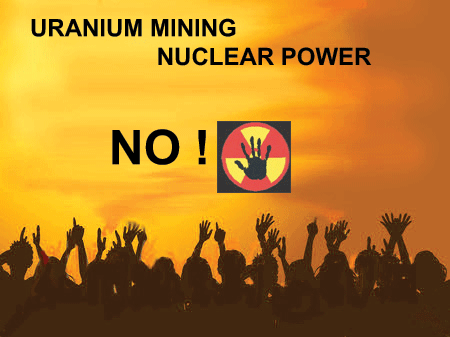 “Stop uranium mining, transportation, enrichment and nuclear fuel production”, Indymedia Submitted by Anonymous (not verified) on Thu, 04/12/2014 Münster, Germany, 30 November 2014 – – At a two-day meeting here around 50 anti-nuclear activists from Russia, France, The Netherlands and from across Germany demanded an immediate end to the countless transports of uranium which ensure nuclear operations in Europe and elsewhere round the world.
They also demanded an end to uranium mining and processing everywhere. They demanded that the German government close down uranium enrichment in Gronau and production of nuclear fuel in Lingen.
Both factories are not included in the shutdown of nuclear power production planned for Germany and supply power stations around the world.
The conference participants intensively discussed the considerable dangers created by the mostly secret uranium transports.
They tracked them from mining in Kazakhstan and Uzbekistan through Russia across the Baltic Sea through the Kiel Canal to the central uranium transportation hub in the port of Hamburg.
From there the uranium concentrate rolls by train through Lower Saxony, Bremen, North-Rhine Westphalia and the Mosel/Saar region for processing in Narbonne-Malvési and Pierrelatte in southern France.
As uranium hexafluoride it then moves back to Germany for enrichment in Gronau or not far into The Netherlands at the same kind of plant at Almelo.
The next step is the Areva fuel production in Lingen, before the final products often move again through Hamburg or also Rotterdem to all over the world.
The conference condemned as unacceptable that in many ways France, Germany, Russia and The Netherlands continue to enable a future for the nuclear industry.
The activists also demand determined action from the German state governments to stop the growing number of uranium transports which endanger countless people……………
The conference ended on 30 November with protests outside the Gronau and Lingen plants.
In Lingen a woman representing the French anti-nuclear umbrella organisation, Réseau “Sortir du nucléaire” called for immediate closure of the Areva fuel factory. Areva is a globally operating French corporation.
Areva currently has big financial problems and the Lingen operations had to be downsized some weeks ago because of serious technical problems.
The activists announced more joint protects against uranium transportation and the uranium industry as a whole.
More information in German at www.urantransport.de, www.sofa-ms.de, www.robinwood.de, www.wise-uranium.org,www.umweltfairaendern.de
Pictures of the conference at
http://www.anti-atom-aktuell.de/fotos/20141129-internationales-urantrans… https://indymedia.org.au/2014/12/04/stop-uranium-mining-transportation-enrichment-and-nuclear-fuel-production
Britain’s aging nuclear reactors getting near to closing time
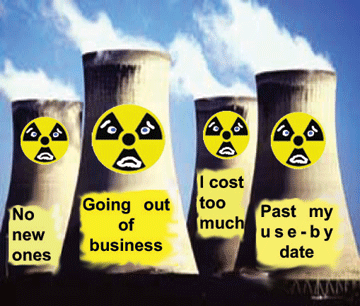
 The coming nuclear crisis: All but one of Britain’s ageing reactors ‘will need to close in 15 years’ , The Independent, 5 Dec 14 All but one of Britain’s ageing fleet of nuclear reactors will have to be closed down within 15 years due to concerns over their economic viability or safety, a panel of experts has warned…….. Professor Williams warned that there will be a point when either it will be uneconomic to continue operating a given nuclear reactor, due to the additional maintenance work needed, or if it becomes too unsafe……http://www.independent.co.uk/news/uk/politics/the-coming-nuclear-crisis-all-but-one-of-britains-ageing-reactors-will-need-to-close-in-15-years-9896597.html
NO to uranium mining. Quebec’s Nunavik Inuit stand firm
Makivik President Jobie Tukkiapik says the consensus is clear: Nunavik Inuit fears for radioactive contamination of the land trump any economic windfall they might reap from uranium mining.
“Uranium is a controversial topic, and must be considered separately from conventional mining activities exploiting other minerals in Nunavik,” Tukkiapik says.
Makivik Corporation, the land claims organization, teamed up with the Kativik Regional Government in stating their case to Quebec’s environmental consultation office.
The land claims organization made the announcement following three years of consultations throughout Nunavik’s 14 communities. They also did consultations in Montreal and some neighbouring Cree villages. KRG chair Maggie Emudluk says the key concern is the health of country food.
Inuit rely on hunting wildlife for sustenance, and Emudluk says the impact of radioactive material getting into the food chain could be deadly.
“The psychological effects cannot be underestimated,” she says. “People are afraid of uranium in general, but when a population is so dependent on locally sourced food, the fear and uncertainty escalate.”
It remains to be seen whether the declaration is legally enforceable under Quebec law
Ineffective parts in 14 South Korean nuclear reactors
|
’14 reactors have ineffective parts’ http://www.koreatimes.co.kr/www/news/nation/2014/12/116_169248.html
|
Dirty tricks involved in Eon’s move to renewable energy

 The filthy tricks behind splitting German nuclear power producer https://indymedia.org.au/2014/12/04/stop-uranium-mining-transportation-enrichment-and-nuclear-fuel-production Submitted by Anonymous (not verified) on Fri, 05/12/2014 The filthy tricks behind splitting German nuclear power producerBy Jochen Stay
Jochen Stay, born 1965, has been active in non-parliamentary movements since he turned 15. Since 1985 public protests stopped a nuclear fuel processing plant being built in Wackersdorf, Bavaria, he’s been an anti-nuclear activist. Since 2008 he’s been the spokesman for the anti-nuclear group, .ausgestrahlt.
Some praise Eon for apparently abandoning its nuclear and coal business and announcing it’s witching to renewable energies in future. But they overlook what’s really driving this splitting into two enterprises.
The outsourcing of nuclear and coal power production under a new name does not lead to Eon customers having less dirty energy delivered to their homes in future. The then make-believe-green company will continue to buy from the new sister company. It’s just not as obvious – and hence less bad for the image.
In future the Eon logo will no longer be on the coal and nuclear power stations, even though Eon will remain the biggest buyer of the power they produce. It’s a way of keeping customers who don’t want to trade with firms directly co-responsible for nuclear waste and the climate catastrophe. This kind of thing is normally called label fraud or greenwashing.
And so it’ll be harder in future to persuade Eon customers to change to other suppliers, seeing that their present one, after all, has become totally green.
When the company publishes numbers that put the self-produced green power in the foreground but hide the bought-in dirty power, a completely false impression will be created in consumers. And the negative headlines about mishaps in power stations, legal action against stopping nuclear power and nuclear waste scandals will then be pasted on the new no-name company, which will be owned by the same shareholders as ever.
The outsourced dirty power department can then act totally without scruples because it no longer has to worry about its reputation – after all, it doesn’t supply any consumers directly.
Eon chief Johannes Teyssen is already wooing investors to the new entity with prospects of billions in compensation legal action is attempting to pry from the government because it ordered closure of a few old nuclear power stations in 2011.
There’s another dangerous background to the splitting of the Düsseldorf based energy giant: in future Eon can no longer be made liable for the costs that will accrue for the dismantling of power stations and the storage of nuclear waste. The reserves set aside for these activities, which fall far short of what will be needed, will pass together with the stations to the new enterprise.
Since these reserves aren’t kept in a bank safe or a fixed term account somewhere, but are invested in coal stations, for example, that are becoming ever less profitable because of the energy turnaround, even many of these very inadequate funds are in danger of being lost.
Sooner or later the new corporation will fall bankrupt and the state will have to shoulder the burden, while Eon, freed of old burdens, can happily continue raking in profits by passing coal and nuclear power to unsuspecting consumers.
This is how this Eon outsourcing under a new name will quasi become a “bad company” – analogous to a “bad bank” in the finance crisis: everything that isn’t profitable in the long term is shoved off into state responsibility.
The fact that the federal economics minister, Sigmar Gabriel, welcomes the Eon split in this situation and claims that the reserves are both secure and adequate is scandalous.
Instead, the federal government must block Eon’s plans and ensure that those who for decades made billions from nuclear and coal power have to pay for the consequences.
Europe’s largest utility goes for renewables, dumps coal and nuclear
EU’s biggest utility dumps conventional generation to focus on renewables, REneweconomy, By Giles Parkinson on 2 December 2014 Out with the old, in with the new. That’s the dramatic new strategy of E.ON, Europe’s largest utility, which on Monday announced it was dumping conventional energy generation and would focus instead on renewables, distributed generation, and customer solutions.
The stunning divestment – coinciding with the first day of the annual climate change talks in Lima, Peru – is the most dramatic in a series of announcements by major utilities in the EU and the US in recent months, flagging a move towards wind and solar, decentralised generation, and a move away from the centralised model and conventional generation that has dominated the energy market for more than a century.
E.ON says it will focus exclusively on renewable energy, energy efficiency, digitising the distribution network and enabling customer-sited energy sources like storage paired with solar. Its main markets will be Europe and North America, and CEO Johannes Teyssen said the split was necessary because the new energy system required a compete change of culture, and it was impossible to grow two businesses in the same organisation………..
This is how E.ON sees the future of energy generation. There is the conventional energy world, based around large scale, centralised generation (coal, gas, nuclear), and the new energy world, focused on the customer, on sustainability, on distributed energy models (local generation and storage), and renewable energy.
What they are doing is splitting into listed companies. The new E.ON will consist of renewables, networks and customers, while the “old utility” will own all thermal and hydro plants and the global commodities business, and the remaining nuclear assets. E.ON shareholders will receive a majority stake in the “old utility”, but E.ON itself intends to sell its stake in the old utility.
Like any company or bank with dud assets – they are splitting their business into two, good and bad, old and new.
As UBS analysts noted: “This is the most radical transformation E.ON could have chosen, but we think it makes strategic sense and could create more value and growth than the traditional integrated business model.” It noted that E.ON clearly thought there would be no renaissance of conventional generation, and recognised that “green utilities” would get a higher rating by investors.
This is how Teyssen explained the new system:………….
The question for other utilities, including in Australia, is how long they can continue to marry the “old and the new” in the same organisation. As we have seen in recent months, all the three vertically integrated utilities – Origin Energy, AGL Energy, and EnergyAustralia – have recognised the threat of the “new energy” system, but downplayed its impact on their business.
They still act as though it is a threat rather than an opportunity, and the very fact of their vertical integration means that their policy position is to protect their incumbent businesses. Part of the problem is that unlike E.ON, they do not own network assets. That is for whom distributed generation makes most sense. The big assets for the Australian utilities are generators – who stand to lose from local solar and storage – and retailing, essentially packing bills for consumers.
Contrast the approach from Australian utilities with that of NRG, which could see the way that technology was changing, and decided to act before it was forced to by policy makers and regulators,
“We got sick of waiting around to see what was going to happen on the policy end,” Leah Seligmann, NRG Energy’s chief sustainability officer, told ThinkProgress last month.. “Frankly if the industry does not follow us and start moving, people are not going to have much patience with it. We can either become extinct or we can become involved.” http://reneweconomy.com.au/2014/eus-biggest-utility-dumps-conventional-generation-to-focus-on-renewables-41244
1 This Month


Tell the Ukrainian Government to Drop Prosecution of Peace Activist Yurii Sheliazhenko

Petition to revoke the licensing of the Near Surface Nuclear Disposal Facility (NSDF) at Chalk River. https://www.ourcommons.ca/petitions/en/Petition/Details?Petition=e-7247


of the week – STOP SMALL MODULAR REACTORS IN CANADA
To see nuclear-related stories in greater depth and intensity – go to https://nuclearinformation.wordpress.com
-
Archives
- March 2026 (204)
- February 2026 (268)
- January 2026 (308)
- December 2025 (358)
- November 2025 (359)
- October 2025 (376)
- September 2025 (258)
- August 2025 (319)
- July 2025 (230)
- June 2025 (348)
- May 2025 (261)
- April 2025 (305)
-
Categories
- 1
- 1 NUCLEAR ISSUES
- business and costs
- climate change
- culture and arts
- ENERGY
- environment
- health
- history
- indigenous issues
- Legal
- marketing of nuclear
- media
- opposition to nuclear
- PERSONAL STORIES
- politics
- politics international
- Religion and ethics
- safety
- secrets,lies and civil liberties
- spinbuster
- technology
- Uranium
- wastes
- weapons and war
- Women
- 2 WORLD
- ACTION
- AFRICA
- Atrocities
- AUSTRALIA
- Christina's notes
- Christina's themes
- culture and arts
- Events
- Fuk 2022
- Fuk 2023
- Fukushima 2017
- Fukushima 2018
- fukushima 2019
- Fukushima 2020
- Fukushima 2021
- general
- global warming
- Humour (God we need it)
- Nuclear
- RARE EARTHS
- Reference
- resources – print
- Resources -audiovicual
- Weekly Newsletter
- World
- World Nuclear
- YouTube
-
RSS
Entries RSS
Comments RSS
 nuclear-news