Weaker radiation standards, Price Anderson Act – recipes for nuclear disaster
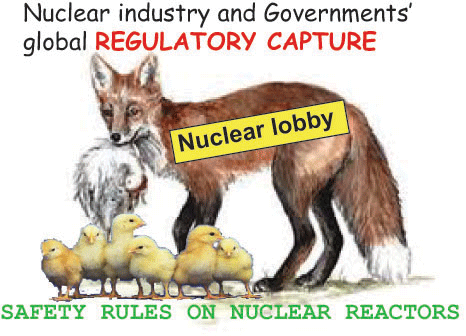 Bowling for Nuclear Meltdowns (and Throwing Gas on the Fire), Common Dreams, 31 Oct 14 by John LaForge Weakening radiation standards; a cap on accident liability; reactor propaganda vs improvements; old units running past expiration dates; revving the engines beyond design specs …. You’d think we were itching for a meltdown.
The Environmental Protection Agency has recommended increased radiation exposure limits following major releases. It would save the industry a bundle to permit large human exposures then, rather than shut down rickety reactors now.
The EPA proposal is a knock-off prompted by Fukushima, because after the triple meltdown started three years ago, Japan increased — by 20 times — the allowable radiation exposures deemed tolerable for humans. Prior to the meltdowns of March 2011, Japan allowed only 1 milliSievert of radiation per year in an individual’s personal space. Now, the limit is 20 milliSieverts per year. This is not safe, it’s just allowable, or, rather, affordable, since the cost of decontaminating 1,000 square miles of Japan to the stricter standard could bust the bank.
The Price Anderson Act provides US reactor owners with a liability cap and a tax-payer bailout in the event of serious accidents or attacks. The law relieves utilities of hundreds of billions in financial risk posed by our ongoing meltdown roulette game. The owners won’t be bankrupted by the next loss-of-coolant disaster, but the US might.
Fukushima has spewed more long-lived radioactive chemicals to the air, the soil and the ocean than any catastrophe in history. But the chant heard round the world is: “The dose is low, there’s no immediate danger.” Promoters of nuclear power repeat this mantra at every opportunity, hoping to dodge Germany’s answer to Fukushima — a permanent reactor phase-out — and it has nearly drowned out all warnings of radiation’s health and environmental effects.
Have you heard of PSR’s March 2011 “Health risks of the releases of radioactivity from the Fukushima reactors: Are they a concern for residents of the US?”; or IPPNW’s June 2014 “Critical Analysis of the UNSCEAR Report”; or the Nov. 2012 “Report of the UN Special Rapporteur on the right to health within the context of the nuclear accident at Fukushima”; or Greenpeace’s two major reports, “Lessons from Fukushima,” and “Fukushima Fallout”? No, the feds would rather you read the UN Scientific Committee’s exec. summary which claims Fukushima’s effects are “unlikely to be observable.” This conclusion was made before any research was done.
The chances of radiation disasters will increase further if the Nuclear Regulatory Commission allows US reactors to run for 80 years. This is what Duke Power, Dominion Power and Exelon suggest for seven of their 40-year-old rattle traps now operating in Pennsylvania, Virginia and South Carolina………http://www.commondreams.org/views/2014/10/31/bowling-nuclear-meltdowns-and-throwing-gas-fire
No comments yet.
1 This Month


18 March Webinar @ 1 PM EST: An Assessment of SMR Projects: The Case of Canada
register for the zoom:
https://us02web.zoom.us/webinar/register/WN_o8BIIOUvQ2ONJR1nta65DQ#/registration


of the week – STOP SMALL MODULAR REACTORS IN CANADA
To see nuclear-related stories in greater depth and intensity – go to https://nuclearinformation.wordpress.com
-
Archives
- March 2026 (140)
- February 2026 (268)
- January 2026 (308)
- December 2025 (358)
- November 2025 (359)
- October 2025 (376)
- September 2025 (258)
- August 2025 (319)
- July 2025 (230)
- June 2025 (348)
- May 2025 (261)
- April 2025 (305)
-
Categories
- 1
- 1 NUCLEAR ISSUES
- business and costs
- climate change
- culture and arts
- ENERGY
- environment
- health
- history
- indigenous issues
- Legal
- marketing of nuclear
- media
- opposition to nuclear
- PERSONAL STORIES
- politics
- politics international
- Religion and ethics
- safety
- secrets,lies and civil liberties
- spinbuster
- technology
- Uranium
- wastes
- weapons and war
- Women
- 2 WORLD
- ACTION
- AFRICA
- Atrocities
- AUSTRALIA
- Christina's notes
- Christina's themes
- culture and arts
- Events
- Fuk 2022
- Fuk 2023
- Fukushima 2017
- Fukushima 2018
- fukushima 2019
- Fukushima 2020
- Fukushima 2021
- general
- global warming
- Humour (God we need it)
- Nuclear
- RARE EARTHS
- Reference
- resources – print
- Resources -audiovicual
- Weekly Newsletter
- World
- World Nuclear
- YouTube
-
RSS
Entries RSS
Comments RSS
 nuclear-news
Leave a comment