Ponzi economics: endless growth in a finite ecology
Ponzi schemes are stable for a short while in their initial operations, but depend on unrestricted growth through finding ever-more new investors. Ponzis have to collapse because of their growth and they can’t exist without it.
To grow or not to grow
So it is with modern economics; growth is the central mantra, but no system dependent on finite resources can continue to grow forever.
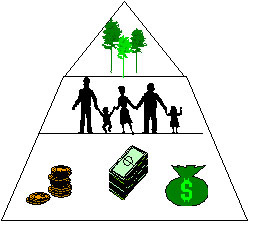 Modern economics count on Ponzi ecology ABC Science Capitalist economies suffer from
the lack of scope and accounting for all the environmental resources needed to make them work, argues Paul Willis. 5 Nov 14 Recently an ecologist friend of mine commented that modern capitalist economies are little more than elaborate Ponzi schemes, complicated frauds that can only end in their own spectacular collapse in direct proportion to their stratospheric success………
The problem with a Ponzi scheme is that it can only sustain paying profits in the initial stages, as long as an increasing number of new investors enter the scheme. Once there is a decline in the number of new investors, the profits cannot be paid to the older investors and the whole scheme comes undone with most investors losing their investment without seeing any profit………
Ecological flaws
The ecological flaws in modern economics include the failure to account for all the resources required to fuel an economy, the lack of recognition that many of these resources are finite (and the assumption that they are infinite) and the relentless growth of the economy without regard to the limitations of resource supply. In short, modern economics suffers from the lack of scope and accounting for all the resources needed to make it work.
Usually an economy managed through modern economic theory and practice isolates the flow of capital and the exchange of resources from the context of the environment and the physical world around it. Many resources that are consumed within the operation of an economy, such as the air and soil used in the growing of crops, are not accounted for. Nor are the costs of production of unwanted by-products such as pollution of the air, water and soil. In these ways, economies fail to recognise or work within some basic ecological principles.
It’s also in these aspects that there are some similarities to Mr Ponzi’s scheme; taking new investments to pay the profits of older investors in the same way that we are using resources that will be unavailable to future generations to prop up the economy of today (the concept of ‘Future-eating‘ as put forward by Tim Flannery).
And there is another similarity that should cause great alarm; Ponzi schemes are stable for a short while in their initial operations, but depend on unrestricted growth through finding ever-more new investors. Ponzis have to collapse because of their growth and they can’t exist without it.
To grow or not to grow
So it is with modern economics; growth is the central mantra, but no system dependent on finite resources can continue to grow forever.
Crudely there are two drivers of growth in modern economies. If economics is about the flow and distribution of resources through a society, then population growth must lead to a commensurate growth of the economy, sometimes called ‘consumption growth’.
The second type of growth within a capitalist economy is capital growth: the idea that businesses or individuals have a right to accumulate resources beyond their needs. Economic modelling usually occurs in very limited timeframes, often a year or two, sometimes a decade or more but rarely deeper into the future than a century. The environmental systems they are embedded within have been around for thousands or millions of years and I am not aware of any economic model that extends a similar distance into the future.
A fundamental difference between ecology and economics is that the parameters of ecological systems are set by the laws of nature, we cannot change them without severe penalties..Economies are entirely human constructs, we make the rules and have ultimate control over their conduct. We can alter the economies of the world because we made them. That is not an option for the ecosystems that our economies rely on…….http://www.abc.net.au/science/articles/2014/11/03/4119082.htm
No comments yet.
1 This Month


Tell the Ukrainian Government to Drop Prosecution of Peace Activist Yurii Sheliazhenko

Petition to revoke the licensing of the Near Surface Nuclear Disposal Facility (NSDF) at Chalk River. https://www.ourcommons.ca/petitions/en/Petition/Details?Petition=e-7247


of the week – STOP SMALL MODULAR REACTORS IN CANADA
To see nuclear-related stories in greater depth and intensity – go to https://nuclearinformation.wordpress.com
-
Archives
- March 2026 (204)
- February 2026 (268)
- January 2026 (308)
- December 2025 (358)
- November 2025 (359)
- October 2025 (376)
- September 2025 (258)
- August 2025 (319)
- July 2025 (230)
- June 2025 (348)
- May 2025 (261)
- April 2025 (305)
-
Categories
- 1
- 1 NUCLEAR ISSUES
- business and costs
- climate change
- culture and arts
- ENERGY
- environment
- health
- history
- indigenous issues
- Legal
- marketing of nuclear
- media
- opposition to nuclear
- PERSONAL STORIES
- politics
- politics international
- Religion and ethics
- safety
- secrets,lies and civil liberties
- spinbuster
- technology
- Uranium
- wastes
- weapons and war
- Women
- 2 WORLD
- ACTION
- AFRICA
- Atrocities
- AUSTRALIA
- Christina's notes
- Christina's themes
- culture and arts
- Events
- Fuk 2022
- Fuk 2023
- Fukushima 2017
- Fukushima 2018
- fukushima 2019
- Fukushima 2020
- Fukushima 2021
- general
- global warming
- Humour (God we need it)
- Nuclear
- RARE EARTHS
- Reference
- resources – print
- Resources -audiovicual
- Weekly Newsletter
- World
- World Nuclear
- YouTube
-
RSS
Entries RSS
Comments RSS
 nuclear-news
Leave a comment