Japan’s government looks to financially supporting the nuclear industry

 Editorial: Nuclear plant support measures run counter to official policy, Mainichi 22 Sept 14 拡大写真The Ministry of Economy, Trade and Industry is considering boosting support for nuclear power plants as Japan moves toward full liberalization of its electricity retailing market.
Under the system eyed by the ministry, consumers would shoulder the huge costs of building and decommissioning reactors so that even if there were an electricity price war, power companies wouldn’t go into the red. In essence, the system makes it easy to build and rebuild nuclear power plants and maintain them in the future.
But proposals that attempt to extend the life of nuclear power plants when the government has yet to present a picture for the future of the nation’s energy policies cannot be justified.
Nuclear power costs much more than thermal and other forms of power, yet for decades power companies have recovered expenses, protected by regional monopolies and the full cost pricing method that tacks the cost of producing electricity onto power bills.
With the full liberalization of electricity retailing set to be implemented in fiscal 2016, however, those power companies will lose their regional monopolies. And then the full cost pricing method will be abolished. If more newcomers enter the electricity market and the price of electricity drops, it will become even harder for power companies to recover costs associated with nuclear power.
The Ministry of Economy, Trade and Industry therefore proposed new measures to support nuclear power at a meeting to deliberate the role of the nation’s nuclear power plants. With respect to the system guaranteeing a set price for electricity produced though nuclear power, the ministry proposed that the cost of decommissioning nuclear reactors and the disposing of spent nuclear fuel be made part of a standard price, with consumers forced to cover the difference if the market price falls below that standard.
The ministry is also reportedly set to consider revisions to accounting systems to ease the effects of reactor decommissioning on management.
In terms of fuel alone, nuclear power plants can be run more cheaply than oil-fired power plants or those running on liquefied natural gas. This is probably why power companies are rushing to restart reactors. But when it comes to building a new nuclear plant or rebuilding an existing one, then the circumstances are entirely different. The latest support measures indicate that if market principles were to be given free reign, then the option of maintaining nuclear power would vanish…….http://mainichi.jp/english/english/perspectives/news/20140918p2a00m0na003000c.html
Anxiety over new plutonium leak at USA’s Nuclear Waste Isolation Pilot Plant (WIPP)

 Reuters: Investigation suggests another drum with plutonium ruptured at US nuclear site — TV: “There are new concerns at WIPP that there could be another radiation leak” (VIDEO) http://enenews.com/tv-new-concerns-could-be-another-radiation-leak-nuclear-site-reuters-new-investigation-suggests-another-drum-plutonium-ruptured-video?utm_source=feedburner&utm_medium=email&utm_campaign=Feed%3A+ENENews+%28Energy+News%29
Joe Franco, DOE official, Sept. 18, 2014 (at 41:00 in): “As you probably heard… there’s been some items about a 2nd drum in Panel 6… We’ve taken into consideration, that what if we had that event again while our folks are in the underground… What’s come out insinuates that we have another potential drum… We’re taking things seriously.” >> Watch video here
Reuters, Sept. 19, 2014 (emphasis added):Second container possibly leaked at New Mexico nuclear dump — A second container of plutonium-contaminated debris may have contributed to a radiation leak [at New Mexico’s Waste Isolation Pilot Plant] a U.S. Energy Department official said on Thursday…. “What has come out insinuates we have another potential drum,” Joe Franco, manager of the Energy Department field office in Carlsbad that oversees the plant, told a public meeting. Franco said further investigation of the underground suggests the rupture of an additional barrel of nuclear waste…
KRQE, Sept 18, 2014: Concerns about future WIPP leak emerge… new concerns at WIPP that there could be another radiation leak >> Video here
Albuquerque Journal, Sept. 18, 2014: Concern over another WIPP drum… State Sen. Peter Wirth… said there’s also concern that the WIPP area where the… drum is stored has not been sealed and that the Department of Energy has not presented a promised “recovery plan” for cleaning up WIPP
Santa Fe New Mexican, Sept. 18, 2014: “It’s concerning that… the problem was presented to us as one drum,” said state Sen. Peter Wirth, D-Santa Fe… “Now the scope being represented by the lab involves more high-risk drums.”… 16 drums [contain] disturbing mixtures of waste… Twelve of the drums containing waste identified as high risk are at WIPP — 11 of them in Panel 6 [– which includes the] waste container… identified as a potential powder keg… [That panel]cannot be immediately accessed in a way that ensures radiation will not escape.
Carlsbad Current Argus, Sept. 16, 2014: “I cannot guarantee that second drum won’t go” [ LANL official Terry Wallace] said… “kitty litter and nitric acid… requires very high temperatures to initiate that, just like we had talked about at the World Trade Center… [Reactions] could have heated this drum up to the point where you would begin to have a reaction with the [litter].”
Terry Wallace, LANL official, Aug 15, 2014 (at 6:45 in): The [breached] drum was originally white, it’s now black … it was exposed to very high temperatures… The World Trade Center… came down [because of burning] paper that was contained within the filing cabinets, and that allowed temperatures to reach 1,200-1,300ºC. We worry about the same kinds of thing in drums — can you have a series of reactions? >> Watch video here
Los Alamos Monitor, Aug 22, 2014: Records about [the nitric acid] process were handwrittenand LANL cannot say with certainty whether some of the drums were fully neutralized.
Global carbon emissions to hit record high in 2014
 Global carbon report: emissions will hit new heights in 2014, The Conversation, Pep Canadell Executive director, Global Carbon Project at CSIRO Michael Raupach Director of the Climate Change Institute at Australian National University, 22 September 2014,
As heads of state gather in New York for tomorrow’s United Nations climate summit, a new report on the state of the world’s carbon budget tells them that greenhouse emissions hit a new record last year, and are still growing.
The Global Carbon Project has released its annual report card on the global and national trends in carbon dioxide (CO2) emissions.
It shows that global emissions from burning fossil fuels and cement production reached a new record of 36 billion tonnes of CO2 in 2013, and are predicted to grow by a further 2.5% in 2014, bringing the total CO2 emissions from all sources to more than 40 billion tonnes. This is about 65% more fossil-fuel emission than in 1990, when international negotiations to reduce emissions to address climate change began……..
Is it too late to tame the climate?
Our estimates (see here and here) show that, at current emissions levels, average global warming will hit 2C in about 30 years.
Despite this apparently imminent event, economic models can still come up with scenarios in which global warming is kept within 2C by 2100, while both population and per capita wealth continue to grow. Are these models playing tricks on us?…
http://theconversation.com/global-carbon-report-emissions-will-hit-new-heights-in-2014-31834?utm_medium=email&utm_campaign=Latest+from+The+Conversation+for+21+September+2014+-+1934&utm_content=Latest+from+The+Conversation+for+21+September+2014+-+1934+CID_cc30f6107f0d3fcd110e8e0dd6549531&utm_source=campaign_monitor&utm_term=Global%20carbon%20report%20emissions%20will%20hit%20new%20heights%20in%20201
Japanese town finds a way to regulate against nuclear waste plans for its area
Tochigi town passes water-protection ordinance to block nuclear waste plans THE ASAHI SHIMBUN, 21 Sept 14 A town in Tochigi Prefecture has found a novel way to block the construction of a final disposal site for radioactive waste from the 2011 Fukushima nuclear crisis by passing an ordinance that will protect its natural resources.
The ordinance, passed unanimously by the Shioya town assembly on Sept. 19, will protect an area that includes local springs, as well as mountain forest that was designated by the Environment Ministry as a candidate for the final disposal facility.
The ministry plans to use the site to store designated waste which contains more than 8,000 becquerels of radioactivity per kilogram.
Under the ordinance, the town government aims to protect the quality and quantity of water in springs, including the Shojinzawa Yusui, recognized by the ministry as one of the best 100 natural waters in Japan……..A group opposed to the construction of the disposal site had gathered more than 60,000 signatures inside and outside the prefecture as of Sept. 19, more than five times the town’s population……. http://ajw.asahi.com/article/0311disaster/fukushima/AJ201409200104
Japan’s politicians look for nuclear plan B – burying reactors
Politicians mull idea of burying power plants Politicians discuss plan B in nuclear power push: underground reactors, Japan Times BY ERIC JOHNSTON 21 Sept 14 For more than four decades, the Kansai region has relied on Fukui Prefecture’s nuclear power plants, including 11 operated by Kansai Electric Power Co. (Kepco), to keep the region powered up.
But now that a growing number of plants are nearing or have reached the end of their 40-year life cycle, the question is: What’s next?
While most of the discussion is focused on whether to continue running or decommission them, there is an interesting — to be polite — school of thought among certain politicians that says they should be replaced with underground reactors……http://www.japantimes.co.jp/news/2014/09/21/national/politics-diplomacy/atomic-plan-b-go-underground/#.VCChHpRdUnk
Sea-based nuclear weapons being developed by Pakistan
Pakistan developing sea-based and short-range nuclear weapons: report Livemint 21 Sept 14 Pakistan to develop nuclear warheads suitable for deployment from Indian Ocean, either from warships or from its submarines, report saysIslamabad/Washington: Pakistan is developing sea-based missiles and expanding its interest in tactical nuclear warheads to give it a “second-strike” capability if a catastrophic nuclear attack destroyed all its land-based weapons, according to a media report on Sunday. The next step of Pakistan’s strategy includes an effort to develop nuclear warheads suitable for deployment from the Indian Ocean, either from warships or from one of the country’s five diesel-powered Navy submarines, The Washington Post reported quoting Pakistani and Western analysts…….
http://www.livemint.com/Politics/NvrdWIYVzgef8b24VLV1TL/Pakistan-developing-seabased-and-shortrange-nuclear-weapon.html?utm_source=copy
China joins the nuclear marketing frenzy to sell to India
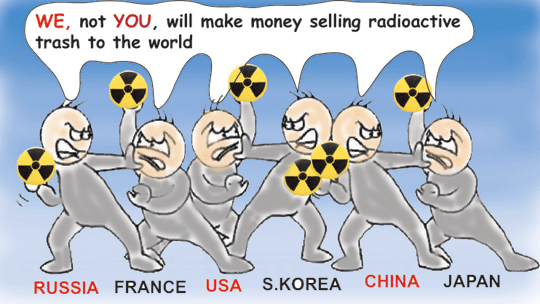 China joins nations eyeing India’s civil nuclear sector, Cold Air Currents, 21 Sept 14 Yahoo News UK: NEW DELHI (Reuters) – China became the latest nation to line up for a stake in India’s civil nuclear energy drive on Thursday, agreeing to open talks on cooperation in a sector that New Delhi sees as the solution to its chronic power problems.
...”I think the Chinese are looking basically at the commercial angle, since India is going to be giving contracts for nearly $150 billion in the next 10-15 years,” said Srikanth Kondapalli, a China watcher at Delhi’s Jawaharlal Nehru University.
The announcement, made after Xi met Prime Minister Narendra Modi in New Delhi, comes on the heels of a deal India struck earlier this month to buy uranium from Australia to increase its fuel supplies.
Days before that, Modi and Japanese Prime Minister Shinzo Abe agreed to accelerate talks on a nuclear energy pact……http://coldaircurrents.luftonline.net/2014/09/china-joins-nations-eyeing-indias-civil.html
Only collective action on climate change can save the world
What to do when you’re running out of time on climate change Grist, By Rebecca Solnit Cross-posted from TomDispatch 20 Sep 2014 “…..The glorious 10,000-year period of stable climate in which humanity flourished and then exploded to overrun the Earth and all its ecosystems is over.
But responding to these current cataclysmic changes means taking on people who believe, or at least assert, that those of us who want to react and act are gratuitously disrupting a stable system that’s working fine. It isn’t stable. Itis working fine — in the short term and the most limited sense — for oil companies and the people who profit from them and for some of us in the particularly cushy parts of the world who haven’t been impacted yet by weather events like, say, the recent torrential floods in Japan or southern Nevada and Arizona, or the monsoon versions of the same that have devastated parts of India and Pakistan, or the drought that has mummified my beloved California, or the wildfires of Australia.
The problem, of course, is that the people who most benefit from the current arrangements have effectively purchased a lot of politicians, and that a great many of the rest of them are either hopelessly dim or amazingly timid. Most of the Democrats recognize the reality of climate change but not the urgency of doing something about it. Many of the Republicans used to — John McCain has done an amazing about-face from being a sane voice on climate to a shrill denier — and they present a horrific obstacle to any international treaties…..
We are powerful and need to become more so in the next year as a major conference in Paris approaches in December 2015 where the climate agreements we need could be hammered out. Or not. This is, after all, a sequel to the Copenhagen conference of 2009, where representatives of many smaller and more vulnerable nations, as well as citizens’ groups, were eager for a treaty that took on climate change in significant ways, only to have their hopes crushed by the recalcitrant governments of the United States and China.
Right now, we are in a churning sea of change, of climate change, of subtle changes in everyday life, of powerful efforts by elites to serve themselves and damn the rest of us, and of increasingly powerful activist and social-movement campaigns to make a world that benefits more beings, human and otherwise, in the longer term. Every choice you make aligns you with one set of these forces or another. That includes doing nothing, which means aligning yourself with the worst of the status quo dragging us down in that ocean of carbon and consumption.
To make personal changes is to do too little. Only great movements, only collective action can save us now. Only is a scary word, but when the ship is sinking, it can be an encouraging one as well. It can hold out hope. The world has changed again and again in ways that, until they happened, would have been considered improbable by just about everyone on the planet. It is changing now and the direction is up to us…….http://grist.org/climate-energy/what-to-do-when-youre-running-out-of-time-on-climate-change/?utm_source=syndication&utm_medium=rss&utm_campaign=feed
US Congress may not be keen to prop up bank supporting nuclear exports
Congress Props Up Ex-Im Bank But Leaves Nuclear Energy To Dangle Congress has decided to prop up the U.S.-Export Bank for nine more months, after threatening to cut its cord and saying it typified corporate welfare. In “preserving” the 80-year-old institution, U.S. lawmakers have given American exporters — both big and small — a chance to regroup, especially the nuclear energy industry.
No other industrial sector has been knocked down — and gotten back up — more than nuclear companies. But the latest fight over whether to continue funding the “Ex-Im Bank,” has been a blow delivered by its “backers,” or conservative lawmakers who generally support such development. Now, though, those congressional members have momentarily caved to a broad swath of the bank’s friends, consisting mostly of members who are pro-business and who want to see U.S. companies expand their franchises internationally. The ultimate question is whether that concession is temporary or permanent………
It’s a controversy that extends well beyond the safety and efficiency record of nuclear power plants. It’s mostly about one that delves deeply into how foreign projects would be financed — and whether a U.S. public agency ought to bankroll construction at favorable rates. …….
Despite the short-term “victory,” supporters of the Ex-Im Bank realize that complacency is the enemy. While the bank has gotten a nine-month reprieve, the battle over whether to continue it after that will resume early next year — just after a new Congress is sworn in. The outcome of the upcoming November elections is unknown. But if Republicans take it over, they may get dominated by the Tea Party, which calls the Ex-Im Bank unnecessary, saying that private institutions could make the same loans if they were so inclined…….
In the current rough-and-tumble political environment, however, it’s less about “wiser heads” and more about “one-upping” the opposition, leaving the nuclear energy industry to dangle even longer and all in the midst of a tenuous future in the United States. http://www.forbes.com/sites/kensilverstein/2014/09/21/congress-props-up-ex-im-bank-but-leaves-nuclear-energy-to-dangle/
Finland’s political divide over nuclear power
Nuclear-power project debates expose political divide in Finland YLE News Eye on the Arctic
September 20, 2014 The Social Democratic Party’s parliamentary group proposed on Tuesday that supplementary applications from both the Fennovoima and TVO nuclear projects should be considered by the Finnish Parliament.
The announcement is in direct opposition to Monday’s recommendation from the Economic Minister to green-light only the Fennovoima project for parliamentary deliberation. The ongoing saga regarding the future of Finland’s nuclear power is exposing a clear divide in Finnish politics, as the five parties of the coalition government scramble to secure their position on two pending nuclear plant investments.
Both projects were already approved by the government and parliament in an earlier round, but significant changes in their makeup have made it necessary for both to re-apply for supplementary permission to continue……….
Greens already have one foot out the door
Meanwhile, Green League chair and Environment Minister Ville Niinistö made headlines on Monday when he said his party will go into opposition if the Stubb government approves the Russian-built Fennovoima plant.
He cited that one of his party’s three stipulations for joining the coalition government had been that no new nuclear power permits would be granted during its four-year legislative term. http://www.adn.com/article/20140920/nuclear-power-project-debates-expose-political-divide-finland
The IARC-WHO classification of cell phone radiation is misrepresented by the industry
Use of Cell Phones Increase Cancer Risk, Natural Healing Tools News, (DNA, August 18) Dr Dariusz Leszczynski, Adjunct Professor, Division of Biochemistry and cellphone radiation as possibly carcinogenic, in conversation with Maitri Porecha, reveals how leading cell phone operators and manufacturers are withdrawing funding for research, leading to closing down of laboratories studying effects of radio-frequency electromagnetic fields as emitted by cellphones and cell towers. Excerpts –
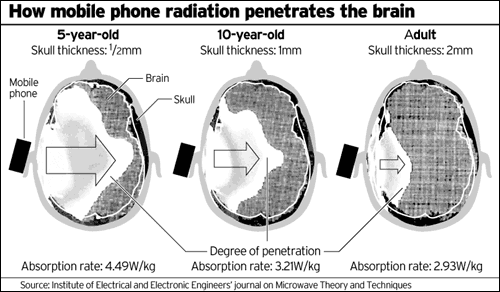
While majority of the funding for such research projects consists of tax payers money and industry pumps in only a part of the money, the advice of industry is highly valued during sanctioning of funds by the government………..
ICNIRP scientists are involved in the WHO report and, therefore, one cannot expect that it will substantially differ from what ICNIRP is saying.
The recent French CERENAT epidemiological study provides, together with Interphone and Hardell studies, is an evidence sufficient to consider cell phone radiation as a probable carcinogen – Group 2A in IARC’s scale of carcinogenicity…..
Brain cancer risk is increased by cellphone use
Cell tower radiation increases risk of brain cancer DNA 21 Sept 14 Busting the myths about lack of evidence on harm caused by cellphone radiation, Finnish scientist Dariusz Leszczynski on Friday said that long-term exposure to cellphone and cell tower radiation, on an average of thirty minutes a day over ten years, causes an increased risk of brain cancer.
Cellphone radiation increases risk of cancer?
“The Interfone, Hardell and the recently concluded CERENAT studies in France have all pointed towards a common risk to increased brain cancer,” said Leszczynski, adjunct professor, biochemistry, University of Helsinki. Leszczynski is one of the members of the expert committee constituted by World Health Organization’s International Agency for Research on Cancer (IARC). WHO has classified electromagnetic frequency radiation emitted by cellphone, cell towers and wi-fi as category 2(B) or possibly carcinogenic…..http://www.dnaindia.com/mumbai/report-cell-tower-radiation-increases-risk-of-brain-cancer-2020015
Naomi Klein’s new book challenges the climate deniers
global capitalism has “from its very first moments, systematically sabotaged our collective response to climate change”.

More than Dangerous: Naomi Klein takes on climate deniers September 20, 2014 Peter HannamEnvironment Editor, The Sydney Morning Herald The disturbing implications of climate change are rarely taken to their logical conclusions in public discussion.
Scientists who spend their careers researching the climate system and publishing findings in professional journals are typically far more candid in private than in their scholarly publications.
The human-generated surge in greenhouse gas emissions is accelerating, they note, altering the chemistry of the biosphere and, ultimately, the conditions for life.
“People are not being told the truth,” one scientist told Fairfax Media this week. “It’s an event to which species will struggle to adapt. This is more than dangerous.” Continue reading
Environmental causes of cancer: dispelling the “inheritance myth”

 The Inheritance Myth Time to Talk Frankly About Cancer CounterPunch, by KRISTINE MATTIS SEPTEMBER 17, 2014 In a September 2014 article in the Journal of the American Medical Association, Dr. Mary-Claire King – the woman who first discovered the so-called breast cancer gene BRCA1 – and her colleagues suggested that all women should undergo routine medical screening for this gene as well as BRCA2. Of course, it seems reasonable that women should know if they carry these mutant allele forms of these genes, because the mutant genes confer a greater risk for breast cancer and ovarian cancer in women who have the mutants than in women who do not.
There has been some discussion about Dr. King’s proposal in newspapers and on the radio, but the dialogue inevitably has two tremendous pieces of the cancer puzzle missing: cause and prevention. In fact, too much cancer information tends to be myopic, neglecting to mention essential elements of the global portrait of cancer etiology. Conventional wisdom about cancer tends to end up promulgating misinformation and misinterpretations, not sound science. Dr. King’s piece, as well the highly publicized bi-annual Stand Up to Cancer celebrity charity telethon, which raises money for cancer treatment, have done nothing to provide more clear information to the public that could help avert this all-too-common but potentially highly preventable scourge that has caused suffering upon and taken the lives of so many of our friends and family.
First and foremost, it is important to emphasize that cancer is NOT heritable. Actor Piece Brosnan proclaimed on the aforementioned telethon that cancer was a “wretched inherited disease.” It certainly is wretched, but is not inherited nor is it really a single disease……..
the BRCA1 and BRCA2 mutant genes do not cause cancer; they merely make it more difficult for your cells to repair damage done to your DNA. When your cells are exposed to a cancer-causing agent (i.e., a carcinogen) such as ionizing radiation, certain natural and synthetic compounds, certain viruses, and some endocrine disrupting chemicals, to name a few, they have mechanisms to repair the damage that agent may cause to your DNA. But if the damage is too severe or widespread, or if the cell lacks that mechanism for repair, as in the case of those who have the “breast-cancer genes,” your risk of contracting cancer is increased.
It is basic scientific knowledge that cancer is not inheritable, but in light of the discovery of various genes that confer increased susceptibility to cancer, this fact is not always well understood by the population at large. Only 5-10% of people who contract any type of cancer have any sort of inherited genetic susceptibility. Therefore, the focus on inherited mutant alleles leaves out the majority 90-95% of people suffering from cancer. While it is true that the minority 5-10% who do have these mutant alleles have a much greater risk for disease than the rest of us, they do not have an inherent “predisposition” to cancer. Labeling these genes as “cancer genes” or even “genetic predispositions” is a terrible misnomer. These genes increase susceptibility to cancer when exposed to cancer causing agents……….
More and more we are learning that many of the over 80,000 synthetic chemicals that humans have constructed over the course of the last century or so not only directly cause DNA mutations that lead to cancer, but mimic estrogen in our bodies, which indirectly lead to cancer. These chemicals are in food we eat, the air we breathe, the water we drink, and the endless industrial products we produce and consume. They are quite often the products and processes of industry, and are not essential to maintain a comfortable life on this planet. In addition, the radiation we receive from sources such as diagnostic exams via x-ray, CT scan, and other radiologic medical procedures are being shown to contribute to excess cancers. For example, the UK Committee on Medical Aspects of Radiation in the Environment recently stated that one out of 2000 people will contract cancer due to abdominal CT scans – otherwise known as an iatrogenic cancer. This may seem a fairly small risk, unless you are that one person who has had an unnecessary CT scan and then is diagnosed with a preventable cancer because of it……
for some reason, this plain and simple fact that exposure to carcinogens can and does lead to cancer is always absent in the medical discussion of cancer. Part of the reason may be that medical practitioners are rarely, if ever, versed in environmental health, so they are not even educated about environmental toxicology and the myriad diseases caused by environmental exposures. But part of the reason is likely political and economic. Real biological causes of cancer seem to be verboten because scientists and scholars who speak these truths are condemned, defamed, and discredited by the powerful industrial public relations machine, which has multi-billions of dollars worth of revenue to protect, as it maintains the businesses and industries that introduce so many of the carcinogenic products in our world.
Another important clarification in discussing cancer is that diagnosis does not equal prevention. In an Orwellian twist of double-speak, health care professionals have delineated different forms of “prevention” and have decided that the diagnosis and screening for cancer is what they deem “secondary prevention.” In truth, diagnosis is not prevention at all and should not be termed as such. …….
When discussing cancer, the lack of conversation about our ubiquitous exposures to carcinogens is highly negligent. ……http://www.counterpunch.org/2014/09/17/time-to-talk-frankly-about-cancer/
The Fukushima nuclear emergency DID cause radiation sickness
 VIDEO: Gov’t experts highly suspicious of Japan’s claim that nobody suffered acute radiation syndrome after Fukushima — So many workers were ill they had to lay on cardboard after running out of beds — Officials “repeatedly talked of death” — CBS: There were reports of people with radiation sickness http://enenews.com/video-foreign-govt-very-suspicious-japans-claim-suffered-acute-radiation-syndrome-after-fukushima-many-workers-ill-lay-cardboard-after-running-beds-officials-repeatedly-talked-death-video?utm_source=feedburner&utm_medium=email&utm_campaign=Feed%3A+ENENews+%28Energy+News%29
Japan Times, Sept. 17, 2014 (emphasis added): [Deceased Fukushima Daiichi chief Masao Yoshida] repeatedly talks of “death” in the initial days of the crisis as the realization sinks in that the nuclear fuel had already started to melt.
Mainichi, Sept 12, 2014: “Nobody came to help us. I am still full of resentment and bitterness,” Yoshida said… heaping scorn on [the] TEPCO President… and calling him ”that man.”
Xinhua, Sept 11, 2014: Masao Yoshida [revealed] the government had utterly failed to understand the gravity of the workers’ situation at the plant… three days into the crisis the chief had lost hope and was losing his grip on the situation… politicians and TEPCO officials at the headquarters were clueless as to the dire predicament he and his workers were in, including those who had been exposed to potentially lethal levels of radiation.
Kyodo News, Sept 14, 2014: [Satoru] Hayashizaki and his coworker opened the door to the [No. 3] suppression chamber’s room… “My hands, covered by rubber gloves, instantly got hot”…Hayashizaki felt groggy… he put his right foot down on it only to see the rubber sole of his shoe melt instantly, leaving a black smear… He was alarmed to see [his dosimeter number] rising rapidly, even though he was [back] in the control room… everyone else’s dosimeters were rising… [He] thought he might die… and started writing a farewell letter.
Kyodo News, Sept. 14, 2014: Mitsuhiro Matsumoto, 47, was outside during both explosions… he [became] unable to believe anyone or any of the information he received. “I completely lost my will to fight”… Many [workers] had already absorbed more than 100 millisieverts… A man injured by the rubble was soon brought in on a stretcher… there were no doctors… Another man [was] in a state of panic… Those feeling ill were taken to a meeting room… Tepco quickly ran out of mattresses and had to put down cardboard for them to lie on… the door closed behind [Yumiko Kato and a reactor operator] shouted: “Is that an explosion? Again?” He then clasped his arms around his knees and trembled, muttering “I am afraid, afraid, afraid.”… “I want to go home,” a young female Tepco employee said as she started to cry…[Kato] said, “Let’s believe in our people, because they are working very hard.” The situation, however, only got worse, cornering everyone at the plant.
IRSN, France’s Institute for Radiological Protection and Nuclear Safety (at 11:00 in): “At first sight there was no acute radiation syndrome observed in the weeks following the accident, , as was the case of the first rescue workers during the Chernobyl accident. These figures are to be taken with great caution because of severe degradations due to the tsunami… Medical checkups are now implemented by the Japanese authorities.” >> Watch the video here
Contrary to IRSN’s claim about medical checkups, NHK recently reported, “Screening of workers is left up to the contractors […] they’re not obliged to submit data. [A gov’t adviser says they need] a centralized system to collect health data right away.” And according to the Asahi Shimbun, “Many companies involved have failed to conduct medical examinations.. [It’s now] impossible to check whether workers have suffered health problems.”
CBS News discussed radiation sickness after the explosions: Prof. Cham Dallas, a nuclear energy expert, you’ve been in contact with both the Japanese and the US government throughout this process… Let’s talk about radiation exposure… Dallas: “There’s some disconnects here. We’re being told by the Japanese government that the radiation levels are very low… We have reports of people with radiation sickness. That’s the disconnect, usually it takes days for radiation [sickness]” >> Watch the broadcast here
How Australians pay twice over for electricity infrastructure
DORC rort: The art of getting energy infrastructure paid for twice, SMH, September 19, 2014 Michael West Business columnist “……..you will hear how you have been paying for something, on a quarterly basis for the past 10 years, which you have already paid for. We are all victims of a high-brow rort by governments and energy companies.
While the consulting industry thrives on selling so-called expert valuations to justify this rort, Sydney University finance professor David Johnstone says it should end…….
energy companies are valuing old assets such as gas pipelines – things that consumers have already paid for – as if they were brand-spanking new. We, the mug punters, are lumbered with the cost on our power bills.
This is the DORC rort (depreciated optimised replacement cost), its moniker alone sufficient to discourage further inquiry.
Suffice to say that a reasonable thing for regulators to do might simply be to value assets at their cost, or to recognise only what their owners actually spend. Suffice to say that in Singapore and Hong Kong they would not be silly enough to use DORC, yet large corporations from these places are here enjoying riskless 10 per cent returns by stinging we mug Aussies twice for access to old gas pipelines, things that were paid for, and privatised, years ago……
why are assets that are already in private hands given the same favourable regulatory treatment? “I think it comes down to ideology as well as vested interests,” Johnstone says. “Economists fall in love their own models and crave the authority of being scientists.” http://www.smh.com.au/business/dorc-rort-the-art-of-getting-energy-infrastructure-paid-for-twice-20140919-10jega.html#ixzz3DuqE0nIm
1 This Month


Pine Ridge Uranium is the real threat, not Tehran- Tell Burgum: Stop the Extraction.
Chernobyl: The Lost Tapes – A good documentary on Chernobyl on SBS available On Demand for the next 3 weeks– https://www.sbs.com.au/ondemand/tv-program/chernobyl-the-lost-tapes/2352741955560
To see nuclear-related stories in greater depth and intensity – go to https://nuclearinformation.wordpress.com
-
Archives
- April 2026 (288)
- March 2026 (251)
- February 2026 (268)
- January 2026 (308)
- December 2025 (358)
- November 2025 (359)
- October 2025 (376)
- September 2025 (257)
- August 2025 (319)
- July 2025 (230)
- June 2025 (348)
- May 2025 (261)
-
Categories
- 1
- 1 NUCLEAR ISSUES
- business and costs
- climate change
- culture and arts
- ENERGY
- environment
- health
- history
- indigenous issues
- Legal
- marketing of nuclear
- media
- opposition to nuclear
- PERSONAL STORIES
- politics
- politics international
- Religion and ethics
- safety
- secrets,lies and civil liberties
- spinbuster
- technology
- Uranium
- wastes
- weapons and war
- Women
- 2 WORLD
- ACTION
- AFRICA
- Atrocities
- AUSTRALIA
- Christina's notes
- Christina's themes
- culture and arts
- Events
- Fuk 2022
- Fuk 2023
- Fukushima 2017
- Fukushima 2018
- fukushima 2019
- Fukushima 2020
- Fukushima 2021
- general
- global warming
- Humour (God we need it)
- Nuclear
- RARE EARTHS
- Reference
- resources – print
- Resources -audiovicual
- Weekly Newsletter
- World
- World Nuclear
- YouTube
-
RSS
Entries RSS
Comments RSS
 nuclear-news