Lek Walesa warns that arming Ukraine could lead to nuclear war

 Arming Ukraine could lead to nuclear war: Lech Walesa http://www.channelnewsasia.com/news/world/arming-ukraine-could-lead/1342632.html
> 03 Sep 2014 European military assistance to Ukraine could lead to a nuclear conflict between Russia and NATO, according to Poland’s iconic cold warrior and Nobel Peace Prize laureate Lech Walesa. KRYNICA, Poland: European military assistance to Ukraine could lead to a nuclear conflict between Russia and NATO, according to Poland’s iconic cold warrior and Nobel Peace Prize laureate Lech Walesa.”It could lead to a nuclear war,” the anti-Communist legend told reporters when asked whether the EU should send weapons to Ukraine to help it fights off separatist rebels and Russian aggression.
“The EU is well aware that Russia has nuclear weapons. NATO has them too. Must we then destroy each other?” said the former Solidarity trade union leader famous for negotiating a bloodless end to communism in Poland in 1989.
“This is why the EU keeps on repeating: stop being silly (…) This is why it isn’t getting involved too much!” he added, at an annual regional economic in Krynica, southern Poland.
The EU on Saturday agreed to impose fresh sanctions on Russia should Moscow failed to change its behaviour in Ukraine, after Kiev said Russian soldiers were fighting along side pro-Moscow rebels.
Massive transport of nuclear waste crossing the ocean from Fukushima
Fukushima forecast used by gov’t shows nuclear waste crossing ocean in single massive cluster — “Maximum concentration propagates eastward in Pacific toward U.S.” — Highest levels worldwide remain along coast of N. America through 2026 (VIDEO) http://enenews.com/fukushima-forecast-govt-shows-nuclear-waste-crossing-ocean-single-massive-cluster-maximum-concentration-propagates-eastward-pacific-highest-levels-world-remain-coast-america-2026-video?utm_source=feedburner&utm_medium=email&utm_campaign=Feed%3A+ENENews+%28Energy+News%29
Nansen Environmental and Remote Sensing Center (Norway), 2013 (emphasis added): The massive nuclear leakage into ocean from Fukushima Nuclear Power Plant was observed on March 25th,2011. The transport of leaked radioactive pollutant from the Fukushima Nuclear Power Plant was simulated… assuming constant and continuous leakage for 20 days (scenario 1) and for one year(scenario 2) starting from March 25th, 2011 and was integrated for 20 years… There is no remarkable difference of transport pathways… for the nuclear waste… The results of the ensembles indicate that the nuclear pollutant for both scenarios transports eastward to eastern Pacific… It takes about 10 to 15 years to reach the coast of East Asia… a realistic sourcefunction is required and atmospheric fallout and role of ocean ecology should also be taken into account, in order to get a more reliable assessment of possible impact of the radioactive leakage on the ocean environment.

Nansen Environmental and Remote Sensing Center, Prof. Ola Johannessen, University of Bergen Geophysical Institute: Ocean spreading of radioactivity from the Fukushima nuclear plant in Japan […] The results show that the maximum concentration propagates eastward in the Pacific toward the United States during a 7-year period while the total concentration drops to 1-2% of the source concentration (100%) after 5 years.
Nansen-Zhu International Research Centre, China: Extraordinary earthquake hit Japan and led the nuclear leakage of Japanese Fukushima reactor to the ocean. Dr. Yongqi Gao with colleagues at NERSC and NZC used the numerical model to simulate the propagation of radioactive elements in the ocean. Model system has been used for EU RADARC (Simulation scenarios for potential radioactive spreading in the 21st century from rivers and external sources in the Russian Arctic coastal zone, 2001-2003) and Norwegian Research Council supported project ARC (Arctic Radioactive Contamination, 2004-2006)… results were also cited by the State Council of China.
Why Australia should NOT sell uranium to India
Australian and Indian nuclear trade http://www.dailytimes.com.pk/opinion/29-Aug-2014/australian-and-indian-nuclear-trade Hasan Ehtisham 4 Sept 14 Adding Australian uranium into India’s energy mix would have serious fallouts on prevailing strained relations between India and its nuclear-armed neighbours Australia is expected to sign a civil nuclear agreement with India during the visit of Australian Prime Minister Tony Abbott early next month. Negotiations have been concluded to smooth the path for uranium imports from Australia.

The news came out when hundreds of thousands of Indian men and women protested against the expanding nuclear industry. These protests have been a regular feature in Koodankulam (Tamil Nadu), Jaitapur (Maharashtra) and Gorakhpur (Haryana), and at least five activists have lost their lives since 2010 in their struggle against the Indian government’s decision without taking the affected parties on board. Radioactive waste from uranium mining in the country’s east is reportedly affecting adjacent communities. Thousands of Indians suffer from the effects of uranium mining related to poor technical and management practices.
Costs are killing the nuclear industry in USA – 3 new reactors, but 8 shutting down
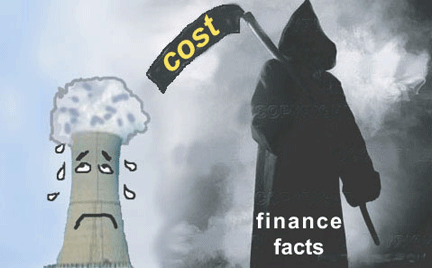 TVA’s costly reactor illuminates nuclear challenge Duane Gang, USA TODAY September 3, 2014 “…..The Watts Bar project also illustrates the challenges facing the U.S. nuclear industry. Nuclear plants are expensive, complicated and time-consuming to build. They require huge sums of upfront capital — the new Watts Bar reactor could cost as much as $4.5 billion, nearly double earlier estimates.
Only two other utilities across the USA have new nuclear reactors under construction. The South Carolina Electric & Gas Company has two units underway in Jenkinsville, S.C. The Southern Company also is building two near Waynesboro, Ga.
By contrast, eight reactors have decommissioning in progress, according to the Nuclear Regulatory Commission, as companies find it too expensive to repair aging units or can’t compete economically with cheap natural gas…….http://www.usatoday.com/story/news/nation/2014/09/02/tva-nuclear-reactor-challenge/14990433/?utm_source=feedblitz&utm_medium=FeedBlitzRss&utm_campaign=usatoday-newstopstories
Birth deformities and cancers in Indian villagers near uranium facilities
Independent studies of the health status of people who live near the uranium mines and mills have found both that there are physical deformities occurring at a much higher rate than controlled villages which are having similar population but are a little bit further away from the mines and mills, as well as lung diseases coming in at a much higher rate among those who work in the mines and mills.
Australia to sell uranium to India but at what cost to its people? Australian Broadcasting Corporation Broadcast: 03/09/2014 Reporter: Stephanie March
As Prime Minister Tony Abbott prepares to sign off on a deal to sell Australian uranium to India, critics are warning of the cost to the lives and safety of India’s most vulnerable.
Transcript
CHRIS UHLMANN, PRESENTER: “……. critics say India’s drive towards a nuclear future is coming at a cost – the lives and safety of the country’s most vulnerable.
South Asia correspondent Stephanie March reports.
STEPHANIE MARCH, REPORTER: This lush forest land in eastern India is home to the Adivasi, one of the country’s Indigenous tribes people. Here in the town of the Jaduguda, the Adivasi live simple lives, much the way they have for centuries.
But the locals feel something isn’t right with the world around them.
Mohammad Yusuf is just one child in the village deformed since birth.
MOHAMMAD MOIN (voiceover translation): We didn’t realise that there was anything wrong with him immediately, but four to five months after he was born, we realised that his legs and arms were not functioning properly.
STEPHANIE MARCH: The 14-year-old tries hard to be independent, but his wasted and stiff body makes it hard for him to move.
MOHAMMAD MOIN (voiceover translation): The doctor’s examined him. They said it wasn’t polio. They said that there was some damage that had taken place before he was born. His nerves were damaged or something like that.
STEPHANIE MARCH: A few doors down, Jobarani Acharya’s three-year-old son, Zariyadev (phonetic spelling), struggles to breathe and can’t sit without help. She doesn’t know what’s wrong with him and can’t afford to take him to hospital to find out.
JOBARANI ACHARYA (voiceover translation): I worry about what will happen when he grows older. What can we do for him? How do we cope with this situation?
STEPHANIE MARCH: Jobarani’s neighbour is a young boy named Gunda, born blind and mentally handicapped. In this hamlet of a few dozen houses there are at least three children with obvious physical deformities and locals believe they know the cause.
MOHAMMAD MOIN (voiceover translation): One of my other children, just six days old, died after dark patches erupted on its body all of a sudden. With Yusuf too, it seems that there was some poisoning or radiation that led to a birth defect.
STEPHANIE MARCH: The village where Mohammad Yusuf and Zariyadev were born is less than two kilometres from this tailing pond, attached to a uranium mine run by the Government-owned Uranium Corporation of India Limited, UCIL.
MOHAMMAD MOIN (voiceover translation): We feel that these are due to the affects of uranium. We’ve seen these kinds of incidents not just with humans, but also with the babies born to animals.
GHANSHYAM BIRULLE, JHARKHAND ORG. AGAINST RADIATION (voiceover translation): We cannot see any benefits. We have received only cancer and diseases. UCIL has given us nothing else.
STEPHANIE MARCH: Independent studies on the impact of the mining operation have been scathing. One survey by Indian Doctors for Peace and Development found that children born to families living near the mining operations were almost twice as likely to have congenital deformities than those born in villages 30 kilometres away and that those with deformities were five times more likely to die than those living in non-mining areas.
30-year-old Rapta Sadr has been physically disabled since birth and blames his problems on being born near the tailing ponds.
In addition, cancer rate are 50 per cent higher in the villages near the tailing ponds and people are 20 per cent less likely to reach the average life expectancy for the state.
M.V. RAMANA, NUCLEAR FUTURES LAB, PRINCETON UNI.: Independent studies of the health status of people who live near the uranium mines and mills have found both that there are physical deformities occurring at a much higher rate than controlled villages which are having similar population but are a little bit further away from the mines and mills, as well as lung diseases coming in at a much higher rate among those who work in the mines and mills.
STEPHANIE MARCH: M.V. Ramana is a nuclear physicist based at Princeton University who’s written extensively on the nuclear industry in India. He’s closely studied the situation in Jaduguda.
M.V. RAMANA: As far as I know, UCIL has offered no evidence that is has actually carried out any kind of detailed epidemiological studies. All it has done is make various assertions. These assertions start with denial, saying that there is no such problem, or claiming that these problems have to do with malnutrition – exactly the kind of thing epidemiological studies rule out……http://www.abc.net.au/7.30/content/2014/s4080503.htm
Japan’s Prime Minister’s wife reiterates her opposition to nuclear power
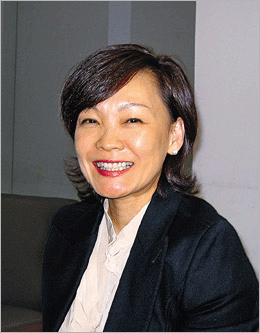 Japan’s First Lady speaks out on sales tax, nuclear power REUTERS, BY LINDA SIEG TOKYO Thu Sep 4, 2014 “…….FIRST LADY DIPLOMACY?
Abe has not been held a summit with Chinese President Xi Jinping since taking office due to Sino-Japanese feuds over territory and wartime history. He has called on Xi to meet on the sidelines of an Asian-Pacific leaders gathering November.
Mrs. Abe said she hoped to meet Xi’s wife, Peng Liyuan, if possible, even if not one-on-one, since First Ladies could chat without the burden of national interests on their shoulders.
“I felt she is really beautiful and stylish and has an aura,” she said, referring to a meeting with Peng last year.
In another departure from her husband’s policies, Mrs. Abe reiterated that she believed Japan should exit nuclear power if alternate energy sources can be found, given the risks shown by the March 2011 Fukushima disaster, the world’s worst atomic accident since Chernobyl.
“Once an accident occurs, it is a terrible thing that cannot be undone,” she said. “If there are alternative sources of energy, I would like them to stop (nuclear power). I’d like them not to restart off-line reactors.”…….http://www.reuters.com/article/2014/09/04/us-japan-firstlady-idUSKBN0GZ07I20140904
$30 million grant to protect Washington DC from nuclear threats
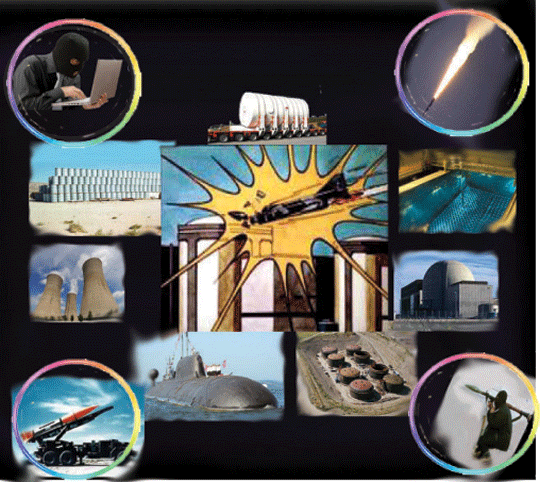 Washington DC gets $30 million grant to protect against nuclear threats THE BLAZE< Sep. 3, 2014 Pete Kasperowicz The Department of Homeland Security announced that it has awarded Washington DC a $30 million grant to expand its ability to detect and deter nuclear and radiological threats.
The grant, which will be distributed to Washington DC over five years, was made by DHS’s Domestic Nuclear Detection Office, which runs a program called Securing the Cities. That program started in 2006 and provided aide to New York City, and was then expanded to the Los Angeles/Long Beach area………http://www.theblaze.com/blog/2014/09/03/washington-dc-gets-30-million-grant-to-protect-against-nuclear-threats/
Red Wing and Prairie Island Indian Community say new NRC waste ruling is no good

the only sensible thing to do is to STOP MAKING RADIOACTIVE TRASH
Red Wing officials disappointed in feds’ decision on spent nuclear fuel, MINN POST, By Joe Kimball | 09/03/14 Red Wing city officials and leaders of the Prairie Island Indian Community say they are unhappy with a recent Nuclear Regulatory Commission ruling that does little to resolve the ongoing dispute over storage of spent nuclear fuel.
The Prairie Island nuclear power plant is on the Mississippi River in Red Wing, and is adjacent to the Indian reservation.
A story in the Rochester Post Bulletin says the NRC ruling:
“…opens the door for on-site nuclear waste storage for 100 years or more. The language also lifts a suspension on licensing additional nuclear facilities even without the creation of a national repository for nuclear waste.”
Not good, says Red Wing City Council member Peggy Rehder, who has lobbied in Washington, D.C., on the issue, and wasn’t surprised with the ruling……
And Ron Johnson, president of the Prairie Island Indian Community’s Tribal Council, said in a statement:
“…the NRC affirmed a new rule and generic environmental impact statement that concluded that spent nuclear fuel — some of the most dangerous and toxic substances known to mankind — can be safely stored 600 yards from our homes indefinitely if no geologic repository is ever built. No other community sits as close to a nuclear site and its waste storage.”
According to the paper, Xcel Energy says it has “38 casks containing nuclear waste near Red Wing and is permitted to store waste in 64 casks when the current operating licenses end in 2033 and 2034.” http://www.minnpost.com/political-agenda/2014/09/red-wing-officials-disappointed-feds-decision-spent-nuclear-fuel
An apology to all of the grandchildren
 DEAR GRANDCHILDREN, WE’RE SORRY, Ikkuma.com GARY LEBLANC September 29, 2043
Dear Grandchildren,
We’re sorry for…
… playing God with mother nature and destroying our food chain with GMOs and indiscriminate biotech engineering.
… neglecting our health and burdening you with insurmountable health costs. We felt we were entitled to do what we wanted.
… destroying our oceans. We didn’t collectively protect our oceans from the billions of tons of toxic waste we dumped in it daily.
… killing off entire species of animals for our selfish wants. Ignorance was an easier path than activism.
… forgetting the meaning of community. I can’t tell you when we stopped supporting those in need. The philosophy of abundance just seemed to take a back seat to one of scarcity.
… ignoring the effects of climate change. We just thought it was too expensive to address the issue. It was too easy to pretend things would be ok.
We really hope you understand. You can’t blame us. Nobody knew this would happen. In the meantime, listen to this song. And really, we’re very sorry.
Sincerely yours,
“Grandparents” http://ikkuma.com/life/dear-grandchildren/
USA government plans radioactive trash trains to… nowhere
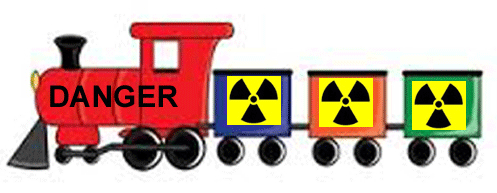
Putting the cart before the horse, the U.S. Department of Energy recently asked companies for ideas on how the government should get the rail cars needed to haul 150-ton casks filled with used, radioactive nuclear fuel.
They won’t be moving anytime soon. The latest government plans call for having an interim test storage site in 2021 and a long-term geologic depository in 2048.
No one knows where those sites will be, Continue reading
Iran’s constructive and pragmatic approach to nuclear talks

 Iran is playing a win-win game at the nuclear talks Al Arabia News Camelia Entekhabi-Fard Monday, 1 September 2014 “……. being too optimistic or too pessimistic is not constructive. Simply put, Iran’s foreign policy has been changed due to the regional and international circumstances…….
President Rowhani and his nuclear negotiating team took very constructive and major steps in order to restore Iran’s image and to try to solve disputes.
They seem to be succeeding because the supreme leader decided to change course and achieve the ambitions they had since the revolution, but in a different way. He understands the importance of being engaged in regional and international matters to play a part rather than sit back in isolation, worrying about national security.
In my opinion, what made Iran’s supreme leader back the nuclear talks and show flexibility, according to his own statement, are the events in the region and the opportunities for Iran to become a regional power once again.
The events in Iraq and Syria,the rise of extremism and Iran’s geopolitical and regional importance coalesce to make Iranians feel like they could gain by changing their language and the way they presen themselves in the region.
Nuclear bombs can’t feed the masses
Final abandonment of Fukushima communities – as governor agrees to nuclear waste storage

 Fukushima governor accepts ‘temporary’ radioactive waste storage http://www.radioaustralia.net.au/international/2014-09-01/fukushima-governor-accepts-temporary-radioactive-waste-storage/1363279 1 September 2014,
The governor of Fukushima has agreed to accept the “temporary” storage of radioactive waste from the 2011 nuclear disaster. Yuhei Sato has been cajoled with the promises of subsidies if he accepts a Japanese government plan to build a depot on land near the battered Fukushima Daiichi plant.
“I have made an agonising decision to accept plans to construct temporary storage facilities in order to achieve recovery in the environment as soon as possible,” Mr Sato told central government ministers in Tokyo. A magnitude 9.0 earthquake and subsequent tsunami in March 2011 prompted the meltdown of the Fukushima nuclear plant on Japan’s northeast coast.
The resulting plumes of radiation contaminated areas far and wide, rendering a swathe of Fukushima uninhabitable and forcing tens of thousands of people from their homes.Tokyo’s solution has been to try to scrub the radiation from the affected areas, often by lifting topsoil in the hope that contamination levels will go down. This has left the problem of what to do with all the waste, with no community in Japan prepared to accept its permanent storage.
The government’s answer has been to seek a temporary fix while it works on getting a long-term plan in place.Mr Sato’s acquiescence came after prime minister Shinzo Abe’s government offered subsidies worth more than 300 billion yen ($2.9 billion), including land rent for the facility location.
Under the plan, the government will build storage units on an area of 16 square kilometres near the power plant.
While observers have long said the area around Fukushima is the only viable option, people already displaced have seen it as unacceptable because it would in effect finalise the abandonment of their communities.
India and Japan fail to reach a deal on nuclear technology sales
 No Nuclear Deal In PM Modi’s Talks With Japanese Premier Shinzo Abe NDTV, All India | Edited by Deepshikha Ghosh September 01, 2014 TOKYO: Despite the bonhomie between Prime Minister Narendra Modi and Japanese premier Shinzo Abe, India and Japan failed to break new grounds in ongoing talks on a nuclear deal between the two countries.
Sources say the Modi government had hoped to lure investment into its $85 billion market while addressing Japan’s concerns.
India has been pushing for an agreement with Japan on the lines of a 2008 deal with the United States under which India was allowed to import US nuclear fuel and technology without giving up its military nuclear programme……..
India operates 20 mostly small reactors at six sites with a capacity of 4,780 MW, or 2 percent of its total power capacity, according to the Nuclear Power Corporation of India Limited. The government hopes to increase its nuclear capacity to 63,000 MW by 2032 by adding nearly 30 reactors. http://www.ndtv.com/article/india/no-nuclear-deal-in-pm-modi-s-talks-with-japanese-premier-shinzo-abe-585088
Video: children of UK’s nuclear veterans call for compensation
 Video: Children of nuclear guinea pigs demand compensation http://www.3news.co.nz/world/kids-of-nuclear-guinea-pigs-demand-compensation-2014090209
Tuesday 2 Sep 2014 British veterans who took part in nuclear testing in the 1950s and 1960s are campaigning for a charitable fund to help them and their relatives.
Campaigners say over the decades many of them – and their children – have suffered health problems caused by deliberate exposure to radiation.
The UK’s nuclear arsenal was developed as a result of experimental explosions, and 22,000 service personnel were used as guinea pigs – standing in line as bombs many times the power of the one used on Hiroshima were detonated at Christmas Island.
They weren’t given any protection at all – some just wearing t-shirts and jandals.
The risks of radiation were poorly understood at the time.
Watch the video for the full report.
China to start huge carbon trading scheme
China’s national carbon market to start in 2016, official says SMH, September 1, 2014 China plans to roll out its national market for carbon permit trading in 2016, an official said Sunday, adding that the government is close to finalising rules for what will be the world’s biggest emissions trading scheme.
The world’s biggest-emitting nation, accounting for nearly 30 per cent of global greenhouse gas emissions, plans to use the market to slow its rapid growth in climate-changing emissions.
China has pledged to reduce the amount of carbon it emits per unit of GDP to 40-45 per cent below 2005 levels by 2020.
It has already launched seven regional pilot markets in a bid to gain experience ahead of a nationwide scheme…….The Chinese market, when fully functional, would dwarf the European emissions trading system, which is currently the world’s biggest.
It would be the main carbon trading hub in Asia and the Pacific, where Kazakhstan and New Zealand already operate similar markets. South Korea will launch a national scheme on Jan. 1, 2015, while Indonesia, Thailand and Vietnam are drawing up plans for markets of their own. http://www.smh.com.au/business/carbon-economy/chinas-national-carbon-market-to-start-in-2016-official-says-20140901-10arz1.html#ixzz3CDBKLO8u
1 This Month
26 April – Chernobyl: Inside the Meltdown airs on National Geographic on Sunday 26th April from 4pm

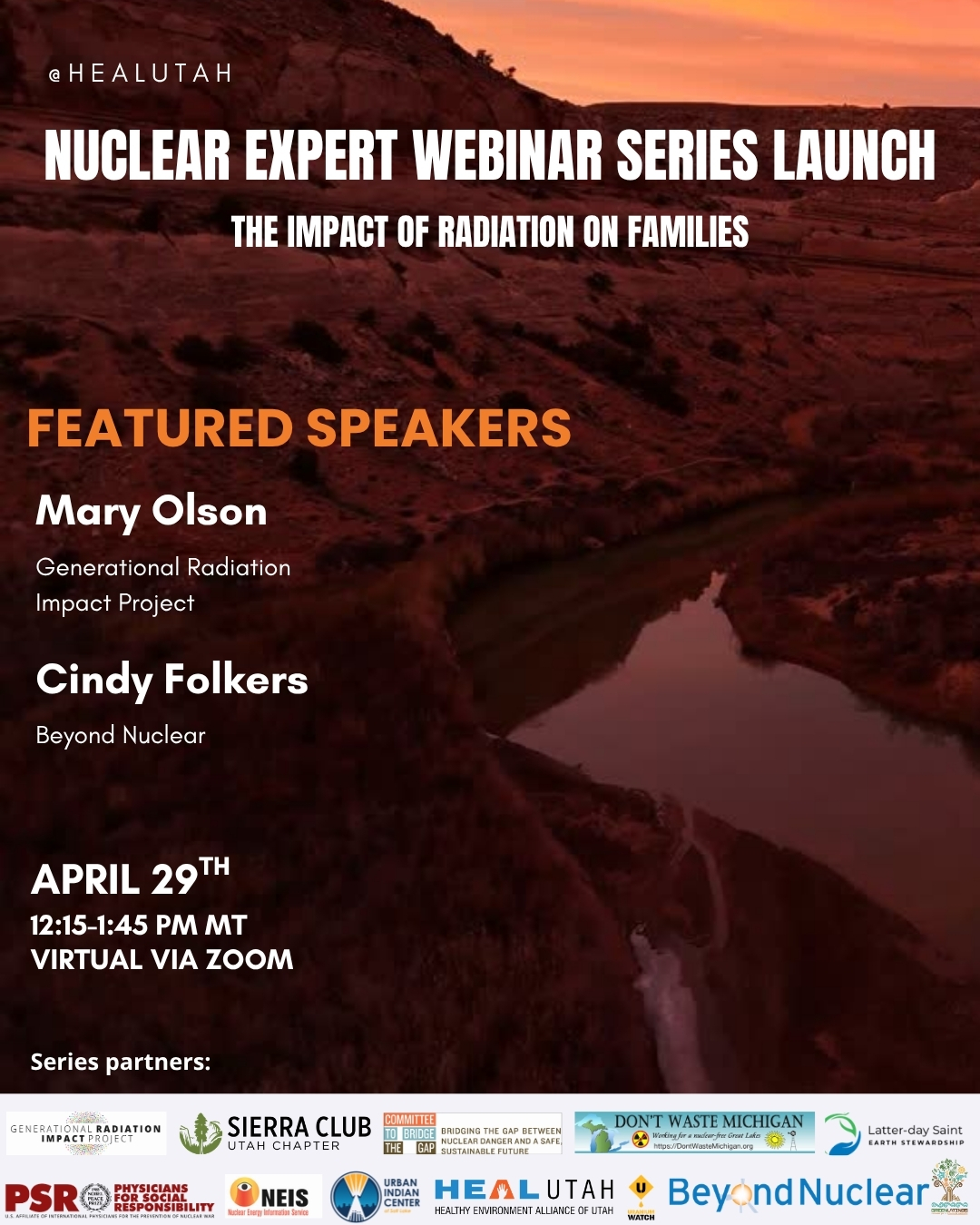
29 April – Nuclear Expert Webinar #1 – Radiation Impacts on Families with Mary Olson and Cindy Folkers
- 12:15 PM MT – 1:45 PM MT
- Location: Virtual – REGISTER TODAY

4 May -West Suburban Peace Coalition to discuss Iran war at May Educational Forum
Monday, May 4, 7:00 – 8:00 PM Central Standard Time
Title: : How Trump’s Narrative Tries to Shape the Reality of the War on Iran.
Contact Walt Zlotow, zlotow@hotmail.com 630 442 3045 for further information
14 May – online event From Bombs to Data Centres: the Face of Nuclear Colonialism

Pine Ridge Uranium is the real threat, not Tehran- Tell Burgum: Stop the Extraction.
Chernobyl: The Lost Tapes – A good documentary on Chernobyl on SBS available On Demand for the next 3 weeks– https://www.sbs.com.au/ondemand/tv-program/chernobyl-the-lost-tapes/2352741955560
To see nuclear-related stories in greater depth and intensity – go to https://nuclearinformation.wordpress.com
-
Archives
- April 2026 (338)
- March 2026 (251)
- February 2026 (268)
- January 2026 (308)
- December 2025 (358)
- November 2025 (359)
- October 2025 (376)
- September 2025 (257)
- August 2025 (319)
- July 2025 (230)
- June 2025 (348)
- May 2025 (261)
-
Categories
- 1
- 1 NUCLEAR ISSUES
- business and costs
- climate change
- culture and arts
- ENERGY
- environment
- health
- history
- indigenous issues
- Legal
- marketing of nuclear
- media
- opposition to nuclear
- PERSONAL STORIES
- politics
- politics international
- Religion and ethics
- safety
- secrets,lies and civil liberties
- spinbuster
- technology
- Uranium
- wastes
- weapons and war
- Women
- 2 WORLD
- ACTION
- AFRICA
- Atrocities
- AUSTRALIA
- Christina's notes
- Christina's themes
- culture and arts
- Events
- Fuk 2022
- Fuk 2023
- Fukushima 2017
- Fukushima 2018
- fukushima 2019
- Fukushima 2020
- Fukushima 2021
- general
- global warming
- Humour (God we need it)
- Nuclear
- RARE EARTHS
- Reference
- resources – print
- Resources -audiovicual
- Weekly Newsletter
- World
- World Nuclear
- YouTube
-
RSS
Entries RSS
Comments RSS
 nuclear-news