Lack of accountability of Russia’s nuclear corporation Rosatom
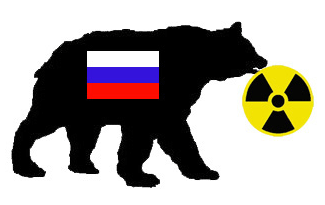 Analysis: Why we won’t be getting any nuclear power plants from Russia anytime soon, Daily Maverick, DIRK DE VOS SOUTH AFRICA 25 SEP 2014 …….who is this Rosatom, then, and what is their track record? Full details of Rosatom are hard to find, but the organisation is tracked by a Norwegian-based NGO, the Bellona Foundation, which has a significant presence in Russia. It was cobbled together from the husk of the Soviet era nuclear programme, incorporating more than 250 enterprises and scientific institutions, including all civil nuclear companies of Russia and nuclear weapons complex’s facilities. It covers everything from exploring, mining and enriching uranium, constructing and operating nuclear power plants, nuclear plant decommissioning and managing and storing spent nuclear fuel. It emerged from Russia’s energy 2003 strategy of 2003, which prioritised reducing reliance on natural gas-based power supplies which could be more profitably exported.
Rosatom is part of a central concept in Russia’s President Putin’s economic policy of having national champions or vertically integrated companies in strategic sectors that are expected to become self-sustaining, but also to advance the interests of Russia. Rosatom is the result of Putin’s efforts at restoring its nuclear energy industry, subsidised up to 2015 by $42.7 billion from the federal budget to nuclear power and industry development before 2015. Quite quickly, Rosatom has become a major player in the global nuclear sector. Rosatom owns the world’s 2nd largest uranium reserves, is the 5thlargest uranium miner, is the 4th largest in electricity generation, provides 40% of the world uranium enrichment services and 17% of the world nuclear fuel market.
…..the corporate and governance structure of Rosatom is unusual. It is governed by its own legislation, enacted in 2007, roughly translated as “On the State Atomic Corporation Rosatom“. The Corporation is not a part of the government apparatus and does 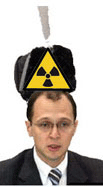 not report to government either. It has been headed by Sergey Kirienko from the outset, who, in terms of the specially adopted legislation, is appointed by the Russian president and can also be dismissed by him. The president retains wide-ranging powers. For example, by decree various enterprises and organisations can be placed under the auspices of Rosatom and become a property investment of the Russian Federation. While it is separate from the state, its funding is closely tied to the state budget.
More unusually, especially in the context of nuclear energy, its powers cover important aspect of the licensing and control over the activities of entities engaged in development, preparation, experimentation, transport, storage, liquidation and dismantlement of nuclear weapons and military nuclear energy installations. Rosatom also has the responsibility for assuring government control for the safety of nuclear materials transport, for radiological installations, and also for taking measures to warn of nuclear and radiological disasters. It therefore exercises significant oversight functions over its own activities and this function is not monitored by the Russian state either. Instead it operates under its Director General, appointed at the discretion of the Russian president.
This is not an insignificant point: When there is no history of independent nuclear regulators standing at arm’s length to the state, the processes and detailed assessments required to guarantee safety of any future facilities in the country were they are to be built are not necessarily top priority. Nuclear firms from western countries can point to a tradition of independent regulation. Safety is not just about reactor design; the Rosatom reactors 1200 MWe VVER (AES-2006) appear up to standard. Safety in nuclear is about relentless quality control, which is harder when there is no regulatory background, or when there are questionable records on quality control and corruption……
Rosatom’s success in building its book is widely ascribed to the financing terms it is able to offer. This is described in detail in different postings in a fascinating blog run by Aaron Stein who runs the nonproliferation programme at the Centre for Economics and Foreign Policy Studies in Istanbul, where he works on security and proliferation issues in the Middle East. In one posting, he gives a fascinating and detailed history of the efforts to build a (desperately needed) nuclear power plant at a site known as Akkuyu. The history goes back to the 1980s, when Turkey’s government developed a build-operate-transfer (BOT) financing model for nuclear procurement. This would see the supplying company pay 100 percent of the construction cost, operate the reactor for a specified period of time, and then transfer the operation and ownership to a local firm. The foreign nuclear firm would recoup its expenses through guaranteed electricity sales at a fixed cost.
Eventually in 1996, Stein describes how Turkey tried to open a bidding process, but after intense lobbying by nuclear firms and several missed deadlines, this mismanaged tender process was cancelled in 2001, only to be revived in 2008. Because Turkey insisted on its BOT financing model and the tight construction deadlines imposed, only a Russian-led consortium submitted a bid. The BOT financing model was one of the major reasons for this lack of interest. The problem for Turkey was the price of electricity to be generated from the facility. Eventually, this tender was also cancelled. Rather than pursue a new nuclear tender, Turkey and Russia opted to negotiate bilaterally and came to an agreement for four reactor units at a total cost of $20 billion. …..http://www.dailymaverick.co.za/article/2014-09-25-analysis-why-we-wont-be-getting-any-nuclear-power-plants-from-russia-anytime-soon/#.VCXSO2ddUnl
No comments yet.
1 This Month

of the week – Shut Down Drone Warfare!


Tell the Ukrainian Government to Drop Prosecution of Peace Activist Yurii Sheliazhenko

Petition to revoke the licensing of the Near Surface Nuclear Disposal Facility (NSDF) at Chalk River. https://www.ourcommons.ca/petitions/en/Petition/Details?Petition=e-7247
To see nuclear-related stories in greater depth and intensity – go to https://nuclearinformation.wordpress.com
-
Archives
- April 2026 (103)
- March 2026 (251)
- February 2026 (268)
- January 2026 (308)
- December 2025 (358)
- November 2025 (359)
- October 2025 (376)
- September 2025 (257)
- August 2025 (319)
- July 2025 (230)
- June 2025 (348)
- May 2025 (261)
-
Categories
- 1
- 1 NUCLEAR ISSUES
- business and costs
- climate change
- culture and arts
- ENERGY
- environment
- health
- history
- indigenous issues
- Legal
- marketing of nuclear
- media
- opposition to nuclear
- PERSONAL STORIES
- politics
- politics international
- Religion and ethics
- safety
- secrets,lies and civil liberties
- spinbuster
- technology
- Uranium
- wastes
- weapons and war
- Women
- 2 WORLD
- ACTION
- AFRICA
- Atrocities
- AUSTRALIA
- Christina's notes
- Christina's themes
- culture and arts
- Events
- Fuk 2022
- Fuk 2023
- Fukushima 2017
- Fukushima 2018
- fukushima 2019
- Fukushima 2020
- Fukushima 2021
- general
- global warming
- Humour (God we need it)
- Nuclear
- RARE EARTHS
- Reference
- resources – print
- Resources -audiovicual
- Weekly Newsletter
- World
- World Nuclear
- YouTube
-
RSS
Entries RSS
Comments RSS
 nuclear-news
Leave a comment