Painfully slow and expensive – Fukushima radioactive trash cleanup
Fukushima cleanup going painfully slow, Japan Times BY MIZUHO AOKI STAFF WRITER SEP 22, 2014 Three and a half years after Tokyo Electric Power Co.’s crippled Fukushima No. 1 nuclear power station spewed massive amounts of radioactive materials into the air and water, decontamination work in Fukushima Prefecture has yet to draw to an end.
The government initially hoped to complete the decontamination by the end of last March, but the process continues to lag far behind, prompting the government to push back the goal by three years to 2017.
Due to the slow progress, huge bags filled with contaminated soil can still be seen piled up at hundreds of temporary storage sites across the prefecture, and many residents are in limbo, unable to make up their minds about whether to return home in the near future or to relocate for good.
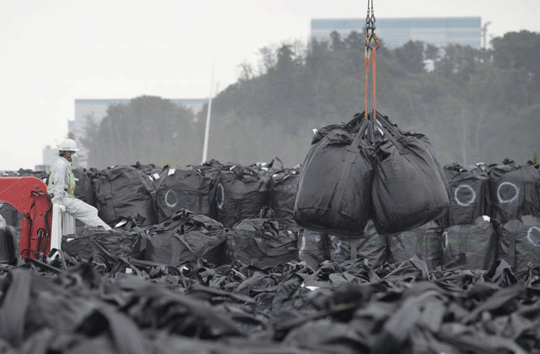
How are toxic houses and land decontaminated?
The work mainly consists of scraping off the top layer of soil, removing grass and fallen leaves, and washing roofs and walls with water or wiping them off with cloth.
As of March, the removed soil and grass was being stored at more than 660 temporary storage sites set up by municipal governments in Fukushima and at 53,000 decontaminated spots such as school grounds and people’s front yards, according to the Fukushima Minpo newspaper………
Why is it taking so long?
The major reason is the lack of temporary storage sites that would be used until the government builds more permanent facilities.
Some residents are opposing the temporary storage of contaminated waste out of fear of radiation and uncertainty over how long the bags of tainted soil will be stored there.
But the central government hopes to speed up the whole process after reaching agreement with Fukushima Gov. Yuhei Sato on Sept. 1 to build temporary storage facilities in Okuma and Futaba in return for ¥301 billion in subsidies.
The government plans to start moving waste to the facilities in January and complete the transportation in three years.
The government is currently mulling the best way to move the contaminated waste. Last Thursday, the Environment Ministry proposed a transportation plan to a panel of experts, including using 10-ton dump trucks on expressways to deliver the soil quickly — and hopefully safely — to sites where it will likely sit for decades awaiting permanent disposal.
Will the government’s plan work?
That remains to be seen. The government still needs to negotiate with more than 2,000 landowners to acquire 16 sq. km of land in Okuma and Futaba to build the storage facilities…….
The total is estimated to reach 22 million cu. meters, equal to filling the Tokyo Dome 18 times.
Within three decades, the waste is supposed to moved to the final disposal sites the government plans to create outside Fukushima. However, the locations of these final sites have yet to be found.
The neighboring prefectures are having their own problems with radiation-tainted waste, as their residents are strongly opposed to storage nearby.
In July, the Environment Ministry designated a plot of state-owned land in Shioya, in Tochigi Prefecture, but the mayor and residents are opposed to the plan, saying it will damage the environment in which they live…….
The government estimates that the decontamination will cost about ¥2.5 trillion in total. But according to a calculation by the National Institute of Advanced Industrial Science and Technology, it could be twice as much, reaching a staggering ¥5 trillion. http://www.japantimes.co.jp/news/2014/09/22/reference/fukushima-cleanup-going-painfully-slow/#.VCNe35RdUnk
No comments yet.
1 This Month

of the week – Shut Down Drone Warfare!


Tell the Ukrainian Government to Drop Prosecution of Peace Activist Yurii Sheliazhenko

Petition to revoke the licensing of the Near Surface Nuclear Disposal Facility (NSDF) at Chalk River. https://www.ourcommons.ca/petitions/en/Petition/Details?Petition=e-7247
To see nuclear-related stories in greater depth and intensity – go to https://nuclearinformation.wordpress.com
-
Archives
- March 2026 (230)
- February 2026 (268)
- January 2026 (308)
- December 2025 (358)
- November 2025 (359)
- October 2025 (376)
- September 2025 (257)
- August 2025 (319)
- July 2025 (230)
- June 2025 (348)
- May 2025 (261)
- April 2025 (305)
-
Categories
- 1
- 1 NUCLEAR ISSUES
- business and costs
- climate change
- culture and arts
- ENERGY
- environment
- health
- history
- indigenous issues
- Legal
- marketing of nuclear
- media
- opposition to nuclear
- PERSONAL STORIES
- politics
- politics international
- Religion and ethics
- safety
- secrets,lies and civil liberties
- spinbuster
- technology
- Uranium
- wastes
- weapons and war
- Women
- 2 WORLD
- ACTION
- AFRICA
- Atrocities
- AUSTRALIA
- Christina's notes
- Christina's themes
- culture and arts
- Events
- Fuk 2022
- Fuk 2023
- Fukushima 2017
- Fukushima 2018
- fukushima 2019
- Fukushima 2020
- Fukushima 2021
- general
- global warming
- Humour (God we need it)
- Nuclear
- RARE EARTHS
- Reference
- resources – print
- Resources -audiovicual
- Weekly Newsletter
- World
- World Nuclear
- YouTube
-
RSS
Entries RSS
Comments RSS
 nuclear-news
Leave a comment