Environmental causes of cancer: dispelling the “inheritance myth”
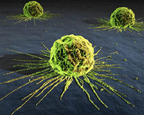
 The Inheritance Myth Time to Talk Frankly About Cancer CounterPunch, by KRISTINE MATTIS SEPTEMBER 17, 2014 In a September 2014 article in the Journal of the American Medical Association, Dr. Mary-Claire King – the woman who first discovered the so-called breast cancer gene BRCA1 – and her colleagues suggested that all women should undergo routine medical screening for this gene as well as BRCA2. Of course, it seems reasonable that women should know if they carry these mutant allele forms of these genes, because the mutant genes confer a greater risk for breast cancer and ovarian cancer in women who have the mutants than in women who do not.
There has been some discussion about Dr. King’s proposal in newspapers and on the radio, but the dialogue inevitably has two tremendous pieces of the cancer puzzle missing: cause and prevention. In fact, too much cancer information tends to be myopic, neglecting to mention essential elements of the global portrait of cancer etiology. Conventional wisdom about cancer tends to end up promulgating misinformation and misinterpretations, not sound science. Dr. King’s piece, as well the highly publicized bi-annual Stand Up to Cancer celebrity charity telethon, which raises money for cancer treatment, have done nothing to provide more clear information to the public that could help avert this all-too-common but potentially highly preventable scourge that has caused suffering upon and taken the lives of so many of our friends and family.
First and foremost, it is important to emphasize that cancer is NOT heritable. Actor Piece Brosnan proclaimed on the aforementioned telethon that cancer was a “wretched inherited disease.” It certainly is wretched, but is not inherited nor is it really a single disease……..
the BRCA1 and BRCA2 mutant genes do not cause cancer; they merely make it more difficult for your cells to repair damage done to your DNA. When your cells are exposed to a cancer-causing agent (i.e., a carcinogen) such as ionizing radiation, certain natural and synthetic compounds, certain viruses, and some endocrine disrupting chemicals, to name a few, they have mechanisms to repair the damage that agent may cause to your DNA. But if the damage is too severe or widespread, or if the cell lacks that mechanism for repair, as in the case of those who have the “breast-cancer genes,” your risk of contracting cancer is increased.
It is basic scientific knowledge that cancer is not inheritable, but in light of the discovery of various genes that confer increased susceptibility to cancer, this fact is not always well understood by the population at large. Only 5-10% of people who contract any type of cancer have any sort of inherited genetic susceptibility. Therefore, the focus on inherited mutant alleles leaves out the majority 90-95% of people suffering from cancer. While it is true that the minority 5-10% who do have these mutant alleles have a much greater risk for disease than the rest of us, they do not have an inherent “predisposition” to cancer. Labeling these genes as “cancer genes” or even “genetic predispositions” is a terrible misnomer. These genes increase susceptibility to cancer when exposed to cancer causing agents……….
More and more we are learning that many of the over 80,000 synthetic chemicals that humans have constructed over the course of the last century or so not only directly cause DNA mutations that lead to cancer, but mimic estrogen in our bodies, which indirectly lead to cancer. These chemicals are in food we eat, the air we breathe, the water we drink, and the endless industrial products we produce and consume. They are quite often the products and processes of industry, and are not essential to maintain a comfortable life on this planet. In addition, the radiation we receive from sources such as diagnostic exams via x-ray, CT scan, and other radiologic medical procedures are being shown to contribute to excess cancers. For example, the UK Committee on Medical Aspects of Radiation in the Environment recently stated that one out of 2000 people will contract cancer due to abdominal CT scans – otherwise known as an iatrogenic cancer. This may seem a fairly small risk, unless you are that one person who has had an unnecessary CT scan and then is diagnosed with a preventable cancer because of it……
for some reason, this plain and simple fact that exposure to carcinogens can and does lead to cancer is always absent in the medical discussion of cancer. Part of the reason may be that medical practitioners are rarely, if ever, versed in environmental health, so they are not even educated about environmental toxicology and the myriad diseases caused by environmental exposures. But part of the reason is likely political and economic. Real biological causes of cancer seem to be verboten because scientists and scholars who speak these truths are condemned, defamed, and discredited by the powerful industrial public relations machine, which has multi-billions of dollars worth of revenue to protect, as it maintains the businesses and industries that introduce so many of the carcinogenic products in our world.
Another important clarification in discussing cancer is that diagnosis does not equal prevention. In an Orwellian twist of double-speak, health care professionals have delineated different forms of “prevention” and have decided that the diagnosis and screening for cancer is what they deem “secondary prevention.” In truth, diagnosis is not prevention at all and should not be termed as such. …….
When discussing cancer, the lack of conversation about our ubiquitous exposures to carcinogens is highly negligent. ……http://www.counterpunch.org/2014/09/17/time-to-talk-frankly-about-cancer/
No comments yet.
1 This Month

of the week – Shut Down Drone Warfare!


Tell the Ukrainian Government to Drop Prosecution of Peace Activist Yurii Sheliazhenko

Petition to revoke the licensing of the Near Surface Nuclear Disposal Facility (NSDF) at Chalk River. https://www.ourcommons.ca/petitions/en/Petition/Details?Petition=e-7247
To see nuclear-related stories in greater depth and intensity – go to https://nuclearinformation.wordpress.com
-
Archives
- April 2026 (79)
- March 2026 (251)
- February 2026 (268)
- January 2026 (308)
- December 2025 (358)
- November 2025 (359)
- October 2025 (376)
- September 2025 (257)
- August 2025 (319)
- July 2025 (230)
- June 2025 (348)
- May 2025 (261)
-
Categories
- 1
- 1 NUCLEAR ISSUES
- business and costs
- climate change
- culture and arts
- ENERGY
- environment
- health
- history
- indigenous issues
- Legal
- marketing of nuclear
- media
- opposition to nuclear
- PERSONAL STORIES
- politics
- politics international
- Religion and ethics
- safety
- secrets,lies and civil liberties
- spinbuster
- technology
- Uranium
- wastes
- weapons and war
- Women
- 2 WORLD
- ACTION
- AFRICA
- Atrocities
- AUSTRALIA
- Christina's notes
- Christina's themes
- culture and arts
- Events
- Fuk 2022
- Fuk 2023
- Fukushima 2017
- Fukushima 2018
- fukushima 2019
- Fukushima 2020
- Fukushima 2021
- general
- global warming
- Humour (God we need it)
- Nuclear
- RARE EARTHS
- Reference
- resources – print
- Resources -audiovicual
- Weekly Newsletter
- World
- World Nuclear
- YouTube
-
RSS
Entries RSS
Comments RSS
 nuclear-news
Leave a comment