An insight onto the nuclear industry’s manipulations to shift their cost burdens
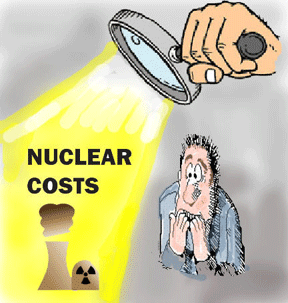 Vendors adapt to financing role World Nuclear News, 5 September 2014 Nuclear power reactor vendors have been forced to adapt to the fact that governments are no longer willing to assume the financial risks associated with nuclear new build projects, Jerry Hopwood, vice president of product development at Candu Energy, said on 12 September….
Private sector models are difficult to execute for nuclear projects due to first-of-a-kind issues, their large capital requirement, long construction timescales and investor return expectations. But they can work within a positive framework of incentives – for example the UK’s contract for difference model, he said..
Several emerging markets are still developing state-owned models, but are incorporating mechanisms where risks are placed with the appropriate parties, such as nuclear initial public offerings and build-own-operate-transfer.
“Public-private partnership seems to be where the sector is going,” he said.
Public-private partnerships
This combination means a project is financed by both the government and a private investor, with the public share able to attract export credit. Such a model requires a power purchase agreement matched to debt obligations and the project risks are allocated between government agencies and private companies.
Regulatory and technology risks are “two separate sides to the same coin,” he said. Other risks include engineering, supply and project management; technical services; skilled labour and availability and rates; training and commissioning, and lifetime operational support.
Government sponsored financial incentives encourage private sector companies to take increased financial responsibility for nuclear new build projects.
These include contracts for difference and power purchase agreements, loan guarantees, export credits, carbon credits, and cost and schedule overruns.
“Vendors play a critical role in the success of the public-private partnership model by focusing on key areas, which are project risk reduction and regulatory feedback. No matter how the risks are allocated, if they are too high, you won’t get the financing,” he said…….
Collaboration
“Working closely with regulators, vendors can ensure that reactor designs meet safety and environmental standards before project deployment,” he said. “A vendor pre-project design review of a new nuclear power plant allows the regulatory body an opportunity to assess a design prior to any licensing activities and to identify potential issues that would require resolution.”
Further co-ordination between regulators, either bilaterally or through multi-lateral forums, such as MDEP [Multinational Design Evaluation Program], can help to harmonize views and mitigate risks. In that way a design qualified in the home country can be used elsewhere. We need regulatory cooperation across the world,” he said.
The success of future new build projects is “imperative” to ensure the long-term sustainability and growth of the industry, he said. “Failure is not an option.“……
Vendor-led financing is not sustainable in the long term, Hopwood said.
“I think it’s a sort of kick starting mechanism, a way to get projects going so that we start to have a track record,” he told World Nuclear News. “Whether it be in a big way or a small way, it’s showing vendor commitment and it’s getting some projects on the books and going and creating a track record and that’s the value of it and necessarily it must lead to more.”
“If we picture a world with many nuclear projects going ahead – there are 71 nuclear units under construction at the moment – the financing requirement is far more than any vendor or even any individual utility can finance, so financing has to come from aggregating from many sectors in order to have a flourishing nuclear industry. The demand for money is going to be so great that it will necessarily require us to seek out all sorts of funding, all kinds of capital formations,” he said. http://www.world-nuclear-news.org/NN-Vendors-adapt-to-financing-role-1509201401.html
At last – thorough research into cancers caused by world’s first atomic-bomb test
a sadness that still hangs over Tularosa.
“Whole families have died here,”

 Decades After Nuclear Test, U.S. Studies Cancer Fallout http://online.wsj.com/articles/decades-after-nuclear-test-u-s-studies-cancer-fallout-1410802085
Examination Will Probe Radiation Exposure Near 1945 Trinity Blast in New MexicoBy
DAN FROSCH Write to Dan Frosch at dan.frosch@wsj.com Sept. 15, 2014 TULAROSA, N.M.—Nearly 70 years after the U.S. conducted the world’s first atomic-bomb test here in the New Mexico desert, federal researchers are slated to visit the state this month to begin studying whether some residents developed cancer due to the blast.
As part of the long anticipated project, scheduled to start Sept. 25, investigators with the National Cancer Institute will interview people who lived in the state around the time of the 1945 Trinity test and assess the effects of consuming food, milk and water that may have been contaminated by the explosion.
For years, residents of the rural, heavily Hispanic villages near the test site have claimed that a mysterious wave of cancer has swept through this dusty stretch of south-central New Mexico, decimating families and prompting calls for the government to determine whether radiation exposure played a role. Continue reading
India’s uranium legacy of birth defects
 India’s nuclear nightmare: The village of birth defects The Star.com By: Raveena Aulakh on Mon Sep 15 2014 Indian court trying to unravel mystery of sick and disabled children, miscarriages and fatal cancers around the country’s first uranium mine……..Now, an Indian court wants to unravel the mystery of what is happening in Jadugora, the hub of India’s uranium mining industry since the late 1960s……..
Today, nuclear power provides less than 5 per cent of India’s electricity. The aim is to make it 25 per cent by 2050. This month, Australia signed an agreement giving India access to its vast supplies of uranium.
But activists say Jadugora is paying the price for India’s nuclear dreams……….
Until a decade ago, miners took their uniforms home to be washed by their wives or daughters, says Xavier Dias, a political activist who has worked for decades with the indigenous people who made up the majority of the mine’s workforce.
“They never wore masks then … or boots. Or even gloves.”
The workers were free to take building materials from the mine and even waste material, which they used to build their homes, he says.
When people began to notice that young women were having miscarriages, witches and spirits were blamed. Prayers were said to ward off the “evil eye.” But people had lesions, children were born with deformities, hair loss was common. Cows couldn’t give birth, hens laid fewer eggs, fish had skin diseases.
“If you ask the tribals (as the indigenous people are known) who have lived there for decades, long before uranium was discovered, they will tell you that they lived healthy lives, drank from the rivers, ate fruits and vegetables … and they never saw the inside of a hospital,” says Dias……
In Jadugora, tailing ponds take up more than 65 hectares — and they are all uncovered with easy access for people and animals. A few homes stand fewer than 50 metres from the pond’s edge. There are some no-trespassing signs, but children still play cricket or hopscotch nearby. Another tailing pond a few kilometres away sits beside a busy street with pipes constantly delivering more sludge.
The tailing ponds tend to overflow, especially during monsoon season, say villagers. If that happens, radioactivity can seep out and contaminate the groundwater and rivers. River water is used for washing and bathing, sowing and irrigation — and sometimes for drinking.
Trucks filled with yellow cake or mine waste trundle day and night along the highway. The cakes are covered with flimsy plastic covers; sometimes bits of rubble fall off………
The Jharkhand High Court is also looking for answers.
In March, it sent a notice to UCILasking for an explanation for the deformities, cancers and miscarriages around the Jadugora mine. It based the notice on local media reports, which included shocking pictures of children who were sick or deformed. (The demand was made by the court unilaterally, without a filing by officials or victims, in what is known as a suo moto action.)
According to local reports, UCIL told the court that the radiation emitted through its mining is under permissible limits and contained within a safe zone. The court refused to accept the submissions because they were old.
In August, the court also asked that the company disclose the radiation levels and the presence of any heavy metals in soil and water in the cluster of villages around Jadugora. It also asked UCIL to explain how it ensures the safety of those who live near radioactive waste.
The answers are due in November……….
While families of children with deformities will tell their stories to reporters, the families of women who have been unable to get pregnant or who have had unexplained miscarriages often don’t.
Since Jadugora’s health problems made the local newspapers, few families receive marriage offers for their daughters. In a country where not being able to bear children is such a stigma that women are either thrown out by their in-laws or banished to their parents’ homes, Jadugora women are now tainted and unwanted……….http://www.thestar.com/news/world/2014/09/15/indias_nuclear_nightmare_the_village_of_birth_defects.html
South Africa’s nuclear power plans clouded in secret deals

 Eskom not taking part in nuclear acquisition BUSINESS DAY BY CAROL PATON, 15 SEPTEMBER 2014, ESKOM, FORMERLY DESIGNATED THE “OWNER AND OPERATOR” OF SA’S NUCLEAR PROGRAMME, WILL NOT BE INVOLVED IN THE UP COMING NUCLEAR PROCUREMENT, SAY DEPARTMENT OF ENERGY OFFICIALS, EXCEPT AS THE PURCHASER OF POWER FROM A NEW — POSSIBLY FOREIGN — NUCLEAR ENTITY.
The Cabinet subcommittee on energy security is deep into the technical work needed to procure a massive nuclear fleet. Key to the procurement going ahead will be the financing arrangements, as the construction of nuclear plants has enormous capital costs.
While the Nuclear Energy Policy for SA of 2008 designates Eskom as the “owner and operator of nuclear power plants in SA”, department acting director-general Wolsey Barnard said recently that both Eskom’s financial circumstances and the availability of alternative financing arrangements for energy meant this would have to change.
“The nuclear policy has not yet changed, but what needs to be realised is that the financial position of Eskom has deteriorated since 2008 and to expose Eskom to such a project at this stage would not be sustainable. ……..
Insufficient consultation
Though the government feels confident that public opinion has been taken into account, neither business nor labour agrees that consultation has been sufficient.
The National Development Plan urged caution on nuclear power, saying other options — such as natural gas — should be explored first.
Business Unity SA (Busa) acting CEO Cas Coovadia said “an effective debate on our energy options in the long term” was urgently required. Busa is working to draft an energy policy both for SA’s immediate and long-term needs, he said.
National Union of Mineworkers general secretary Frans Baleni, whose union is a leading opponent of nuclear energy in the Congress of South African Trade Unions, said the union was dead-against nuclear power over safety and cost issues.
“As a country we have not had a dialogue on nuclear power. The process is not transparent and will be easily corrupted. It will make the arms deal look like a Sunday picnic. And the National Development Plan (NDP) is not positive on nuclear. Government can’t pick and choose on the NDP; if they do it is not a plan,” said Mr Baleni……….
Eskom spokesman on nuclear power Tony Stott. said there would be another opportunity for comment through the National Nuclear Regulator’s and Nersa’s licensing processes.
However, these will be long after the contracting is completed. http://www.bdlive.co.za/business/energy/2014/09/15/eskom-not-taking-part-in-nuclear-acquisition
South Africa’s very suspect plan for vendor-financed nuclear power
A nuclear tale that sounds too good to be true Business Day BY CAROL PATON, 15 SEPTEMBER 2014, BUILD now, pay much later. That is the good news story about nuclear energy being told to SA’s decision-makers. In this model, a nuclear vendor and a financier — usually the government of the country of the vendor or a state-owned enterprise or bank — come as a package. The loan from the financier is repaid from the electricity tariff over the long term, 15 to 20 years, and repayments begin when electricity is produced.
The vendor-financed option has made the scary R1-trillion price tag, wielded by Department of Energy and Treasury officials as a warning to their political principals, disappear in a puff of smoke. The nuclear option appears even more attractive when vendors move onto the next part of the story: as operating costs for nuclear energy are low, and the expense lies in construction, once the loan is repaid, energy becomes a virtual “cash cow” for the operator, and any private investors, for up to 30 years………
The clear frontrunners in this are French company Areva and Russian state-owned enterprise Rosatom. Both offer technology and finance in one package, with some differences. At the heart of both is a power purchase agreement in which the operator of the grid, Eskom, would make an irrevocable commitment to purchase the electricity at an agreed tariff………
An important part of the financing package for vendors interested in SA is the government’s commitment in the nuclear policy of 2008 to a fleet approach. Vendors are able to offer better prices if a fleet of reactors is procured as they get better at building them. Some vendors will not consider SA at all without a fleet procurement.
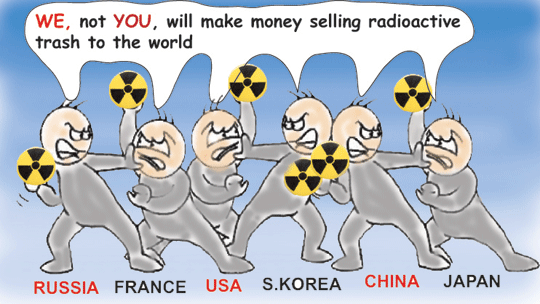
This is what lies behind SA’s curious decision in the IRP 2010, SA’s electricity plan, to include 9,600MW of nuclear power in the energy mix. This would amount to a fleet of six Areva reactors (or more, if other vendors with smaller reactors are selected). As electricity demand is far from certain, and has not grown as expected over the past two years or more, overbuilding capacity is a risk.
Independent analysts, such as Prof Harald Winkler of the University of Cape Town, argue that even a nuclear fleet would be more expensive than other options and would lock SA into even higher electricity prices with negative effects on the economy.
Costs such as insurance in the event of a nuclear accident, dealing with the waste, and decommissioning the plant, are not built into the construction prices.
The conclusion of all of this is that the magnitude of the government guarantees required in a R400bn-R800bn nuclear plant building exercise remain very difficult to estimate. Whatever the size of the guarantee and its purpose — for construction or as a guarantee to purchase the power — it would have to find its way onto SA’s contingent liabilities……..
Despite the good “build now, pay later” message being punted by nuclear vendors, the probability is that it will be business and consumers that not only pay later, but pay much more. http://www.bdlive.co.za/business/energy/2014/09/15/news-analysis-a-nuclear-tale-that-sounds-too-good-to-be-true
Nuclear power in America: condition terminal?
 If it’s not Sustainable, its condition is Terminal.http://geoharvey.wordpress.com/ September 15, 2014
¶ The most recent reported status of US nuclear power plants can be found at the US Nuclear Power Report. It is a distressingly dull digest of information from the NRC, posted most weekdays and Saturdays, most recently on September 15. Latest information is that out of 100 US reactors, 11 were at reduced output and 5 were not operating.
¶ By NRC reckoning, Vermont Yankee (VY) is running at 100% of capacity. When the NRC rates output at 100%, it means it is 124% of specification. The plant is at 106% of its intended lifespan and the spent fuel pool has 500% of its intended load.
¶ Video: Energy Week with George Harvey and Tom Finnell, September 11
¶ Comments: End Life Support for the Fossil Fuel Industry, September 7
geoharvey is one of George Harvey’s Blogs.
Kiev threatens to restart nuclear weapons program
 ‘Inmates running the asylum’: Kiev threatens to restart nuclear weapons program RT.com September 15, 2014 Kiev’s promise to restart its nuclear weapons program if it doesn’t get enough support from the West is completely insane, be it real or just an empty threat, political commentator Daniel Patrick Welch told RT.
“If we cannot protect Ukraine today, if the world doesn’t help us, we will have to go back to the development of nuclear weapons, which will protect us from Russia,” Ukrainian Defense Minister Valery Geletey said in an interview with Ukrainian TV, also claiming that NATO members have already started supplying Kiev with conventional weapons.
NATO members start supplying weapons to Kiev – Ukrainian Defense Minister ……http://rt.com/op-edge/187772-ukraine-nuclear-program-us/
Political risk for Finland’s government in Russian nuclear build deal
 Finnish Greens Warn Over Russian Nuclear Project Junior Party Opposes Reactor to Be Built by Finnish-Russian Consortium WSJ By JUHANA ROSSI Write to Juhana Rossi at juhana.rossi@wsj.com Sept. 15, 2014
HELSINKI—Finland’s Prime Minister Alexander Stubb said he is confident his government will remain in office despite a junior party’s threat to quit the government over a proposal to allow a Finnish-Russian consortium to proceed with its controversial nuclear power-plant project in Finland.
 Finland’s Minister of the Environment Ville Niinisto said Monday he will take the Greens of Finland out of government if it issues on Thursday a preliminary permit for Fennovoima Oy to build a nuclear reactor on a greenfield site on the west coast of Finland. The Greens party is a junior partner in Finland’s five-party coalition government…..
Mr. Niinisto said that the Greens cannot abide by a potential government decision. In case the decision goes against the Greens’ wishes, Mr. Niinisto said he would submit a request at a party meeting this weekend for the Greens to withdraw from the government. If the Greens choose to exit, the government will command a razor-thin majority of 101 votes in Finland’s 200-seat parliament…….
The escalation of the Ukraine crisis this year has cast further doubt over Fennovoima. Mr. Niinisto cited Rosatom’s close links with Russian government as one of the reasons why he is firmly opposed to Fennovoima’s project…….
Deterred by risks and the potentially high costs associated with nuclear power, several of Fennovoima’s Finnish investors have backed away from the project in recent years. As a result, now only 54 percentage points of Voimaosakeyhtio SF’s 66% stake in Fennovoima have actually been subscribed to by Finnish investors, while remaining 12 percentage points don’t have an assigned investor.
Mr. Vapaavuori said that at least 60% of Fennovoima has to be owned by investors from Finland or more broadly from the EU. Otherwise Fennovoima won’t be granted a building permit, the final stage in the approval process for a new nuclear reactor. http://online.wsj.com/articles/finnish-greens-warn-over-russian-nuclear-project-1410805908
1 This Month
Chernobyl: The Lost Tapes – A good documentary on Chernobyl on SBS available On Demand for the next 3 weeks– https://www.sbs.com.au/ondemand/tv-program/chernobyl-the-lost-tapes/2352741955560

of the week–London Campaign for Nuclear Disarmament

Tell the Ukrainian Government to Drop Prosecution of Peace Activist Yurii Sheliazhenko
To see nuclear-related stories in greater depth and intensity – go to https://nuclearinformation.wordpress.com
-
Archives
- April 2026 (152)
- March 2026 (251)
- February 2026 (268)
- January 2026 (308)
- December 2025 (358)
- November 2025 (359)
- October 2025 (376)
- September 2025 (257)
- August 2025 (319)
- July 2025 (230)
- June 2025 (348)
- May 2025 (261)
-
Categories
- 1
- 1 NUCLEAR ISSUES
- business and costs
- climate change
- culture and arts
- ENERGY
- environment
- health
- history
- indigenous issues
- Legal
- marketing of nuclear
- media
- opposition to nuclear
- PERSONAL STORIES
- politics
- politics international
- Religion and ethics
- safety
- secrets,lies and civil liberties
- spinbuster
- technology
- Uranium
- wastes
- weapons and war
- Women
- 2 WORLD
- ACTION
- AFRICA
- Atrocities
- AUSTRALIA
- Christina's notes
- Christina's themes
- culture and arts
- Events
- Fuk 2022
- Fuk 2023
- Fukushima 2017
- Fukushima 2018
- fukushima 2019
- Fukushima 2020
- Fukushima 2021
- general
- global warming
- Humour (God we need it)
- Nuclear
- RARE EARTHS
- Reference
- resources – print
- Resources -audiovicual
- Weekly Newsletter
- World
- World Nuclear
- YouTube
-
RSS
Entries RSS
Comments RSS
 nuclear-news