The high financial risk of nuclear power
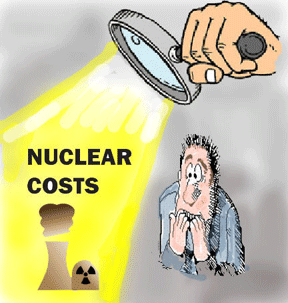 A nuclear tale that sounds too good to be true Business Day BY CAROL PATON, 15 SEPTEMBER 2014, “…….The World Nuclear Industry Status Report 2014, sponsored in part by the anti-nuclear Green Party in the European Parliament, contains dire warnings on accepting these undertakings at face value. The report shows that nuclear energy globally is in decline due in the most part to nuclear accidents, the scale of the finance required, and the enormous risk of cost and time overruns during construction. The world has 50 fewer nuclear plants today than in 2002, with an installed capacity less than two decades ago.
The high risk in the construction of nuclear plants means that the only way that nuclear power plants are built any more is when the vendors bring the financing.
“Commercial banks will not finance it; development banks won’t finance it. Not only are these very large loans, but nobody knows what the plant will cost in the end. The only options for financing are through government subsidies or when the vendor brings its own backing,” the report’s lead writer, energy analyst Mycle Schneider, said in an interview.
Of the 67 reactors under construction, eight have been under construction for more than 20 years and 49 have encountered construction delays, most of them significant, says the report.
Who bears the risk of cost and time overruns? With international experience indicating that cost overruns are between 50% and 200%, the Treasury would need to assume at least a 100% overrun. How this risk is managed will depend on contracting arrangements. While vendors insist there are models in which the vendor takes all the risk, this has not persuaded Treasury officials.
Apart from the fact that nuclear vendors usually want governments to share the construction risk, the undertaking to purchase the power they produce is irrevocable. The key way in which vendors have tried to mitigate risk is through the agreed feed-in tariff. In the example of the Hinkley Point power plant under construction in the UK, the guaranteed tariff will be £92.50/MWh, more than double Eskom’s average electricity price and much more expensive than other base-load options considered in SA’s electricity plan, the Integrated Resource Plan (IRP). It is also roughly twice the current bulk level price in the UK, says Mr Schneider, and “by the time the reactors are scheduled to generate power in 2023, the price will reach a staggering £121/MWh”.
Rosatom’s Turkey project, where construction has not begun, involves a 15-year power purchase agreement, with a guaranteed tariff of $123.5/MWh rising to $153.3/MWh if necessary to ensure payback of the project. The higher limit is 50% higher than the wholesale price for electricity in Turkey in 2010…………http://www.bdlive.co.za/business/energy/2014/09/15/news-analysis-a-nuclear-tale-that-sounds-too-good-to-be-true
1 Comment »
Leave a comment
1 This Month
10 March A LIVE WEBINAR THE REAL EFFECTS OF NUCLEAR POWER
What the Industry Isn’t Telling Us
1:00 PM Mountain, 2 pm Central, 3 pm Eastern. Live on the Keepers of the Water Facebook page

18 March Webinar @ 1 PM EST: An Assessment of SMR Projects: The Case of Canada
register for the zoom:
https://us02web.zoom.us/webinar/register/WN_o8BIIOUvQ2ONJR1nta65DQ#/registration


of the week – STOP SMALL MODULAR REACTORS IN CANADA
To see nuclear-related stories in greater depth and intensity – go to https://nuclearinformation.wordpress.com
-
Archives
- February 2026 (268)
- January 2026 (308)
- December 2025 (358)
- November 2025 (359)
- October 2025 (376)
- September 2025 (258)
- August 2025 (319)
- July 2025 (230)
- June 2025 (348)
- May 2025 (261)
- April 2025 (305)
- March 2025 (319)
-
Categories
- 1
- 1 NUCLEAR ISSUES
- business and costs
- climate change
- culture and arts
- ENERGY
- environment
- health
- history
- indigenous issues
- Legal
- marketing of nuclear
- media
- opposition to nuclear
- PERSONAL STORIES
- politics
- politics international
- Religion and ethics
- safety
- secrets,lies and civil liberties
- spinbuster
- technology
- Uranium
- wastes
- weapons and war
- Women
- 2 WORLD
- ACTION
- AFRICA
- Atrocities
- AUSTRALIA
- Christina's notes
- Christina's themes
- culture and arts
- Events
- Fuk 2022
- Fuk 2023
- Fukushima 2017
- Fukushima 2018
- fukushima 2019
- Fukushima 2020
- Fukushima 2021
- general
- global warming
- Humour (God we need it)
- Nuclear
- RARE EARTHS
- Reference
- resources – print
- Resources -audiovicual
- Weekly Newsletter
- World
- World Nuclear
- YouTube
-
RSS
Entries RSS
Comments RSS
 nuclear-news
Reblogged this on Imbuteria's Blog.