New book: Fukushima: Dispossession or Denuclearization?
 Fukushima: Dispossession or Denuclearization? http://www.lulu.com/shop/nadesan-boys-mckillop-wilcox/fukushima-dispossession-or-denuclearization/ebook/product-21800492.html By eBook (ePub)
The Fukushima nuclear power plant explosions and the Hiroshima/Nagasaki bombings are intimately connected events, bound together across time by a nuclear will to power that holds little regard for life. In Fukushima: Dispossession or Denuclearization? contributors document and explore diverse dispossession effects stemming from this nuclear will to power, including market distortions, radiation damage to personal property, wrecked livelihoods, and transgenerational mutations potentially eroding human health and happiness. Liberal democratic capitalism is itself disclosed as vulnerable to the corrupting influences of the nuclear will to power. Contributors contend that denuclearization stands as the only viable path forward capable of freeing humans from the catastrophic risks engineered into global nuclear networks. They conclude that the choice of dispossession or denuclearization through the pursuit of alternative technologies will determine human survival across the twenty-first century.
The contributors are:
Majia Nadesan, Adam Broinowski, Richard Wilcox, Tony Boys, Chris Busby, Paul Langley, Harvey Wasserman, Christian T. Lystbaek, Andrew McKillop, The Fukushima Five, William Banzai 7.
This book available as an e-book. but also as print version The book (printed version) is available at http://www.lulu.com/shop/nadesanboysmckillopwilcox-editors/fukushima-dispossession-or-denuclearization/paperback/product-21798972.html
All proceeds after costs go to the Fukushima Collective Evacuation (Trial Team)http://www.youtube.com/watch?feature=player_embedded&v=rGuvFn8nJJA
Toshio Yanagihara- Katsumi Hasegawa: “The 2nd Fukushima Collective Evacuation Trial”
Uncompetitive nuclear industry is rigging regulations and “spinning” media in order to survive
 Killing the Competition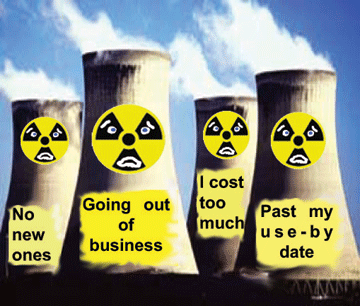
Exelon and Entergy see sustainable energy solutions—renewable energy, efficiency, conservation, etc.—as a long-term threat to
their profits. This is not because of excessive regulations or safety requirements on nuclear power: the industry has not had to implement a single safety upgrade due to the Fukushima meltdowns and faces less regulatory enforcement than it did twenty years ago. The closure of a record number of reactors since 2013 has exposed fundamental economic problems facing the industry, and a growing number of nuclear plants simply cannot compete with modern, efficient, cost-effective
energy resources.
USA’s Waste Isolation Pilot Plant sent plutonium to city 30 miles away!
 Plutonium found in city nearly 30 miles from US nuclear site — Newspaper: Explosion ‘melted through’ container causing radioactive release — More Pu-241 went airborne than all other types of plutonium combined, yet not included in test results http://enenews.com/plutonium-detected-city-30-miles-nuclear-site-explosion-melted-container-released-four-types-plutonium-officials-testing-pu-241-leaked-all-others-combined?utm_source=feedburner&utm_medium=email&utm_campaign=Feed%3A+ENENews+%28Energy+News%29
Carlsbad Current-Argus, Sept. 9, 2014: DOE will provide WIPP update next week — It appears the Waste Isolation Pilot Plant is far from reopening… According to photographic evidence made public by the DOE, it appears a chemical reaction caused an explosion inside one of the waste drums. The explosion melted through portions of the drum, and the incident triggered a small release of americium and plutonium into the outside air about half a mile from the facility.
“Plutonium… about half a mile from the facility”? Recently published air monitoring data from the state of New Mexico indicates that soon after the WIPP radioactive release 3 types of plutonium were found nearly 30 miles away in Carlsbad, the state’s 10th largest city. The levels were similar to those found within the nuclear site’s boundary:
- WIPP NW Border, 2/21-2/28: Plutonium-238 = 0.015 pCi/sample (Lab minimum detectable activity [MDA] = 0.0082)
- WIPP site, 2/21-2/28: Plutonium-239/240 = 0.0092 pCi/sample (MDA = 0.0062)
- WIPP site, 2/28-3/11: Plutonium-238 = 0.027 pCi/sample (MDA = 0.024)
- Carlsbad, 25+ mi. away, 2/28-3/11: Plutonium-238 = 0.016 pCi/sample (MDA = 0.0074)
- Carlsbad, 25+ mi. away, 2/28-3/11: Plutonium-239/240 = 0.022 pCi/sample (MDA = 0.0074)
More Plutonium-241 was released from WIPP than all other plutonium isotopes combined, yet officials have not included it in any publicly available test results:
- Plutonium-241 = 15,900 dpm
- Plutonium-239/240 = 11,600 dpm
- Plutonium-238 = 514 dpm
Until at least 2026 radioactive plume will continue to flow across Pacific
 assive Radiation Plume from Fukushima Heading Toward American West Coast According to a Scientific Report By David Gutierrez Global Research, September 11, 2014 According to scientific modeling systems used by the European Union, the radioactive ocean plume released by the 2011 Fukushima nuclear disaster is likely to remain a massive clump of radioactivity until it slams into the West Coast of the United States in late 2017. On March 11, 2011, a massive earthquake and tsunami struck Japan, knocking out power and cooling capability to the Fukushima Daiichi nuclear plant. Within three days, multiple meltdowns and reactor explosions had taken place. By March 25, massive amounts of radioactive material were observed leaking directly into the Pacific Ocean.
In 2013, the Nansen Environmental and Remote Sensing Center in Norway used computer models to project the movement and dispersion of this radioactive plume. Although the results of this study have been cited in official Chinese government documents, they have not been widely publicized.
Levels to remain high through at least 2026
The researchers used two separate scenarios to model leakage of radioactivity from the Fukushima plant into the Pacific. The first scenario assumed continuous and constant leakage for 20 days, while the second assumed continuous and constant leakage for one year.
Although delivering differing estimates of total radiation, both models concluded that the pollution would remain in a relatively unified mass and take the same path across the ocean until crashing up against western North America. Both models show the plume colliding with the U.S. West Coast and beginning to spread out starting around late 2017, with a maximum concentration of radiation hitting the coast toward the end of 2018……..http://www.globalresearch.ca/massive-radiation-plume-from-fukushima-heading-toward-american-west-coast-according-to-a-scientific-report/5401006
Ban making nuclear weapons material – call from Egypt at Conference on Disarmament
 Egypt Calls for Ban On Fissile Material Production for Nuclear Weapons http://allafrica.com/stories/201409120325.html Permanent Representative of Egypt to the United Nations at Geneva Amr Ahmed Ramadan called on Wednesday 10/9/2014 for an international convention to ban the production of fissile materials used in nuclear weapons.
Ramadan made the remarks during the closing session of the Conference on Disarmament (CD), 2014 held in Geneva.
A suggested agreement will lead to prevention of nuclear weapons production, the diplomat said.
Also, Ramadan urged to keep the outer space away from armed conflict, reiterating the importance of giving guarantees by the nuclear States not to threaten other non-nuclear countries.
In his speech, Ramadan reviewed a number of effects of the proliferation of nuclear weapons on humanity, citing the results of Humanitarian Impact of Nuclear Weapons conferences in Oslo, March 2013 and in Nayarit, February 2014.
Testimony reveals despair of Fukushima Nuclear Plant Chief Yoshida
Secret Fukushima Testimony Revealed: Plant chief considered “disemboweling himself” after explosions… “I should kill myself” — Smoke seen at No. 3 reactor before blast, “I figured this was the end of plant” — At start of crisis “I was in despair… panicking… I could not afford to logically think”http://enenews.com/secret-testimony-reveals-fukushima-plant-chief-contemplated-ritually-disembowelling-after-reactors-exploded-kill-despair-honestly-panicking-could-afford-logically?utm_source=feedburner&utm_medium=email&utm_campaign=Feed%3A+ENENews+%28Energy+News%29
The Times (UK), Sept. 11 2014: Hero of Fukushima nuclear disaster considered hara-kiri … [Masao] Yoshida describes his horror on realising the reactors faced meltdown… [He] contemplated ritually disembowelling himself after an explosion that appeared to have killed dozens of his men… the manager of the Fukushima Daiichi nuclear power plant, made the admission in recently released secret testimony…
Former Fukushima Daiichi plant manager Masao Yoshida’s interview with gov’t investigation committee, Yomiuri Shimbun, published Sept. 10, 2014:
No. 1 Reactor — “I was in despair… I was panicking… I could not afford to logically think”
- YOSHIDA: “To be honest, I was stunned [the plant lost all AC power]. I thought the situation was grave… My first thought was, ‘It’s a calamity.’… I was in despair… The No. 1 reactor fell into a state of crisis first, and then the No. 3 reactor. A crisis [like an explosion] could have erupted at any time… honestly, I was panicking… the No. 1 reactor exploded… Everything was in turmoil, and I could not afford to logically think.”
No. 3 Reactor Explosion — “I thought I should kill myself… I should commit harakiri”
- Q: TEPCO’s records show radiation levels registered 300 millisieverts within the consecutive doors leading into the [No. 3] reactor building, and also that there was whitish smoke nearby… YOSHIDA: “Yes… before an explosion took place there… I assumed that the No. 3 reactor’s fuel had been damaged… and that steam and other leaks from its container were starting to fill its building… I figured this was the end of the plant. That is to say, I wanted to inject water sooner, but in the end, a range of circumstances piled up and conspired against us… I explained that the No. 3 reactor also had its fuel rod damaged and that, based on the pressure in the containment vessel, it was approaching the same condition the No. 1 reactor had been in. There was a risk of another explosion at 9:30 a.m. or 10 a.m. on March 14, so I called for an evacuation of all personnel at that time… However, when discussing this with headquarters, I was told, “Just how long are you evacuating?” I told them that there was a risk of an explosion, and there was no way we could put personnel on the ground… The pressure on the containment vessel had dropped a bit… I issued the order to go back, and almost as we were doing so, it exploded. They said there were about 40-plus people missing… I thought I should kill myself at that point. If that report were true, and some 40-plus people were really dead, I thought I should commit harakiri.”
No. 2 Reactor — “The containment vessel might have been destroyed”
- YOSHIDA: “That morning [of March 15]… we got word that the [pressure in the No. 2 reactor’s suppression chamber] had reached zero… the containment vessel might have broken. Thinking conservatively, this meant the vessel might have been destroyed, and that popping sound would suggest some sort of breakage… I decided to treat this as an emergency and issued an evacuation order, leaving only core [personnel]… I gave an order for all other personnel to temporarily evacuate from the site… the prime minister came at, I think, a bit after 5 a.m… I stated that I was evacuating personnel. There was pushback that the containment vessel would surely not explode because there was still pressure, but I countered that the pressure gauges could not be trusted.”
Masao Yoshida warned Japan of the dangers of large nuclear plants

 Late Fukushima manager flagged ‘density danger’ risks plaguing Japan’s big nuclear plants http://rt.com/news/187128-nuclear-japan-reactors-safety/ September 12, 2014 Recently disclosed documents show the late manager of Japan’s destroyed Fukushima plant warned of safety risks in restarting nuclear power stations in the seismic-prone country, which is considering rebooting full-scale nuclear energy production.
Yoshida specifically cited the Kashiwazaki-Kariwa site in northern Japan, also run by Fukushima operator TEPCO. A seven-reactor facility, he said, was difficult to operate as “chaos” ruled the site after the earthquake. He added that grouping numerous nuclear reactors together made it more difficult to manage.
“I thought it wasn’t very good from a risk-diversification standpoint, but [Tepco] had already built this [Fukushima Daiichi] and Kashiwazaki, so I had to work within that [system],” he said, Reuters reported. The Kashiwazaki-Kariwa Nuclear Power Plant was completely shut down for 21 months following an earthquake in 2007.The transcript released by the government is part of a government investigation into the causes of the Fukushima nuclear disaster. Since the 2011 incident, Japan has shut down all of its nuclear facilities.
But on Wednesday, Japan’s Nuclear Regulation Authority (NRA) approved the restart of two reactors of a nuclear power station at Sedai after the plant met safety requirements needed. It is seen as the first step to reopening an industry of 48 reactors.
Under Japanese safety regulations, reactors after 40 years are to be decommissioned, unless they receive a 20-year extension. Reuters estimates that as many as two-thirds of Japan’s 48 idled nuclear units may never restart again.
Prior to March 2011, Japan generated 30 percent of its electrical power from nuclear reactors.
Nuclear industry muscling in on USA’s climate standards
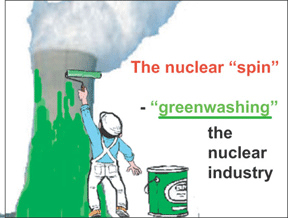 Killing the Competition The Nuclear Power Agenda to Block Climate Action, Stop Renewable Energy, and Subsidize Old Reactors, Report by Nuclear Information and Resource Center (NIRS) Sept 14
Scotland’s independence movement makes UK’s nuclear Trident programme look unsustainable
in the face of such opposition from Scotland — even in the possible wake of a decided No vote — it will remain difficult for the UK government to continue its absurd and costly pursuit of renewing the Trident nuclear weapons system against the backdrop of international negotiations to ban nuclear weapons.
Britain’s wee nuclear problem, IFP.com Erika Simpson and Bill Kidd, Special to QMI Agency Friday,  September 12, 2014″…..The SNP pledges it will negotiate the removal of the UK’s Trident nuclear weapon system from the Faslane naval base, 40 km from Glasgow. The UK’s four Vanguard submarines are stationed on the Firth of Clyde, a series of rivers, estuaries and sea lochs.
A Yes vote would mean Britain’s 20-billion-pound replacement of the four Trident submarines during the next decade could not go ahead.
It also could mean the UK’s commitment to nuclear weapons would need to be rethought.
The UK government has assumed since 1968 that the Nuclear Non-Proliferation Treaty gives it some kind of right to possess nuclear weapons.
If an independent Scotland fulfills its policy to remove the submarine-based Trident nuclear weapons system from its territory, the UK will need, within four years, to find another stationing location for all its sea-based nuclear warheads, since it costs too much to deploy them at sea for months at a time.
This will be a difficult task, almost as tough as it would be for Vladimir Putin to find another home for Russia’s Black Sea fleet stationed in the Crimean Peninsula.
If the UK wants to maintain its nuclear-armed submarines, it would need to find another deep-water port, preferably on British turf and not on another colony’s territory….. The UK government says other potential locations in England are unacceptable due to their proximity to population centres, although the UK has housed nuclear submarines and loaded nuclear weapons onto them not far from Glasgow since 1969. If Westminster does decide to relocate the weapons, cost estimates vary enormously.
Some argue building a new base would cost merely 2.5 billion to 3.5 billion pounds ($4.47 billion to $6.26 billion), while others say moving the Tridents will cost closer to 50 billion pounds. Certainly, it would be a lot extra for English and Welsh taxpayers to pay for in the wake of their country’s partition and probable economic decline……..
if an independent Scotland decided to join the alliance, it could follow the example of other NATO states such as Canada, Norway and Lithuania, which do not allow nuclear weapons on their soil. Furthermore, if an independent Scotland spearheaded initiatives to establish more international treaties to prohibit nuclear weapons, its approach could have a major impact on other NATO members, despite the inclination to erect a new central front in Europe to protect the Baltic states.
Even if not enough Scots vote Yes to win independence, their voting patterns could provide an opportunity for Britons as a whole to rethink their approach to nuclear weapons. The very high costs of replacing the submarines, coupled with the logistical challenges of relocating the weapons, means there is a strong opportunity to reject the nuclear option, should a Westminster political party adopt such a policy.
For their part, representatives of the SNP are prepared to participate actively in the humanitarian initiative on nuclear weapons and support negotiations on an international treaty to prohibit nuclear weapons, even without the participation of the nuclear-armed states. Such a treaty would make the possession of nuclear weapons unambiguously illegal for all, putting them on the same footing as biological and chemical weapons.
In the face of such opposition from Scotland — even in the possible wake of a decided No vote — it will remain difficult for the UK government to continue its absurd and costly pursuit of renewing the Trident nuclear weapons system against the backdrop of international negotiations to ban nuclear weapons. Scotland’s vote this Thursday could go either way, but it is already sure to push Mother England to overcome her Cold War thinking about security by undermining traditional arguments in favour of maintaining these weapons of mass destruction.
— Bill Kidd is the Scottish Member of Parliament for Glasgow Anniesland and a member of the Scottish National Party, which supports an independent and non-nuclear Scotland.
— Erika Simpson is an associate professor of international relations in the politics department of Western University. http://www.lfpress.com/2014/09/12/britains-wee-nuclear-problem
International Energy Agency waking up to economy and efficiency of solar energy
 Only solar PV is exceeding expectations for clean energy http://reneweconomy.com.au/2014/iea-renewables-report-solar-pv-exceed-expectations-79110 By Terje Osmundsen on 11 September 2014

This is troublesome news for renewables in general, but encouraging news for solar energy. And having studied the underlying assumptions in the report, I am tempted to add: This is just the beginning of the solar awakening of IEA; be ready for better news next year. There are three main markets driving the deployment to 2020, according to IEA. First, it’s China where renewables will account for nearly 45% of all new power generation capacity, clearly ahead of even coal. Secondly, it’s the more mature OECD markets, where renewable generation is expected to account for nearly 80% of new power generation between 2013 and 2020. And thirdly, it’s the emerging markets of Latin-America, Asia and Africa, starting from a lower level but with a higher growth rate. Continue reading
Kevin Rudd calls for China and USA to co-operate on climate change
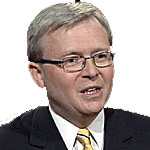 Kevin Rudd warns of climate change consequences at US forum, SMH September 12, 2014 – Latika Bourke National political reporter There is still time for China to curb its carbon emissions to give the planet a “reasonable future”, Australia’s former prime minister Kevin Rudd has said.
And Mr Rudd has proposed a “transformation” of the US-China relationship, arguing the two should co-lead a “new strategic deal” aimed at resolving tensions on the Korean peninsula.
Mr Rudd said while it was a “very hard call” for China to curb its emissions the “mathematics and science” of the planet demanded action and warned of huge consequences, including extreme weather events and the loss of arable land, if there is no change.
Mr Rudd made the comments appearing alongside former US Treasury secretary Hank Paulson to discuss “Asia and the World Order” at a forum in New York.
“Climate change threatens all of us, it threatens China, it threatens America and it threatens Australia,” he warned.
The former Labor leader – who in 2007 declared climate change “the greatest moral challenge of our generation” – told the audience that if the concentration of greenhouse gases in the earth’s atmosphere exceeded 450ppm (parts per million), “four thousand humourless guys in white coats” have concluded that we run a “huge risk of irreversible climate change”.
He outlined the former Labor government’s success in introducing a carbon tax but said the conservatives were about to repeal it in Australia. Prime Minister Tony Abbott successfully unwound Labor’s carbon price in July.
Mr Rudd said the Chinese view that the Western economies had unfairly been allowed to grow its economies until they were “drunk” on “energy and cheap carbon” was legitimate. But he said “mathematics dictates” there is a “finite quantum” of greenhouse gases humans can pump into the air.
“Based on that, our friends in China need to work on what ultimately becomes China’s own carbon ceiling, now that’s hard stuff, because China is late in the development curve,” he said.
“But if China gets this right, then the planet’s got a reasonable future, if it doesn’t get this right, I don’t think we’ve begun to think through the broad implications for the planet and the world about going past 450ppm,” he said.
He warned that drifting pollution from China across Japan, Korea and the United States would open up new foreign policy challenges………
Mr Rudd envisioned the package comprising the removal of nuclear weapons from the north, a form of “political coexistence between the two sides of the peninsula” and an American troop withdrawal from the Chinese border.
“You might say that’s all too hard, three of four years ago it was too hard but I think smart people in both capitals begin to think about this,” he said.
Mr Rudd said while he understood Washington’s “preoccupation with the Middle East” the world should not underestimate the significance of a non-English speaking and non-democratic economy set to overtake America’s as the world’s biggest.
Japanese government slow to recognise dire situation of Fukushima nuclear plant
Fukushima plant chief rapped gov’t for not sharing sense of crisis, Fukushima Emergency What Can We Do by dunrenard September 11, 2014
India looking to invest $100 billion in renewable energy
 $100 billion investment likely in renewable energy in 4 years: Piyush Goyal, Economic Times By PTI | 11 Sep, 2014, NEW DELHI: The government is expecting $ 100 billion investment in the renewable energy sector in the next four years as it firms up a new policy framework for the same.
“We expect $ 100 billion in the renewable energy sector in the next four years,” Power, Coal and Renewable Energy Minister Piyush Goyal said today at Economist India summit.
Read more at:
China’s renewable energy – not only to decarbonise, but for energy security
 China shows there’s more to renewable energy than fighting climate change ” The Conversation.11 September 2014, .… China’s large investments in renewables are best understood as enhancing the country’s energy security and not solely as a means of reducing carbon emissions…….
As the scale of Chinese manufacturing has grown — in our article we note that production of solar cells has expanded about 100-fold since 2005 — the costs of renewable-energy devices have plummeted. Countries such as Germany and South Korea, like China, are boosting their national renewable-energy industries and markets.
But others, including the United States, seem yet to notice this shift and are pursuing ineffective energy policies, including considering alternative fossil-fuels sources like coal-seam gas and putting trade tariffs on Chinese-made solar panels. Indeed oil addiction in the US appears to be worse than ever.
There are clear implications for Australia too. The current wave of anti-renewables rhetoric and negative reaction by the Australian government is out of step with the rest of world, and in particular with China and India, (and Germany) all of which countries see renewables as an important and growing element of their energy mix.
And there is a second clear implication: as they build their renewables industries, these countries will come to depend less and less on fossil fuels – and (China in particular), less and less on imports of Australian fossil fuels……..
In terms of electric power generation, China generated over 1,000 terawatt hours of electricity from water, wind and solar sources in 2013, which is comparable to the entire power generation combined of France and Germany.
But it is the rate of expansion that is so remarkable. China is rapidly expanding its renewable energy industries and its use of renewable devices to generate electric power.
Its latest target is that renewables will have a capacity of 550 gigawatts — over half a trillion watts — by the year 2017. We calculate that this will exert a major impact in China — enhancing energy security; reducing emissions pollution; and reducing carbon emissions.
But the primary impact will be on energy security. China became a net importer of oil in 1993; of natural gas in 2007; and of coal in 2011. If it can reach its 2017 target of 550 GW renewables, we calculate that this would translate into a saving of 45% on current imports of coal, oil and natural gas.
China is leading the way to a world of decarbonized energy, by placing the emphasis of its policy on growing the markets for renewables and building the industries to supply wind turbines, solar cells, batteries and other devices.
In this way it is driving down costs, through the learning curve, and making renewables more accessible to all countries. This is good for China, and for the world.http://theconversation.com/china-shows-theres-more-to-renewable-energy-than-fighting-climate-change-31471
1 This Month
Chernobyl: The Lost Tapes – A good documentary on Chernobyl on SBS available On Demand for the next 3 weeks– https://www.sbs.com.au/ondemand/tv-program/chernobyl-the-lost-tapes/2352741955560

of the week–London Campaign for Nuclear Disarmament

Tell the Ukrainian Government to Drop Prosecution of Peace Activist Yurii Sheliazhenko
To see nuclear-related stories in greater depth and intensity – go to https://nuclearinformation.wordpress.com
-
Archives
- April 2026 (152)
- March 2026 (251)
- February 2026 (268)
- January 2026 (308)
- December 2025 (358)
- November 2025 (359)
- October 2025 (376)
- September 2025 (257)
- August 2025 (319)
- July 2025 (230)
- June 2025 (348)
- May 2025 (261)
-
Categories
- 1
- 1 NUCLEAR ISSUES
- business and costs
- climate change
- culture and arts
- ENERGY
- environment
- health
- history
- indigenous issues
- Legal
- marketing of nuclear
- media
- opposition to nuclear
- PERSONAL STORIES
- politics
- politics international
- Religion and ethics
- safety
- secrets,lies and civil liberties
- spinbuster
- technology
- Uranium
- wastes
- weapons and war
- Women
- 2 WORLD
- ACTION
- AFRICA
- Atrocities
- AUSTRALIA
- Christina's notes
- Christina's themes
- culture and arts
- Events
- Fuk 2022
- Fuk 2023
- Fukushima 2017
- Fukushima 2018
- fukushima 2019
- Fukushima 2020
- Fukushima 2021
- general
- global warming
- Humour (God we need it)
- Nuclear
- RARE EARTHS
- Reference
- resources – print
- Resources -audiovicual
- Weekly Newsletter
- World
- World Nuclear
- YouTube
-
RSS
Entries RSS
Comments RSS
 nuclear-news