Nuclear power in the Anthropocene Age – theme for September 2014
Great changes in the Earth’s history are marked in geological Ages, with great changes caused by events such as volcanoes, meteorite impacts, climate change and the movement of the Earth’s tectonic plates, and occurring over millions of years. Now geologists are seeing changes in the Earth that are occurring over merely one hundred years.
These changes are caused by the activities of one species – human beings. They usher in a new Age – the Anthropocene (or human-caused ) Epoch.
The changes in the Anthropocene Age are already profound:
- Landscape – Deforestation, desertification, mountains carved by mining, rivers dammed and rerouted, islands sinking under sea level rise.
- Ecology – massive extinctions of species – loss of habitat, loss of biodiversity
- Climate change – rise in greenhouse gases in atmosphere, heating of air and oceans, acidification of oceans, glaciers melting, sea level rise
- Water – shortage of clean drinking water, pollution of groundwater and surface waters.
Those are just a few “headlines” for the changes that we have already wrought on the only liveable planet.
THE NUCLEAR CONTRIBUTION to the Anthropocene Epoch has already been great – with the landscape scarring effect of thousands of atmospheric and underground atomic bomb tests.
Radioactive pollution – from atomic bomb making, and testing, and from several parts of the nuclear power chain has affected soil, groundwater and air.
The nuclear lobby loves to talk about “background radiation” as if it’s all naturally caused and benign. However it includes radionuclides that never before existed on Earth – plutonium, strontium, cesium, carbon-14, and radioactive iodine from atomic bomb testing and other nuclear activities.

Japan’s Nuclear Regulator stands firm on need to close reactor sited over earthquake fault
 Regulatory panel in Japan affirms decision that will force decommissioning of Tsuruga reactor, Enformable, Lucas W Hixson, 5 Sept 14
On Thursday, a panel of experts organized by Japan’s Nuclear Regulation Authority (NRA) determined that it will not change its 2013 judgment that an active geologic fault exists under the Unit 2 reactor at the Tsuruga nuclear power plant.
The determination means that the Japan Atomic Power Company (JAPC), the utility which operates the Tsuruga nuclear power plant, will be forced to decommission one of the two reactors at the nuclear site.
During the meeting, officials from the JAPC attempted to present new data, which they said challenged the decision made by NRA, but many experts at the meeting debated the validity and objective nature of the data and the ability of the new findings to support claims made by the utility.
After hearing the panel’s decision, the vice president of Japan Atomic Power demanded more discussion on the issue, but was rebuffed by NRA Commissioner Kunihiko Shimazaki who stated that “Enough scientific debates have been done.”…….
After NRA experts determined that the D-1 fault zone of pebbles and sediments under the Unit 2 reactor is an active fault in May 2013, the JAPC began actively working to change the regulator’s decision, and the meetings between the two parties have been known to be contentious.
The secretariat of the NRA has told reporters that it plans to file a protest with Japan Atomic Power Company over inappropriate and threatening remarks made by Hiroshima University professor Koji Okumura, who is affiliated with the utility……..
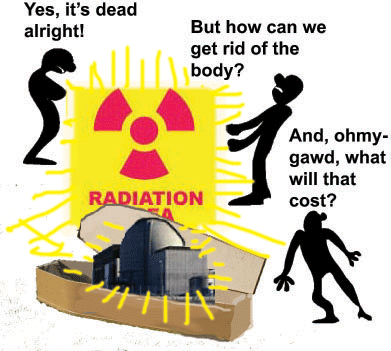 Experts estimate that the costs to decommission a reactor like the Unit 2 reactor at the Tsuruga nuclear site will cost in excess of $650 million.
Fukushima Radiation Continues As Experts Warn Of ‘American Fukushima’

 Experts Warn of ‘Inevitable’ Fukushima Disaster in California Nation of Change ANTHONY GUCCIARDI NATURAL SOCIETY / NEWS REPORT Wednesday 3 September 2014 Since the catastrophic meltdown of the Fukushima nuclear power plant in March of 2011 irreparably altered the state of the planet for the known future, the incident has been shrouded in nothing but bureaucratic cover ups and government-backed disinformation. Now, within our own borders, top experts turned whistleblowers are warning of a nuclear nightmare that could surpass Fukushima and Chernobyl alike by leaps and bounds.
Initially listed as a Level 4 incident on the International Nuclear Event Scale, pressure from scientists on an international level ultimately led to Fukushima’s classification as a maximum Level 7 accident within the INES system — with some suggesting an entirely new level was needed to describe the true impact and atrocity of the nuclear meltdown. Now, even after witnessing what happens when a major power plant is placed within the crosshairs of earthquake activity, a ‘new Fukushima’ is sitting off the Central Coast within California’s Diablo Canyon.
And top level nuclear experts, including a senior federal nuclear inspector turned whistleblower, are warning that the California-based plant is a sitting radioactive duck amid the nearby faults that have actually been found to be more dangerous than previously thought. Back in 2008, a new fault known as the Shoreline fault was discovered just offshore from the Diablo Canyon nuclear facility: a discovery that truly changes everything about the ‘safety’ of the California plant.
The whistleblower and former federal inspector of the plant, Michael Peck, has even presented his case highlighting the serious hazards of the plant he used to oversee to the U.S. Nuclear Regulatory Commission in a highly confidential report. National organizations are already calling attention to Peck’s finding and reports, with senior strategist Damon Moglen of Friends of the Earth International stating:
“We agree with him that Diablo Canyon is vulnerable to earthquakes and must be shut down immediately. Rather than the NRC keeping this a secret, there must be a thorough investigation with public hearings to determine whether these reactors can operate safely.”
Yet it appears that the general public is not even being made aware of what’s really going on, let alone the real threat that they face on a national and international level.
As usual, the general public is not being told about ways in which they can prepare themselves for a nuclear meltdown. Instead, government officials were caught back in February stockpiling iodine stores in excess of 14 million doses in a purchase order that came conveniently after reports began surfacing over another possible meltdown at the Fukushima plant. The doses will be enough for many officials and federal employees, however the public will be forced to fend for themselves — and they will not even be told about the necessity of iodine nor how they can better prepare their families for a radioactive scenario.
The reality is that even getting a hold of low quality potassium iodide, which I would not ever personally take over a higher quality form of pure iodine, is becoming difficult as the population becomes aware of Fukushima’s expansive dangers. Many manufacturers are now stockpiling raw iodine and holding on to the element as a form of investment with the knowledge that Fukushima may very well meltdown in the coming months. For this reason, we have had a very hard time securing nascent iodine formulas that many in the field of preparedness have been stockpiling for quite some time.
Fukushima Radiation Continues As Experts Warn Of ‘American Fukushima’
But even outside out Peck’s analysis and years of experience as a nuclear inspector at the federal level, numerous high level scientists and researchers have been speaking out about the continuation of Fukushima’s devastating effects and the need to further stabilize and shutdown nuclear plants along the fault lines throughout the United States — and California is not the only region in question. Even another earthquake affecting Japan could lead to the ‘evacuation of North America’, according to scientists David Suzuki…………….http://www.nationofchange.org/experts-warn-inevitable-fukushima-disaster-california-1409758143
Japan’s nuclear regulators pushing for permanent closure of aging reactors
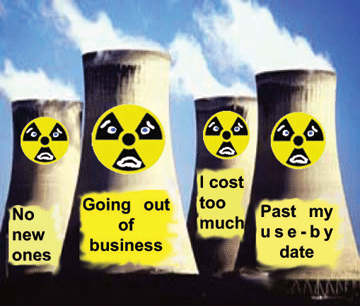
 Aging Nuclear Reactors May Close in Japan http://www.scientificamerican.com/article/aging-nuclear-reactors-may-close-in-japan/ TOKYO (Reuters) 5 Sept 14 – Japan will push nuclear operators to draft plans to scrap a quarter of the country’s 48 reactors, which are either too old or too costly to upgrade to meet new standards imposed after the Fukushima disaster, the Nikkei reported on Friday.
The government is betting that by forcing older units considered more vulnerable to disaster to shut down it may gain public support to restart newer units, the Nikkei reported.
America’s nuclear guinea pigs – in Utah
 The Day We Bombed Utah This is my father’s side of a phone conversation. I asked him about the nuclear tests that occurred in the 1950’s just a few miles from his home, specifically timed while the wind was blowing away from Las Vegas – and towards St. George, Utah. kateful.blogspot.com.au SEPTEMBER 5, 2014
“My boss, Art Crosby, was out looking for uranium [that day], he thought he’d get rich quick. Wave of the future.
“He left his Geiger counter sitting on his desk [at the gas station]. I set it to its lowest setting and the needle just slammed against the stop. I thought I’d broken it. And that was inside. The government came around and gave news conferences telling everyone not to worry…but they also offered to wash everybody’s car. I stayed inside. I didn’t go out much those days. The president of Dixie college in those days had been a biology teacher and an outdoors guy, best teacher I ever had, and he took his family out on some mountains like 40 miles closer to ground zero to watch the explosions, get up at 3 o’clock in the morning.
“He died of some type of leukemia, his daughter wrote a book about her family’s problems with various kinds of radioactive related diseases…she tried to have kids and had weird miscarriages. The dad died really young. Her mom died fairly young. Her sister died too. And she could never have a child.
“And then there’s the sheep. Sheep out in the hills eating the grass, it’s fallout. Literally radioactive particles. The sheep would lie down in the dirt, and all over southwestern Utah there were all stories of sheep born with 3 legs and 2 heads, miscarried lambs,
“That was ’54. ’57 through ’59 I was on my mission. When I came back I was in school, driving the truck, on the radio. But from ’59 on I was in school in northern Utah. Moved to California in ’68.
“There were studies that indicated the leukemia was some number of times greater.
“They waited until the wind wasn’t blowing towards Las Vegas. The population of all of Washington County might have been only 10,000 people, Cedar City even less. Kanab was a town of 2 or 3 thousand people…there’s just nothing. I remember when the state hit a million population. …..
“So…guinea pigs.” http://kateful.blogspot.com.au/2014/09/the-day-we-bombed-utah-oral-history-of.html
Australia’s nuclear guinea pigs at Maralinga
 AUDIO: Maralinga: Australia’s experience of nuclear testing http://www.abc.net.au/pm/content/2014/s4082110.htm ABC Radio p.m Mark Colvin reported this story on Friday, September 5, 2014 DAVID MARK: It happened in the 1950s. But the truth about a series of nuclear tests in which Britain let off atomic bombs at Maralinga in the South Australian desert only started to emerge in the ’70s.
Even now, there are still survivors demanding justice. Many are now dead, but there are still fears about the effects of the big doses of radiation they absorbed having on their children and even their grandchildren.
The journalist Frank Walker has written a book about Maralinga and he told Mark Colvin about what Australian servicemen actually experienced at the test site. …………
British scientists came over in their white overcoats and the helmets and the oxygen tanks – the whole thing – while the RAAF blokes stood there in their regular flying gear wondering what the hell was going on…….
FRANK WALKER: The British scientists wouldn’t do a lot of things that they said the Australian servicemen had to do, such as drive the heavy vehicles into the red hot zone and pick up the scientific equipment and bring it back to them.
What the British wanted to know was could a nation survive an atomic war? In other words, if Britain was caught in an atomic war, they – obviously bombs would fall on London, Manchester, all the big industrial cities – but what would – could Britain survive? Could they grow food? Could the people survive? Would the children grow up to be adults?
This was what they wanted to know and this was why the instructions were to have men positioned at certain distances from the blast to see whether they could function afterwards.
MARK COLVIN: Now we’ve talked a bit about the servicemen, but we haven’t talked about the traditional owners of the land. What happened to them? FRANK WALKER: They were treated absolutely abominably. First of all, they were just totally disregarded. They had no knowledge of whether Aborigines used Maralinga as a traditional hunting area and when it turned out they did, that this was actually a – many songlines went through this territory, that they would walk through this territory from waterhole to waterhole. They knew this land very well. They were – they tried to keep them out.
They had one sort of patrol bloke who knew the outback very well. He was a bushman, a bloke by the name of MacDougall, very interesting character. He had a job of trying to keep Aborigines out of an area that’s about a million square kilometres.
MARK COLVIN: One bloke.
FRANK WALKER: One bloke.
MARK COLVIN: So, we will probably never know if any Aborigines were killed in the actual blast?
FRANK WALKER: I believe they were. I believe – there were several accounts that came up before the atomic royal commission in the 1980s where soldiers, where lower ranks described finding corpses in the Maralinga area. Certainly we know that some did come through the area and were found alive and they tried to decontaminate them and so on.
But the accounts of corpses being found in some of the craters and in trails near the test sites were – could not be proven. It ended up being the junior blokes, junior ranks would say, “We saw it. We saw them bulldoze the bodies.” The senior ranks would come along and say, “No, it never happened.”…..FRANK WALKER: I think both governments are extremely liable. The Australian Government at the time, at the very best, turned a blind eye to what was going on. The British Government was running the show and they were quite content in they treated Australia as though it were just do whatever they wanted and, under Menzies, the government did………
Pacific Islanders face need to eventually migrate, due to rising sea levels
 Pacific Islanders reject ‘climate refugee’ status, want to ‘migrate with dignity’, SIDS conference hears ABC News 4 Sept 14 They have long been described as climate refugees: the hundreds of thousands of people living on low-lying Pacific islands who may be forced to migrate if rising sea levels leave their homes uninhabitable.
But it is a term Pacific leaders say is loaded with political connotations and does not reflect the true dimensions of the problem.
“They see [refugee] as a negative term that connotes victimhood and people in need of protection by the international community,” Professor Jane McAdam, director of the Andrew & Renata Kaldor Centre for International Refugee Law at UNSW, told the ABC.
“For them it signifies that they’ve become people who don’t have any agency or aren’t able to contribute.
They can be worthwhile citizens when we relocate them as a community, not as refugees.
Kiribati’s president Anote Tong
“What Pacific Islanders have told me is that, ‘we want to be seen as active economic and social contributors to any country to which we might need to move. We would like to have opportunities to migrate with dignity rather than have to wait until the situation becomes so dire that we are forcibly displaced’.”
The sentiment was echoed at the International Conference on Small Island Developing States (SIDS) which wrapped up in Apia, Samoa, on Thursday………
Australia has joined the steering group of the Nansen Initiative on Disaster-Induced Cross-Border Displacement, which aims to “build consensus on the development of a protection agenda” for those forced to flee natural disasters and the effects of climate change.
“We do need to enable people to have opportunities to migrate … but we also need to combine that with disaster risk reduction strategies, with adaptation strategies and with good development practices so that we have a holistic approach to the issue,” said Professor McAdam, who sits on the Nansen Initiative’s consultative committee.
She said the Nansen Initiative will put forward “a comprehensive framework of solutions” next year.http://www.abc.net.au/news/2014-09-05/pacific-islanders-reject-calls-for-27climate-refugee27-status/5723078
Russia to copy USA and get a nuclear pre-emptive strike policy?
Note: USA already has a pre-emptive nuclear strike policy
 Russian General Seeks Nuclear First-Strike Option Against US NEWSMAX,, 04 Sep 2014 By Sean Piccoli A Russian defense minister wants his country’s official military doctrine rewritten to allow for a pre-emptive nuclear attack against the United States and NATO, the Russian-language news agency Interfax reports.
Russia categorizes its nuclear arsenal as a defensive measure to be used in the event of an imminent attack that threatens the country’s existence, Interfax reported.
Nuclear war talk has crept back into official Russian discourse amid the fighting in Ukraine, where pro-Russia separatists are being armed by Moscow and supported with Russian ground troops.
The United States and the European Union have jointly condemned Russia’s actions in Ukraine and imposed successively harsher economic sanctions. The rhetoric from Moscow has followed suit…….The Russian general’s remarks came ahead of joint military exercises between NATO and Ukrainian forces that are scheduled to begin on Sept. 16 and “likely to further fuel suspicions between Moscow and the West,” the Toronto Globe and Mail reported. http://www.newsmax.com/Newsfront/Russian-pre-emptive-nuclear-strike/2014/09/04/id/592739/
The one big hurdle to the India-Japan nuclear deal
The hurdles to this deal emanate from Japan’s insistence that no reprocessing of spent fuel would be done in India, and that in the event of a nuclear test by India, the components supplied would be immediately returned to Japan.
The nuclear thorn in India-Japan ties http://www.thehindubusinessline.com/opinion/the-nuclear-thorn-in-indiajapan-ties/article6383865.ece?utm_source=RSS_Feed&utm_medium=RSS&utm_campaign=RSS_Syndication BHASKAR BALAKRISHNAN 5 SEPT 14 The recent visit to Japan by Prime Minister Narendra Modi has brought into focus the ongoing India-Japan negotiations on a civil nuclear agreement. This remains an item of unfinished business, though both sides have declared that it would be pursued with greater vigour. Exactly how important is this agreement in the context of India’s nuclear programme? What factors underlie the Japanese position? Continue reading
The Fukushima nuclear nightmare is far from over, and is still being mishandled
Experts Warn of ‘Inevitable’ Fukushima Disaster in California Nation of Change ANTHONY GUCCIARDI NATURAL SOCIETY / NEWS REPORT Wednesday 3 September 2014
“………In statements made during a presentation on water ecology at the University of Alberta, award winning scientist David Suzuki went on record in saying that in the event of another seven or above earthquake, which he says has about a 95% chance of occurring over the next three years, it would require a complete evacuation of North America and mean ‘bye bye Japan’.
“I have seen a paper which says that if in fact the fourth plant goes under in an earthquake and those rods are exposed, it’s bye bye Japan and everybody on the west coast of North America should evacuate,” he said.
 Specifically speaking to the nature of Fukushima’s ticking time bomb, Suzuki began the breakdown of the plant’s numerous threats with stating the very real concept that Fukushima is perhaps the largest threat to both humanity and the planet that we face in the immediate future.
“Fukushima is the most terrifying situation I can imagine,” he said before delving into the issue. “Three out of the four plants were destroyed in the earthquake and in the tsunami. The fourth one has been so badly damaged that the fear is, if there’s another earthquake of a seven or above that, that building will go and then all hell breaks loose… And the probability of a seven or above earthquake in the next three years is over 95 per cent.”
And Suzuki is not the only one with major concerns. In fact, Suzuki is perhaps one of the very few who actually received media attention due to his celebrity status as a recipient of 16 significant academic awards and host of the popular CBC Television program entitled ‘The Nature of Things’. Yale University professor Charles Perrow has voiced similar concerns in a telling piece entitled ‘Fukushima Forever’, which highlights the very serious threat of nuclear meltdown as a result of human error when it comes to removing the plant’s spent fuel rods.
A danger that the United States government certainly recognizes as legitimate based on the analysis of top experts, and undoubtedly is silently preparing for behind the scenes.
Perrow writes:
Much more serious is the danger that the spent fuel rod pool at the top of the nuclear plant number four will collapse in a storm or an earthquake, or in a failed attempt to carefully remove each of the 1,535 rods and safely transport them to the common storage pool 50 meters away. Conditions in the unit 4 pool, 100 feet from the ground, are perilous, and if any two of the rods touch it could cause a nuclear reaction that would be uncontrollable. The radiation emitted from all these rods, if they are not continually cool and kept separate, would require the evacuation of surrounding areas including Tokyo. Because of the radiation at the site the 6,375 rods in the common storage pool could not be continuously cooled; they would fission and all of humanity will be threatened, for thousands of years.
The Fukushima nuclear nightmare is far from over, and even now the disaster is being extremely mishandled and blatantly ignored by plant operator company TEPCO and the Japanese government. In the event of an American Fukushima within California, which would in fact be much more devastating, there is truly no telling how much of a fatal blow would be dealt to humanity. http://www.nationofchange.org/experts-warn-inevitable-fukushima-disaster-california-1409758143
North Korea’s Yongbyon may be restarting
 North Korean nuclear reactor may be operational, DW 5 Sept 14 A new report by the United Nations nuclear watchdog says North Korea may be operating a reactor at its main nuclear facility in Yongbyon. The site has previously been associated with the production of nuclear weapons. In the document seen by news agencies on Friday, the International Atomic Energy Agency (IAEA) said it had detected signs the reactor in the country’s north was undergoing tests that suggested it was being prepared for a restart.
The agency said it had “observed, through analysis of satellite imagery, steam discharges and the outflow of cooling water” at the reactor since late August 2013, adding that these were “consistent with the reactor’s operation.”
However, the IAEA stopped short of saying the facility was fully operational, as it has had “no access to the five megawatt reactor since April 2009.” The IAEA relies mainly on satellite images in its assessments of North Korea’s nuclear activities because Pyongyang does not allow the agency’s inspectors into the country………http://www.dw.de/north-korean-nuclear-reactor-may-be-operational/a-17904551
USA poll finds renewable energy favoured far more than coal, gas, nuclear power
 Energy efficiency, renewable energy rules favored by voters, poll finds, Cleveland.com By John Funk, The Plain Dealer on September 05, 2014 COLUMBUS, Ohio – Ohio voters favor the state’s renewable energy and energy efficiency mandates that Republican lawmakers just put on ice for two years, a new poll suggests.
Commissioned by a coalition of environmental groups and conducted jointly by two national polling companies, one which 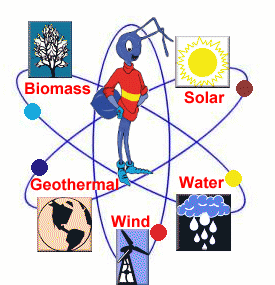 works for Republican candidates and the other for Democratic candidates, the poll interviewed 405 registered Ohio voters and has a margin of error of 4.9 percent.
The survey found that voters would favor political candidates by a two-to-one margin who favor more wind and solar energy development over those who think the state’s reliance on coal, gas and nuclear power is adequate. A total of 64 percent favored the green candidates while only 31 percent said they would be more likely to vote for candidates supporting traditional energy production.
The poll also found that 69 percent of voters would favor candidates who believe requiring electric utilities to help customers use less electricity would save ratepayers money, while just 23 percent would vote for candidates who argue that such mandated efficiency programs cost ratepayers more than they save.
Other key findings include:
– Democrats and independents, 82 percent and 61 percent respectively, favor candidates who would push for clean energy, while Republican voters are split evenly at 47 percent in favor and 47 percent opposed.
– A majority of voters, whether Democrat, Independent or Republican, like the idea of gradually requiring utilities to generate or at least sell more and more power generated by wind, solar and other renewable technologies. About 87 percent of Democratic voters said they favored such renewable growth, 70 percent of independents and 56 percent of Republicans said they were in favor.
– The end of coal-fired power plants is blowing in the wind. Three quarters of all those surveyed said they favored cleaner sources of energy and 91 percent said they supported diversifying how electricity is generated.
—- Everyone loves the idea of energy efficiency, at least generally speaking. A total of 85 percent of Republican voters said they strong support energy efficiency, 81 percent of Democrats and 73 percent of independents.
– Large majorities of those surveyed said they favored policies that would make residential rooftop solar more affordable. They also support job training programs for wind and solar installers………
The survey was designed and conducted by pollsters at Public Opinion Strategies, the largest Republican polling company in the nation, and by Fairbank, Maslin, Maullin,, Metz & Associates, a national Democratic opinion research company. The two companies have conducted joint research projects for political campaigns and businesses in 42 states. http://www.cleveland.com/business/index.ssf/2014/09/energy_efficiency_renewable_en.html
IN UK 2 important nuclear power stations could be out of action for 2014
The ongoing problems at Heysham 1 and Hartlepool reactors, taken offline last month, forced Centrica, a 20% owner of the atomic fleet with EDF, to issue a profit warning………The power outages following the discovery of a fault on a boiler “spine” at Heysham 1 have already led the National Grid to fast-forward an emergency plan to obtain more electricity from other providers to meet a possible shortfall…….http://www.theguardian.com/environment/2014/sep/04/nuclear-power-stations-out-december-edf
Discussion over the Fukushima witness testimony of Masao Yoshida
Japan’s nuclear disaster Toxic legacy, The EconomistSep 5th 2014, by D.McN. | TOKYO IN THE pantheon of Fukushima heroes, Masao Yoshida is a key figure. As the manager of the crippled Daiichi plant in 2011, Mr Yoshida was the captain of a nuclear Titanic, ready to go down with his ship rather than let it spin totally out of control. He later gave the most complete account from the cockpit of the world’s worst nuclear disaster since Chernobyl. Inevitably, perhaps, his account is now at the centre of a toxic row over the legacy of nuclear power.
But the Sankei mined the same extract and found confusion, not insubordination. Mr Yoshida’s orders were not properly conveyed, and in any case he later agreed with the workers’ decision to evacuate to the Daini plant about 10km away, it said. The newspaper accused the Asahi of “twisting” Mr Yoshida’s account to further the anti-nuclear cause.
Arguments over what took place have simmered for over three years and both sides have well-entrenched positions: one seeking to highlight the managerial and political fault-lines of the nuclear industry, the other trying to shift blame elsewhere, particularly on to Naoto Kan, who was Japan’s prime minister in 2011…….http://www.economist.com/blogs/banyan/2014/09/japans-nuclear-disaster
1 This Month
Chernobyl: The Lost Tapes – A good documentary on Chernobyl on SBS available On Demand for the next 3 weeks– https://www.sbs.com.au/ondemand/tv-program/chernobyl-the-lost-tapes/2352741955560

of the week–London Campaign for Nuclear Disarmament

Tell the Ukrainian Government to Drop Prosecution of Peace Activist Yurii Sheliazhenko
To see nuclear-related stories in greater depth and intensity – go to https://nuclearinformation.wordpress.com
-
Archives
- April 2026 (152)
- March 2026 (251)
- February 2026 (268)
- January 2026 (308)
- December 2025 (358)
- November 2025 (359)
- October 2025 (376)
- September 2025 (257)
- August 2025 (319)
- July 2025 (230)
- June 2025 (348)
- May 2025 (261)
-
Categories
- 1
- 1 NUCLEAR ISSUES
- business and costs
- climate change
- culture and arts
- ENERGY
- environment
- health
- history
- indigenous issues
- Legal
- marketing of nuclear
- media
- opposition to nuclear
- PERSONAL STORIES
- politics
- politics international
- Religion and ethics
- safety
- secrets,lies and civil liberties
- spinbuster
- technology
- Uranium
- wastes
- weapons and war
- Women
- 2 WORLD
- ACTION
- AFRICA
- Atrocities
- AUSTRALIA
- Christina's notes
- Christina's themes
- culture and arts
- Events
- Fuk 2022
- Fuk 2023
- Fukushima 2017
- Fukushima 2018
- fukushima 2019
- Fukushima 2020
- Fukushima 2021
- general
- global warming
- Humour (God we need it)
- Nuclear
- RARE EARTHS
- Reference
- resources – print
- Resources -audiovicual
- Weekly Newsletter
- World
- World Nuclear
- YouTube
-
RSS
Entries RSS
Comments RSS
 nuclear-news