Serious flaws in India-Japan Nuclear Deal
 Reasons to Oppose the India-Japan Nuclear Deal – Nuclear Free by 2045 ? Dennis Riches 14 Aug 14 In late July and early August, a leading member of India’s Coalition for Peace and Nuclear Disarmament, Kumar Sundaram, visited several Japanese cities in order to speak to the mass media and Japanese citizens about the proposed Japan-India nuclear energy agreement. He timed his visit to Japan to precede
  that of Indian Prime Minister Narendra Modi at the end of August. Modi will meet with his Japanese counterpart in hopes of finalizing a deal to allow the purchase of vital components of nuclear power plants that are proposed or under construction
Finland’s Environment Minister call sto end nuclear deal with Russia, and increase renewable energy
 Greens’ Niinistö calls for gov’t to reconsider Rosatom for nuclear plant uutiset 15 Aug 14 Cooperating with the Russian nuclear contractor Rosatom would be a step backward in Finland’s attempts to reduce energy dependency on Russia, says Green League party chair and Environment Minister Ville Niinistö. The Minister said that energy production should remain in domestic hands.
 Green Environment Minister Ville Niinistö said he believes that giving the Russian nuclear plant builder Rosatom a permit to construct a new nuclear power facility in Finland would be strange, given that the rest of the European Union is working to reduce dependency on Russian energy. Rosatom is a Russian state-owned nuclear power construction company…….
He pointed out that the Czech Republic had rejected a bid by Rosatom to build a nuclear power plant and that Britain is also re-evaluating possible cooperation with Rosatom in light of the crisis in Ukraine.
Niinistö also called for a national programme to increase the use of home-grown renewable energy. http://yle.fi/uutiset/greens_niinisto_calls_for_govt_to_reconsider_rosatom_for_nuclear_plant/7414053
Defects in EDF’s nuclear reactors could close down many reactors: a warning to France
 Belgian Doel 4 nuclear reactor closed till year-end Major turbine damage forces closure till year-end By Geert De Clercq PARIS, Aug 14 (Reuters) “…In Britain, EDF Energy, owned by France‘s EDF, took three of its nuclear reactors offline for inspection on Monday after finding a defect in a reactor of a similar design.
The problems of the two French utilities with their reactors abroad may serve as a warning of possible generic flaws that could appear in EDF’s ageing nuclear park at home.
With 58 reactors in 19 nuclear plants, France is the world’s most nuclear-dependent country, relying on it for nearly three quarters of its power.
All of its plants are of the same basic Pressurised Water Reactor design, which means that a flaw discovered in one of EDF’s reactors could force the closure of others…..http://uk.reuters.com/article/2014/08/14/belgium-nuclear-doel-idUKL6N0QK43R20140814
A call to Mr. Putin and Mr. Niinistö for peace, and for non-nuclear energy
Mr. Putin and Mr. Niinistö – the World is Waiting for a Peaceful Solution for Ukraine, Solar Wind Pronet – linking the renewable thinking 15 Aug 14 “…..According to YLE-news, Finnish president Sauli Niinistö will be meeting the president of Russian Federation, Vladimir Putin tomorrow in Sochi, Russia. ……..
And about the energy issues, Mr. Putin: You know very well as every wise leader on this planet today that oil, gas, coal and nuclear power are each a no option to mankind if we like to survive. We have perhaps five to fifteen years to turn the CO2 -emissions into a sustainable level. And there we need renewable energy, masses of renewable energy. Russia is a great country with massive potential to produce renewable energy and also manufacture means to generate it for others. Russia could be among the leaders in new technology. But for that we need international co-operation. Finland have clean technology know-how, so does Germany and many other European countries. But as well we need China and the U.S.A. to join the common fight against greenhouse effect. And in the future African countries as well as India, Australia and Southern America will be joining the front to fight climate change.
The Ukrainian people including Russian speaking East and South-East Ukraine need an energy change. Being dependent on Russian natural gas is no good for Russia nor for Ukraine in the long run. They need heating and power for winter and it could be organized by international co-operation including Russian efforts.Bio-energy and solar and wind power should be the main power mix of the future Ukraine. Natural gas could be as backup for some decades. Building solar and wind power takes only a few years and it will be boosting local economy greatly giving working opportunities to tens of thousands. Russia could be part of the solution and learn how to make the energy change that is needed also in Russia.Time for oil, coal and gas economy is simply running out, and you know it, Mr. Putin.
The world is creating the energy change to renewables quicker than anybody thought, people around world are more than ready for it:………
But we need to stop fighting in Ukraine first……….
And Mr. Niinistö:
I hope you will have a good meeting with president Putin! I hope that you will appreciate the opinion of Finnish people when according to new opinion polls 2/3 of Finnish people are against the building of Hanhikivi-1 nuclear reactor. People in Finland want to see renewable energy projects – surely in co-operation with Russian companies also. And Finnish people is surely wishing for a peaceful solution to Ukrainian crises – a solution that is acceptable for both Ukraine and Russia.
Good Luck for both Mr. Presidents! http://solarwindpronet.blogspot.com.au/2014/08/mr-putin-and-mr-niinisto-world-is.html
A warning from UK’s National Health Service on the risks of radiation from CT scans
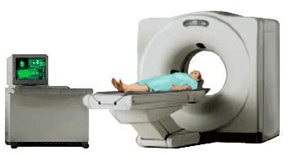 Caution urged over CT scan radiation doses, NHS UK, 15 Aug 14
BBC News reports on a sharp rise in the number of CT scans being performed, exposing people to the potential health risks of radiation.
However, as The Daily Telegraph says, it is not possible to calculate the cancer risk due to exposure to CT scans because there is a lack of data.
These media stories follow the publication of a report by theCommittee on Medical Aspects of Radiation in the Environment (COMARE). COMARE has reviewed trends in the use of CT scans in the UK. The review weighs up the risk-benefit balance of using CT scans, and considers ways to obtain the best quality scan image while minimising the necessary radiation dose.
The COMARE report sets out good practice guidance, encouraging doctors to take a more “proactive approach” to protecting patients and reducing radiation doses.
The committee recommendations cover equipment and procedures already in place, but also note there are dose reduction features available on some of the newer CT scanning machines that should be considered when new equipment is purchased.
What is COMARE and why is it looking at CT scans?….…
only 15% of our radiation exposure comes from medical sources. However, it has still increased from 0.33mSv per person per year in 1997, to 0.4mSv in 2008.
CT scans account for much of this exposure. ……..The report says there has been wider use of CT scans among younger people and children, whose tissues may have greater sensitivity to radiation. They also, of course, have a longer lifespan ahead of them in which potential harmful effects may be observed…..
70% of indications for CT scans recommended by guidance relate to benign (non-harmful) or potentially benign conditions. It says that CT scans are increasingly being used as a standard investigation, replacing other conventional ways of detecting health problems.
There are potential risks related to radiation…….
What does the COMARE report recommend?……..http://www.nhs.uk/news/2014/08August/Pages/caution-urged-over-use-of-ct-scan-radiation-doses.aspx
The true costs of our consumer capitalism must include wastes
 Mendaciousness—Capitalism and the Testimony of Integrity, Through the Flaming sword, August 15, 2014“………..Waste lies. We do the same thing with the true cost of our waste management. Capitalism does not figure into its pricing the real, final cost of disposing of its wastes safely, which ought to be part of its overhead, and never is. And when—or, to be realistic,if—the bill ever comes due for cleanup, capitalists inevitably try to squirm out of paying; it hurts profits and equity value.
This is especially important for wastes that do not biodegrade, but remain toxic and present in the body and bloodstream and organs of Mother Earth more or less permanently. And because Mother Earth is us—because our very bodies come from her—these wastes remain toxic and present in our bodies and bloodstreams and organs, as well.
The great killer disease of the industrial age was tuberculosis, the destruction of human lungs caused by the use of coal as a fuel. The great killer disease of the post-industrial age is cancer, the mutation of cells by toxic foreign substances. Thus some serious percentage of our healthcare costs should be included in the overhead cost of waste management.
Capitalism pretends that the only cost it must bear for managing its prodigious waste stream is the immediate one of getting it some distance away from its producer and providing for some minimal treatment before it gets poured back into Earth’s bloodstream or buried in her soil-flesh.
The superfund put aside for the treatment of “superfund” sites should be the model for the entire economic system. The goal should be zero toxic, non-recyclable waste returning to Mother Earth, zero toxic substances in our own bodies and those of our children—and a massive escrow account fed by some meaningful percentage of every economic transaction set aside to solve these so-far unsolvable problems in the future and to fund research and care for a public health increasingly threatened by capitalist dung.
The true cost of eliminating carbon dioxide, or uranium waste, or the 50,000 or so chemicals that we have never even tested for toxicity, would be staggering. So we just don’t think about it. Let the great-grandchildren deal with it.
In fact, if we really did account properly in our pricing for the destruction of natural capital and the remediation of capitalist waste, the system would collapse. Short-term greed is the main reason we don’t deal with these issues, but the reason we don’t even talk about it is the existential threat to the system itself that transitioning to an honest economic system represents…….http://throughtheflamingsword.wordpress.com/2014/08/15/mendaciousness-capitalism-and-the-testimony-of-integrity/
Huge amounts of Fukushima radioactive fallout are still bound to organic material
 Gov’t Expert: Fukushima hot particles can’t be dissolved, even with hot nitric acid! — Huge amounts of fallout are still bound to organic material… “we have very little knowledge about this” — “Reaction is irreversible”(PHOTO) http://enenews.com/govt-expert-fukushima-radioactive-material-be-dissolved-hot-nitric-acid-huge-amounts-fallout-bound-organic-material-very-little-knowledge-about-reaction-irreversible?utm_
Journal of Radioanalytical and Nuclear Chemistry,Volume 295, Issue 3, 2013 (emphasis added): […] radionuclides were emitted from the FDNPP as airborne ‘hot’ particles […] Subsequent interaction of the ‘hot’ particles with water (e.g. rainfall) dissolved and strongly fixed the radiocesium on rock and soil particles, thus changing the radiocesium into insoluble forms. […] Consequently, ‘hot spots’ were studded on the rock surface rather than being uniformly distributed. […] Leaching experiments demonstrated that radiocesium in rock, soil and river suspended sediment was fairly insoluble, showing that the adsorption [binding of particles to a surface] reaction is irreversible. The micro-scale heterogeneous distribution of radiocesium […] was due to the presence of ‘hot’ particles in aerosols. […] ‘hot’ particles in the aerosols [experienced] irreversible adsorption onto the soil particle complex […]
Agricultural Implications of the Fukushima Nuclear Accident – Radiocesium Absorption by Rice in Paddy Field Ecosystems (pdf), 2013:Unexpectedly, we found that the fallout was relatively insoluble and only a small percentage of the radiocesium could be extracted by a boiling water treatmentfollowed by nitrate leaching. We have very little knowledge about this fallout, including its chemical form and properties, but huge amounts of this relatively insoluble radioactive fallout are still bound to organic matters […]
Presentation by Yasuhito Igarashi of Japan’s Meteorological Research Institute at IAEA’s expert meeting (pdf), February 2014: Mar. 14-15 sample contained insoluble materials not only in water but hot nitric acid! […] They are insoluble; even refractory to conc. nitric acid. […] They would persist for a long time in the environment as well as in living organisms.
Scientific Reports (Nature Publishing Group) — Emission of spherical cesium-bearing particles from an early stage of the Fukushima nuclear accident, Aug. 30, 2013: We analyzed the water solubility of Cs Particle 1 by comparing the particle’s shape before and after exposure to water. The results show that there was no change in shape, suggesting that the particle was insoluble to water at least during atmospheric transportation.
American Chemical Society Publication, Analytical Chemistry — Detection of uranium and chemical state analysis of individual radioactive microparticles emitted from the Fukushima nuclear accident… (Tokyo Univ., Japan’s Meteorological Research Institute), August 1, 2014: We explored the possible sources of the 14 elements (Cr, Mn, Fe, Zn, Rb, Zr, Mo, Ag, Sn, Sb, Te, Cs, Ba, and U) found within the microparticles […] These particle natures suggest that they could have relatively long-term impact on the environment, i.e., the release of soluble radioactive Cs into the environment as these insoluble glassy particles degrade. Similar radioactive particles have been detected in soils, plants, and mushrooms […] it is probable that [these particles are] the same as the microparticles characterized in our study.
Thorium lobby’s misinformation is hampering rare earths industry
 It’s anybody’s guess how long Thorium, with its “peacenik” aura, will take to get traction in corridors well-trodden by the US nuclear energy lobby, who have singularly shown zero interest in the blandishments of Thorium.
Thorium lobby thunder intent on hijacking rare earths’ coattails Investor Intel August 12, 2014 by Christopher Ecclestone Anyone in the Rare Earths space knows that Thorium frequently appears as an unwanted guest at the party. Explorers have worked on various ways to get around the issue. However there is a small group out there who we would call the “deniers”. They absolutely love Thorium. They are like Swedes liberated from the sauna in the dead of winter and would roll around in the stuff naked, if they could, to prove their commitment. While greater love hath no man to a chemical element than the Thorium crowd to their object of desire, the more measured amongst us realize that the mineral has been stuck for decades like a racehorse suffering a starting-gate malfunction.
What are we talking of here Continue reading
More delays, more cost overruns for South Carolina nuclear power plants

SCE&G nuclear plants facing more delays, cost overruns, The State, South Carolina, BY RODDIE BURRIS rburris@thestate.com August 12, 2014 Two nuclear reactors under construction in Fairfield County are facing another significant delay, utility provider S.C. Electric & Gas confirmed.
The delay will put the $10 billion project at V.C. Summer Nuclear Power plant outside the 18-month contingency allowed by state regulators and likely will drive up the costs, but utility officials said they would not know how much until later this year…….. Continue reading
Indian Point nuclear reactor in “stable hot shutdown”
 Nuclear reactor at Indian Point shuts down Capital, ALBANY—One of the two nuclear reactors at the Indian Point Energy Center shut down Wednesday morning after the system tripped for an unknown reason, officials said.
Indian Point Unit 3 shut down automatically at 11:57 a.m., spokesman Jerry Nappi said. The plant remains in “stable hot shutdown” while the cause of the trip is under investigation, he said……..
The aging Westchester County facility has beentargeted by Governor Andrew Cuomo for closure because of its proximity to New York City. The state has been planning alternatives that would help take it offline, and the Department of Environmental Conservation recently proposed shutting it down for up to three months to protect fish in the Hudson River. …http://www.capitalnewyork.com/article/albany/2014/08/8550729/nuclear-reactor-indian-point-shuts-down
Uranium mining destroys lives
Yet another example of how mining companies destroy local peoples lives Papua New Guinea Mine Watch 14 Aug 14
“The government and the company don’t give a damn whether the tribal people live or die,” said Ghanshyam Birulee. “The government is treating us as guinea pigs to fulfill its greed for Uranium.”
India uranium mining fuels health crisis
Radioactive waste generated in three government owned mines spurs health fears in eastern Jharkhand state.
Sanjay Pandey | Al Jazeera “They took away my land,” 35-year-old Agnu Murmu told Al Jazeera, days before he died. “I begged them to give me a small truck… but they gifted me with cancer.”
Murmu, according to social activist Ghanshyam Birulee, was just the latest casualty of radiation pollution in Jadugoda, a tribal heartland in the eastern Indian state of Jharkhand.
His house sits dangerously close to a tailing pond, where the government-run Uranium Corporation of India Limited (UCIL) discharges waste from its mining operations. Murmu’s mother said the family knew nothing about radiation when mining began here about five decades ago.
“Like other unsuspecting parents, I would also allow my children to play near the tailing pond and catch fish from the canal that I know now is contaminated by radiation pollution,” said Rakhi Murmu, 52, with tears spilling down her creased cheeks.
“Uranium mines have ruined our lives. I know they won’t rest till they bury us all in those pits.”
Spontaneous abortions and miscarriages
Radioactive waste generated by three government owned mines – Narwapahar, Bhatin and Jadugoda – has spurred fears of a health crisis in the region.
Residents say they suffer from a number of diseases linked to radiation pollution, including congenital deformities, sterility, spontaneous abortions and cancer – yet mining continues unabated near these Indian villages, without proper security measures in place.
Dumping of radioactive waste by the roadside or near the villages may be putting even more people at risk………
radiation pollution
Several surveys conducted by independent agencies, including Japan’s Kyoto University and India’s Jadavpur University, have confirmed radiation pollution in the air, water and soil in Jadugoda.
Independent nuclear scientist Sanghmitra Gadekar, who conducted a survey on 9,000 villagers living in and around mines, has documented cases of congenital deformities, infertility, cancer, respiratory problems and miscarriages……..
Guinea pigs?
Nitish Priyadarshi, a geologist who has surveyed radioactivity in Jamshedpur and Ranchi, said while uranium particles cannot travel that far, “its sister elements like radon gas, which damages lungs and kidney, can travel to the city and take the already high radioactivity to alarming levels.”…….
whatever the government policy, Jadugoda’s 50,000 tribal residents continue to stand exposed to a danger which the activists say “nobody cares about”.
“The government and the company don’t give a damn whether the tribal people live or die,” said Ghanshyam Birulee. “The government is treating us as guinea pigs to fulfill its greed for Uranium.” http://ramumine.wordpress.com/2014/08/14/yet-another-example-of-how-mining-companies-destroy-local-peoples-lives/
A truly ‘hot’ export – Japan’s radioactive cars
Japan’s ‘Hottest’ Export This Year – Radioactive Cars Zero Hedge by Tyler Durden on 08/11/2014 At the start of the year, Russia said ‘nyet’ to 132 Japanese cars imported through Vladivostok due to high radiation levels. Fast forward seven months and as AutoWeek reports, it appears the Japanese are up to their old tricks – desperate to make Abenomics look like it’s working by jamming exports higher – a total of 70 used cars imported from Japan and found to have increased levels of radiation are being stored in Bishkek, Kyrgyzstan. The import of used Japanese cars is big business in Central Asia, especially in Mongolia and the Russian far-east regions, but several batches of cars have been seized by the government during the last three years – despite ‘agreements’ from Japan……..http://www.zerohedge.com/news/2014-08-11/japans-hottest-export-year-radioactive-cars
A fraudulent choice between a healthy community and uranium jobs
The source of the real fraud against Southside : uranium mining Piedmont Residents in Defense of the Environment Mary Rafferty , February 27, 2011 The real “fraud” in the ongoing debate over lifting Virginia’s uranium mining ban is the false choice posited between healthy communities on the one hand and energy independence and jobs on the other.
The truth is in order to rebuild our local economy, Southside Virginia must embrace clean and healthy solutions for job creation in a way that strengthens our community for this and future generations. We don’t have to choose between a vibrant economy and a healthy environment.
We can rebuild our economy by creating jobs in the energy solutions of today not the disasters of yesterday.
In order to set the record straight, here are a few plain facts about the economic and health consequences of uranium mining in Southside Virginia.
» Uranium mining would harm our health: Uranium mining could put the health of Southside Virginia citizens in significant danger.
Thousands of people in communities out West, where mining and milling operations are currently conducted, are struggling with cancer and diabetes due to their prolonged exposure to uranium mill tailings waste. And while independent researchers continue to determine the full effects exposure to uranium waste has on human health, studies have linked exposure to uranium tailings waste to increased rates of cancer, kidney failure, leukemia and diabetes.
» Uranium mining and milling would endanger our water: Virginia’s wet climate makes the proposed site at Coles Hill a risky experiment. Uranium mining and milling sites are typically operated in dry sparsely populated areas. But in Southside Virginia, severe weather events and flooding can overwhelm uranium operations, flushing uranium mill tailing waste into the bordering Bannister River (which flows into the Dan River) as well as local groundwater…….http://prideva.blogspot.com.au/2014/08/the-source-of-real-fraud-against.html
Relocating Trident nuclear missile systems from Scotland could be afforded
Trident missiles ‘could be relocated to Plymouth from independent Scotland‘ Devonport is obvious alternative to Faslane for Britain’s nuclear missiles, says Rusi thinktank, despite risk of ‘accidental ignition’ Richard Norton-Taylor The Guardian, Thursday 14 August 2014 There would be no insurmountable technical or financial obstacle to relocating Britain’s Trident nuclear missile base to England out of an independent Scotland, a report by a leading thinktank says on Thursday.
Any local opposition might delay but not stop relocation, and the favoured site would be Devonport in Plymouth, it says.
Some opponents of Scottish independence have suggested it would mean the end of the Trident nuclear weapons system and that the cost of moving the submarine base at Faslane and the nuclear warhead depot at Coulport would be prohibitive.
The study by the Royal United Services Institute (Rusi) says that relocating Trident would add up to £3.5bn to the cost of retaining the UK’s nuclear forces. The cost of the overall nuclear deterrent programme over 25 years is estimated to be £80bn………
The study acknowledges there would be safety concerns: “Introducing nuclear-armed [submarines] to Devonport will unavoidably introduce a new risk that an accidental ignition of one or all of a submarine’s Trident D5 missiles could spread radioactive material over some of Plymouth’s 260,000 inhabitants.”
Though there would be opposition on safety grounds, it notes that the Ministry of Defence is reported to have waived safety requirements at Coulport in the 1970s to allow that base to continue operating……>It adds: “The various challenges of relocation would probably trigger a wider national discussion in the [rest of the UK] on whether or not the strategic benefits of retaining nuclear weapons exceeded the costs involved.” http://www.theguardian.com/uk-news/2014/aug/14/trident-missiles-relocate-plymouth-independent-scotland-rusi-report
Tepco dumps AREVA’s ineffective radiation decontamination system
” Tokyo Electric has determined that it will cease use of AREVA’s decontamination system, which uses chemicals to remove radioactive materials from water, as it has not lived up to expectations since it was installed. The utility will file an application with the Nuclear Regulation Authority in order to scrap the system.
The decontamination system was set up in June 2011, three months after the onset of the Fukushima Daiichi nuclear disaster. The design was so complicated that it took 50 welders more than a month to put the system together. In the first three months, the system processed 76,000 tons of contaminated water, but was repeatedly forced to be shut down by a variety of problems.
For the last three years the system has been unused and kept out of operations and in the meantime, TEPCO has introduced a new system to process the ever-accumulating amounts of contaminated water…
View original 236 more words
1 This Month
26 April – Chernobyl: Inside the Meltdown airs on National Geographic on Sunday 26th April from 4pm

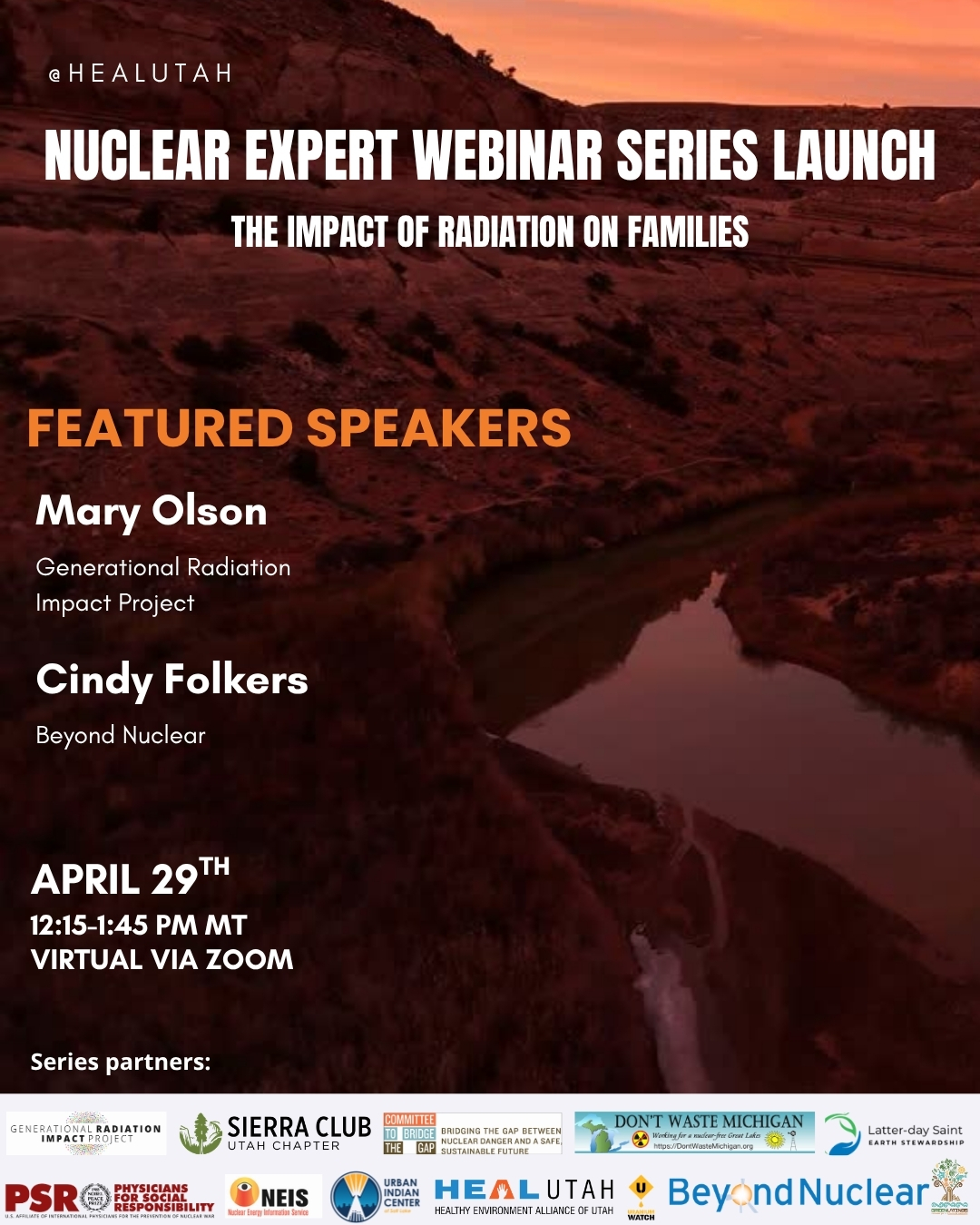
29 April – Nuclear Expert Webinar #1 – Radiation Impacts on Families with Mary Olson and Cindy Folkers
- 12:15 PM MT – 1:45 PM MT
- Location: Virtual – REGISTER TODAY

4 May -West Suburban Peace Coalition to discuss Iran war at May Educational Forum
Monday, May 4, 7:00 – 8:00 PM Central Standard Time
Title: : How Trump’s Narrative Tries to Shape the Reality of the War on Iran.
Contact Walt Zlotow, zlotow@hotmail.com 630 442 3045 for further information
14 May – online event From Bombs to Data Centres: the Face of Nuclear Colonialism
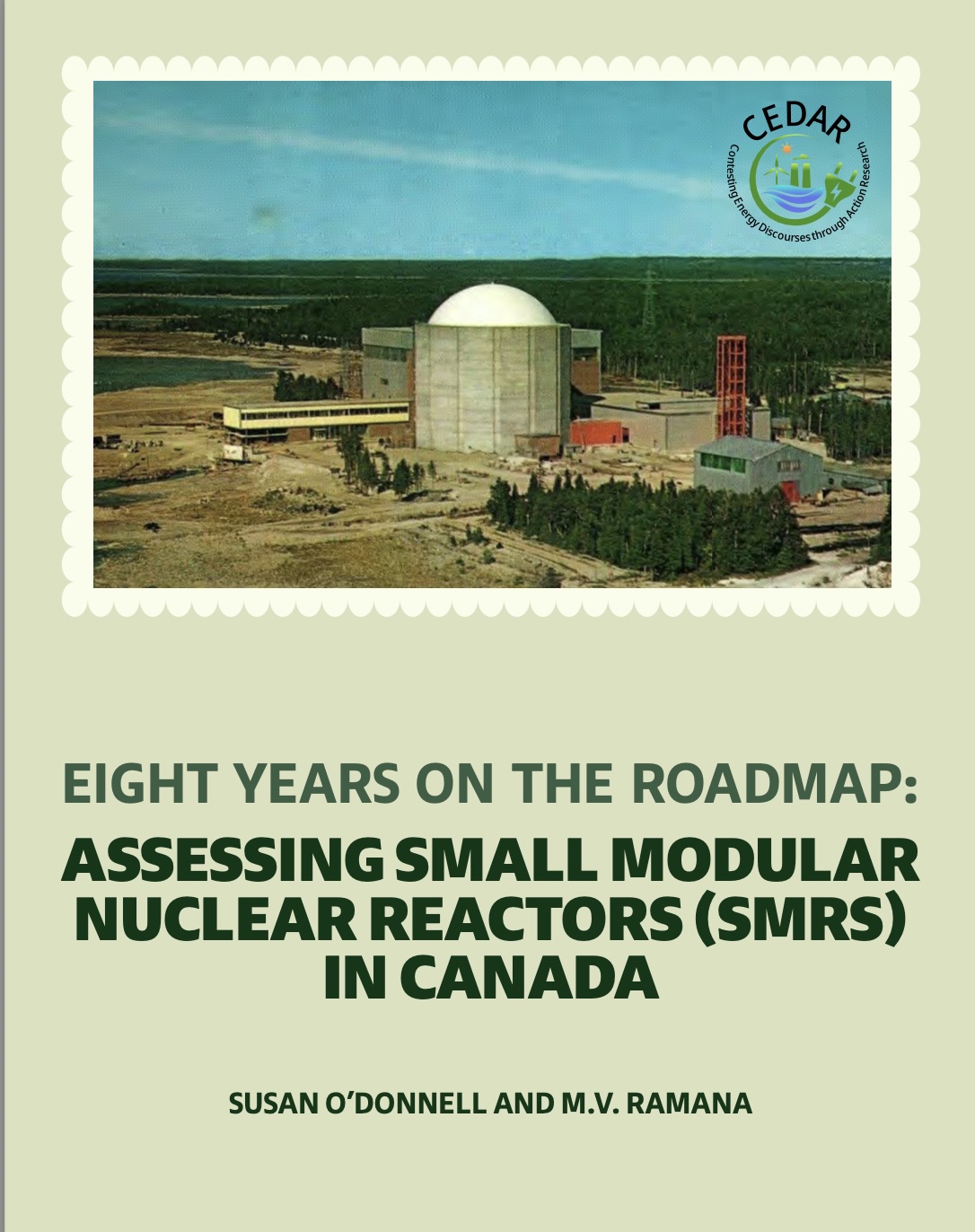

Pine Ridge Uranium is the real threat, not Tehran- Tell Burgum: Stop the Extraction.
Chernobyl: The Lost Tapes – A good documentary on Chernobyl on SBS available On Demand for the next 3 weeks– https://www.sbs.com.au/ondemand/tv-program/chernobyl-the-lost-tapes/2352741955560
To see nuclear-related stories in greater depth and intensity – go to https://nuclearinformation.wordpress.com
-
Archives
- April 2026 (288)
- March 2026 (251)
- February 2026 (268)
- January 2026 (308)
- December 2025 (358)
- November 2025 (359)
- October 2025 (376)
- September 2025 (257)
- August 2025 (319)
- July 2025 (230)
- June 2025 (348)
- May 2025 (261)
-
Categories
- 1
- 1 NUCLEAR ISSUES
- business and costs
- climate change
- culture and arts
- ENERGY
- environment
- health
- history
- indigenous issues
- Legal
- marketing of nuclear
- media
- opposition to nuclear
- PERSONAL STORIES
- politics
- politics international
- Religion and ethics
- safety
- secrets,lies and civil liberties
- spinbuster
- technology
- Uranium
- wastes
- weapons and war
- Women
- 2 WORLD
- ACTION
- AFRICA
- Atrocities
- AUSTRALIA
- Christina's notes
- Christina's themes
- culture and arts
- Events
- Fuk 2022
- Fuk 2023
- Fukushima 2017
- Fukushima 2018
- fukushima 2019
- Fukushima 2020
- Fukushima 2021
- general
- global warming
- Humour (God we need it)
- Nuclear
- RARE EARTHS
- Reference
- resources – print
- Resources -audiovicual
- Weekly Newsletter
- World
- World Nuclear
- YouTube
-
RSS
Entries RSS
Comments RSS
 nuclear-news