Story of one of the 21,000 soldiers exposed to Pacific atomic test radiation
‘The MoD’s nuclear test blinded me’ http://www.express.co.uk/news/uk/502624/EXCLUSIVE-Brian-Jones-BLINDED WHEN the bomb dropped Brian Jones was staring right at it, unaware of the danger nuclear weapons could pose to him and his family. By: Jaymi McCann, August 24, 2014 The 19-year-old sapper witnessed nine nuclear bomb tests while serving with the Royal Engineers on Christmas Island between 1957 and 1958. Continue reading
UN and Denmark help boost Renewable Energy Technology Transfer between China and Ghana and Zambia
 New initiative boosts Renewable Energy Technology Transfer between China and Ghana and Zambia with UNDP and Danish Development Assistance as catalysts Jakarta Post BEIJING, Aug. 19, 2014 /PRNewswire/ — A milestone partnership was forged today inBeijing between China, Denmark, Ghana, Zambia and UNDP with the signing of a project agreement for Renewable Energy Technology Transfer.
This project is one of the first examples of triangular South-South cooperation betweenChina and Africa with support from a donor. Its objective is to ensure that Chinese renewable energy technologies are optimally responding to priorities and needs inGhana and Zambia, and critical skills are also transferred and developed to make the technologies actually work on the ground. This approach will have a tremendous impact on increasing access to energy for the rural poor in the two countries, and for other developing countries interested in such cooperation withChina in the future.
The project is part of the UNDP-China agreement for Strengthened Partnership signed in 2010 to promote South-South cooperation through innovative programmes. “UNDP is pleased to embark on this cooperation and is committed to making projects more impactful and more sustainable by providing ‘software’ support with the transfer of renewable energy technologies, rather than just relying on the traditional hardware of equipment or infrastructure,” said Xu Haoliang, UN Assistant Secretary-General, UNDP Director of the Regional Bureau ofAsia and Pacific
The Government of Denmark provided funding for the initial formulation of the project and a contribution of29.25 million DKK, equivalent of US$ 5.4 million, to UNDP for its implementation inGhana and Zambia. This implementation will be led by the Government of the two countries with the Ministry of Sciences and Technology as the Chinese counterpart institution, and support from the UNDP offices inBeijing, Accra and Lusaka……..
The project will help with achieving the objective of Sustainable Energy for All (SE4ALL) of the UN Secretary- GeneralBan Ki-Moon by increasing access to energy through off-grid and community-based electrification. Support will not be in the form of hardware transfer but instead will focus on creating conditions required to make adoption of renewable energy technologies more effective, removing barriers and strengthening local capacities to respond to national priorities and meet local needs. ……
UNDP partners with people at all levels of society to help build nations that can withstand crisis, and drive and sustain the kind of growth that improves the quality of life for everyone. On the ground in 177 countries and territories, we offer global perspective and local insight to help empower lives and build resilient nations.www.undp.org http://prnw.cbe.thejakartapost.com/news/2014/new-initiative-boosts-renewable-energy-technology-transfer-between-china-and-ghana-and-zambia-with-undp-and-danish-development-assistance-as-catalysts.html
Bill in USA Congress supports plans in Kiev for an attack on Crimea

 “The Russian Aggression Prevention Act” (RAPA): A Direct Path to Nuclear War with Russia
The Russian Aggression Prevention Act”, introduced to Congress by U.S. Senator Bob Corker (R-Tenn.), will set the US on a path towards direct military conflict with Russia in Ukraine. Global Research, By Steven Starr , Senior Scientist, Physicians for Social Responsibility August 22, 2014
“………..RAPA supports plans in Kiev for an attack on Crimea
The Russian Aggression Prevention Act demands that Russia “withdraw from the eastern border of Ukraine,” which is by definition, the Russian border. In other words, RAPA provocatively demands that Russia remove its own military forces away from its own borders, while Ukrainian military forces are meanwhile massed on the other side, attacking predominantly Russian cities.
RAPA also demands that “Russian forces must have withdrawn from Crimea within seven days of the enactment of the Act.” Not likely to happen, given that
(1) Crimea was part of the Russian empire from 1783 until 1954,
(2) withdrawal from Crimea would require Russia to abandon its only warm water port at Sevastopol, where Russian forces have been based, by internationally recognized treaty, since 1997, and
(3) more than three-quarters of all Crimeans voted “yes” to reunify with Russia, a vote which Russia accepted by its subsequent annexation of Crimea.
Thus, in the eyes of Russia, the requirement to “withdraw from Crimea” amounts to a US demand that Russia surrender Russian territory. Putin has just taken the entire Russian Duma (the Russian House of Representatives) to Crimea, to address them there and strongly make the point that there will be no withdrawal from Crimea.
RAPA, however, stipulates that the US does not recognize the Russian annexation of Crimea, and creates sanctions and legal penalties for anyone who does. RAPA therefore provides both military and political support for Ukrainian President Poroshenko’s stated goat that Ukraine will retake Crimea.
This goal was recently echoed by the Ukrainian defense minister, who was applauded by the Ukrainian Parliament when he told them that the Ukrainian army will “have a victory parade in Sevastopol“. These statements are taken seriously in Moscow, where they are viewed as a promise to attack Russia. Thus, Putin’s advisers are telling him he must fight today in Eastern Ukraine, or tomorrow in Crimea.
Any Russian military intervention in Eastern Ukraine would certainly be described in the West as Russian aggression in pursuit of empire, which would trigger deafening demands that US/NATO forces act to support Ukraine. Should NATO intervene, subsequent Russian military action against any NATO member would trigger the alliance’s Chapter 5 mutual defense clause, committing it to war with Russia.
Any major Ukrainian attack upon Crimea would make war with Russia inevitable. Ukraine appears to be preparing for such an assault by drafting all men of ages 18 to 60 years, in a forced mobilizationof its armed forces, which also includes calling up its active reserves of one million men, and bringing more than 1000 battle tanksout of storage. Putin is being told by his close advisers thatUkraine will have an army of half a million men in 2015.
RAPA would provide hundreds of millions of dollars to train and arm the rapidly expanding Ukrainian armed forces, and position US/NATO forces for rapid intervention on the side of Ukraine in the event of a Ukrainian-Russian war. Thus, the many political and military provisions of RAPA would certainly act to fully encourage Ukraine to carry out its stated policy to retake Crimea. The Republic of Georgia attacked Russian forces in 2008 with far fewer US promises of aid. Of course, RAPA would also arm Georgia, too………..http://www.globalresearch.ca/the-russian-aggression-prevention-act-rapa-a-direct-path-to-nuclear-war-with-russia/5397171
Nuclear weapons do not make us more secure: quite the opposite
Nuclear weapons do not make us saferhttp://www.washingtonpost.com/opinions/nuclear-weapons-do-not-make-us-safer/2014/08/22/185b4644-28ad-11e4-8b10-7db129976abb_story.html David Krieger, Santa Barbara, Calif.Are NATO-based nuclear weapons really an advantage in a dangerous world, as Brent Scowcroft, Stephen J. Hadley and Franklin Miller suggested in their Aug. 18 op-ed, “A dangerous proposition”? They are not. They make the world a far more dangerous place.
Nuclear deterrence is not a guarantee of security. Rather, it is a hypothesis about human behavior, a hypothesis that has come close to failing on many occasions. Additionally, nuclear weapons are not “political weapons,” as the writers asserted. They are weapons of mass extermination.
The United States and the other nuclear-armed countries are obligated under the terms of the Nuclear Non-Proliferation Treaty and/or customary international law to pursue negotiations in good faith for an end to the nuclear arms race and complete nuclear disarmament. This is the substance of the Nuclear Zero lawsuits brought by the Marshall Islands against the nine nuclear-armed countries at the International Court of Justice and in U.S. federal court. The United States continues to evade its obligations. Rather than continuing to posture with its nuclear weapons in Europe, the United States should be leading the way in convening negotiations to eliminate all nuclear weapons for its own security and that of all the world’s inhabitants. The writer is president of the Nuclear Age Peace Foundation.
Typhoon on its way to Fukushima nuclear plant area
Once-In-A-Decade Typhoon Heads For Japan Nuclear Plant Earth Changes Media August 22, 2014 Tokyo (AFP) – A typhoon described as the “strongest in 10 years” closed in on Japan on Wednesday, on a path that will take it towards the precarious Fukushima nuclear power plant.
Tokyo and surrounding areas were hit by violent winds and heavy rains in the early hours of Wednesday morning as Typhoon Wipha moved northeast off the coast of central Japan.
Thousands were evacuated from their homes in the neighbouring prefecture Chiba and power outages were reported.
Record rainfall of around 118.5 millimetres (4.7 inches) per hour was recorded on Izu Oshima Island, which lies in the Pacific, 120 kilometres (75 miles) south of central Tokyo, the Japan Meteorological Agency said, according to Kyodo news agency.
Three homes on the island had been washed away by a swollen river, Kyodo reported, citing police.
The weather bureau warned the typhoon could make landfall in the densely populated Kanto region, which includes Tokyo, later in the morning.
Typhoon Wipha, packing winds of nearly 200 kilometres (125 miles) per hour near its centre, was moving northeast at around 55 kilometres per hour in the early hours of the morning, Kyodo said……..TEPCO bracing for impact
Japanese airlines announced the cancellation of 500 flights on Wednesday, while 30 high-speed trains and 100 other trains were cancelled, rail companies said.
Automaker Nissan said it had told employees across Kanto to stay at home for the morning to ride out the storm……
As the weather agency issued warnings of torrential rain and strong winds, the operator of the Fukushima plant, Tokyo Electric Power Co. (TEPCO), said it was bracing for the storm after a series of leaks of radiation-polluted water.
“We are making preparations for proper management of contaminated water…. We will patrol places that could have inflows of water (from the storm),” a company spokesman said.
Cables and hoses have been bundled together, while ground and off-shore works have been halted, he said……..
The nuclear plant was badly damaged by the tsunami that hit in March 2011. Critics say it remains in a fragile state and at the mercy of extreme weather or other natural hazards…….http://earthchangesmedia.com/once-in-a-decade-typhoon-heads-for-japan-nuclear-plant
Arab initiative at UN meeting will focus on Israel’s nuclear arsenal
Arab states, Israel set to clash at U.N. nuclear meeting The Daily Star :: Lebanon News :: http://www.dailystar.com.lb Reuters VIENNA: As war rages in Gaza, Arab states will likely try to heighten  diplomatic pressure on Israel over its assumed nuclear arsenal at next month’s annual meeting of the U.N. nuclear agency’s 160 member states, diplomats said Friday.
An Arab initiative to single out Israel for criticism was defeated in voting last year.
But Western diplomats opposed to the Arab move said the unresolved Gaza conflict may influence any wavering countries at this year’s debate, although there was no direct link between the issues.
“It is all about getting out the undecided vote. And it will be all about Israel widely and not about the actual nuclear issue,” one Vienna-based diplomat said.
“I would expect ongoing conflict to lead many [Arabs and any others critical of Israel] to want to lash out in any forum available.”
An Arab resolution on what it calls Israeli Nuclear Capabilities would be non-binding even if it were to be approved by the Sept. 22-26 General Conference of the International Atomic Energy Agency.
However, lobbying by both sides underlines its symbolic significance as well as deep divisions.
Israel is believed to possess the Middle East’s only nuclear arsenal, and frequently draws condemnation from Arab countries and Iran which say that it threatens regional peace and security…….http://www.dailystar.com.lb/News/Middle-East/2014/Aug-23/268217-arab-states-israel-set-to-clash-at-un-nuclear-meeting.ashx#axzz3BFYUb8Ga
Scrutiny on the methods of pro Thorium Twitter trolls
I am constantly the victim of Twitter trollism because I campaign against the nuclear industry. It is ironic that these trolls use climate change as their argument for nuclear power, – and accuse me constantly of being in the pay of the coal and gas companies. That’s despite the fact that I repeatedly write and publish on websites on the critical need for action to address climate change
Thomas Huxley @thjr19
Noel Wauchope: Please! Fossil Fuel Shill Manager: No! NW: Please! FFSM: OK, every 2nd tweet. NO MORE, hear me
Thomas Huxley @thjr19
Noel Wauchope, fossil fuel industry shill, has been told to lay off coal. How long to get permission again?!
Wind energy shown to be much more scalable than nuclear energy.
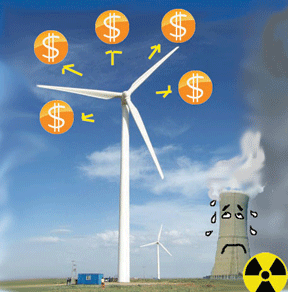 Which Is More Scalable, Nuclear Energy Or Wind Energy? Forbes, 22 Aug 14 Answer by Mike Barnard, Senior Fellow – Wind, E&PI,on Quora,
China is the true experiment for maximum scalability of nuclear vs wind. It has a tremendous gap between demand and generation. It can mostly ignore democracy and social license for nuclear. It is building both wind and nuclear as rapidly as possible. It has been on a crash course for both for about the same period of time. It has bypassed most of the regulatory red tape for nuclear.
So how is it doing?
- China turned on just over 16 GW of nameplate capacity of wind generation in 2013 according to the Global Wind Energy Council.
- Over the four years of 2010 to 2014, China managed to put 4.7 GW of nuclear intooperation at the Qinshan Phase II, Ling Ao Phase II, Ningde, Hongyanhe and Yangjiang plants. This is not their stated plans for nuclear, which had them building almost double this in 2013 alone and around 28 GW by 2015, but the actual plants put into production. The variance between the nuclear roadmap and nuclear reality in China is following the trajectory of nuclear buildout worldwide: delays, cost overruns, and unmet expectations.
- Modern wind turbines have a median 40.35% capacity factor and exceed 50% in the best wind resources according to the US National Renewable Energy Laboratory (NREL) who track the actuals on this sort of thing.
- Taking similarly sourced numbers for nuclear capacity factor from the Nuclear Energy Institute, we see 90.9% capacity factors for nuclear reactors. These are apples-to-apples statistics from the same country.
Running the math, that’s about 6.5 GW of real capacity of wind energy in one year vs 4.3 GW of real capacity for nuclear over four years. That’s roughly six times more real wind energy capacity than nuclear per year. 2014 might be better than average as perhaps 2 GW have been made operational this year. We’ll see what reality brings as wind energy is being expanded rapidly as well. So far nuclear is losing the race badly.
No other geography is capable of building as much nuclear per capita as China is. In the most pro-nuclear geography in the world with the most relaxed regulatory regime, the nuclear industry is being outstripped by the wind industry…………http://www.forbes.com/sites/quora/2014/08/22/which-is-more-scalable-nuclear-energy-or-wind-energy/
Should Japan take the nuclear power risk again?
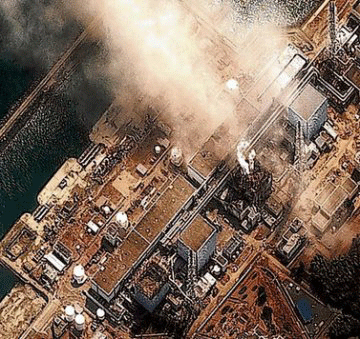 Should Japan restart its nuclear reactors? Cyprus Mail, 22 Aug 14, By Arnie Gundersen Only luck and real courage at 14 nuclear reactors on Japan’s Pacific coast overcame the technical failures of nuclear power and prevented the nation from being destroyed by radiation.
The untold story of March 11, 2011 is how close Japan came to three more spent fuel pool fires at Fukushima Daiichi and four meltdowns at Fukushima Daini.
When the magnitude 9.0 earthquake off the Pacific coast caused a seismic shock wave that reverberated throughout northern Japan, the country’s nuclear plants shut down automatically, as planned, preventing any further nuclear chain reactions.
Therein lies nuclear power’s fatal flaw, because an automatic shutdown does not stop the ongoing heat generated inside each nuclear reactor.
When uranium atoms split (a process called fission), they release tremendous energy, as well as rubble. Even when the chain reaction stops, the highly radioactive rubble emits decay heat that continues for years. Automatic shutdown simply means that no new nuclear fissions will occur……..
When the tsunami struck, the cooling equipment along the shoreline was turned into a scrap yard of twisted metal. Even if they had not been flooded, without operational shoreline pumps, the emergency diesel generators were doomed to fail, making it impossible to cool the nuclear core. In truth, the utter destruction of the shoreline pumps caused the triple meltdown at Fukushima Daiichi.
The tsunami also wrecked cooling pumps at eight other reactors located at Fukushima Daini, Onagawa, and Tokai.
Twenty-four of the 37 emergency diesel generators located at four separate nuclear power sites, which contained a total of 14 nuclear reactors, failed during the tsunami. Of the 24 diesel generators that failed, only nine failures were due to flooding (eight at Fukushima Daiichi and one at Fukushima Daini). The other 15 diesel generators were not flooded, but were disabled when the tsunami wrecked their shoreline cooling pumps.
The situation in Japan was dire when the sun set on March 11, 2011. At Fukushima Daiichi, three reactors were melting down and three spent fuel pools were at risk of catching fire because they could not be cooled. Conditions were also worsening at Fukushima Daini’s four reactors.
It was good fortune and extreme courage that saved Japan and its people from a more tragic catastrophe………
If the earthquake and tsunami had begun at night, only 200 employees would have been working at these plants. With roads and bridges destroyed, none of the necessary staff would have been able to return to work.
Now, more than three years after the Fukushima Daiichi disaster, shoreline cooling pumps throughout the world – including in Japan – remain unprotected from flooding or terrorist attacks.
Japan is prone to earthquakes and tsunamis. Is reopening its nuclear plants worth the risk to its people and their homeland?
The simultaneous technological failure at 14 nuclear reactors due to a single natural phenomenon clearly shows that the nuclear engineers who envisioned and designed nuclear power failed to expect the unexpected.
Unfortunately, the nuclear industry continues to push its message that nuclear power can be made safer. Fukushima, and before it Chernobyl, shows us that nuclear technology will always be able to destroy the fabric of a country in the blink of an eye. http://cyprus-mail.com/2014/08/22/should-japan-restart-its-nuclear-reactors/
Catastrophic Risk if Nuclear Regulatory Commission relaxes waste safety rules

that they should just stop making the stuff!
Ruling on Nuclear Waste Storage Could Create a “Catastrophic Risk” Regulators may let companies store radioactive rods in on-site pools for up to 120 years. Mother Jones, —By Josh Harkinson Fri Aug. 22, 2014 Strict safety controls sought by environmental groups for the storage of radioactive waste at dozens of nuclear power plants may fall to the wayside under a rule that’s expected be approved by the Nuclear Regulatory Commission next week. According to a congressional source who does not wish to be identified, the NRC is rushing to vote on the rule before the September retirement of Commissioner William Magwood, an ally of the nuclear power industry.
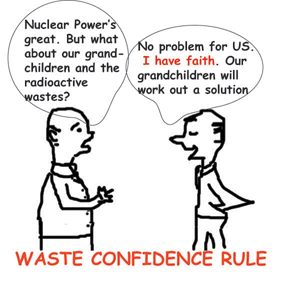
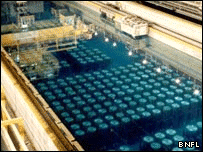 The rule would establish that the environmental risks of storing spent fuel in pools of water at reactor sites for extended periods are negligible and for the most part don’t need to be studied as part of the licensing requirements for nuclear power plants.
But critics of the rule say that the NRC is blatantly ignoring its own research, which shows that the practice could lead to serious disasters: “You will have all the waste sitting, basically, in a giant swimming pool,” the source says, “and the potential of the swimming pool draining or being breached by an accident or an attack or a power loss that causes the water to boil off—all of those things would have impacts that the NRC’s own analysis says would equal that of a meltdown of the reactor core.”
<!–more–>
Existing nuclear plants are designed to store spent fuel for no more than a few years but have accumulated large stockpiles of it due to repeated delays in plans to build a permanent repository in Nevada’s Yucca Mountain. In 2010, the Obama administration canceled the $15 billion Yucca project, raising the distinct possibility that a single geologic waste storage site may never be built. In 2012, the Natural Resources Defense Council successfully sued to force the NRC to stop licensing nuclear reactors until the commission conducted an environmental impact study on the long-term risks posed by on-site waste—including the possibility that those temporary storage sites will become permanent. The completed study, along with the new rule, is expected to be approved by the NRC on Tuesday, over the strong objections of environmental groups.
The NRC rule would pave the way for nuclear waste to be stored in open cooling pools at reactor sites for up to 120 years—and up to 60 years after a reactor is decommissioned. Environmental groups say that’s way too long. “The pools are a catastrophic risk,” says Kevin Kamps, the radioactive-waste watchdog for a group called Beyond Nuclear. Many pools are holding up to four times as many spent rods as intended. Packing so many rods into the pools dramatically increases the risk of a fire should a leak cause the cooling water to drain. A 2013 NRC study found that a pool fire could contaminate 9,400 square miles and displace 4 million Americans from their homes for years.
The NRC’s assumption that operators will guard and maintain their waste for decades after their plants are decommissioned is laughable to many enviros. In comments submitted to the NRC last December, the NRDC pointed to “the sad history” of managing hazardous waste in America, which often involves commercial operations going bankrupt and saddling taxpayers with the cleanup.
Even at operable nuclear plants, about a dozen waste storage pools are known to be leaking, including one at New York’s Indian Point reactor, which is discharging radioactive water into the Hudson River. To minimize the risk of disaster, environmental groups want the industry to immediately move its waste into thick concrete-and-steel dry casks at a cost of roughly $7 billion. But in a 4-1 vote earlier this year, the NRC ruled that this wouldn’t be cost-effective…….
Environmental groups hope the new commission will break with its industry-friendly past. “The industry crawls all over that place in terms of lobbying,” Kamps told me. “They own that place.” http://www.motherjones.com/environment/2014/08/nuclear-regulatory-commission-radioactive-waste-magwood
Australia should wean other countries onto renewables and off nuclear power says former PM of Japan
Former Japanese PM Naoto Kan urges Australia to wean world off uranium, focus on renewables http://www.abc.net.au/news/2014-08-22/move-towards-renewables-former-japanese-pm-tells-australia/5691118 By Kate Wild and Xavier La Canna
Japan’s prime minister during the Fukushima disaster says Australia should be trying to wean other countries away from nuclear power, not increase exports of uranium.
Naoto Kan, who was prime minister from June 2010 to August 2011 is in Australia to lobby for a greater use of renewable energy sources.
He said the world was moving away from nuclear power, and Australia should not get in the way of that.
“Rather than looking at making contributions through exporting and making it more possible for more countries to be relying on nuclear power, all countries including Australia should be making efforts to do what can be done to reduce such dependence on nuclear power,” Mr Kan said.
“I hope that Australia can be exporting not uranium or coal for example, but electricity created through renewable sources,” he said.
When he was Japanese PM, representing the Democratic party of Japan, a tsunami caused a nuclear incident in which three nuclear reactors melted down at the Fukushima nuclear power plant and forced widespread evacuations.
“We were very close to the scenario of having to evacuate people in a 250 kilometre radius,” he said.
“This would have included also Tokyo, which would mean 40 per cent of the entire Japanese population – close to 50 million people.”
His party initiated policies to see nuclear power phased out in Japan by the 2030s, but this policy was overturned by the Liberal Democratic Power, which regained office in 2012.
Australia is thought to have the world’s largest uranium resources, and mines exist in the Northern Territory and South Australia, while Queensland recently lifted a 30-year ban on uranium mining.
Western Australia is also looking to develop its uranium industry.
Prime Minister Tony Abbott will soon travel to India to finalise a deal for Australia to sell uranium to their energy-hungry economy for the first time.
New nuclear generation is limited to China and India – and even then …
Which Is More Scalable, Nuclear Energy Or Wind Energy? Forbes, 22 Aug 14 Answer by Mike Barnard, Senior Fellow – Wind, E&PI,on Quora, “………… India is often touted as another great country for buildout of nuclear. Its track record is worse than China’s; it only has a total of 4.2 GW of nuclear generation capacity in operation after decades meanwhile it built 1.7 GW of wind energy in 2013 alone.
Unlike nuclear power, most countries are perfectly capable of building wind farms and are doing just that, with utility-scale wind generation in 100 states globally so far. For the past five years, wind energy has averaged 40 GW of new operational nameplate capacity according to GWEC or 16 GW of median capacity and that is expected to grow.
Meanwhile, globally nuclear capacity has diminished and is expected to continue to diminish for the next several years as France shuts off 33% of its fleet in favour of mostly wind energy, Germany shuts off its fleet entirely,Ontario intends to move from 55% to 42% supply from nuclear according to its draft long term energy plan and aging reactors globally reach end-of-life with no economic refurbishment possible. Japan will be able to restart at most a third of the reactors it shut down after Fukushima according to knowledgeable sources.
In empirical terms, it doesn’t matter what anybody claims is theoretically possible: wind energy is growing rapidly while nuclear is going backwards. That’s reality……..
Pragmatic reality limits nuclear generation growth mostly to China and India because they both are existing nuclear powers and both have vast disparity between demand and supply so will pay a premium for expensive nuclear energy. Similarly, refurbishing reactors in the developed world often makes economic sense. But there are a lot of other factors also hindering nuclear growth that don’t apply to renewables. http://www.forbes.com/sites/quora/2014/08/22/which-is-more-scalable-nuclear-energy-or-wind-energy/
Japan thyroid cancer children – crimes against humanity – Tokyo Press Conference
 Tokyo Press Conference: Gov’t is committing crimes against humanity; Fukushima children living in war zone and can’t leave — Childhood cancer developing much faster than Chernobyl; Rate now 14 times higher — Parent: “I’m revealing the reality of what’s going on… it’s only way to get rid of the criminals” (VIDEO) http://enenews.com/tokyo-press-conference-officials-committing-crimes-against-humanity-fukushima-children-living-war-zone-evacuate-childhood-cancer-developing-faster-chernobyl-rate-14-times-higher-parent-im-reveal?utm_source=feedburner&utm_medium=e
Press Conference at The Foreign Correspondents’ Club of Japan, August 18, 2014:
Toshio Yanagihara, attorney representing Fukushima children and their parents
- 5:00 — Thyroid cases after Chernobyl in Belarus — comparing that with the present situation in Fukushima, [here] there’s 14 times [the rate] of children with thyroid cancer.
- 6:00 — Fukushima prefecture’s announced that the massive number of thorough screenings [is the reason why there’s] more numbers of people with cancer — but we found that doubtful. In Fukushima prefecture, the west part of Fukushima compared to those areas that are closer to the nuclear power plant, there are about ¼ or even 1/5 the people who are found with thyroid cancer.
- 7:00 — June 10th of this year, the Fukushima committee in charge of researching thyroid cancer admitted for the first time that the suspicion of malignancy is due to the lymph node metastasis. This is the common thing that was found after the Chernobyl accident.
- 8:00 — In Fukushima right now, we see that the number of the children found with thyroid cancer — and the scale of this catastrophe is ongoing — it is going much faster than it was in the Ukraine after Chernobyl.
- 11:45 — The announcement from the Sendai high court from April 2013 that the Fukushima children’s lives are threatened… this didn’t cause Fukushima or the Japanese government to help provide support.
- 16:15 — We emphasis that the Japanese government is discriminating against the Fukushima children, and in the international [court], we can say this is a crime against humanity. This is Japan’s most important and most criminal human problem that we’re facing right now.
- 17:15 — Fukushima is a war zone, and children have a right to be evacuated to a safer place… In Japan, this present situation is the most harsh child-rearing situation in the world.
- 19:15 — They’re supposed to support and evacuate children from Fukushima during this war zone… It must be argued at the international court that this is a crime against humanity. We would like to take this case to the International Criminal Court, and we’re preparing for that.
Katsumi Hasegawa, parent of two young children who evacuated from Koriyama (60km from Daiichi)
- 22:45 — We currently live in Shizouka prefecture where we evacuated to in August 2011 — my pregnant wife and 5 year-old son… Why did the Japanese government contain us in the no-go zone 20 or 30 km radius, while many foreign countries had told residents within 80 km from Fukushima Daiichi to evacuate?
- 35:00 – I’m a parent of children, and I’m an adult whose living at the time of this accident — this era. I would like to reveal the reality of what is going on. And I would like to do my best, even if I’m starting right now, I would like to do my best. That is my responsibility, and that is the only way to get rid of the criminals — and irresponsibility that we have committed already… Even though raising my voice is hard, I know that there are things that we need to do. Thank you.
- 36:30 — Lucy Birmingham, FCCJ president: Thank you so much. OK… wow.
Belgium’s closed nuclear reactors may remain shut
Nuclear Shutdowns Leave Belgium Looking for Power Closure of Three Nuclear Power Plants WSJ By VANESSA MOCK 21 Aug 14, BRUSSELS—Belgian authorities are racing to map out emergency plans in case of a severe energy crunch this winter. The country could face energy shortfalls in the depths of winter after the sudden closure of three major nuclear power plants over the past months.
Two nuclear reactors, Doel 3 and Tihange 2, were closed in May after cracks appeared in the steel reactor casings, and another large plant, Doel 4, closed down on Aug. 5, after an oil leak which its French parent company GDF Suez GSZ.FR +0.38% said was due to sabotage.
The incidents mean that all three plants are likely to remain out of action until the end of the year, depriving Belgium of more than half its nuclear capacity.
Belgium’s parliament is holding a special session on Friday to discuss situation and it has commissioned the national crisis center to set out possible scenarios in case of a power shortages this winter.
If shortages look imminent, authorities would launch an appeal, urging the general public to cut down on energy use and would order some industrial firms to reduce production…….. http://online.wsj.com/articles/nuclear-shutdowns-leave-belgium-looking-for-power-1408632643
The People’s Climate March is one month away, but you can start it now
 RC’s Nuclear Blog August 21, 2014
Dear Friends,
The historic People’s Climate March is just one month away–September 21, 2014. And NIRS and all the other groups supporting this massive event have launched an all-out mobilizing campaign starting now.
This weekend, we ask every organization–and every individual–supporting the Nuclear Free-Carbon-Free Contingent to help get the word out about this event. Send an e-mail–or just forward this one–to everyone on your lists. Put up a notice on your websites and blogs; post on Facebook/Twitter or any other social media sites you use. Send a letter to the editor of your local paper about why you’re going to the march, or just to raise awareness of it (we’ve made this easy for you, see details below).
The March Starts Now
We’re not waiting until September 21–we’re kicking off the march now! We’re creating a photo gallery of marchers to visually tell everyone why we’re marching. And if you absolutely can’t come to New York City on September 21, this is a perfect way for you to stand and be counted……. http://rceezwhatsup.blogspot.com.au/2014/08/the-peoples-climate-march-is-one-month.html
1 This Month
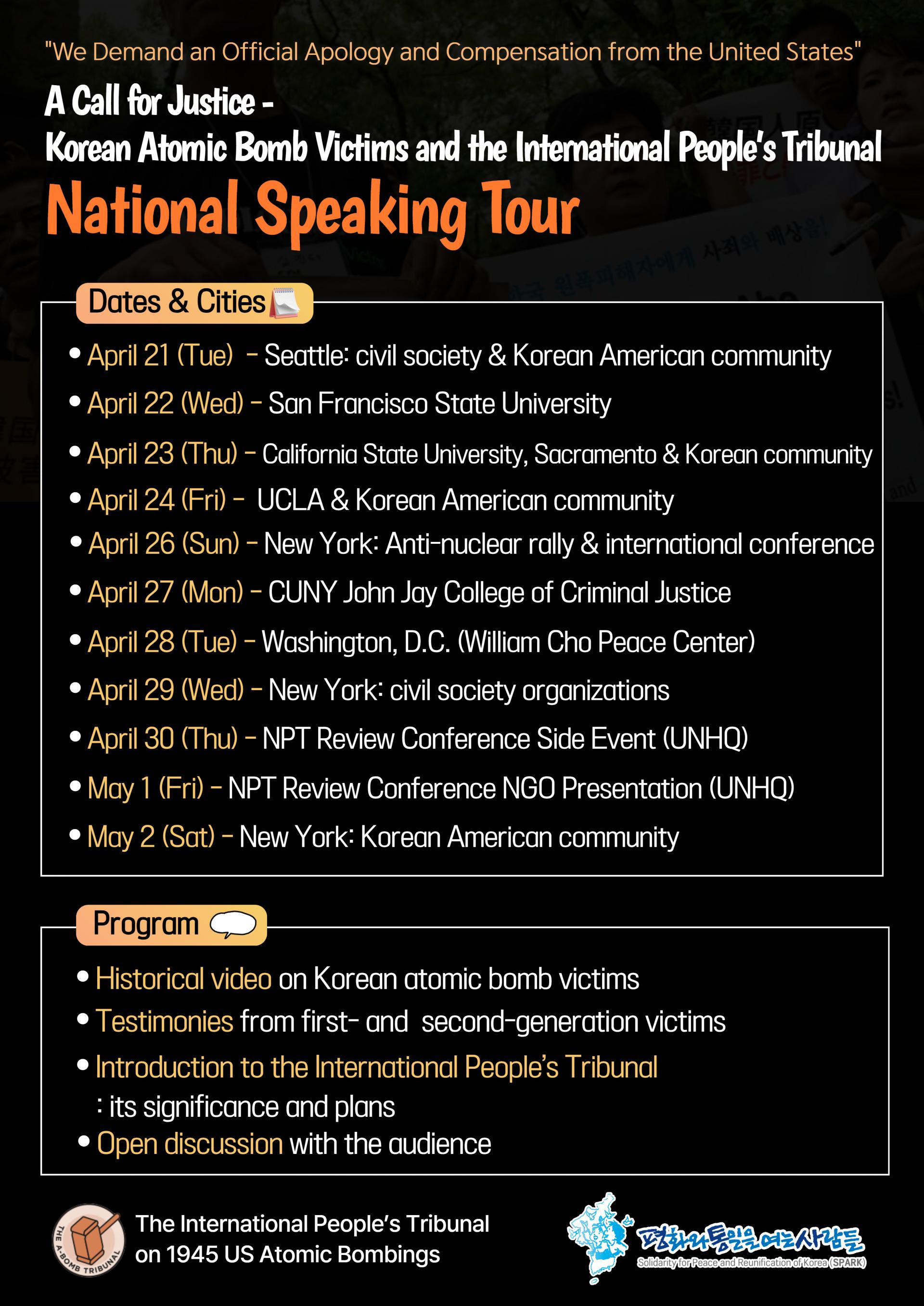
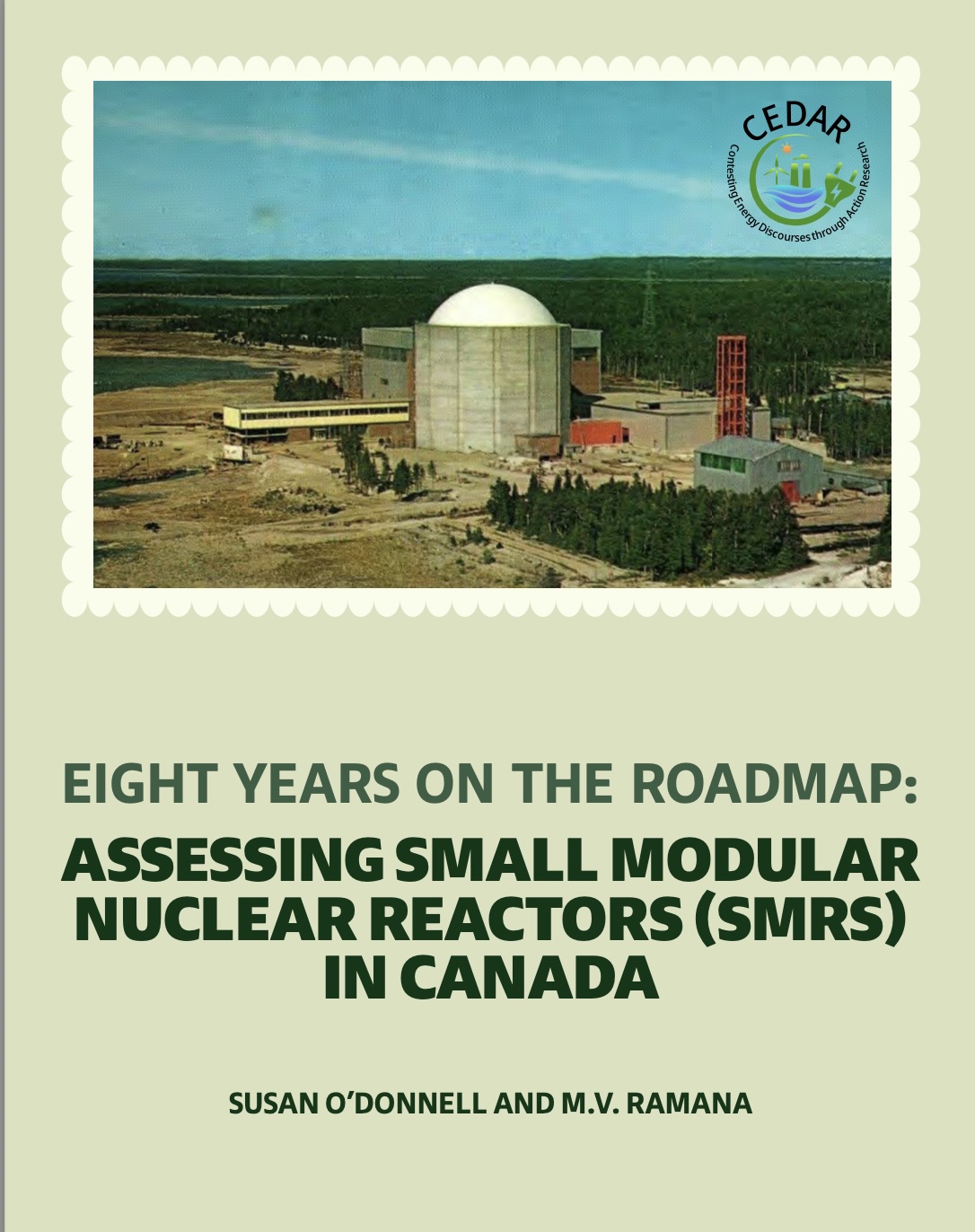

Pine Ridge Uranium is the real threat, not Tehran- Tell Burgum: Stop the Extraction.
Chernobyl: The Lost Tapes – A good documentary on Chernobyl on SBS available On Demand for the next 3 weeks– https://www.sbs.com.au/ondemand/tv-program/chernobyl-the-lost-tapes/2352741955560
To see nuclear-related stories in greater depth and intensity – go to https://nuclearinformation.wordpress.com
-
Archives
- April 2026 (288)
- March 2026 (251)
- February 2026 (268)
- January 2026 (308)
- December 2025 (358)
- November 2025 (359)
- October 2025 (376)
- September 2025 (257)
- August 2025 (319)
- July 2025 (230)
- June 2025 (348)
- May 2025 (261)
-
Categories
- 1
- 1 NUCLEAR ISSUES
- business and costs
- climate change
- culture and arts
- ENERGY
- environment
- health
- history
- indigenous issues
- Legal
- marketing of nuclear
- media
- opposition to nuclear
- PERSONAL STORIES
- politics
- politics international
- Religion and ethics
- safety
- secrets,lies and civil liberties
- spinbuster
- technology
- Uranium
- wastes
- weapons and war
- Women
- 2 WORLD
- ACTION
- AFRICA
- Atrocities
- AUSTRALIA
- Christina's notes
- Christina's themes
- culture and arts
- Events
- Fuk 2022
- Fuk 2023
- Fukushima 2017
- Fukushima 2018
- fukushima 2019
- Fukushima 2020
- Fukushima 2021
- general
- global warming
- Humour (God we need it)
- Nuclear
- RARE EARTHS
- Reference
- resources – print
- Resources -audiovicual
- Weekly Newsletter
- World
- World Nuclear
- YouTube
-
RSS
Entries RSS
Comments RSS
 nuclear-news