Tokyo’s radiation level 0.036 μSv/h before March 2011, now 13μSv/h.
 Radiological Disaster Survey in Tokyo Suburbs: 13μSv/h in Kashiwa, Chiba http://fukushimaemergencywhatcanwedo.blogspot.com.au/2014/08/
 radiological-disaster-survey-in-tokyo_26.html 2014-08-24 osted by dunrenard According to Ministry of Education, Culture, Sports, Science and Technology, the radiation level (gamma ray) in Tokyo was 0.036 μSv/h before 311. And now with the Japan fukushima nuclear
  contamination Tokyo 13μSv/h.


13μSv/h is 388 times more than what the Tokyo government measures at Shinjuku, 176 times more than their measurement in Edogawa-ku.
Here is what the Tokyo government finds at their (concrete and metal) monitoring posts (some of which are conveniently located 23 meters above ground):
http://monitoring.tokyo-eiken.go.jp/en/index.html
Sources:
Radiological Disaster Survey in Tokyo Suburbs: 13μSv/h in Kashiwa, Chiba 2014-08-24
https://www.youtube.com/watch?v=PUAPJc1ZUYU
Radiation back ground level was 0.036 μSv/h in Tokyo before 311
http://fukushima-diary.com/2012/12/radiation-back-ground-level-was-0-036-μsvh-in-tokyo-before-311/
Courtesy of Troy Livingstone and Bruce Brinkman
USA Nuclear permits to resume , as NRC renews its religious faith in a future solution to radioactive trash problem
U.S. to Resume Nuclear Permits, Relicensing on Waste Rule http://www.bloomberg.com/news/2014-08-26/u-s-to-resume-nuclear-permits-relicensing-on-waste-rule.html
The commission approved a final rule addressing the environmental effects of storing spent nuclear fuel at a plant site, satisfying a court order that it needed to consider the possibility a permanent underground waste repository may never be built in the U.S., according to a statement today.

The Court of Appeals struck down the agency’s “waste confidence” rule in June 2012, saying the regulator also needed to do further studies on spent fuel pool leaks and fires. The agency suspended final licensing decisions on new reactors as well as license renewals for plants and storage facilities while it formulated its response. That suspension will be lifted once the final storage rule becomes effective, 30 days after publication in the Federal Register.
“The completion of this rulemaking is an important step that will facilitate final decisions on industry licensing actions pending,” Ellen Ginsberg, general counsel for the Washington-based industry group the Nuclear Energy Institute, said in a statement.
There are currently eight applications to build reactors awaiting agency action, according to its website. About 74 percent of the 100 operating U.S. reactors have been relicensed, allowing them to operate 20 years beyond their original 40-year lifespan.
Among the plants awaiting relicensing are Entergy Corp. (ETR)’s Indian Point reactors in New York and PG&E Corp.’s Diablo Canyon units in California.
To contact the reporter on this story: Mark Chediak in San Francisco at mchediak@bloomberg.net
To contact the editors responsible for this story: Susan Warren at susanwarren@bloomberg.netTina Davis, Robin Saponar
A legal precedent, as TEPCO us ruled liable for a Fukushima suicide

 In a first, Japanese court rules that nuclear plant operator is liable for suicide WP, By Anna Fifield and Yuki Oda August 26 at 6:07 AM TOKYO — A court in Fukushima has ruled that Tokyo Electric Power Co., the Japanese nuclear power plant operator, can be held responsible for the suicide of a woman who became depressed after the 2011 disaster.
The court ordered Tepco to pay $470,000 to Mikio Watanabe and his children after his 58-year-old wife, Hamako, killed herself a few months after the nuclear meltdown in the wake of the earthquake and tsunami forced them out of their home and destroyed their livelihoods.
The ruling was the first time that the struggling utility has been found liable for a suicide resulting from the accident, and it could galvanize others seeking redress from the company…….
The family’s attorney declared the verdict a “complete victory.”
“This ruling is significant as the precedent of a case caused by the nuclear power plant accident,” Tsuguo Hirota said. “Today’s verdict will greatly influence future lawsuits.”……..http://www.washingtonpost.com/world/in-a-first-japanese-court-rules-that-nuclear-plant-operator-is-liable-for-suicide/2014/08/26/bc43af62-6c30-4e70-8e22-ffe1895727c1_story.html
Danger to nuclear reactors, of California’s earthquakes
 California earthquakes may pose threat to nuclear plant, expert says http://www.csmonitor.com/Environment/Latest-News-Wires/2014/0826/California-earthquakes-may-pose-threat-to-nuclear-plant-expert-says
By Michael R. Blood, Associated Press AUGUST 26, 2014 LOS ANGELES — A senior federal nuclear expert is urging regulators to shut down California‘s last operating nuclear plant until they can determine whether the facility’s twin reactors can withstand powerful shaking from nearby earthquake faults.
Michael Peck, who for five years was Diablo Canyon‘s lead inspector, says in a confidential report that the Nuclear Regulatory Commission is not applying safety rules it set out for the plant’s operation.
The document, which was obtained and verified by The Associated Press, does not say the plant is unsafe. Instead, according to Peck’s analysis, no one knows whether the facility’s equipment can withstand strong shaking from those faults — the potential for which was realized decades after the facility was built. Continuing to run the reactors, Peck writes, “challenges the presumption of nuclear safety.”
Peck’s 2013 filing is part of an agency review in which employees can appeal a supervisor’s or agency ruling. The NRC, however, has not yet ruled. Spokeswoman Lara Uselding said in emails that the agency would have no comment.
The NRC, which oversees the nation’s commercial nuclear power industry, and Diablo Canyon owner Pacific Gas and Electric Co., say the nearly three-decade-old reactors are safe and that the facility complies with its operating license, including earthquake safety standards.
Former Prime Minister Naoto Kan calls for full disclosure of Fukushima nuclear disaster testimony
Kan seeks full disclosure of testimony on nuclear crisis http://www.japantimes.co.jp/news/2014/08/26/national/kan-seeks-full-disclosure-testimony-nuclear-crisis/#.U_5HVMVdUnk CANBERRA – Former Prime Minister Naoto Kan called Tuesday for the full disclosure of testimony regarding the Fukushima nuclear crisis, including that of plant chief Masao Yoshida.
Kan, prime minister during the March 2011 disaster, welcomed the Abe administration’s decision to release Yoshida’s testimony in September.
“It is the most important material to understand the cause of the accident and how it developed,” he said.
Kan, known for his opposition to nuclear power, is currently visiting Australia at the invitation of an environmental group.
“It is necessary to re-examine all the facts” related to the nuclear crisis, he said.
The government had resisted releasing Yoshida’s testimony. Before he died of esophageal cancer in July 2013 at age 58, he signed a statement preventing the release of interviews, citing concerns that he would be misinterpreted. Yoshida was interviewed for more than 20 hours from July to November 2011 by a government panel examining the crisis.
The government is also preparing to disclose testimony by others involved in the disaster as soon as it obtains consent from the interviewees.
“Since public interest of the examination of the accident is extremely high, I believe testimony by then senior executives of Tokyo Electric, including the chairman and president, as well as records of its teleconferences, should be disclosed,” Kan said.
He said he has approved the release of his own testimony.
Multiple fuel cores ejected from Fukushima nuclear reactors
Studies show multiple fuel cores ejected from Fukushima reactors – Hot particles of uranium and plutonium fuels detected nearly 300 miles away http://fukushimaemergencywhatcanwedo.blogspot.com.au/2014/08/studies-show-multiple-fuel-cores.html
Source: pdf: http://bostonchemicaldata.com/wpi/mKaltofenNagoya2014.pdf
Kaltofen : Radioisotopes in dusts released by Fukushima Daiichi units [include] Uranium and plutonium fuels and transuranics such as americium and neptunium… individual radioactive particles [in an] Ibaraki dust sample [include] Eu, Y, Zr, Th, Ce, Sr… in 1 to 15 um size range…
Source: (pdf) : https://engineering.dartmouth.edu/%7Ed30345d/courses/engs43/MarcoKaltofen.pdf
Kaltofen : The Japanese samples came from as far north as Sapporo in Hokkaido Prefecture and as far south as Tokyo, a range of 780 km. Fifty nine samples of dust from Japan were analyzed… Radioisotopes specific to the Fukushima Daiichi accidents, including Cs134, Cs137, and Co60 were detected in dust samples taken throughout Northern Japan, including areas more than 200 km outside of the accident exclusion zone. Cs134 was detected at all of the Japanese sites tested… Japanese samples… analyzed in the first month after the accident also contained I131 and Am241… Radioactive dust has become a ubiquitous part of life in northern Japan.
Source: (pdf) : http://www.indymedia.ie/attachments/mar2014/kaltofenjp_measuringradioactivedustinnorthernjapan.pdf
Chris Harris, former licensed Senior Reactor Operator & engineer, Aug 21, 2014 (at 24:00 in): NHK just [broadcasted] that many studies are showing… that multiple cores — parts of it, or some, or even most of it — had been ejected. We thought that too. Once you breach containment, that was one of my big concerns — where did the core go after an explosion like? Whether it be steam or hydrogen explosion or a combination of both… it got ‘sneezed out’ all over the place. It’s totally – it’s a huge mess.
Source: (video interview with Harris here) : https://www.youtube.com/watch?feature=player_detailpage&v=tQ5hmieRTpQ#t=1438
U.S. personnel given strict radiation safety orders in Fukushima area March 16 – 19, 2011
 US Official: There were orders to not get within 230 miles of Fukushima Daiichi — Potassium iodide given to all defense personnel and families within 200 miles of plant — Over 1,100 kinds of radioactive material detected http://enenews.com/us-official-there-were-orders-not-to-go-within-230-miles-of-fukushima-daiichi-potassium-iodide-given-to-all-defense-personnel-and-families-within-200-miles-over-1100-kinds-of-radioactive-mater
 Assistant Secretary of Defense Jonathan Woodson, June 19, 2014: Between March 16 and 19, 2011, ships supporting OT [Operation Tomodachi] were directed to remain at least 100 nm [nautical miles] from Fukushima Daiichi and greater than 150 nm from Fukushima Daiichi along a 90 degree arc, or wedge, centered on the direction of wind from Fukushima Daiichi. The standoff distance from Fukushima Daiichi was temporarily increased to 200 nm [230 miles] on March 16, 2011, as a precaution following detection of abnormally high radiation levels above the Fukushima Daiichi Unit 3 containment building by the Japanese military. On March 19, 2011, the wedge was reduced to 125 nm…
Joint Effects Coordination Board/Joint Requirement Review Board Review:
- Mar. 17, 2011 — Personnel entering within the 100 nm radius of Fukushima Daiichi Nuclear Power Plants, KI [potassium iodide] should be administered.
- Mar. 21, 2011 — Mission: Distribute KI to all DOD personnel and families within 200 miles from the Fukushima power plant.
Defense Threat Reduction Agency (pdf), Sept. 2013: The Defense Threat Reduction Agency’s (DTRA) Hazard Prediction and Assessment Capability (HPAC) model was used to generate the radiation exposure rates and air activity concentrations for at-sea crew. Inputs to the HPAC model included data on the isotopes inside [Fukushima Daiichi’s] reactors that had the potential for release to the environment… Although HPAC’s output included over 1,100 isotopes, it was determined that the major contributors to inhalation doses were the following 10 isotopes: I-131, I-132, I-133, Cs-134, Cs-136, Cs-137, Te-129, Te-129m, Te-131m and Te-132.
Asahi Shimbun: about 1,000 kinds of radioactive materials [are in the] water at the crippled Fukushima No. 1 nuclear power plant, sources said.
“Reliable” nuclear power? – sabotage, defects, aging all afflicting the industry
 Nuclear power: reliably unreliablehttp://www.greenpeace.org/international/en/news/Blogs/nuclear-reaction/nuclear-power-reliably-unreliable/blog/50384/
With wind power filling the energy gap left by shutdown nuclear reactors in the UK, and police investigating allegations of sabotage at a reactor in Belgium, the myth of “reliable” nuclear energy is being exposed like never before. The nuclear industry tells us that nuclear power is a reliable energy source, that it offers “energy security“. Tell that to Belgium and the UK who are seeing significant parts of their nuclear fleet shutdown.
It’s been confirmed that the major damage that shut down Belgium’s Doel 4 reactor was caused by sabotage. Meanwhile, cracks found in two other reactors – Tihange 2 and Doel 3 – means they may never reopen. The three reactors make up over half of the country’s nuclear power output.
(Worryingly, there are 22 other reactors around the world that share the same design as Tihange 2 and Doel 3.)
In the UK, four nuclear reactors – at Heysham and Hartlepool – are out of action while defects are investigated.
There have previously been issues with nuclear power plants being closed in EU and USA at times of drought because of water shortages.
What fills the energy gap while these “reliable” nuclear reactors are shut down?
Belgium is having to rely on electricity from its neighbours. So much for nuclear power giving the country energy security.
In the UK, things are much more optimistic. Renewable energy has come to the rescue. “Demand is low at this time of year, and a lot of wind power is being generated right now,” said the UK’s National Grid. Electricity supplies have been unaffected.
What lessons can we learn here?
Firstly, the idea that nuclear power is a reliable energy source that offers energy security is a myth, particularly in a world where aging nuclear reactors are coming to the end of their lives. Secondly, we see a reversal of the view that renewables need to be supported by nuclear power. Although nuclear and wind power do not have the same generation characteristics, nuclear reactors now needing to lean on renewables means the nuclear industry has a big problem.
More and more nuclear reactors will be closing in the coming years as they reach retirement age. The nuclear industry simply can’t build replacement reactors quickly or cheaply enough to fill the gap.
That’s a gap that renewables and energy efficiency can exploit safely and reliably. As the recently released 2014 World Nuclear Industry Status Report says…
[B]ig thermal plants running whenever they’re available are replaced by cheaper-to-run portfolios of renewables, mostly variable renewables, that add up to “virtual baseload” supply—collectively providing reliable electricity from a shifting mix of resources. This way of operating the grid is analogous to a symphony orchestra (as Rocky Mountain Institute’s Clay Stranger puts it): no instrument plays all the time, but with a good score and conductor, beautiful music is continuously produced. This approach is unfamiliar to traditional utilities, but it works.
The wind across the UK is playing some beautiful music right now.
Here we have yet more reasons to abandon nuclear power. It’s not reliable and does not guarantee energy security. It’s not your friend and is going to let you down sooner or later.
UN’s latest report – global warming might now be irreversible
 Global warming is already here and could be irreversible, UN panel sayshttp://www.theguardian.com/environment/2014/aug/26/global-warming-irreversible-un-panel-report A 127-page draft report by the UN Intergovernmental Panel on Climate Change describes what can be done about it
Global warming is here, human-caused and probably already dangerous – and it’s increasingly likely that the heating trend could be irreversible, a draft of a new international science report says.
The United Nations’ Intergovernmental Panel on Climate Change on Monday sent governments a final draft of its synthesis report, which combines three earlier, gigantic documents by the Nobel Prize-winning group. There is little in the report that wasn’t in the other more-detailed versions, but the language is more stark and the report attempts to connect the different scientific disciplines studying problems caused by the burning of fossil fuels, such as coal, oil and gas.
The 127-page draft, obtained by The Associated Press, paints a harsh warning of what’s causing global warming and what it will do to humans and the environment. It also describes what can be done about it.
“Continued emission of greenhouse gases will cause further warming and long-lasting changes in all components of the climate system, increasing the likelihood of severe, pervasive and irreversible impacts for people and ecosystems,” the report says. The final report will be issued after governments and scientists go over the draft line by line in an October conference in Copenhagen.
Depending on circumstances and values, “currently observed impacts might already be considered dangerous,” the report says. It mentions extreme weather and rising sea levels, such as heat waves, flooding and droughts. It even raises, as an earlier report did, the idea that climate change will worsen violent conflicts and refugee problems and could hinder efforts to grow more food. And ocean acidification, which comes from the added carbon absorbed by oceans, will harm marine life, it says.
Without changes in greenhouse gas emissions, “climate change risks are likely to be high or very high by the end of the 21st century,” the report says.
In 2009, countries across the globe set a goal of limiting global warming to about another 2 degrees Fahrenheit (-16.67C) above current levels. But the report says that it is looking more likely that the world will shoot past that point. Limiting warming to that much is possible but would require dramatic and immediate cuts in carbon dioxide pollution.
The report says if the world continues to spew greenhouse gases at its accelerating rate, it’s likely that by mid-century temperatures will increase by about another 3.6 degrees Fahrenheit (2 degrees Celsius) compared to temperatures from 1986 to 2005. And by the end of the century, that scenario will bring temperatures that are about 6.7 degrees Fahrenheit warmer (3.7 degrees Celsius).
Looks like global warming is stopping nuclear power, rather than the other way round
 Heavy Rain in South Korea Kills Five, Shuts Nuclear Plant Officials Say Five People Still Missing WSJ, By
JEYUP S. KWAAK 25 Aug 14, SEOUL-Heavy rainfall on Monday killed at least five people and shut down a nuclear reactor in South Korea, pushing the country’s populous southeast region to a near-standstill. …… A 650-megawatt nuclear reactor in Busan, about 330 kilometers (204 miles) southeast of Seoul, was also suspended on Monday after rising water flowed into the facilities, the national nuclear-power-plant operator Korea Hydro & Nuclear Power Co. Ltd said. The reactor remained shut down as of Tuesday morning…….http://online.wsj.com/articles/heavy-rain-in-south-korea-kills-five-shuts-nuclear-plant-1409023982
The Decline, but not quite yet Fall, of the global nuclear industry
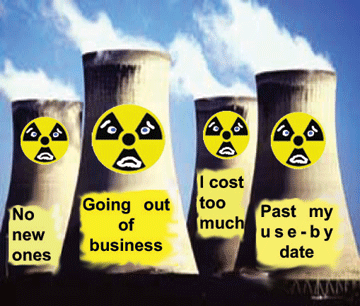 The nuclear industry today: declining, but not (yet) dying, Ecologist Jonathon Porritt 25th August 2014 The World Nuclear Industry Status Report provides an account of an industry in decline, writes Jonathon Porritt – with rising operating costs and an ever-shrinking share of world energy production, while the sector loses the race for investment and new generating capacity to fast growing renewable energy technologies.
Every year, theWorld Nuclear Industry Status Report reminds me why those in the Green movement who think nuclear has a major role to play in securing a low-carbon world are completely, dangerously off their collective trollies.
The Status Report is not an anti-nuclear polemic. Over the years, its authors (Mycle Schneider and Antony Froggatt) have assiduously built its reputation for dispassionate reporting on the state of the industry, presented as objectively and non-judgmentally as possible.
It uses a wide range of sources (academic, industry, avowedly pro-nuclear and avowedly anti-nuclear) to maintain longitudinal datasets going back over decades to tell it as it is – in contrast to all the froth of partisan propaganda. On both sides.
Let me just give you a taste from the newly-published 2014 Report:
Overview
“The nuclear share of the world’s power generation declined steadily from an historic peak of 17.6% in 1996 to 10.8% in 2013. Nuclear power’s share of global commercial primary energy production declined from the 2012 low of 4.5%, a level last seen in 1984, to a new low of 4.4%.”
“Twenty-eight years after the Chernobyl disaster, none of the next generation reactors (or so-called Generation III or III+) has entered service, with construction projects in Finland and France many years behind schedule.”
Construction…..delays
Certification delays…..
Operating cost increases….
Installed capacity – nuclear declining, wind increasing…
Nuclear’s installed capacity at the level of decades ago…..
As I worked my way through all this, page by page, it’s all but impossible for me to understand how any thoughtful, intelligent environmentalist could possibly suppose either that
- a so-called nuclear renaissance is ever going to happen; or
- even in the improbable circumstances that it did, how it could possibly deliver the kind of safe, secure, low-carbon energy the world needs so desperately.
And the longer they hang on to these fantasies, the more damage they do, sowing confusion and doubt, distracting attention from the business of driving forward with the renewables-efficiency-storage alternative.
All I can think is that these people never actually read up on the state of play in the nuclear industry. They should try it: it’s illuminating. http://www.theecologist.org/blogs_and_comments/commentators/2529402/the_nuclear_industry_today_declining_but_not_yet_dying.html
Corporate espionage against Non Profit Groups
 Dow Chemical vs. Greenpeace Corporations Spy on Nonprofits with Impunity, CounterPunch,
Yes, that means using a great array of spycraft and snoopery, including planned electronic surveillance, wiretapping, information warfare, infiltration, dumpster diving and so much more.
The evidence abounds.
For example, six years ago, based on extensive documentary evidence, James Ridgeway reported in Mother Jones on a major corporate espionage scheme by Dow Chemical focused on Greenpeace and other environmental and food activists……..
This is hardly the only case of corporate espionage against nonprofits. Last year, my colleagues produced a report titled Spooky Business, which documented 27 sets of stories involving corporate espionage against nonprofits, activists and whistleblowers. Most of the stories occurred in the US, but some occurred in the UK, France and Ecuador. None of the US-based cases has resulted in a verdict or settlement or even any meaningful public accountability. In contrast, in France there was a judgment against Electricite de France for spying on Greenpeace, and in the UK there is an ongoing effort regarding News Corp/News of the World and phone hacking.
Spooky Business found that “Many of the world’s largest corporations and their trade associations – including the U.S. Chamber of Commerce, Walmart, Monsanto, Bank of America, Dow Chemical, Kraft, Coca-Cola, Chevron, Burger King, McDonald’s, Shell, BP, BAE, Sasol, Brown & Williamson and E.ON – have been linked to espionage or planned espionage against nonprofit organizations, activists and whistleblowers.”
Three examples:……..
While there is a congressional effort to hold the NSA accountable for its privacy invasions, there is no such effort to hold powerful corporations accountable for theirs……..Ralph Nader’s latest book is: Unstoppable: the Emerging Left-Right Alliance to Dismantle the Corporate State. http://www.counterpunch.org/2014/08/25/corporations-spy-on-nonprofits-with-impunity/
SunFarmer shows the way, with off grid electricity powering health clinics
More Than A Light Bulb: How Clean Energy Is Powering Health Clinics Beyond The Grid http://cleantechnica.com/2014/08/26/light-bulb-clean-energy-powering-health-clinics-beyond-tthe-grid/August 26th, 2014 by Vrinda Manglik It is hard to overstate the effect that access to reliable electricity can have on people’s lives in rural communities worldwide.
That’s why we are so supportive of interventions like off-grid clean energy that not only put power directly in people’s hands, but do it in a time frame that matters: now, not decades from now. That’s something traditional grid extension and centralized power plants simply can’t do. Despite the important leg up off-grid clean energy provides these communities, we’ve heard some concerns that these interventions can only be used to provide lighting and supplies like light bulbs. This couldn’t be further from the truth.
To help us understand what kinds of resources these companies are powering with clean energy, we turned to SunFarmer, a US- and Canada-based non-profit organization, to learn more about off-grid companies powering health clinics.

SunFarmer is a pretty unique organization. As a non-profit, it has learned important lessons all off-grid companies should live by, including not to give things away for free. That’s why SunFarmer employs a rent-to-own business model that specifically seeks to empower local companies to deliver clean energy services to hospitals and health clinics. SunFarmer’s value to these companies is simple, but big: it unlocks crucial financing. Given how hard financing is to come by in this market, that’s incredibly important.
In addition, SunFarmer provides ever critical after-sales service in the form of technical assistance, quality assurance, and system maintenance — while local partners lead on project management. SunFarmer is also developing a monitoring and control platform to track the levels of energy production, observe the system’s battery performance, and communicate any issues (including energy theft) to health clinic staff. All of these critical data points prove that the next big frontier for these markets is data analytics.
But why should SunFarmer target large consumers, like health clinics, when most organizations working in this clean energy market start with small household needs — including lighting and mobile phone charging?
The answer is simple: the founders of SunFarmer were moved by the negative effect unreliable power has on 300,000 healthcare facilities worldwide. These critical public health care providers suffered from hours of power shortages and cuts that were keeping them from doing their job — saving lives.
When hospitals or health clinics lack reliable power, they can’t refrigerate vaccines. They can’t perform surgeries. Babies are delivered by flashlights or candlelight. Health clinic staff with SunFarmer projects have described the difference between delivering babies in darkness versus light, noting, “Previously, delivery was difficult using flashlights held in the mouth as they could neither see clearly nor could give instructions.” Continue reading
International companies attempting to remove tritium from toxic water at Fukushima nuclear plant
 Three firms picked to help tackle toxic water at Fukushima No. 1 http://fukushimaemergencywhatcanwedo.blogspot.com.au/2014/08/three-firms-picked-to-help-tackle-toxic.html by dunrenard Aug 26, 2014 The government picked three overseas companies Tuesday to participate in a subsidized project to determine the best available technology for separating radioactive tritium from the toxic water building up at the Fukushima No. 1 nuclear plant.
Thus tritium-laced water is expected to accumulate at the plant in the absence of any method to remove the isotope.
The three firms chosen from 29 applicants are U.S. firm Kurion Inc., which offers technologies to treat nuclear and hazardous waste; GE Hitachi Nuclear Energy Canada Inc., a joint venture of Hitachi Ltd. and U.S. firm General Electric Co.; and Federal State Unitary Enterprise RosRAO, a Russian radioactive waste management firm.
The government will provide up to ¥1 billion for each examination of the technologies and running costs, and consider whether any of them can be applied to treat the water at Fukushima No. 1, the industry ministry said.
The three companies are to conclude their experiments by the end of March 2016, a ministry official said.
The official cautioned there is no guarantee that any of the technologies will be put to practical use.
Source: Japan Times
http://www.japantimes.co.jp/news/2014/08/26/national/three-firms-picked-help-tackle-toxic-water-fukushima-1/
1 This Month


Tell the Ukrainian Government to Drop Prosecution of Peace Activist Yurii Sheliazhenko

Petition to revoke the licensing of the Near Surface Nuclear Disposal Facility (NSDF) at Chalk River. https://www.ourcommons.ca/petitions/en/Petition/Details?Petition=e-7247


of the week – STOP SMALL MODULAR REACTORS IN CANADA
To see nuclear-related stories in greater depth and intensity – go to https://nuclearinformation.wordpress.com
-
Archives
- March 2026 (193)
- February 2026 (268)
- January 2026 (308)
- December 2025 (358)
- November 2025 (359)
- October 2025 (376)
- September 2025 (258)
- August 2025 (319)
- July 2025 (230)
- June 2025 (348)
- May 2025 (261)
- April 2025 (305)
-
Categories
- 1
- 1 NUCLEAR ISSUES
- business and costs
- climate change
- culture and arts
- ENERGY
- environment
- health
- history
- indigenous issues
- Legal
- marketing of nuclear
- media
- opposition to nuclear
- PERSONAL STORIES
- politics
- politics international
- Religion and ethics
- safety
- secrets,lies and civil liberties
- spinbuster
- technology
- Uranium
- wastes
- weapons and war
- Women
- 2 WORLD
- ACTION
- AFRICA
- Atrocities
- AUSTRALIA
- Christina's notes
- Christina's themes
- culture and arts
- Events
- Fuk 2022
- Fuk 2023
- Fukushima 2017
- Fukushima 2018
- fukushima 2019
- Fukushima 2020
- Fukushima 2021
- general
- global warming
- Humour (God we need it)
- Nuclear
- RARE EARTHS
- Reference
- resources – print
- Resources -audiovicual
- Weekly Newsletter
- World
- World Nuclear
- YouTube
-
RSS
Entries RSS
Comments RSS
 nuclear-news