Fukushima situation is a continuing international crisis, requiring international help
“There should be an international consortium of global experts from France, from Russia, from the United States, and Canada, putting their heads together with the Japanese and working out solutions,” she said.
Others believe that Japan needs to look northwest, towards the Kremlin. Chernobyl gave Russia and Ukraine a level of experience in handling nuclear failures that stands apart from most of the world
NO ONE WANTS YOU TO KNOW HOW BAD FUKUSHIMA MIGHT STILL BE VICE By Johnny Magdaleno Aug 19 2014 “…………When I asked past Nobel Peace Prize nominee Dr. Helen Caldicott these questions, she was quick to respond: “Because money matters more than people.”
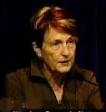 Dr. Caldicott was a faculty member at Harvard Medical School when she became president ofPhysicians for Social Responsibility, an American organization of doctors against nuclear warfare, climate change, and other environmental issues, in 1978. The organization, along with its parent body the International Physicians for the Prevention of Nuclear War, won the Nobel Peace Prize in 1985, a year after Caldicott left.
Last September, Caldicott organized a symposium at the New York Academy of Medicine entitled, “The Medical and Ecological Consequences of Fukushima,” and has a book coming out on the issue this October. Her expertise on the subject is founded on academic research, but also her lifelong role as a doctor practicing preventative medicine in the nuclear age.
“Japan produces parts for nuclear reactors, like reactor containment vessels,” she said in an interview with VICE. “They’re heavily invested in nuclear power, even though they actually have access to nine times more renewable energy than Germany.”
Although Caldicott says what separates Fukushima from Chernobyl is the continuous leakage of radioactive material, in her eyes they’re unified by an institutionalized effort to keep the veil from lifting. “The Japanese government took three months to tell the world that there had been three meltdowns, even though the meltdowns had taken place in the first three days,” she said. “They’re not testing the food routinely. In fact, they’re growing food in highly radioactive areas, and there are stories that the most radioactive food is being canned and sold to third-world countries.”
“Some doctors in Japan are starting to get very worried about the fact that they’re seeing an increase in diseases but they’re being told not to tell their patients that the diseases are related to radiation,” she continued. “This is all because of money. Bottom line.”
The money she refers to isn’t only rooted in Japan’s export of nuclear reactor parts, or the fact thatthe economy is starting to reclaim its reign over Japan’s national consciousness. It’s threaded throughout a history of collusion and secretive deals that extend beyond TEPCO’s record. Late last month, a longterm vice president of the Kansai Electric Power Company (KEPCO), which sourced nearly 50 percent of its electricity from nuclear power sources like Fukushima before the 2011 accident, revealed to Japanese reporters that the company’s president donated approximately $3.6 million to seven different Japanese prime ministers and other political figures between 1970 and 1990. The amount officials received was based on how much their incumbency profited the nuclear and electric energy sectors.
And if it’s not money that lies beneath these multi-faceted attempts at obscuring information about Fukushima, it’s the fear of mass hysteria. When it was revealed that the United Nations-affiliated pro-nuclear group International Atomic Energy Association made a deal with local government officials in Fukushima to classify information that might stoke public concern (like, observers speculate, cancer rates and radiation levels), civilian fears of a cover-up campaign crept out of the mischief associated with conspiracy and into the gravity of a situation that feels more and more surreal.
Despite these efforts, plenty has come to light. As of August 2014, we know that radiation levels around the Fukushima area continue to rise, even after three years of containment attempts. We know that doctors have found 89 cases of thyroid cancer in a study of less than 300,000 children from the Fukushima area—even though the normal incidence rate of this disease among youths isone or two for every million. We know that Japanese scientists are still reluctant to publicize their findings on Fukushima due to a fear of getting stigmatized by the national government.
We also know that US sailors who plotted a relief effort in Fukushima immediately after the disaster have reportedly been experiencing a well-up of different cancers, that monkeys living outside Fukushima’s restricted zone have lower blood cell counts than those living in other parts of northern Japan, and that the International Physicians for the Prevention of Nuclear War’s thorough critique of a recent Fukushima report by the UN Scientific Committee on the Effects of Radiation shows how the international community is severely underestimating the effects of the crisis.
Whether or not TEPCO’s ice wall will be as successful as the company’s lead engineers expect is ultimately dependent on trial. …..“The problem is that TEPCO has hardly invited in the international community to help to try and solve the problem,” says Dr. Caldicott. “A huge company like [Florida-based engineering group] Bechtol, which makes reactors and is a very good engineering company, should have been invited in by the Japanese government to try and propose a way to deal with these problems in an engineering fashion.”
At the same time, she recognizes that it’s not only up to Japan. “There should be an international consortium of global experts from France, from Russia, from the United States, and Canada, putting their heads together with the Japanese and working out solutions,” she said.
Others believe that Japan needs to look northwest, towards the Kremlin. Chernobyl gave Russia and Ukraine a level of experience in handling nuclear failures that stands apart from most of the world…….http://www.vice.com/read/no-one-wants-you-to-know-how-bad-fukushima-might-still-be-666
No comments yet.
1 This Month


Tell the Ukrainian Government to Drop Prosecution of Peace Activist Yurii Sheliazhenko

Petition to revoke the licensing of the Near Surface Nuclear Disposal Facility (NSDF) at Chalk River. https://www.ourcommons.ca/petitions/en/Petition/Details?Petition=e-7247


of the week – STOP SMALL MODULAR REACTORS IN CANADA
To see nuclear-related stories in greater depth and intensity – go to https://nuclearinformation.wordpress.com
-
Archives
- March 2026 (193)
- February 2026 (268)
- January 2026 (308)
- December 2025 (358)
- November 2025 (359)
- October 2025 (376)
- September 2025 (258)
- August 2025 (319)
- July 2025 (230)
- June 2025 (348)
- May 2025 (261)
- April 2025 (305)
-
Categories
- 1
- 1 NUCLEAR ISSUES
- business and costs
- climate change
- culture and arts
- ENERGY
- environment
- health
- history
- indigenous issues
- Legal
- marketing of nuclear
- media
- opposition to nuclear
- PERSONAL STORIES
- politics
- politics international
- Religion and ethics
- safety
- secrets,lies and civil liberties
- spinbuster
- technology
- Uranium
- wastes
- weapons and war
- Women
- 2 WORLD
- ACTION
- AFRICA
- Atrocities
- AUSTRALIA
- Christina's notes
- Christina's themes
- culture and arts
- Events
- Fuk 2022
- Fuk 2023
- Fukushima 2017
- Fukushima 2018
- fukushima 2019
- Fukushima 2020
- Fukushima 2021
- general
- global warming
- Humour (God we need it)
- Nuclear
- RARE EARTHS
- Reference
- resources – print
- Resources -audiovicual
- Weekly Newsletter
- World
- World Nuclear
- YouTube
-
RSS
Entries RSS
Comments RSS
 nuclear-news
Leave a comment