Sabotage of a nuclear reactor
 Belgian Doel 4 nuclear reactor closed till year-end Major turbine damage forces closure till year-end By Geert De Clercq PARIS, Aug 14 (Reuters)
* GDF Suez confirms outage was due to sabotage
* Other reactors down, Belgian nuclear capacity halved
* Further outage set to impact GDF Suez earnings (Adds GDF Suez quote on sabotage, detail on capacity)
– Belgian energy company Electrabel said its Doel 4 nuclear reactor would stay offline at least until the end of this year after major damage to its turbine, with the cause confirmed as sabotage.
On Tuesday, Electrabel had said the plant would remain offline until Sept. 15 as it carried out repairs and investigated an oil leak that forced its closure on Aug. 5. Its French parent company GDF Suez confirmed the closure was due to sabotage.
The shutdown of Doel 4’s nearly 1 gigawatt (GW) of electricity generating capacity as well as closures of two other reactors (Doel 3 and Tihange 2) or months because of cracks in steel reactor casings adds up to just over 3 GW of Belgian nuclear capacity that is offline, more than half of the total.
The latest closure will put further pressure on the earnings of GDF Suez, which warned last month that the closure of the first two Belgian plants would push its 2014 group net recurring income to the lower end of its forecast range of 3.3 billion to 3.7 billion euros.
The French company said those outages would have an impact of about 40 million euros per month on net recurring income.
Electrabel said on Thursday the Doel 4 reactor had shut automatically on Aug. 5 following an oil leak in its steam turbine in the non-nuclear part of the plant. The firm said the leak had caused major damage to the turbine’s high-pressure section.
“Based on this partial analysis, Doel 4 will certainly not be available before Dec. 31, 2014,” Electrabel said.
A GDF Suez spokesman confirmed Belgian press reports about suspicion of sabotage.
“There was an intentional manipulation,” he said, adding that somebody had tampered with the system used for emptying oil from the Alstom-made turbine.
He said no outsiders had penetrated into the plant but declined to say whether an employee could have purposely caused the leak, as has been reported in some Belgian media.
He said Electrabel had filed a complaint and that the Belgian police had started an investigation.http://uk.reuters.com/article/2014/08/14/belgium-nuclear-doel-idUKL6N0QK43R20140814
Fukushima and Chernobyl’s plants and animals have suffered from radiation
 No, Fukushima Is Not a Wildlife Haven—and Neither Is Chernobyl http://www.citylab.com/tech/2014/08/no-fukushima-is-no-eden-for-animalsand-neither-is-chernobyl/376046/ A slew of new research reveals the deleterious effects of radiation on Fukushima’s ecology. LAURA BLISS @mslaurabliss Aug 14, 2014
Perhaps you’ve encountered the well-publicized idea that Chernobyl, the world’s worst nuclear disaster of 1986, has become a kind of ‘wildlife haven’ as a result of its abandonment by humans.
So what of Fukushima Daiichi, Japan’s nuclear collapse of 2011—might we expect a happy menagerie there, too? Not so much, according to a slew of new papers out in the Journal of Heredity. And you may want to rethink Chernobyl-as-Eden, too.
The findings of the new studies tell of significant population decline across many different species of animals and plants, as well as a range of expressions of genetic damage and cell mutation.
One paper reports that the pale grass blue butterfly, one of Japan’s most common butterfly species, has suffered from significant size reduction, slowed growth, high mortality and abnormal wing patterns both within the Fukushima exclusion zone and among lab-raised offspring of parents collected at the site. Which is to say, radiation-caused genetic mutations were passed down.
 Researchers also found major declines in populations of birds, butterflies, cicadas, and some small mammals, as well as aberrations and albinism in the feathers of certain birds.
Timothy Mousseau, a prominent biologist and lead author of that population study, has also conducted significant research into radiation’s impacts at Chernobyl. He roundly rejects the claim that the area has become an animal haven, arguing that notion was based on anecdotal evidence rather than scientific data. Mousseau’s own work demonstrates radiation has had similar effects on Chernobyl’s ecology as on Fukushima’s.
Further inquiry into all manner of species living at the Chernobyl site could help scientists better predict Fukushima’s biological trajectory, he says. “There is an urgent need for greater investment in basic scientific research of the wild animals and plants of Fukushima,” Mousseau told the Journal of Heredity.
Japan’s nuclear power restart is just not really happening
 After the Fukushima meltdown, Japan’s nuclear restart is stalled, WP By Daniel Aldrich and James Platte August 15 “……Last month, the two reactors at the Kyushu Electric Power Company’s Sendai nuclear power plant were the first to pass new, stricter safety tests, but the actual restart date has been pushed back into the winter of 2015. Residents within 5 km of the plant now have potassium-iodide pills in the event of another accident, and some nine towns within 30 km of the plant have finally designed evacuation plans in case of a meltdown. These changes were a direct result of the Fukushima accident, which also spurred the creation of a new, independent nuclear industry regulator.
The Nuclear Regulation Authority (NRA) replaced a patchwork of bureaucrats who controlled the industry before the disaster — many of whom were simultaneously tasked with promoting the field through incentives and grants to local communities. ……..
Beyond changing the regulatory environment in Japan, the Fukushima meltdowns caused a sea change in public opinion on nuclear power. Before the accidents, some two-thirds of respondents regularly supported increasing the number of nuclear power plants. Now, the same percentage of residents oppose the use of nuclear power in Japan, and a national poll at the end of July found nearly 60 percent of respondents opposed the restart of the Sendai nuclear plant.
Communities that directly host the facilities continue to — with some exceptions — support the restart of these facilities. Their support derives primarily from financial reasons: the central government provides up to $10 million a year to the small, rural, coastal towns that have these projects in their back yards. Research published by one economist showed that even for these communities the actual benefits to individuals vary widely.
But towns more than 5 km from the plant receive few, if any, financial benefits and have been vocal in their opposition to restarts. Further, because of a longstanding gentlemen’s agreement between utilities and local communities, mayors and governors hold unofficial veto power over the process. Without their support, power utilities will be unable to restart their plants…….
all of Japan’s power utilities that operate nuclear power plants are struggling financially, consistently posting large losses since 2011. TEPCO was effectively nationalized to prevent it from failing, and in April, the state-owned Development Bank of Japan announced a total of nearly$1.5 billion in preferred stock investments into Kyushu Electric Power Company and Hokkaido Electric Power Company. Kyushu and Kansai Electric Power Company both recorded losses of over $900 million last year.
The ultimate question is how many reactors will restart and by when……..
While restarting some reactors will help generate revenue for Japan’s struggling power utilities, the cost of decommissioning about half of Japan’s pre-Fukushima reactor fleet will be significant. Despite the nuclear revival ambitions of the LDP and industrial leaders, Japan’s nuclear sector appears to have a long, difficult road ahead of it. http://www.washingtonpost.com/blogs/monkey-cage/wp/2014/08/15/after-the-fukushima-meltdown-japans-nuclear-restart-is-stalled/
Los Alamos nuclear weapons lab ‘s efforts to shut up a critic of nuclear war

 Did Los Alamos fire a researcher for questioning U.S. nuclear doctrine? Michael Hiltzik LOS ANGELES TIMES michael.hiltzik@latimes.com 15 Aug 14 Los Alamos may be a government laboratory with lots of classified secrets, but it also guarantees its researchers intellectual freedom on a par with that enjoyed by university professors. Political scientist James Doyle says that freedom was violated when he was fired last month after questioning U.S. nuclear weapons doctrine in a published article.
Doyle’s case was laid out in a lengthy piece by Douglas Birch of the Center for Public Integrity. A follow-up appears in the current issue of Science. Zaid says he’ll be appealing Doyle’s termination to the secretary of Energy and bringing it before other Washington officials who investigate allegations of retaliations against whistleblowers. So you can expect to hear more about it.
We’ve asked for a comment from the University of California, which is a major partner in the consortium that manages Los Alamos for the government and has three representatives on its board, including the board chairman, UC Regent Norman J. Pattiz, but haven’t received an answer.
Zaid, who says he represents other government whistleblowers, doesn’t buy the lab’s explanation. “It’s very easy for a government agency to independently justify any personnel action against someone,” he told us. But he questions how “someone with Doyle’s expertise, long-standing history with the lab, and stellar personal evaluations can suddenly be [laid off] as ‘non-essential.'”
The 8,100-word article at the center of the case appeared in Survival in February 2013 under the title, “Why Eliminate Nuclear Weapons?” Written on Doyle’s own time and presented explicitly as the author’s own views, it’s a sober and closely argued analysis of the postwar doctrine of “deterrence.”……
On the surface, Doyle’s argument that “nuclear weapons should be eliminated” parallels the Obama administration’s stated goal of “a world without nuclear weapons.” But it’s at odds with the defining mission of Los Alamos, which is devoted to weapons development……..
Doyle’s analysis should be heeded. The U.S. government’s nuclear doctrine must be updated to the 21st century. Mutually assured deterrence doesn’t work against the nonstate groups that pose the greatest threat to national security. More than ever, a world awash with nuclear weapons is in peril. http://www.latimes.com/business/hiltzik/la-fi-mh-antinuclear-article-20140815-column.html#page=1
Research slowly showing the harmful effects of Chernobyl and Fukushima radiation on the ecosystem
The Crushing Effects Of Radiation From The Fukushima Disaster On The Ecosystem Are Being Slowly Revealed http://www.businessinsider.com.au/the-serious-biological-effects-of-fukushima-radiation-on-plants-insects-and-animals-is-slowly-being-revealed-2014-8 CHRIS PASH A range of scientific studies at Fukushima have begun to reveal the impact on the natural world from the radiation leaks at the power station in Japan caused by an earthquake and tsunami in 2011.
Biological samples were obtained only after extensive delays following the 1986 Chernobyl nuclear power plant meltdown, limiting the information which could be gained about the impact of that disaster.
Scientists, determined not to repeat the shortcomings of the Chernobyl studies, began gathering biological information only a few months after the meltdown of the Daiichi power plant in 2011.
Results of these studies are now beginning to reveal serious biological effects of the Fukushima radiation on non-human organisms ranging from plants to butterflies to birds.
A series of articles summarising these studies has now been published in the Journal of Heredity. These describe widespread impacts, ranging from population declines to genetic damage to responses by the repair mechanisms that help organisms cope with radiation exposure.
“A growing body of empirical results from studies of birds, monkeys, butterflies, and other insects suggests that some species have been significantly impacted by the radioactive releases related to the Fukushima disaster,” says Dr Timothy Mousseau of the University of South Carolina, lead author of one of the studies. Continue reading
Serious flaws in India-Japan Nuclear Deal
 Reasons to Oppose the India-Japan Nuclear Deal – Nuclear Free by 2045 ? Dennis Riches 14 Aug 14 In late July and early August, a leading member of India’s Coalition for Peace and Nuclear Disarmament, Kumar Sundaram, visited several Japanese cities in order to speak to the mass media and Japanese citizens about the proposed Japan-India nuclear energy agreement. He timed his visit to Japan to precede
  that of Indian Prime Minister Narendra Modi at the end of August. Modi will meet with his Japanese counterpart in hopes of finalizing a deal to allow the purchase of vital components of nuclear power plants that are proposed or under construction
Finland’s Environment Minister call sto end nuclear deal with Russia, and increase renewable energy
 Greens’ Niinistö calls for gov’t to reconsider Rosatom for nuclear plant uutiset 15 Aug 14 Cooperating with the Russian nuclear contractor Rosatom would be a step backward in Finland’s attempts to reduce energy dependency on Russia, says Green League party chair and Environment Minister Ville Niinistö. The Minister said that energy production should remain in domestic hands.
 Green Environment Minister Ville Niinistö said he believes that giving the Russian nuclear plant builder Rosatom a permit to construct a new nuclear power facility in Finland would be strange, given that the rest of the European Union is working to reduce dependency on Russian energy. Rosatom is a Russian state-owned nuclear power construction company…….
He pointed out that the Czech Republic had rejected a bid by Rosatom to build a nuclear power plant and that Britain is also re-evaluating possible cooperation with Rosatom in light of the crisis in Ukraine.
Niinistö also called for a national programme to increase the use of home-grown renewable energy. http://yle.fi/uutiset/greens_niinisto_calls_for_govt_to_reconsider_rosatom_for_nuclear_plant/7414053
Defects in EDF’s nuclear reactors could close down many reactors: a warning to France
 Belgian Doel 4 nuclear reactor closed till year-end Major turbine damage forces closure till year-end By Geert De Clercq PARIS, Aug 14 (Reuters) “…In Britain, EDF Energy, owned by France‘s EDF, took three of its nuclear reactors offline for inspection on Monday after finding a defect in a reactor of a similar design.
The problems of the two French utilities with their reactors abroad may serve as a warning of possible generic flaws that could appear in EDF’s ageing nuclear park at home.
With 58 reactors in 19 nuclear plants, France is the world’s most nuclear-dependent country, relying on it for nearly three quarters of its power.
All of its plants are of the same basic Pressurised Water Reactor design, which means that a flaw discovered in one of EDF’s reactors could force the closure of others…..http://uk.reuters.com/article/2014/08/14/belgium-nuclear-doel-idUKL6N0QK43R20140814
A call to Mr. Putin and Mr. Niinistö for peace, and for non-nuclear energy
Mr. Putin and Mr. Niinistö – the World is Waiting for a Peaceful Solution for Ukraine, Solar Wind Pronet – linking the renewable thinking 15 Aug 14 “…..According to YLE-news, Finnish president Sauli Niinistö will be meeting the president of Russian Federation, Vladimir Putin tomorrow in Sochi, Russia. ……..
And about the energy issues, Mr. Putin: You know very well as every wise leader on this planet today that oil, gas, coal and nuclear power are each a no option to mankind if we like to survive. We have perhaps five to fifteen years to turn the CO2 -emissions into a sustainable level. And there we need renewable energy, masses of renewable energy. Russia is a great country with massive potential to produce renewable energy and also manufacture means to generate it for others. Russia could be among the leaders in new technology. But for that we need international co-operation. Finland have clean technology know-how, so does Germany and many other European countries. But as well we need China and the U.S.A. to join the common fight against greenhouse effect. And in the future African countries as well as India, Australia and Southern America will be joining the front to fight climate change.
The Ukrainian people including Russian speaking East and South-East Ukraine need an energy change. Being dependent on Russian natural gas is no good for Russia nor for Ukraine in the long run. They need heating and power for winter and it could be organized by international co-operation including Russian efforts.Bio-energy and solar and wind power should be the main power mix of the future Ukraine. Natural gas could be as backup for some decades. Building solar and wind power takes only a few years and it will be boosting local economy greatly giving working opportunities to tens of thousands. Russia could be part of the solution and learn how to make the energy change that is needed also in Russia.Time for oil, coal and gas economy is simply running out, and you know it, Mr. Putin.
The world is creating the energy change to renewables quicker than anybody thought, people around world are more than ready for it:………
But we need to stop fighting in Ukraine first……….
And Mr. Niinistö:
I hope you will have a good meeting with president Putin! I hope that you will appreciate the opinion of Finnish people when according to new opinion polls 2/3 of Finnish people are against the building of Hanhikivi-1 nuclear reactor. People in Finland want to see renewable energy projects – surely in co-operation with Russian companies also. And Finnish people is surely wishing for a peaceful solution to Ukrainian crises – a solution that is acceptable for both Ukraine and Russia.
Good Luck for both Mr. Presidents! http://solarwindpronet.blogspot.com.au/2014/08/mr-putin-and-mr-niinisto-world-is.html
A warning from UK’s National Health Service on the risks of radiation from CT scans
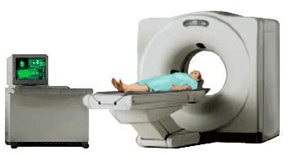 Caution urged over CT scan radiation doses, NHS UK, 15 Aug 14
BBC News reports on a sharp rise in the number of CT scans being performed, exposing people to the potential health risks of radiation.
However, as The Daily Telegraph says, it is not possible to calculate the cancer risk due to exposure to CT scans because there is a lack of data.
These media stories follow the publication of a report by theCommittee on Medical Aspects of Radiation in the Environment (COMARE). COMARE has reviewed trends in the use of CT scans in the UK. The review weighs up the risk-benefit balance of using CT scans, and considers ways to obtain the best quality scan image while minimising the necessary radiation dose.
The COMARE report sets out good practice guidance, encouraging doctors to take a more “proactive approach” to protecting patients and reducing radiation doses.
The committee recommendations cover equipment and procedures already in place, but also note there are dose reduction features available on some of the newer CT scanning machines that should be considered when new equipment is purchased.
What is COMARE and why is it looking at CT scans?….…
only 15% of our radiation exposure comes from medical sources. However, it has still increased from 0.33mSv per person per year in 1997, to 0.4mSv in 2008.
CT scans account for much of this exposure. ……..The report says there has been wider use of CT scans among younger people and children, whose tissues may have greater sensitivity to radiation. They also, of course, have a longer lifespan ahead of them in which potential harmful effects may be observed…..
70% of indications for CT scans recommended by guidance relate to benign (non-harmful) or potentially benign conditions. It says that CT scans are increasingly being used as a standard investigation, replacing other conventional ways of detecting health problems.
There are potential risks related to radiation…….
What does the COMARE report recommend?……..http://www.nhs.uk/news/2014/08August/Pages/caution-urged-over-use-of-ct-scan-radiation-doses.aspx
The true costs of our consumer capitalism must include wastes
 Mendaciousness—Capitalism and the Testimony of Integrity, Through the Flaming sword, August 15, 2014“………..Waste lies. We do the same thing with the true cost of our waste management. Capitalism does not figure into its pricing the real, final cost of disposing of its wastes safely, which ought to be part of its overhead, and never is. And when—or, to be realistic,if—the bill ever comes due for cleanup, capitalists inevitably try to squirm out of paying; it hurts profits and equity value.
This is especially important for wastes that do not biodegrade, but remain toxic and present in the body and bloodstream and organs of Mother Earth more or less permanently. And because Mother Earth is us—because our very bodies come from her—these wastes remain toxic and present in our bodies and bloodstreams and organs, as well.
The great killer disease of the industrial age was tuberculosis, the destruction of human lungs caused by the use of coal as a fuel. The great killer disease of the post-industrial age is cancer, the mutation of cells by toxic foreign substances. Thus some serious percentage of our healthcare costs should be included in the overhead cost of waste management.
Capitalism pretends that the only cost it must bear for managing its prodigious waste stream is the immediate one of getting it some distance away from its producer and providing for some minimal treatment before it gets poured back into Earth’s bloodstream or buried in her soil-flesh.
The superfund put aside for the treatment of “superfund” sites should be the model for the entire economic system. The goal should be zero toxic, non-recyclable waste returning to Mother Earth, zero toxic substances in our own bodies and those of our children—and a massive escrow account fed by some meaningful percentage of every economic transaction set aside to solve these so-far unsolvable problems in the future and to fund research and care for a public health increasingly threatened by capitalist dung.
The true cost of eliminating carbon dioxide, or uranium waste, or the 50,000 or so chemicals that we have never even tested for toxicity, would be staggering. So we just don’t think about it. Let the great-grandchildren deal with it.
In fact, if we really did account properly in our pricing for the destruction of natural capital and the remediation of capitalist waste, the system would collapse. Short-term greed is the main reason we don’t deal with these issues, but the reason we don’t even talk about it is the existential threat to the system itself that transitioning to an honest economic system represents…….http://throughtheflamingsword.wordpress.com/2014/08/15/mendaciousness-capitalism-and-the-testimony-of-integrity/
1 This Month


Tell the Ukrainian Government to Drop Prosecution of Peace Activist Yurii Sheliazhenko

Petition to revoke the licensing of the Near Surface Nuclear Disposal Facility (NSDF) at Chalk River. https://www.ourcommons.ca/petitions/en/Petition/Details?Petition=e-7247


of the week – STOP SMALL MODULAR REACTORS IN CANADA
To see nuclear-related stories in greater depth and intensity – go to https://nuclearinformation.wordpress.com
-
Archives
- March 2026 (204)
- February 2026 (268)
- January 2026 (308)
- December 2025 (358)
- November 2025 (359)
- October 2025 (376)
- September 2025 (258)
- August 2025 (319)
- July 2025 (230)
- June 2025 (348)
- May 2025 (261)
- April 2025 (305)
-
Categories
- 1
- 1 NUCLEAR ISSUES
- business and costs
- climate change
- culture and arts
- ENERGY
- environment
- health
- history
- indigenous issues
- Legal
- marketing of nuclear
- media
- opposition to nuclear
- PERSONAL STORIES
- politics
- politics international
- Religion and ethics
- safety
- secrets,lies and civil liberties
- spinbuster
- technology
- Uranium
- wastes
- weapons and war
- Women
- 2 WORLD
- ACTION
- AFRICA
- Atrocities
- AUSTRALIA
- Christina's notes
- Christina's themes
- culture and arts
- Events
- Fuk 2022
- Fuk 2023
- Fukushima 2017
- Fukushima 2018
- fukushima 2019
- Fukushima 2020
- Fukushima 2021
- general
- global warming
- Humour (God we need it)
- Nuclear
- RARE EARTHS
- Reference
- resources – print
- Resources -audiovicual
- Weekly Newsletter
- World
- World Nuclear
- YouTube
-
RSS
Entries RSS
Comments RSS
 nuclear-news