Who questions our Nuclear Experts’ beliefs when it come to risk taking?
CaptD 2014/08/07
 At some point, perhaps gross denial is best left for mental professionals with other types of training.
Case in Point, Japan is now suffering with a Trillion Dollar Nuclear Eco-Disaster, yet most nuclear experts and elected Officials consider that it, in effect, is “no big deal”:
Polluted Ocean, N☢ Problem, it will get better after a while….
Polluted Fields, N☢ Problem, they can remove the upper layer
Polluted Air, N☢ Problem, they can wear paper masks for a while
Polluted Food, N☢ Problem, they can mix the good to dilute the bad
Polluted Homes, N☢ Problem, they can power wash them clean
Polluted Schools. N☢ Problem, they can clean them
Polluted Cities, N☢ Problem, they can return soon…
The Fukushima disaster is an example of a case where something like a meltdown with a once per 100,000 years probably not only occurred, but occurred 3 times in less than a week!
Since many elected Leaders & Nuclear Professionals were “surprised” by Fukushima, perhaps SFGate would consider a followup Blog article, asking this question:
Are our Nuclear Power Plants really safe from whatever Nature can throw at them, because if they are not, then global Nuclear Regulators need to begin both internal and external studies ASAP to reevaluate Nuclear Safety before something occurs that we thought never would happen, AGAIN…
The USA is no different than Japan, where the Japanese nuclear Utility “Gangs” are telling the Government what to do, instead of the Government doing what the people want. President Obama has caved into supporting the nuclear industry instead of fast tracking Solar like Germany is doing and the result will be the USA falling further behind the rest of the World in GREEN (N☢N-Nuclear Energy generation and development!
Then there is always the real possibility of a US Fukushima, since Nature can destroy any land based nuclear reactor, any place anytime 24/7 then what?
Massive, decaying, dangerous, weapons empire at Oak Ridge
Y-12: Poster child for a dysfunctional nuclear weapons complex Robert Alvarez, Bulletin of the Atomic Scientists 6 Aug 14 “……The United States halted production of new nuclear weapons in 1989, with the end of the Cold War. But the US nuclear weapons complex—composed of eight key facilities that have an annual budget exceeding $8 billion—has stumbled on, in the form of a massive, decaying empire that in many cases does its work poorly or dangerously, or both. The Y-12 National Security Complex is the poster child for much of what ails the weapons complex. Although Y-12 has not produced weapons for some 25 years, its annual budgets have increased by nearly 50 percent since 1997, to more than $1 billion a year.

For decades, the Energy Department—which manages the weapons complex through the National Nuclear Security Agency (NNSA)—has not been able to reconcile competing objectives at the 811-acre Y-12 site, whether they involve storage areas for HEU and other fissile materials, the restarting of old weapons facilities, environmental cleanup, the building of new weapons facilities, or the downsizing of the site. As a result, costs have significantly increased, and long-standing problems have continued, unresolved, for years that have run into decades. For every dollar spent to maintain and modernize the US nuclear weapons stockpile, nearly three dollars is spent “to provide the underlying infrastructure” for maintenance and modernization at Y-12.
Long-term secrecy and isolation have created a dangerous form of hoarding at Y-12; a panoply of severe hazards continues to build up, constantly awaiting ever more costly mitigation in the future. But the stark reality is that there are no more cans to kick down the road. Y-12 has inexorably caught up with its future. Its environmental and security problems are too threatening to leave unaddressed, and questions about its mission will have to be answered definitively in an age of budgetary austerity and relatively little need for new nuclear weapons…….
During its heyday, Y-12 produced some 1,000 CSAs per year. Now, its annual production capacity has dwindled to less than 100. Though the NNSA declares that Y-12 has multiple missions, including non-proliferation efforts that involve the downblending of HEU and the provision of fuel for the Navy’s nuclear-powered submarines, nearly 99 percent of its budget comes from funds dedicated to maintain the US nuclear weapons stockpile. More than anything, Y-12 serves to stockpile thousands of CSAs from discarded nuclear weapons, as well as depleted uranium, lithium, and other hazardous chemicals…….. the Government Accountability Office finds that “NNSA’s decision to retain many CSAs … poses significant challenges to Y-12’s ability to plan its disassembly workload.” Although exact numbers have been classified since the 1990s, there are likely several thousand excess CSAs, containing hundreds of tons of HEU, awaiting dismantlement at Y-12. ……
Around New Year’s Eve of 1996, a long-awaited vulnerability assessment of HEU storage at Energy Department sites was released. Y-12 had the most significant problems. Even though fires posed the greatest danger of radiation and chemical exposure to workers and the public, buildings, mostly constructed in the 1940’s, had deteriorated and had insufficient or non-existent fire-protection systems, despite the very real possibility of a truly catastrophic fire and resulting release of radiation. It wasn’t until 14 years later that a replacement facility for the aged wooden structure serving as the main HEU storage warehouse was opened; it cost five times the original construction estimate. That facility gained notoriety in August 2012, after nonviolent peace protestors, including an 84-year-old nun, penetrated its security barriers……..
From 1997 to 2006, there were 21 fires and explosions at Y-12 involving electrical equipment, glove boxes, pumps, waste containers, and nuclear and hazardous chemicals. Several resulted in worker injuries and destruction of property. ……….. In March 2014, a large portion of a concrete ceiling collapsedin a building that was once part of the weapons operation. It was a near miss: Foot-long concrete pieces bounced onto walkways and an area where welders had been working just a day before. …..
In April 2014, the NNSA released a “red team” report, led by the director of Oak Ridge National Laboratory, on the troubled UPF. The team’s most significant recommendation was to rethink a basic, “big-box” approach that would create a UPF to serve multiple functions in one structure. Instead, to hold the line at an estimated $6.5 billion for design and construction costs, the team recommended going back to the drawing board to effectively reduce the size and scope of the project. Meanwhile, in recognition of the growing hazards associated with a deteriorating infrastructure for storing “materials at risk,” the team recommended that greater emphasis should be given to safe consolidated storage of materials, deferred maintenance, and safety upgrading……….
Regardless of the wisdom of or need for an asteroid-protection program, the future of Y-12 should be focused on earthly realities: cleaning up the environment, decontamination and decommissioning of facilities, stabilizing nuclear and other hazardous materials, and the dismantlement of a large excess stockpile of weapons components. There is a very real need to replace the collapsing infrastructure at Y-12 with facilities that can accomplish these goals.
Protecting the planet from asteroids is a poor rationale for failing to deal with the environmental, safety, financial, and health challenges the Y-12 site poses to the people who live in the area, and to the country as a whole. http://thebulletin.org/y-12-poster-child-dysfunctional-nuclear-weapons-complex7361
The Future for Small Modular Nuclear Reactors s does not look promising
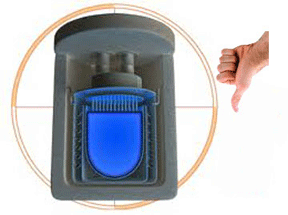 NuClear News August 14 “………The Future for SMRs does not look promising
Los Alamos officials have not silenced Jim Doyle’s thoughtful plea for debate about nuclear weapons
Los Alamos, Freedom of Speech, and Nuclear Disaster Lisbeth Gronlund, physicist & co-director, Global Security Union of Concerned Scientists August 4, 2014
As every high school student learns, the first amendment to the U.S. constitution guarantees the right to freedom of speech. That’s why government employees have the right to express their opinions as long as they make clear that their opinions do not represent those of their employer.
Apparently some folks at Los Alamos National Laboratory—one of the two labs that design and help maintain U.S. nuclear weapons—missed that day in class. Last year, Jim Doyle, then a nuclear security and non-proliferation specialist who had been at the Lab for 17 years, published an article in the journal Survival titled Why Eliminate Nuclear Weapons? Doyle included the requisite disclaimer: “The views presented in this article are the author’s own and do not represent those of the Los Alamos National Laboratory or the US government.” So far, so good.
But soon Los Alamos officials claimed the article contained classified information. Then they docked Doyle’s pay, took away his security clearance, and ultimately fired him. Not subtle.

The shameful tale of Los Alamos and Jim Doyle is thoroughly detailed in an article by Douglas Birch, an investigative journalist who works at the Center for Public Integrity. Among other things, Birch interviews several experts with security clearances who say that Doyle’s article contains nothing classified……..
An informed public debate about U.S. nuclear weapons policies is essential. That Los Alamos Lab officials went out of their way to stifle such debate is especially disturbing. Ironically, their actions have now brought Doyle’s article to the attention of a much larger group of people. http://blog.ucsusa.org/los-alamos-freedom-of-speech-nuclear-disaster-612
Threat of global terrorism means that USA and Russia must work together
 From Russia-US relations to global terrorism, nuclear insecurity is as big a threat as ever PRI’s The WorldProducer Nina Porzucki August 05, 2014 ·
This is what the US Department of Energy said last week in a report they released: “Effective nuclear security for all stockpiles worldwide will be almost impossible to achieve without Russia and the United States working together.”
President Barack Obama said as much himself at the Nuclear Security Summit held in Holland this past March.
“It is important for us not to relax, but rather accelerate our efforts over the next two years, sustain momentum, so that we finish strong in 2016,” he said.
But accelerating they are not. In the wake of the annexation of Crimea and turmoil in eastern Ukraine, relations have actually taken a step backward.
This is not the direction that relations should be going warns Matthew Bunn, who directs the “Managing the Atom Project” at the Belfer Center for Science and International Affairs at Harvard. Halting cooperation doesn’t just punish the Russians.
“We are investing in nuclear in Russia not as a favor to the Russians but as an investment to our own security. It’s important to us that this material — and the Russians have the largest stockpile in the world — be secure and it does not fall into terrorist hands,” Bunn said……..http://www.pri.org/stories/2014-08-05/russia-us-relations-global-terrorism-nuclear-insecurity-big-threat-ever
Renewable enegy already viable – and the myth of storage necessity
We Don’t Need a Huge Breakthrough to Make Renewable Energy Viable—It Already Is The idea that renewable energy can’t handle the load is a myth, says Amory Lovins http://www.smithsonianmag.com/smart-news/we-dont-need-huge-breakthrough-make-renewable-energy-viable-it-already-180952254/?no-ist By Colin Schultz August 5, 2014 From the windy plains to the sunny southwest, energy companies around the U.S. are investing heavily in renewable energy production. More than half of the energy production equipment being planned for installation in the next few years is renewable. Yet despite the environmental and economic sense of renewable energy, the public conception still lingers that wind and solar and other renewable tech will never be able to quite handle the job. After all, do we expect factories and homes to go dark when the sun sets or the wind falters?
The storage necessity myth: how to choreograph high-renewables electricity systems
In the video above, physicist and environmentalist Amory Lovins explains how renewable energy should be able to keep the electricity flowing just fine. We won’t need any big technological breakthroughs in batteries or storage technology, he says, or any other huge breakthroughs. All we’ll really need is good management and a diverse array of renewable energy production equipment.
Amory Lovins is the co-founder of the Rocky Mountain Institute, a think tank working on energy and resource use issues. This video was based on a presentation Lovins gave at the 2014 TED conference.
To help the nuclear industry, USA’s EPA to weaken radiation standards
 Green groups say EPA rules would weaken radiation standards The Hill, By Tim Devaney – 08/04/14 Green groups say the Environmental Protection Agency’s plan to weaken radiation standards at nuclear power plants would triple the likelihood of people in surrounding communities developing cancer.
The EPA said earlier this year it is considering new rules that green groups claim would actually weaken radiation standards, increasing public exposure by at least three times from the current level. The agency has not updated the standards since 1977. “The EPA admits that radiation is much more likely to cause cancer than was believed when the rule was originally written,” said Dan Hirsch, president of nuclear watchdog group Committee to Bridge the Gap. “So it’s perplexing that rather than tightening the rule, they’re proposing to weaken it further.”
The Committee to Bridge the Gap is one of about 70 environmental groups that sent EPA Administrator Gina McCarthy a letter over the weekend, asking her to reconsider the new rules as the public comment period closes and the agency enters the final stages of rule-making.
In addition to the environmental groups, more than 6,000 people have written to the EPA opposing the changes to the radiation standard, Hirsch said.
Under the EPA’s current standards, about one in every 500 people who are exposed to radiation develop cancer, but the new rules would increase the risk even more, Hirsch said.
“They’ve given a free pass to radiation,” Hirsch said……….
environmental groups speculate the Obama administration could be trying to replace coal production with nuclear energy, which they say is why the EPA is loosening radiation standards.
Environmental groups, however, express deep concerns about this plan.
“I would not say that nuclear is safer than coal, not at all,” Hirsch said.
“Choosing between coal and nuclear is a form of picking one’s poison, either carbon or plutonium,” he added. “But we believe that shouldn’t be the choice. The choice should be between dangerous pollutants and renewables, which are far safer.”
Renewable energies such as solar, wind and hydropower are all better replacements for coal than nuclear energy, Hirsch said. : http://thehill.com/regulation/214232-green-groups-say-epa-rules-would-weaken-radiation-standards#ixzz39gQFKYxi
Follow us: @thehill on Twitter | TheHill on Facebook
On costs and safety, solar energy far better than nuclear, for South Africa
 Nuclear plan incomprehensible http://www.bdlive.co.za/opinion/letters/2014/08/05/letter-nuclear-plan-incomprehensible Liz McDaid AUGUST 05 2014 THE Southern African Faith Communities’ Environment Institute (Safcei) shares the government and Eskom’s commitment to service the energy needs of the country and the poor in particular. We therefore find the growing emphasis on and commitment to nuclear energy incomprehensible on economic and moral grounds.
Following Eskom’s revelations to Parliament at the end of last month, Safcei believes that, financially, we cannot afford nuclear energy and calls on the Cabinet to abolish the nuclear focus and expand its renewable energy programme.
According to Eskom, 60% of our power stations are older than the recommended design age of 30 years, resulting in increased breakdowns and need for maintenance.
Life extensions and environmental retrofits will require between R50bn and R260bn. Eskom is looking to claw back additional revenue through more electricity tariff increases. Yet poor communities struggle to afford electricity right now.
According to Deputy President Cyril Ramaphosa, we will find additional finances to build new nuclear energy plants. Given that the cost of nuclear has been put at R1-trillion, who will provide the money?
By contrast, globally, a record of 39GW of new solar photovoltaic capacity was installed last year, which required less financing than in 2012, when only 31GW was deployed. In South Africa, renewable energy plants have added 1,300MW to the grid in just less than two years (with a further 1,200MW expected by end of next year.).
As people of faith, we express our deep concern that our public policies are not in line with the best options for preserving our natural environment, saving energy and alleviating poverty. Safcei believes therefore that there is an ethical imperative to expand renewable energy, which is cheaper to build, has zero fuel costs and can provide sustainable, affordable energy for the people of South Africa.
Public Enterprises Minister Lynne Brown says she is hoping to appoint a CEO for Eskom in the next few weeks. If the government is serious about addressing the Eskom crisis, it needs to direct the utility to abandon 19th-century thinking and catch up with the 21st century.
We therefore call on Ms Brown to appoint someone who can consider the long-term energy needs of the country. Appointing a renewable energy expert as a CEO would be a good first step.
Small Modular Nuclear Reactors in reality are far from safe
nuClear News August 14, “…..Safety of SMRsdepend on convincing the US Nuclear Regulatory Commission to relax existing safetyIndustry and Energy Business taking note of World Nuclear Status Report
Nuclear is generating less of world’s power; renewables are accelerating, MINN Post By Ron Meador 6 Aug 14, At best, nuclear power accounted for only 10.8 percent of the world’s electricity last year — down from a peak of 17.6 percent in 1996 — and faces a difficult future in at least the short term because the world’s reactor fleet is aging, while new projects are burdened by high costs and construction delays.
So says last week’s World Nuclear Industry Status Report 2014, which so far is getting more attention in business and power-industry publications than in general media…….. The report’s chief author is Mycle Schneider…his consulting clients have included the International Atomic Energy Agency, the French and German environment ministries, the Belgian energy ministry and members of the European Parliament.
The IAEA has distributed his reports in the past; some have been reprinted in the Bulletin of the Atomic Scientists. This year’s report has gained attention from U.S. News & World Report, hardly a journal for lefty, anti-nuke bunny-huggers, as well as Power, concerned with “business and technology for the global generation industry.”
And Power’s take on the Schneider analysis, by the way, is that the true decline is even steeper than stated above. It leads with statistics putting nuclear’s share of “global commercial primary energy production” — which does sound like the thing you’d really want to measure — at 4.4 percent last year, “a level not seen since 1984.”………..
-
The average age of the world’s operating nuclear fleet has increased to 28.5 years with over 10% of the total having operated for over 40 years.
-
While 67 reactors are under construction in 14 different countries, at least 49 of them have encountered construction delays, with eight being “under construction” for more than 20 years.
-
“Newcomer countries” have seen delays in development, with Belarus the only nation to have “an actual construction project” while Bangladesh, Jordan, Lithuania, Poland, Saudi Arabia, Turkey, and Vietnam aren’t that far along as yet.
-
Capital costs for construction have escalated from roughly $1,000 per installed kilowatt a decade ago to what is expected to be around $8,000 per installed kilowatt for two new units at the Hinkley Point facility in the UK……..
In 2013 alone, 37 gigawatts of solar and 32 GW of wind capacity were added throughout the world. In contrast, nuclear capacity has declined by 19 GW since 2000. Again, much of that decrease is due to Japanese reactors being placed in LTO, but even with those reactors considered operational, nuclear capacity would only have increased 17.5 GW during the 14-year period………
Schneider’s own view:
It is time to match the international nuclear statistics to the industrial reality. The introduction of the new category Long-Term Outage more appropriately represents the operational status of nuclear power plants and provides industry analysts, political decision-makers and investors with a tool that mirrors empirical facts rather than wishful thinking……..
Industry prefers other stats
Neither U.S. News nor Power sought industry comment on the Schneider analysis but — interestingly — Climate Central’s blogger Bobby McGill did, and neither spokesman he interviewed actually took issue with Schneider’s methods or measures, including LTO. They just prefer different, more nuke-favorable ones:……… http://www.minnpost.com/earth-journal/2014/08/nuclear-generating-less-worlds-power-renewables-are-accelerating

USA’s Nuclear – I mean – Environmental Protection Agency
Officially “Safe” RadiationBy William Boardman OpEd News 8/3/2014 More Radiation Exposure Won’t Hurt You, Says U.S. EPA
“Protection Standards for Nuclear Power Operations” means what?
The Environmental Protection Agency (EPA) of the United States is a full blown oxymoron when it comes to protecting U.S. residents from the danger of increased exposure to ionizing radiation. That’s the kind of radiation that comes from natural sources like Uranium and the sun, as well as unnatural sources like Uranium mines, nuclear weapons, and nuclear power plants (even when they haven’t melted down like Fukushima). The EPA is presently considering allowing everyone in the U.S. to be exposed to higher levels of ionizing radiation.
In 1977, the EPA established levels of radiation exposure “considered safe” for people by federal rule (in bureaucratese, “the regulation at 40 CFR part 190“). In the language of the rule, the 1977 safety standards were: “The standards [that] specify the levels below which normal operations of the uranium fuel cycle are determined to be environmentally acceptable.” In common parlance, this became the level “considered safe,” even though that’s very different from “environmentally acceptable.” “Acceptable by whom? The environment has no vote.
The phrase “considered safe” is key to the issue, since there is no “actually safe” level of radiation exposure. The planet was once naturally radioactive and lifeless. Life emerged only after Earth’s radiation levels decayed to the point where life became possible, in spite of a continuing level of natural “background radiation.” The reality is that there is no “safe” level of radiation exposure.
Is the EPA actually immersed in a protection racket?
The studied ambiguity of the proposal’s title — “Environmental Radiation Protection Standards for Nuclear Power Operations” — goes to the heart of the issue: who or what is really being protected, nuclear power operations?
Quite aware that it is perceived by some as placing the desires of the nuclear power industry above the safety needs of the population, the EPA begins its proposal for changing radiation limits with this defensive and apparently contradictory passage:
This Advance Notice of Proposed Rulemaking is being published to inform stakeholders, including federal and state entities, the nuclear industry, the public and any interested groups, that the Agency is reviewing the existing standards to determine how the regulation at 40 CFR part 190 should be updated and soliciting input on changes (if any) that should be made.
This action is not meant to be construed as an advocacy position either for or against nuclear power.
EPA wants to ensure that environmental protection standards are adequate for the foreseeable future for nuclear fuel cycle facilities. As far as the EPA is concerned, the uranium fuel cycle does not include Uranium mining, despite the serious environmental danger that process entails. Once the environmental and human degradation from Uranium mining has been done, the EPA begins regulating environmental protection from nuclear fuel cycle facilities, beginning with milling and ending with storage or reprocessing facilities for nuclear waste.
According to the agency itself, “EPA’s mission is to protect human health and the
environment. EPA sets limits on the amount of radiation that can be released into the environment.”
Radiation exposure is chronic, cumulative, and unhealthy
Given the pre-existing radiation load on the environment from natural sources, it’s not clear that there is any amount of radiation that can be released into the environment with safety. The EPA pretty much evades that question, since the straight forward answer for human health is: no amount. Besides, the semi-captured protection agency is just as much engaged in protecting economic health for certain industries as it is in protecting human health. This leads it to making formulations that manage to acknowledge human reality without actually supporting it:………
Lower radiation levels provide more environmental protection
Environmental organizations like the Nuclear Information and Resource Service (NIRS) are urging the EPA to lower radiation release standards, to “protect more, not less.” According to NIRS, regulation of nuclear power has a sorry history:……..
In 2005, the National Academy of Sciences addressed “safe” levels of radiation and concluded that there are none in any scientifically meaningful sense.
Humans are exposed to a basic, damaging level of ionizing radiation from multiple sources from gestation till death. This natural background radiation is at a relatively low level, but the risk from radiation is cumulative. Every additional exposure above background radiation adds to the risk. Some of these risks, like radiation treatment to ward off cancer, are widely accepted as reasonable trade-offs. The reasonableness of greater exposure from the nuclear fuel cycle and the uncontrolled growth of nuclear waste is not such an obviously beneficial trade-off. http://www.opednews.com/articles/Officially-Safe-Radiatio-by-William-Boardman-Cancer_Environment_People_Radiation-140803-863.html
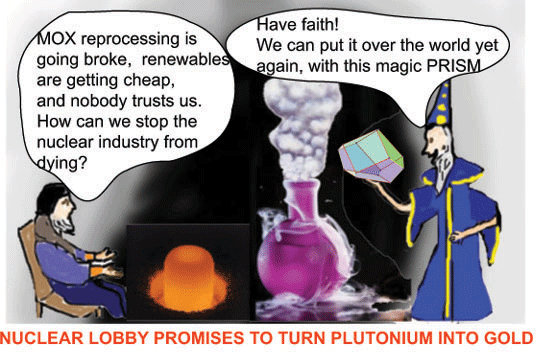
PRISM – Power Reactor Innovative Small Modular, dangerous and produces toxic wastes
USA’s unprecedented nuclear arsenal – the road to mass suicide
 Why We Must Disarm the U.S.’s Unprecedented Nuclear Arsenal http://time.com/3080077/why-we-must-disarm-the-u-s-s-unprecedented-nuclear-arsenal/ Elaine Scarry The potential for so vast a massacre has never before existed.
August 6 is the 69th anniversary of the day the United States dropped an atomic bomb on Hiroshima. The bombing of Nagasaki took place on August 9. An appropriate way to reflect on these events might be to contemplate our current nuclear arsenal and ask why it is being kept in place.The U.S. has by far the most powerful nuclear arsenal on Earth. Our 14 Ohio-class submarines together carry the equivalent of at least 56,000 Hiroshima blasts. These ships are not a remnant of the Cold War. Eight were made after the opening of the Berlin Wall during the presidencies of George H.W. Bush and Bill Clinton.
A fleet of 12 new Ohio-class submarines is currently undergoing design and construction: the first is scheduled for completion in 2021, the last in 2035. Also underway are a next-generation intercontinental ballistic missile and a next-generation heavy bomber, land-based and air-based delivery systems initiated by George W. Bush and continued by Barack Obama.
The country’s nuclear planners do not wait for a crisis to choose possible targets. Thousands of designated targets exist right now, often involving cities whose populations have no quarrel with us. Specific missiles have been assigned to each target city.
The U.S. citizenry cannot stop nuclear missiles once they are fired. Nor can we undo injuries—to humans, animals, plants and to the earth and sky themselves—once they are inflicted. Only by acting now— before they are fired and while the danger seems remote—can missiles be stopped and the injuries cancelled.
Polls conducted at the University of Maryland’s Center for International and Security Studies show that 73% of the U.S. population wants total elimination of nuclear weapons. But anonymous polls require no courage and carry no force. Making audible the population’s voice requires that people speak in their own voices and write their names, putting their opposition on record.
We have freedom over the ways we choose to express our opposition to these weapons. We have no freedom to determine what the stakes are or what happens if opposition fails.
Four factors make openly registering our opposition this summer and fall urgent:
1. Right now we have what we may never have again: a president who, in his Prague speech, put himself on record as saying nuclear weapons have to be eliminated. Furthermore, he acknowledged that because the U. S. is the only country to have used them, we are morally obligated to take the lead in eliminating them. So far Obama has failed to act. But if the U.S. population makes its will clear, he may act.
2. Next spring the Treaty on the Non-Proliferation of Nuclear Weapons will undergo its next five-year review at the United Nations. Article 6 requires that nuclear states give up their nuclear arms. Many of the treaty signers have expressed dismay and disgust with the failure of progress on Article 6. If by April 2015 the nuclear states have—after 45 years—still made little progress, the countries that have so far abstained from acquiring them may become convinced that a nuclear-free world is impossible. The dream of non-proliferation will end.
3. We have at present an ambassador to the United Nations, Samantha Power, who has written extensively about the moral horror of genocide inflicted on Armenians, Rwandans and others. She has criticized the United States for failing to act to stop genocide. Surely our citizenry can convince her that our own nuclear architecture is the genocide-ready instrument most in need of elimination.
4. The U.S. constitution makes Congress (through the requirement for a declaration of war) and the citizenry (through the second amendment) responsible for overseeing the country’s war making. A citizenry that turns its back on this responsibility is infantilized and marooned, severed from all governance. No one can take from us the authority over the country’s defense the constitution gives us; but if we do not act on it, it’s gone.
There are ways of honoring this responsibility that most of us might find too costly. Right now, Megan Rice, an 84-year old nun, is serving a three-year prison sentence for cutting through the security fences at the Oak Ridge, Tenn. nuclear facility. She and two companions set out in the middle of the night, crossing wilderness ground for several hours before they reached and broke through the fences. They risked not just prison sentences; they risked their lives.
The U.S. arsenal has taken away the right of self-defense from all creatures everywhere. Arrangements for so vast a massacre have never before existed on Earth. These arrangements must be unmade. They will not be unmade unless each of us steps forward and insists that it happen.
Elaine Scarry, who teaches at Harvard, is the author ofThermonuclear Monarchy: Choosing Between Democracy and Doom.
Small Modular Nuclear Reactors the energy option that does not stack up economically
 Economics of SMRs nuClear News, August 14 “……….Union of Concerned Scientist says just because these reactors are cheaper doesn’t mean to say they are cost effective.
Wind power – te renewable solution for energy needs in dry Jordan
Jordan turns to wind power in search of renewable energy, Al Monitor, 5 Aug 14 Jordan is carrying out a project to use wind power in Tafila province in the south of the country. The project’s energy production is around 117 megawatts per hour, generating 400 gigawatt hours yearly. The Jordan Wind Project Company (JWPC) will provide the necessary supply for the Jordan Electric Power Company (JEPCO) to carry out the project’s commercial execution in mid-2015, with an estimated cost of around $285 million. JWPC is a joint project between InfraMed (50%), Masdar in Abu Dhabi, UAE (31%) and EP Global Energy (19%). The cost of generating electricity from wind power is estimated at around $120 for every megawatt hour, which is significantly lower than conventional sources of electric power………
The Tafila wind farm project is the first of its kind in Jordan and the region in which a private company uses wind power to generate energy. The project includes installing 38 turbines (3 MW per turbine). The strategy adopted by the energy sector of Jordan aims at having renewable energy rise to 10% of the total energy and reach 8%-10% of the consumed electricity in Jordan by 2020. The Tafila wind farm is expected to generate electricity with a cost 25% lower than thermal energy, which would lower CO2 emissions by 40,000 tons per year.

The Ministry of Energy and Mineral Resources is working on launching a second wind-power project. Last week, the ministry signed a contract with the Spanish company Elecnor for a project designed to generate wind-power energy in Maan [south of the capital, Amman.] The available information shows that this project is going to be funded by the Gulf grant program, Kuwait Fund for Economic Development. On this project as well, the Arab funds create a transparency for contracting and covering expenses……http://www.al-monitor.com/pulse/business/2014/08/jordan-wind-power-project-energy-consumption.html#
1 This Month


10 March A LIVE WEBINAR THE REAL EFFECTS OF NUCLEAR POWER
What the Industry Isn’t Telling Us
1:00 PM Mountain, 2 pm Central, 3 pm Eastern. Live on the Keepers of the Water Facebook page


18 March Webinar @ 1 PM EST: An Assessment of SMR Projects: The Case of Canada
register for the zoom:
https://us02web.zoom.us/webinar/register/WN_o8BIIOUvQ2ONJR1nta65DQ#/registration


of the week – STOP SMALL MODULAR REACTORS IN CANADA
To see nuclear-related stories in greater depth and intensity – go to https://nuclearinformation.wordpress.com
-
Archives
- March 2026 (64)
- February 2026 (268)
- January 2026 (308)
- December 2025 (358)
- November 2025 (359)
- October 2025 (376)
- September 2025 (258)
- August 2025 (319)
- July 2025 (230)
- June 2025 (348)
- May 2025 (261)
- April 2025 (305)
-
Categories
- 1
- 1 NUCLEAR ISSUES
- business and costs
- climate change
- culture and arts
- ENERGY
- environment
- health
- history
- indigenous issues
- Legal
- marketing of nuclear
- media
- opposition to nuclear
- PERSONAL STORIES
- politics
- politics international
- Religion and ethics
- safety
- secrets,lies and civil liberties
- spinbuster
- technology
- Uranium
- wastes
- weapons and war
- Women
- 2 WORLD
- ACTION
- AFRICA
- Atrocities
- AUSTRALIA
- Christina's notes
- Christina's themes
- culture and arts
- Events
- Fuk 2022
- Fuk 2023
- Fukushima 2017
- Fukushima 2018
- fukushima 2019
- Fukushima 2020
- Fukushima 2021
- general
- global warming
- Humour (God we need it)
- Nuclear
- RARE EARTHS
- Reference
- resources – print
- Resources -audiovicual
- Weekly Newsletter
- World
- World Nuclear
- YouTube
-
RSS
Entries RSS
Comments RSS
 nuclear-news