CT scan radiation cancer risk is reduced by Ohio hospital
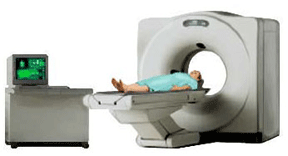
 Ohio hospital slashes CT radiation dose — and cancer risk By Brian Casey, AuntMinnie.com staff writer July 16, 2014 — By changing its scanning protocols, an Ohio hospital was able to cut by more than half the number of radiation-induced cancers that would have occurred following CT exams. The finding could alter the debate over the risks of medical radiation, according to a study in the July issue of the Journal of the American College of Radiology.
In the article, a team of researchers led by Michael Rayo, PhD, of Ohio State University described their project to implement new scanning protocols to reduce radiation dose. The group relied on commercially available tools accessible to most U.S. hospitals, such as iterative reconstruction, tube current modulation, and weight-based variable kV.
While taking into account an overall reduction in CT utilization that occurred during the same time period, the researchers calculated that their efforts would lead to a 63% reduction in cancers induced by the CT scans, based on widely accepted data. If the same scenario were repeated widely around the U.S., it could offer a way out of the morass that has engulfed radiology since the radiation dose controversy erupted in 2007 (JACR, July 2014, Vol. 11:7, pp. 703-708).
Rising volume and radiation dose
CT utilization grew steadily in the U.S. from 1998 through 2008, the authors noted. But in 2007, research studies began appearing that raised the specter that thousands of cancers could be caused by medical imaging exams, in particular CT studies. One study postulated that as many as 2% of all cancers in the U.S. could be caused by exposure to CT radiation, while another estimated that some 29,000 cancers could be caused annually by CT use.
The findings have spurred members of the radiology community to find ways to reduce exposure to medical radiation, with two main avenues being pursued: The first includes efforts such as Choosing Wisely, which reduces exposure by eliminating unnecessary imaging exams, while the second involves developing protocols to reduce the radiation dose used in appropriate exams.
Rayo and colleagues decided to study the topic to determine the impact on radiation dose at Ohio State University Wexner Medical Center, a tertiary-care facility in Columbus. They felt that previous research had not addressed the potential effects of dose reduction protocols and utilization declines on cancer risk reduction.
The researchers examined data for both Medicare and non-Medicare patients treated at the hospital on an inpatient basis in the calendar years 2008 to 2012. They examined reimbursement codes for CT scans of four regions: the abdomen and pelvis, head, sinus, and lumbar spine.
To assess the effectiveness of dose reduction strategies, they calculated the average dose-length product (DLP) in 2010 and 2012 (the hospital implemented its dose reduction program in 2011). The group used a sample of patients for each anatomical region and extrapolated the averages to all the patients scanned for that area at the hospital during the study periods.
Finally, the researchers calculated cancer incidence for both the preintervention and postintervention periods based on data from the Biological Effects of Ionizing Radiation (BEIR) VII report. They divided the estimates into three anatomical regions (estimates were not made for sinus CT due to a small sample size of patients).
They found that overall CT volume grew 21% from 2008 to 2010 and fell by 30% from 2010 to 2012, for a net decline of 15% over the study period. Other changes are shown in the table below. [table in original article]………
Finally, the researchers applied BEIR VII data to calculate how many fewer cancers might develop if all patients were scanned at the lower levels. This translated into an estimated decline of induced cancers from 10.1 cases in 2010 to 3.8 cases in 2012, and a drop in resulting mortalities from 5.1 individuals to 1.9 individuals……….http://www.auntminnie.com/index.aspx?sec=ser&sub=def&pag=dis&ItemID=107954
1 Comment »
Leave a comment
1 This Month

of the week – Shut Down Drone Warfare!


Tell the Ukrainian Government to Drop Prosecution of Peace Activist Yurii Sheliazhenko

Petition to revoke the licensing of the Near Surface Nuclear Disposal Facility (NSDF) at Chalk River. https://www.ourcommons.ca/petitions/en/Petition/Details?Petition=e-7247
To see nuclear-related stories in greater depth and intensity – go to https://nuclearinformation.wordpress.com
-
Archives
- April 2026 (114)
- March 2026 (251)
- February 2026 (268)
- January 2026 (308)
- December 2025 (358)
- November 2025 (359)
- October 2025 (376)
- September 2025 (257)
- August 2025 (319)
- July 2025 (230)
- June 2025 (348)
- May 2025 (261)
-
Categories
- 1
- 1 NUCLEAR ISSUES
- business and costs
- climate change
- culture and arts
- ENERGY
- environment
- health
- history
- indigenous issues
- Legal
- marketing of nuclear
- media
- opposition to nuclear
- PERSONAL STORIES
- politics
- politics international
- Religion and ethics
- safety
- secrets,lies and civil liberties
- spinbuster
- technology
- Uranium
- wastes
- weapons and war
- Women
- 2 WORLD
- ACTION
- AFRICA
- Atrocities
- AUSTRALIA
- Christina's notes
- Christina's themes
- culture and arts
- Events
- Fuk 2022
- Fuk 2023
- Fukushima 2017
- Fukushima 2018
- fukushima 2019
- Fukushima 2020
- Fukushima 2021
- general
- global warming
- Humour (God we need it)
- Nuclear
- RARE EARTHS
- Reference
- resources – print
- Resources -audiovicual
- Weekly Newsletter
- World
- World Nuclear
- YouTube
-
RSS
Entries RSS
Comments RSS
 nuclear-news
[…] The rest is here: CT scan radiation cancer risk is reduced by Ohio hospital « nuclear … […]
Pingback by CT scan radiation cancer risk is reduced by Ohio hospital « nuclear ... | welcome to radiologysecrets.comwelcome to radiologysecrets.com | July 21, 2014 |