 Joy Thompson’s excellent explanation and advice on this – see https://nuclear-news.net/2014/07/19/6-issues-for-americas-epa-on-radiation-safety-limits/
 Is EPA About To Relax Radiation Protections From Nuclear Power? Jeff McMahon Forbes, 19 July 14Both proponents and opponents of nuclear power expect the Environmental Protection Agency in coming months to relax its rules restricting radiation
  emissions from reactors and other nuclear facilities. EPA officials say they have no such intention, but they are willing to reconsider the method they use to limit public exposure—and the public’s level of risk.
“We want you to know EPA is not proposing any changes to the standards at this time,” said Jessica Wieder of EPA’s Office of Radiation. “We’ve issued theANPR just to solicit public input and information early as we evaluate whether the standards need to be changed at all.”
EPA has concerns about several other deficiencies in the current rule, Littleton said, including:
“In addition to finding groundwater contamination in the vicinity of several nuclear power plants, radioactive contaminants including uranium, strontium, and cesium have been found in groundwater in other uranium fuel cycle facilities,” Littleton said. “These environmental problems could linger on long past the operational phase of these facilities.”
Spent Fuel Storage: When the 1977 rule was written, regulators expected used fuel rods to be stored at nuclear plants for no more than 18 months before being transported to reprocessing plants or a long-term waste depository. Now regulators expect fuel rods to continue to accumulate in increasingly crowded conditions at power plants until at least 2050.
“Since these wastes are stored for much longer duration, there’s a possibility that these wastes could contribute to higher public doses,” Littleton said. ”The agency believes that storage is a covered activity, but if we revise it could be prudent to state that the rule is applicable to long-term storage on site.”
Radionuclides: Because regulators in 1977 expected spent fuel to be reprocessed, the rule specifically restricts radionuclides likely to be emitted during reprocessing: krypton-85, iodine-129, plutonium-238 and other alpha emitters. The U.S. no longer considers reprocessing viable for most existing spent fuel…….
Alternative Technologies: The 1977 rule applies only to the uranium fuel cycle, so it does not apply to facilities that use other fuels, like thorium, and it may not be suited to emerging technologies like small modular reactors, Littleton said.
“Do small modular reactors pose unique environmental considerations, or do existing limits adequately address concerns with small modular reactors?”
The EPA is collecting public comments on the proposed rule revision until Aug. 3. The public may submit comments at regulations.gov.

Widespread dispersal of radioactive cesium as Fukushima debris is removed
 Study: Cesium from Fukushima debris removal likely spread 50 km http://ajw.asahi.com/article/0311disaster/fukushima/AJ201407160064 July 16, 2014 By MIKI AOKI/ Staff Writer
Radioactive substances released during rubble-removal work at the Fukushima No. 1 nuclear plant last year likely spread to areas nearly 50 kilometers away, according to a research team at Kyoto University.
The agriculture ministry earlier raised the likelihood that debris-removal operations on Aug. 19, 2013, led to cesium levels exceeding the safety standard detected in rice harvested more than 20 km from the plant.
Akio Koizumi, a health and environment science professor at Kyoto University’s Graduate School of Medicine, and four other scientists discovered that the wind likely carried the cesium more than twice that distance.
The researchers set up air sampling instruments at three points in residential areas of Fukushima Prefecture and have measured radioactive cesium concentrations every week since September 2012 to estimate residents’ exposure to radiation.
From samples collected between Aug. 15 and 22 last year, they found a reading of 1.28 millibecquerels per cubic meter at a location in Soma, 48 km northwest of the plant. That radioactivity level was more than six times higher than usual.
Radioactivity levels were 20 to 30 times higher than normal in Minami-Soma, 27 km north-northwest of the Fukushima plant. And there were almost no changes in cesium concentrations in Kawauchi, 22 km west-southwest of the plant, the researchers said.
Based on the wind’s speed and direction at the time, as well as size of the collected particles, Koizumi and his colleagues concluded that the radioactive cesium came from the Fukushima No. 1 plant as the result of the Aug. 19, 2013, clearance work at the No. 3 reactor.
The team also found that cesium levels at the measuring point in Minami-Soma surged in both May and June 2013. They attributed the increase to debris-clearing operations at the facility.
The research results indicate that future rubble removal at the nuclear plant could disperse radioactive materials over much broader areas surrounding the facility.
In March this year, the scientists presented their findings to the Environment Ministry. It has also been reported that the agriculture ministry instructed Tokyo Electric Power Co., operator of the nuclear plant, to take measures to prevent the release of radioactive substances in the debris-removal work at the site.
TEPCO currently plans to resume debris-removal efforts by the end of July, starting with the dismantling of a cover installed on the No. 1 reactor building, where highly contaminated rubble remains to be removed.
The utility acknowledged that the Aug. 19 operations released a maximum 4 trillion becquerels–more than 10,000 times the usual levels at the site–over four hours, and apologized to residents for “causing trouble.”
However, TEPCO argued that it is unclear whether the increase in cesium readings was related to debris-clearing work.
“Going naked” – the nuclear industry’s huge financial risks
Earth Focus Episode 55 – Nuclear Insurance: America Goes Naked
Earth Focus Episode 55 – Nuclear Insurance: America Goes Naked
Fukushima Crisis Total Cost $1 To $10 TRILLION Dollars; via A Green Road
http://agreenroad.blogspot.com/2012/06/fukushima-crisis-total-cost-up-to-10.html
Fukushima Crisis Total Cost $1 To $10 TRILLION Dollars; via A Green Road
http://agreenroad.blogspot.com/2012/06/fukushima-crisis-total-cost-up-to-10.html
Criticism of nuclear power in Japan in a month’s public debate before nuclear restart is final
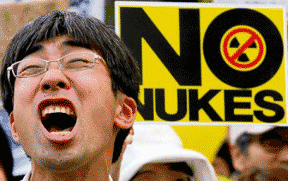 Regulator greenlights reactor restarts in nuclear-weary Japan Rt July 16, 2014 Japan’s nuclear watchdog has given a preliminary safety approval for restarting two nuclear reactors at the Sendai plant. A month is given for opposition groups to make their case against the move before a final decision is taken.
The reactors at Sendai power plant in Kagoshima Prefecture are two of 19 which Japanese electric utilities seek to restart and have applied for permission from the Nuclear Regulation Authority (NRA)………
The regulator is bound to see criticism over the one-month public debate period. Even as it was prepared to release the report on Wednesday, a small groups of protesters shouting “Shame on you!” at the public meeting, with one demonstrator accusing the watchdog officials of being puppets of the nuclear industry.
Greenpeace criticized the approval, charging that NRA is “ignoring unresolved safety issues and rising public opposition.”
The Sendai plant has “no effective evacuation plan for the populations in the region, in particular for the elderly, children and those in hospital, no functioning emergency-response center protected against radiation,” the group said in a statement.
The regulator deflected the criticism from the environmental group, saying that evacuation plans are the responsibility of local governments rather than the NRA.
A petition against the planned restart of the Sendai reactors scored 30,000 signatures of residents in Ichikikushikino, a coastal town 5km from the facility. And a local assembly adopted a resolution calling for Sendai to be decommissioned rather than restarted.
In another example of opposition to Abe’s nuclear policies, a candidate backed by his Liberal Democratic Party lost Sunday election to anti-nuclear candidate for the position of Shiga prefecture governor. http://rt.com/news/173224-nuclear-reactor-restart-japan/
Climate Change challenge to Koch brothers – and from other billionaires!
The Billionaire War Heats Up Slate.com 17 July 14 The richest people in America are turning on one another—over climate change.By Eric Holthaus Move over, Al Gore. There’s a new wealthy environmentalist whom conservatives love to hate. If you haven’t heard of him yet, meet Tom Steyer…….In a biographical post on his super PAC’s website labeled “accountability,” Steyer says “climate change has not always been on my radar.” In 2012, after founding Farallon Capital Management and running it for more than 25 years (amassing a billion-dollar fortune in the process), he left his post to work on global warming full time.
As the Washington Post reported last year, to reduce his footprint (which is probably still pretty big), Steyer chooses to take the red eye. He doesn’t shy away from the occasional environmental campaign rally, but he’s not about to guilt trip you for not switching out your light bulbs, either. His target is much bigger: the American political process itself.
In response to his efforts to make global warming a major political issue in the runup to the 2014 midterm elections,
 Climate change challenge tSteyer is fast drawing the ire of the political landscape’s resident oil-money billionaires, the Koch brothers. Their talking point is simple: Tom Steyer is one of us, so lefties should demonize him, too. As Slate’s David Weigel wrote, “Republicans are trying to Koch-ify Tom Steyer in just five or six months.”
Ever since February, when Steyer announced a $100 million campaign to fight climate change, critics have been eager to pick at anything that may tarnish his green label. Steyer’s campaign—$50 million of his own, and $50 million from his super PAC, NextGen Climate—is primarily meant to encourage action on global warming……….
teyer doesn’t dispute that he “was for coal before he was against it.” In an op-ed in Politico on Monday, Steyer explained his about-face from hedge fund capitalist to environmental crusader, in an attempt to set the record straight:
[I]t’s true—Farallon did make fossil fuel investments under my watch. But the more I learned about the energy and climate problems we currently face, the more I realized I had to change my life. I concluded that the best way to align my work with my beliefs was to make a real change—leaving my role managing a firm with investments across the industrial spectrum, and instead joining in the global effort to find a solution to climate change once and for all.
Steyer says that he’s completely divested his personal holdings from the fossil fuel industry as of June 30 though certainly that won’t stop the right from claiming that he’s being hypocritical. But that’s missing the point. It’s not Steyer’s dollars (or even the source of those dollars) that will make the biggest difference but his example of putting his money where his mouth is. In his Politico piece, he offers an incredibly personal description of his epiphany and his decision to dedicate himself to tackling global warming on behalf of his children’s generation. Steyer has done something that’s still far too unusual: He’s admitting he was wrong on climate change and that he wants to rectify it. It’s that kind of honesty that we’ll all need to embrace if we’re to face the steep climb of remaking the global economy into one that isn’t tied to carbon with a full head of steam (or, electrons, as the case may be).
Meanwhile, in a world where money defines political clout, most billionaires aren’t as eager to ruffle the status quo. The few who are stand out. Last month, Steyer joined billionaire former New York City Mayor Michael Bloomberg and near-billionaire former Goldman Sachs CEO and Treasury Secretary Henry Paulson to release a high-profile report on the economic effects of climate change in the United States. That report called for the leaders of the business community to address the growing specter of climate change out of their own self-interest: to avoid economic risk. With their billions in annual revenue as part of the fossil fuel industry, the Koch brothers may want to take note……….http://www.slate.com/articles/technology/future_tense/2014/07/tom_steyer_koch_brothers_billionaires_are_battling_over_climate_change.html
$1.9 million bonus to Mexico nuclear dump operator – 5 days after underground fire!
 Operator of New Mexico nuclear dump reaped $1.9 million bonus after underground truck fire http://www.foxnews.com/us/2014/07/20/operator-new-mexico-nuclear-dump-reaped-1-million-bonus-after-underground-truck/ CARLSBAD, N.M. – The contractor that operates the federal government’s underground nuclear waste dump in southeastern New Mexico received a $1.9 million bonus just five days after an underground truck fire closed the facility.
The Albuquerque Journal reported (http://bit.ly/1nLfPmq) Sunday that the U.S. Department of Energy awarded Nuclear Waste Partnership the funds based on an “excellent” job performance in maintaining the Waste Isolation Pilot Plant in Carlsbad.
Some observers say last February’s fire and the radiation leak that followed nine days later show the contractor failed at its job.
Initial probes by federal regulators into both incidents identified a host of management and safety shortcomings.
The Department of Energy says it is not considering revising or terminating its contract with Nuclear Waste Partnership.
The company has a contract to operate the Waste Isolation Pilot Plant through 2017.
USA soil still has radioactive material from Fukushima nuclear disaster
 Fox: Fukushima radioactive material still being found in U.S. soil — Japan Gov’t: The disaster “posed radiation threat to human society”… In 4 days “detectable all across northern hemisphere” — Denmark: Fukushima clearly had widespread consequences, not limited to borders (VIDEOS) http://enenews.com/fox-fukushima-radioactive-material-found-arizona-soil-japan-govt-fukushima-release-posed-radiation-threat-human-society-detectable-all-across-northern-hemisphere-4-days-denmark-fukushima-widespr
Danish Emergency Management Agency’s Carsten Israelson, Nordic Nuclear Safety Research’s 2013 Fukushima seminar (at 4:15 in): The accident in Fukushima… clearly showed that there are consequences that are widespread, and is not limited to borders… Nuclear accidents do happen! Nuclear accidents will likely have widespread consequences – for all of us. >> Watch presentation hereNational Institute of Radiological Sciences (Japan), March 3, 2014: The Fukushima Daiichi Nuclear Power Plant (FDNPP) accident led to the release of large amounts of radionuclides into the environment. […] The released radioactive materials posed radiation threat to human society. Thus, source identification of radioactive contamination and long-term environmental behavior of released radioactive materials are important issues of study after the FDNPP accident.
Japan Atomic Energy Agency & University of Tokyo, Apr. 10, 2014: By March 15, traces from the accident in Fukushima were detectable all across the northern hemisphere. By April 13, the associated radioactivity had spread to the southern hemisphere of the Asia-Pacific region and was clearly detectable at CTBT IMS stations located in Australia, Fiji, Malaysia, and Papua New Guinea.
Fox 10 News — Phoenix, AZ, July 15, 2014: [Aubrey Godwin, director of Arizona Radiation Regulatory Agency] says radioactive material can still be found in Arizona soil from nuclear weapons testing in the 50′s and from Fukushima’s nuclear disaster in 2011. Despite that Godwin says there is no health concern.
United Nations verifies that Iran has changed all enriched uranium into safer form

 UN: Iran Turns Nuclear Material Into More Harmless Forms http://www.huffingtonpost.com/2014/07/20/iran-nuclear_n_5604070.html By GEORGE JAHN 07/20/2014 VIENNA (AP) — The United Nations says Iran has turned all enriched uranium closest to the level needed to make nuclear arms into more harmless forms.
Tehran had committed to the move under an agreement with six powers last November that essentially froze its atomic programs while the two sides negotiate a comprehensive deal. They extended those talks Saturday to Nov. 24.
Iran had more than 200 kilograms (over 250 pounds) of 20 percent enriched uranium when the agreement was reached and began reducing it shortly after. The U.N.’s International Atomic Energy Agency said Sunday in a report obtained by The Associated Press that all has now been converted or diluted.
At 20 percent, enriched uranium can be converted quickly to arm a nuclear weapon. Iran denies wanting such arms.
Climate consequences of nuclear war shown by computer models
 Computer Models Show What Exactly Would Happen To Earth After A Nuclear War Let’s take a detailed look at some of these super-fun conclusions, shall we? Francie Diep Australian Popular Science
Jul 19 2014 You’ve seen what a nuclear winter looks like, as imagined by filmmakers and novelists. Now you can take a look at what scientists have to say. In a new study, a team of four U.S. atmospheric and environmental scientists modeled what would happen after a “limited, regional nuclear war.” To inexpert ears, the consequences sound pretty subtle—two or three degrees of global cooling, a nine percent reduction in yearly rainfall. Still, such changes could be enough to trigger crop failures and famines. After all, these would be cooler temperatures than the Earth has seen in 1,000 years.
First, what happened?
The team imagines 100 nuclear warheads, each about the size of the atomic bomb the U.S. dropped on Hiroshima, detonate over the Indian subcontinent. The team members are imagining an India-Pakistan nuclear war. It seems unfair to single out these nations, but I guess they’re the poster children because they have relatively small nuclear stockpiles compared to countries such as the U.S., Russia and China. The idea is, If these lightweights can do this to Earth, imagine what the bigwigs can do.
After the Indian-Pakistani nuclear exchange…
- Five megatons of black carbon enter the atmosphere immediately. Black carbon comes from burned stuff and it absorbs heat from the sun before it can reach the Earth. Some black carbon does eventually falls back to Earth in rain…………..
CT scan radiation cancer risk is reduced by Ohio hospital
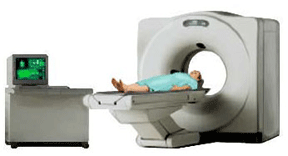 Ohio hospital slashes CT radiation dose — and cancer risk By Brian Casey, AuntMinnie.com staff writer July 16, 2014 — By changing its scanning protocols, an Ohio hospital was able to cut by more than half the number of radiation-induced cancers that would have occurred following CT exams. The finding could alter the debate over the risks of medical radiation, according to a study in the July issue of the Journal of the American College of Radiology.
In the article, a team of researchers led by Michael Rayo, PhD, of Ohio State University described their project to implement new scanning protocols to reduce radiation dose. The group relied on commercially available tools accessible to most U.S. hospitals, such as iterative reconstruction, tube current modulation, and weight-based variable kV.
While taking into account an overall reduction in CT utilization that occurred during the same time period, the researchers calculated that their efforts would lead to a 63% reduction in cancers induced by the CT scans, based on widely accepted data. If the same scenario were repeated widely around the U.S., it could offer a way out of the morass that has engulfed radiology since the radiation dose controversy erupted in 2007 (JACR, July 2014, Vol. 11:7, pp. 703-708).
Rising volume and radiation dose
CT utilization grew steadily in the U.S. from 1998 through 2008, the authors noted. But in 2007, research studies began appearing that raised the specter that thousands of cancers could be caused by medical imaging exams, in particular CT studies. One study postulated that as many as 2% of all cancers in the U.S. could be caused by exposure to CT radiation, while another estimated that some 29,000 cancers could be caused annually by CT use.
The findings have spurred members of the radiology community to find ways to reduce exposure to medical radiation, with two main avenues being pursued: The first includes efforts such as Choosing Wisely, which reduces exposure by eliminating unnecessary imaging exams, while the second involves developing protocols to reduce the radiation dose used in appropriate exams.
Rayo and colleagues decided to study the topic to determine the impact on radiation dose at Ohio State University Wexner Medical Center, a tertiary-care facility in Columbus. They felt that previous research had not addressed the potential effects of dose reduction protocols and utilization declines on cancer risk reduction.
The researchers examined data for both Medicare and non-Medicare patients treated at the hospital on an inpatient basis in the calendar years 2008 to 2012. They examined reimbursement codes for CT scans of four regions: the abdomen and pelvis, head, sinus, and lumbar spine.
To assess the effectiveness of dose reduction strategies, they calculated the average dose-length product (DLP) in 2010 and 2012 (the hospital implemented its dose reduction program in 2011). The group used a sample of patients for each anatomical region and extrapolated the averages to all the patients scanned for that area at the hospital during the study periods.
Finally, the researchers calculated cancer incidence for both the preintervention and postintervention periods based on data from the Biological Effects of Ionizing Radiation (BEIR) VII report. They divided the estimates into three anatomical regions (estimates were not made for sinus CT due to a small sample size of patients).
They found that overall CT volume grew 21% from 2008 to 2010 and fell by 30% from 2010 to 2012, for a net decline of 15% over the study period. Other changes are shown in the table below. [table in original article]………
Finally, the researchers applied BEIR VII data to calculate how many fewer cancers might develop if all patients were scanned at the lower levels. This translated into an estimated decline of induced cancers from 10.1 cases in 2010 to 3.8 cases in 2012, and a drop in resulting mortalities from 5.1 individuals to 1.9 individuals……….http://www.auntminnie.com/index.aspx?sec=ser&sub=def&pag=dis&ItemID=107954
China to get “zombie” Canadian nuclear reprocessing, from SNC Lavalin
SNC-Lavalin seeks to expand nuclear enterprise in China SHAWN MCCARTHY – GLOBAL ENERGY REPORTEROTTAWA — The Globe and Mail Apr. 13 2014,SNC-LAVALIN INC. IS HOPING TO REVITALIZE ITS INTERNATIONAL NUCLEAR BUSINESS THROUGH AN EFFORT WITH ITS CHINESE PARTNERS TO BURN REPROCESSED FUEL IN A CANDU REACTOR AS A WAY TO REDUCE RADIOACTIVE WASTE.
Officials from Candu Energy Inc. are leading a Canadian nuclear industry mission to China this week, which will include a visit Monday to the Qinshan nuclear power station south of Shanghai where two heavy-water Candu 6 reactors are in operation. Candu Energy is the former Atomic Energy of Canada Ltd., and is now wholly owned by SNC-Lavalin……..
Critics contend the Candu 6 is an outdated design that lacks safety features included in newer reactors, and that it is a technology that the international marketplace has largely rejected since the 1990s.
“So yeah, the industry is trying to say Candu isn’t dead. Never say die,” said Shawn-Patrick Stensil, a nuclear campaigner at Greenpeace Canada. “If Candu isn’t dead, it’s a zombie.”
Egypt planning nuclear power launch (is that safe?)
Nuclear plant tender to launch by year’s end; winning country to finance project: El-Osery, Daily News Egypt Sara Aggour / July 20, 2014 Egypt is to launch a global tender for its first Dabaa nuclear plant by the end of 2014, said Ibrahim El-Osery, the Ministry of Electricity’s adviser for nuclear energy
Speaking to the Daily News Egypt, El-Osery said the plant will be located in the Matruh governorate, with Egypt paying for the implementation expenses after operations start.
“One of the tender’s conditions is that whoever wins will take the responsibility of financing the project till its implementation,” said El-Osery……..http://www.dailynewsegypt.com/2014/07/20/nuclear-plant-tender-launch-years-end-winning-country-finance-project-el-osery/
1 This Month

of the week – Shut Down Drone Warfare!


Tell the Ukrainian Government to Drop Prosecution of Peace Activist Yurii Sheliazhenko

Petition to revoke the licensing of the Near Surface Nuclear Disposal Facility (NSDF) at Chalk River. https://www.ourcommons.ca/petitions/en/Petition/Details?Petition=e-7247
To see nuclear-related stories in greater depth and intensity – go to https://nuclearinformation.wordpress.com
-
Archives
- April 2026 (114)
- March 2026 (251)
- February 2026 (268)
- January 2026 (308)
- December 2025 (358)
- November 2025 (359)
- October 2025 (376)
- September 2025 (257)
- August 2025 (319)
- July 2025 (230)
- June 2025 (348)
- May 2025 (261)
-
Categories
- 1
- 1 NUCLEAR ISSUES
- business and costs
- climate change
- culture and arts
- ENERGY
- environment
- health
- history
- indigenous issues
- Legal
- marketing of nuclear
- media
- opposition to nuclear
- PERSONAL STORIES
- politics
- politics international
- Religion and ethics
- safety
- secrets,lies and civil liberties
- spinbuster
- technology
- Uranium
- wastes
- weapons and war
- Women
- 2 WORLD
- ACTION
- AFRICA
- Atrocities
- AUSTRALIA
- Christina's notes
- Christina's themes
- culture and arts
- Events
- Fuk 2022
- Fuk 2023
- Fukushima 2017
- Fukushima 2018
- fukushima 2019
- Fukushima 2020
- Fukushima 2021
- general
- global warming
- Humour (God we need it)
- Nuclear
- RARE EARTHS
- Reference
- resources – print
- Resources -audiovicual
- Weekly Newsletter
- World
- World Nuclear
- YouTube
-
RSS
Entries RSS
Comments RSS
 nuclear-news