Japan’s legal void. Nobody has authority to order restart of nuclear reactors
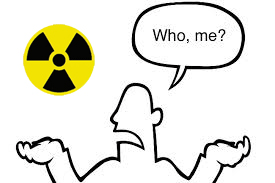 Decider Hard to Find in Japan Nuclear Restarts http://blogs.wsj.com/japanrealtime/2014/07/15/decider-hard-to-find-in-japan-nuclear-restarts/ Back in Japan’s feudal days, commoners would protest from time to time over burdens such as heavy taxes or forced labor. Samurai overlords might grant relief but would typically kill the protest ringleader.
To avoid that consequence, the commoners developed the idea of the “umbrella covenant”: Those who joined the protest signed their names in a circle resembling an open umbrella, making it hard to tell who signed first.
The situation over Japan’s nuclear restarts brings to mind that history, taught in Japanese grade schools, because it’s hard to tell who is the ringleader in bringing the nation’s 48 nuclear reactors back online.
As we reported today, the Nuclear Regulation Authority is set to say Wednesday that two Kyushu Electric Power Co. reactors in Satsuma-Sendai, Kagoshima prefecture, have complied with tougher post-Fukushima safety regulations.
The regulator says it is merely checking compliance with regulations, not verifying the complete safety of the reactors. Members of Prime Minister Shinzo Abe’s cabinet say they defer to the regulator when it comes to verifying safety. Leaders in Satsuma-Sendai say the city needs the central government’s approval before agreeing to restarts.
“The decision is too big. They are afraid of being responsible,” said Miwa Kiwaki, a volunteer helping a civil group in the Fukushima prefecture that has been petitioning the central government for criminal prosecution of those responsible for the Fukushima accident.
“The problem is nobody in Japan has any legal authority to enforce nuclear-power operations. Mr. Abe has to do something about the legal void if he thinks nuclear power is necessary,” said Junji Annen, a professor at Chuo University and the head of a government panel that discusses electricity prices.
Industrial electricity users say they hope for action soon to bring down power prices, which have risen because the nation is importing fuel to replace nuclear power. “A number of companies have already closed down, gone bankrupt, or decided to go overseas and cut staff,” 11 associations of manufacturers said in a joint statement in late May.
No comments yet.
1 This Month


Tell the Ukrainian Government to Drop Prosecution of Peace Activist Yurii Sheliazhenko

Petition to revoke the licensing of the Near Surface Nuclear Disposal Facility (NSDF) at Chalk River. https://www.ourcommons.ca/petitions/en/Petition/Details?Petition=e-7247


of the week – STOP SMALL MODULAR REACTORS IN CANADA
To see nuclear-related stories in greater depth and intensity – go to https://nuclearinformation.wordpress.com
-
Archives
- March 2026 (204)
- February 2026 (268)
- January 2026 (308)
- December 2025 (358)
- November 2025 (359)
- October 2025 (376)
- September 2025 (258)
- August 2025 (319)
- July 2025 (230)
- June 2025 (348)
- May 2025 (261)
- April 2025 (305)
-
Categories
- 1
- 1 NUCLEAR ISSUES
- business and costs
- climate change
- culture and arts
- ENERGY
- environment
- health
- history
- indigenous issues
- Legal
- marketing of nuclear
- media
- opposition to nuclear
- PERSONAL STORIES
- politics
- politics international
- Religion and ethics
- safety
- secrets,lies and civil liberties
- spinbuster
- technology
- Uranium
- wastes
- weapons and war
- Women
- 2 WORLD
- ACTION
- AFRICA
- Atrocities
- AUSTRALIA
- Christina's notes
- Christina's themes
- culture and arts
- Events
- Fuk 2022
- Fuk 2023
- Fukushima 2017
- Fukushima 2018
- fukushima 2019
- Fukushima 2020
- Fukushima 2021
- general
- global warming
- Humour (God we need it)
- Nuclear
- RARE EARTHS
- Reference
- resources – print
- Resources -audiovicual
- Weekly Newsletter
- World
- World Nuclear
- YouTube
-
RSS
Entries RSS
Comments RSS
 nuclear-news
Leave a comment