Fukushima nuclear plant now a radioactive swamp
Japan Nuclear Prof.: Fukushima plant now a ‘swamp of radioactive material’ — Can’t stop pumping in more water because they don’t know where melted fuel went — Build roof over entire site? — Asahi: Continued presence of water threatens construction of ice wall around reactors http://enenews.com/japan-nuclear-prof-fukushima-plant-is-now-a-swamp-of-radioactive-material-cant-stop-pumping-in-more-water-because-tepco-doesnt-know-where-melted-fuel-went-build-roof-over-entire-site-t?utm_source=feedburner&utm_medium=email&

Interview with Professor Hiroaki Koide, Kyoto University Reactor Research Institute, translated by Fukushima Diary, July 13, 2014: Fukushima plant is now like a swamp of radioactive material due to the contaminated water […] Tepco should quit cooling with water since one year ago. However from Tepco’s assumption, it is impossible to shift to air cooling because they can’t identify the exact locations of molten fuel.
More from interview with Professor Koide,translated by Google: I think of that accident of Fukushima […] the human race has been encountered for the first time […] Rather than the cooling in the water, shouldswitch as soon as possible to the cooling method of another I think. […] I thought the most part rain is falling on the site […] so, I cut off the rain. In other words, it is such as paving the entire site. I think I think in some cases, that I would build a roof on the entire site […] in the premises of the Fukushima Daiichi nuclear power plant, but is in a state such as the swamp of radioactivity […]
Asahi Shimbun, July 9, 2014: 11,000 tons of contaminated water [are in] underground trenches connected to the No. 2 and No. 3 reactor turbine buildings. […] contaminated water began seeping into them after the onset of the March 2011 nuclear crisis. If the contaminated water is not removed from the trenches, it could eventually leak out. The Nuclear Regulation Authority instructed TEPCO to promptly remove the water, calling it the “most serious source of concern.” […] But TEPCO officials said the ice walls failed to form because of the constant flow of a maximum 2 milliliters of water per minute around the connecting points. Toyoshi Fuketa, an NRA commissioner, has instructed TEPCO to come up with steps to resolve the matter by the end of July, arguing that the frozen walls should be able to withstand certain levels of water flow under normal circumstances. The continued presence of water threatens to prevent the creation of outer frozen soil walls encircling the No. 1 through No. 4 reactors, which are a central part of TEPCO’s plans to reduce the amount of contaminated water at the plant.
Full interview with Prof. Koide available here (Japanese only)
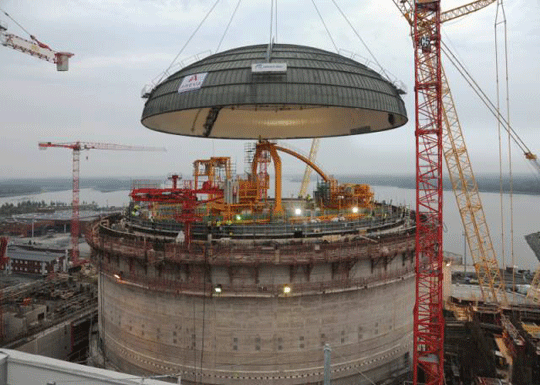
The whopping great financial mess that is Finland’s Olkiluoto nuclear power plant
 French auditors slam Areva for Olkiluoto nuclear project in Finland http://yle.fi/uutiset/french_auditors_slam_areva_for_olkiluoto_nuclear_project_in_finland/7358244?origin=rss 16 July 14, The French nuclear contractor Areva is at the centre of a storm of criticism by French government auditors over its operations. Finland’s Radiation and Nuclear Safety Authority STUK says it still hasn’t received all of the new paperwork relating to nuclear safety for the long-delayed Olkiluoto 3 nuclear power plant currently at a standstill in western Finland. And the company remains locked in a cycle of recrimination with the plant’s owner. A 122-page report by French government auditors has not yet been officially published but the financial paper Les Échos has quoted liberally from the account, which details major fiascos, billion-euro losses and the dissemination of misleading information by the French nuclear power plant contractor Areva.
The progress of the Olkiluoto 3 nuclear reactor in Eurajoki western Finland forms a central part of the narrative. Areva was selected in 2003 — as part of the Franco-German joint venture Areva-Siemens — to deliver the Finnish nuclear reactor.
“Areva was ready to do anything to win the Olkiluoto deal, including downplaying project management deficiencies. They had also previously delivered and commissioned nuclear reactors but they had never undertaken an entire project end-to-end, since the main French contractor had always been the EDF Group (Électricité de France), explained Les Échos editor in chief Pascal Pogam in an interview with Yle’s A-Studio current affairs program.
Based on accounts by parties such as the Olkiluoto owner-operator, the Finnish power consortium Teollisuuden Voima or TVO, Areva is said to have lied about the possibility of constructing a nuclear reactor within the agreed schedule.
“During the time of the Olkiluoto agreement Areva and Siemens (Areva’s former German joint venture nuclear partner) assured TVO that they had the required expertise to see the enterprise through to the end. On hindsight, TVO has speculated that Siemens and Areva minimised their difficulties and covered up their shortcomings to get the deal,” Pogam continued.
Bottomless pit of financial losses However the Olkiluoto reactor turned out to be a bottomless pit of financial losses for Areva, with the project languishing seven years behind schedule and racking up nearly 3.5 billion euros in deficits for the French contractor.
French government auditors took Areva to task for its inability to accurately estimate the cost and timetable required to complete the project.“It’s difficult to blame Areva alone, which is now locked in a futile dialogue with TVO and STUK. The parties can no longer communicate. The future of the project remains wide open because there seems to be no solution to the dispute. Currently Areva and TVO are only communicating via their lawyers. That’s not helping and no one can say when the project will be completed or at what cost,” Pogam remarked.
“According to the report the uncertain situation could get out of hand and the final bill could be massive. However I wouldn’t blame Areva entirely, it’s more a question of each side holding the other to ransom in a situation where each is equally to blame,” Pogam added.
Escalating arbitration battle
For the last couple of years Areva and TVO have been engaged in a pitched arbitration battle before the International Chamber of Commerce, with each side ratcheting up compensation claims over construction delays and unpaid fees.
In late October last year, Areva slapped an additional 700 million euros to bring its claim to 2.6 billion euros for the voided nuclear reactor deal. In its turn, TVO has claimed 1.8 billion euros in compensation for construction delays.
Meanwhile according to the most optimistic estimates the reactor is expected to be ready for firing up at the beginning of next year – many years behind the original completion schedule of 2009. However TVO has said Olkiluoto 3 won’t be operational until one year later in 2016 – and it’s anybody’s guess what the final price tag will be.
Japan’s legal void. Nobody has authority to order restart of nuclear reactors
 Decider Hard to Find in Japan Nuclear Restarts http://blogs.wsj.com/japanrealtime/2014/07/15/decider-hard-to-find-in-japan-nuclear-restarts/ Back in Japan’s feudal days, commoners would protest from time to time over burdens such as heavy taxes or forced labor. Samurai overlords might grant relief but would typically kill the protest ringleader.
To avoid that consequence, the commoners developed the idea of the “umbrella covenant”: Those who joined the protest signed their names in a circle resembling an open umbrella, making it hard to tell who signed first.
The situation over Japan’s nuclear restarts brings to mind that history, taught in Japanese grade schools, because it’s hard to tell who is the ringleader in bringing the nation’s 48 nuclear reactors back online.
As we reported today, the Nuclear Regulation Authority is set to say Wednesday that two Kyushu Electric Power Co. reactors in Satsuma-Sendai, Kagoshima prefecture, have complied with tougher post-Fukushima safety regulations.
The regulator says it is merely checking compliance with regulations, not verifying the complete safety of the reactors. Members of Prime Minister Shinzo Abe’s cabinet say they defer to the regulator when it comes to verifying safety. Leaders in Satsuma-Sendai say the city needs the central government’s approval before agreeing to restarts.
“The decision is too big. They are afraid of being responsible,” said Miwa Kiwaki, a volunteer helping a civil group in the Fukushima prefecture that has been petitioning the central government for criminal prosecution of those responsible for the Fukushima accident.
“The problem is nobody in Japan has any legal authority to enforce nuclear-power operations. Mr. Abe has to do something about the legal void if he thinks nuclear power is necessary,” said Junji Annen, a professor at Chuo University and the head of a government panel that discusses electricity prices.
Industrial electricity users say they hope for action soon to bring down power prices, which have risen because the nation is importing fuel to replace nuclear power. “A number of companies have already closed down, gone bankrupt, or decided to go overseas and cut staff,” 11 associations of manufacturers said in a joint statement in late May.
Public oplnion could put a spanner in the works of Japan’s nuclear power restart.
 CBRN Assessmen t Public opinion likely to affect timeline of Japan’s nuclear restarts, despite safety clearances IHS Jane’s Country Risk Daily Report 14 July 2014 Japan’s Nuclear Regulatory Authority (NRA) said yesterday (14 July) that it will approve an initial safety test to the Sendai nuclear plant in Kagoshima prefecture, in a step towards the gradual restart of nuclear power plants (NPPs) following the 2011 Fukushima disaster.
After the NRA has approved upgraded design and safety features of the Kyushu Electric Power Company-operated 1,780-megawatt (MW) plant, it will seek public comments for one month and carry out further on-site operational checks. Currently, all of Japan’s 48 nuclear reactors remain idled, awaiting NRA safety approvals before they can recommence operations.
Although the NRA’s move is a positive indicator that the Sendai plant could be restarted later in the year, as expected by local nuclear experts, considerable uncertainty remains over when a majority of NPPs will begin to come back online…. (full article – subscribers only) http://www.janes.com/article/40803/public-opinion-likely-to-affect-timeline-of-japan-s-nuclear-restarts-despite-safety-clearances
Japan should not be hosting 2020 Olympics
Why Japan should resign as host of 2020 Summer Olympics OpEdNews 7/15/2014
By carol wolman, MD (about the author) In September 2013, the International Olympic Committee’s (IOC) met in Buenos Aires to elect a host city for the 2020 Summer Olympic Games. Japan’s Prime Minister Shinzo Abe assured the IOC that “the situation [at Fukushima Daiichi] is under control”, and convinced them to hold the Games in Tokyo.
Abe was lying. Unforunately, the site is nowhere near “under control.” Fukushima Daiichi, the nuclear reactor complex damaged by the earthquake/tsunami of March 2011, continues to spew forth radioactivity today. The groundwater, which connects with the Tokyo aquifer, picks up unacceptable levels of radiation from the molten reactor cores. There are radioactive hot spots all over northern Japan, including in Tokyo. The practice field for athletes is only 20 kilometers from the Fukushima Daiichi. If the 2020 Olympics do take place in Tokyo, Japan will be exposing the world’s finest young athletes to potentially harmful soil and water.
Siting the 2020 Olympics in Tokyo involves a huge risk. There are so many things that can still go wrong at Fukushima Daiichi over the next 6 years, that one wonders why the IOC was willing to go along with the obvious lies told by Abe-san. The answer is also obvious- the world economy and current political makeup depends on Japan’s stability, as Japan has the third largest economy on the planet, and is the linchpin of US policy in the Far East. Moreover, the powers that be are heavily invested in nuclear power, and want it to appear safe. The Olympic decision is meant to reassure everyone that Japan is fine and nuclear power is not to be feared, so as to maintain the status quo.
There is a systematic pattern of lying and coverup about conditions at Fukushima Daiichi.

Occasionally we hear that readings were wrong and there is 1000x as much radiation in the groundwater as we were told. Respected national and international groups such as the World Health Organization assure us that there are no deaths or cancer increases from the accident. This, despite the 80 cases of childhood thyroid cancer in the area after only three years, and despite the sick American sailors who were first responders, and despite the many people with nosebleeds, cancers, etc. Japan has a law prohibiting doctors from reporting radiation related diseases. And people who report radiation problems are likely to be prosecuted under the new security law.
So many things can go wrong at Fukushima Daiichi! There’s a 400 foot tower, damaged, that could fall at any time, and is too radioactive to approach and repair. Another huge earthquake, tsunami, typhoon, could destabilize any one of the damaged reactor buildings, topple a spent fuel pool, lead to another explosion. The precarious process of removing damaged rods from the spent fuel pools could fail, leading to an unquenchable nuclear fire. The underground melted cores from reactors 1, 2 or 3 could reach a critical mass. The ground could settle and cause the buildings to fall. Etc., etc, etc. Any of these mishaps could force workers to abandon the site, so that the cooling would stop and the complex would spread radiation over a wide portion of Japan, including Tokyo. If any of these things happen, the Olympics will have to be moved, when there is too little time to build a new complex somewhere else.
On April 1 st , 2014, a new management team was put in place, devoted to decommissioning and decontaminating the plant. It’s telling that it took Tokyo Electric Power Company (TEPCO) 3 years to make such an obvious move. One can only speculate that a combination of denial, corruption, and stupidity prevented this necessary reorganization. http://www.opednews.com/articles/Why-Japan-should-resign-as-by-carol-wolman-MD-Fukushima_Lying_Olympics_Radiation-140715-303.html
Japan’s consumers to be rewarded for reducing use of electricity
Kepco to pay customers to switch off in effort to reduce demand Ft.com 15 July 14 By Jonathan Soble in Tokyo On hot days this summer, some Japanese electricity customers will begin receiving an unusual offer from their energy supplier: a de facto bribe to get them out of the house and away from their air conditioners.
Kansai Electric Power, a utility in western Japan that is struggling to meet demand as a result of the post-Fukushima shutdown of nuclear plants across the country, has announced the experimental reward programme for about 800,000 customers whose homes are equipped with smart meters that monitor usage.

Utilities worldwide have long used financial incentives to induce customers to spread electricity consumption more evenly throughout the day, typically by charging different rates for daytime and night-time use. But Kepco, as the company is known, is taking the idea a step further: it plans to pay customers not to use electricity during peak daytime hours……….
Utilities have avoided outages thanks to nationwide power-saving campaigns – many office air conditioners are set to a far from chilly 28C – but supply is tight nonetheless……….in the aftermath of Fukushima much of the public remains wary of restarting plants: polls show a majority favour eliminating nuclear power for good. http://www.ft.com/intl/cms/s/0/5670af9e-0b22-11e4-9e55-00144feabdc0.html#axzz37ghBiVwG
The risks of stolen nuclear materials

 Stolen uranium compounds not only dirty bomb ingredients within ISIS’ grasp, say experts By Perry Chiaramonte July 15, 2014 FoxNews.com Plenty of materials for a potential dirty bomb are likely scattered throughout the area of Iraq controlled by ISIS, and pulling off an attack that spreads even a minor amount of radiation could be a huge PR coup for the terror group, experts told FoxNews.com.
Last week, the Iraqi government in Baghdad warned the UN that ISIS operatives had stolen 88 pounds of uranium compounds from Mosul University. Even though many experts said the research materials were not enough to cause widespread harm, spreading fear is even more important to terrorists than a big body count, one terrorism expert said. And with ISIS in control of a huge swath of northern Iraq and parts of Syria that includes research labs, hospitals and industrial sites, ingredients for radiation-spreading bombs are within its grasp.
“Obtaining radiological material from places like universities or hospitals is relatively easy if you have the firepower, a chaotic situation and jihadists willing to sacrifice their health handling it,” said Ryan Mauro, national security analyst for The Clarion Project, a think tank that studies Islamic extremism. “We aren’t talking about producing a nuclear bomb; just combining an explosive with radioactive material.”……..
 the risk posed by the lower-level nuclear materials potentially within ISIS’ reach is shared by the group itself. Handling of nuclear materials is extremely dangerous, a fact underscored last December when a truck containing highly radioactive cobalt-60 was stolen en route from a Mexican hospital to a disposal site. The theft triggered alerts throughout Mexico, as well as international notifications to the U.S. and the International Atomic Energy Agency in Vienna and stoked fears the material could have been stolen to make a dirty bomb. …..http://www.foxnews.com/world/2014/07/15/stolen-uranium-compounds-not-only-dirty-bomb-ingredients-within-isis-grasp/
Doubtful that Japan’s nuclear reactors will restart, even with safety clearance
Safety Clearance for Japan Reactors Won’t Guarantee Restarts WSJ, By MARI IWATA July 14, 2014 Gaining Local Approval Could Be Stumbling Block TOKYO—A victory by an antinuclear candidate in a local election points to the difficulty of restarting Japan’s nuclear reactors, all 48 of which are currently offline until they can pass new safety standards and gain local approval for restarting.
The nation’s nuclear regulator said Monday it was planning to release its review of two reactors in southern Japan’s Kagoshima prefecture on Wednesday, an indication of progress in efforts to get nuclear power in Japan back in operation. People on both sides of the nuclear debate have said the two reactors are likely to pass the technical review. But even then, the two units face local opposition and aren’t certain to restart soon. Japan’s other reactors likely face longer waits.
The election of antinuclear candidate Taizo Mikazuki as governor of Shiga prefecture on Sunday is a reminder of the continuing opposition to nuclear restarts in many areas bordering regions that host nuclear plants. Shiga prefecture is located next to Fukui prefecture, home to more than a dozen nuclear reactors. Mr. Mikazuki defeated a candidate backed by Prime Minister Shinzo Abe and succeeds an incumbent with antinuclear views who had insisted on having a say about restarting the Fukui reactors………..the government would continue to back restarts of nuclear reactors deemed safe by the nation’s Nuclear Regulation Authority.
The regulator, however, has said its decisions shouldn’t be treated as authoritative proof of safety……….
Some towns near the Kagoshima reactors have expressed concern about restarts. In one city within 30 kilometers (about 19 miles) of the two units, more than half of the approximately 30,000 residents signed a petition seeking to keep the units closed until better evacuation plans are adopted. The city council of another nearby city on Friday passed a motion objecting to restarts of the units.
Junji Annen, a professor at Chuo University and the head of a government panel that discusses electricity prices, said the current approval system is likely to produce gridlock since no single entity is in charge of pressing the nuclear-restart button. “The problem is nobody in Japan has any legal authority to enforce nuclear-power operations. Mr. Abe has to do something about the legal void if he thinks nuclear power is necessary,” Mr. Annen said.
The prime minister may hesitate to get heavily involved in decisions to restart nuclear reactors because his approval ratings have fallen recently after his unpopular decision to expand the potential role of Japanese military in international conflicts……….
In a poll by Jiji Press in early June, 51% of respondents supported Mr. Abe’s cabinet, but 52% said they were against restarting nuclear-power plants even if they were approved by the NRA.
—Toko Sekiguchi contributed to this article.http://online.wsj.com/articles/safety-clearance-for-japan-reactors-wont-guarantee-restarts-1405340244
Pathways to stopping climate change – report from UN Climate Summit
 Efficiency, renewables, biofuels key to stopping climate change ABC News 14 July 14 The positive message from a scientific report for the UN Climate Summit is that the tough task of cutting greenhosue gas emissions to limit global temperature rise to below two degrees is definitely achievable by following a set of bold, practical steps
The 15 national pathways examined in the report all show the importance of three factors for achieving radically lower carbon emissions.
The first is greatly increased efficiency and conservation in all energy use.
The second factor is taking the carbon out of electricity by using renewable sources, “such as wind and solar, as well as nuclear power, and/or the capture and sequestration of carbon emissions from fossil-fuel burning”.
Nuclear energy still attracts widespread and determined opposition, and carbon capture and sequestration (trapping CO2 emissions and storing them underground or beneath the sea floor) has not yet proved that it can work on a commercial scale.
The third factor involves replacing fossil fuels in transport, heating and industrial processes with a mix of low-carbon electricity, sustainable biofuels, and hydrogen…… http://www.abc.net.au/environment/articles/2014/07/14/4045481.htm
Solar energy to blossom in Japan, with $1 billion loan from Deutsche Bank
$1bn solar loans ‘to blossom for Japan’ Energy live News 15 july 14 Deutsche Bank is said to be planning loans worth around $1 billion (£0.6bn) to solar energy projects in Japan.
Hans Van Der Sande at the German bank’s Tokyo branch said it is ready to dish out loans for three to six projects in the next year or 18 months, reported Bloomberg.
He said: “We got reverse inquiries from some of our clients offshore saying ‘we are interested in Japan solar and developing projects there but having difficulty getting finance from Japanese banks,’” according to the news site….http://www.energylivenews.com/2014/07/14/1bn-solar-loans-to-blossom-for-japan/
Petition calls on Japan to resign as host of 2020 Olympics
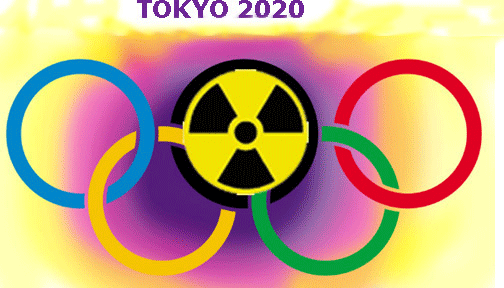 Why Japan should resign as host of 2020 Summer Olympics OpEdNews 7/15/2014 By carol wolman, MD (about the author “,…….The [Fukushima radioactive water clean-up] team is headed by Naohiro Masuda, who has a reputation for toughness, and reportedly saved Fukushima Plant #2, also hit by the tsunami in 2011, from being seriously damaged. He has promised Prime Minister Abe that the groundwater problem would be solved by the end of 2015!
This hope is based on the premise that an ice wall can be formed around the complex. There is no backup plan.
Fukushima Daiichi sits on a floodplain between mountains and the ocean. The idea is to divert the groundwater around the complex so that it’s no longer contaminated by contact with the underground molten cores. Smaller ice walls have been built, but nothing on this scale. The Japan Nuclear Regulatory Commission is worried that diverting the water will cause the ground under the reactors to settle, destabilizating the buildings and perhaps toppling them. Nevertheless, the plan is going forward.
After three months of placing pipes deep in the ground and sending hypercooled solution through them, TEPCO has failed to freeze the ground around the plant. It blames the problem on the fact that the groundwater is flowing too fast, but it seems to me that the molten cores inside the wall must make the ground itself pretty hot. Even if the plan succeeds, it will take an enormous amount of energy and money to maintain the freezing. But so far, Mr. Masuda has no guarantee that he can keep his promise.
The country is still facing an unprecedented nuclear crisis that continues to spread across its land and ocean, and even across national borders. There still is no provisions for a safe work environment at Fukushima Complex. The evacuated people still haven’t secured safe and healthy living environments, nor are they financially stable. Instead of spending resources on the Olympic Games, Japan should make it a priority to restore the affected people’s livelihood as well as to prevent further radioactive contamination.
Please sign this petition:
We, the undersigned, join Ambassador Mitsuhei Murata in calling for “an honorable retreat” for Japan, resigning the position of Host for the 2020 Olympic Games. Since Fukushima is already contaminating Tokyo, says Mr. Murata, bringing people there in large numbers for the games (and the workers building the facilities before that event) is immoral and unethical.
http://www.thepetitionsite.com/352/112/859/radioactive-tokyo-resign-as-host-of-2020-olympics/
Iran nuclear talks likely to continue in coming months

 Iran nuclear talks extension ‘probable’ http://www.skynews.com.au/news/top-stories/2014/07/16/iran-nuclear-talks-extension–probable-.html#sthash.H6xxFYuj.dpuf 16 July 14, US Secretary of State John Kerry and his Iranian counterpart have laid the groundwork for an extension of a Sunday deadline to strike a historic nuclear deal after intense talks in Vienna.
A Western diplomat went as far as to say that it was now ‘highly probable’ Iran and world powers would agree to such a move, and that the extension would be months not weeks.
‘As it’s highly improbable that we will finalise in Vienna before the weekend, it is highly probable that there will be a wish to continue to negotiate in the coming months,’ the diplomat said on condition of anonymity.
After a decade of rising tensions, the mooted accord between Iran and the five permanent members of the UN Security Council plus Germany is aimed at easing concerns that Iran might develop nuclear weapons and silencing talk of war.
Kerry said he would return to Washington to discuss with President Barack Obama ‘the prospects for a comprehensive agreement, as well as a path forward if we do not achieve one by the 20th of July, including the question of whether or not more time is warranted’.
He told a news conference after two days of talks with Iranian counterpart Mohammad Javad Zarif that there had been ‘tangible progress on key issues, and we had extensive conversations in which we moved on certain things’, although ‘very real gaps’ persisted between the two sides. Zarif, in a separate news conference, said that although he still hopes a deal would be possible by Sunday, he believed enough progress has been made to justify a continuation.
‘As we stand now, we have made enough headway to be able to tell our political bosses that this is a process worth continuing,’ Zarif said. ‘This is my recommendation. I am sure Secretary Kerry will make the same recommendation.’
An interim accord struck in November between Iran and the five permanent members of the UN Security Council plus Germany expires on July 20.
Extending the deadline has always been a possibility in order to keep the parties talking, but Washington in particular has stressed it will not agree to such a move without key concessions from Iran first.
1 This Month


Tell the Ukrainian Government to Drop Prosecution of Peace Activist Yurii Sheliazhenko

Petition to revoke the licensing of the Near Surface Nuclear Disposal Facility (NSDF) at Chalk River. https://www.ourcommons.ca/petitions/en/Petition/Details?Petition=e-7247


of the week – STOP SMALL MODULAR REACTORS IN CANADA
To see nuclear-related stories in greater depth and intensity – go to https://nuclearinformation.wordpress.com
-
Archives
- March 2026 (204)
- February 2026 (268)
- January 2026 (308)
- December 2025 (358)
- November 2025 (359)
- October 2025 (376)
- September 2025 (258)
- August 2025 (319)
- July 2025 (230)
- June 2025 (348)
- May 2025 (261)
- April 2025 (305)
-
Categories
- 1
- 1 NUCLEAR ISSUES
- business and costs
- climate change
- culture and arts
- ENERGY
- environment
- health
- history
- indigenous issues
- Legal
- marketing of nuclear
- media
- opposition to nuclear
- PERSONAL STORIES
- politics
- politics international
- Religion and ethics
- safety
- secrets,lies and civil liberties
- spinbuster
- technology
- Uranium
- wastes
- weapons and war
- Women
- 2 WORLD
- ACTION
- AFRICA
- Atrocities
- AUSTRALIA
- Christina's notes
- Christina's themes
- culture and arts
- Events
- Fuk 2022
- Fuk 2023
- Fukushima 2017
- Fukushima 2018
- fukushima 2019
- Fukushima 2020
- Fukushima 2021
- general
- global warming
- Humour (God we need it)
- Nuclear
- RARE EARTHS
- Reference
- resources – print
- Resources -audiovicual
- Weekly Newsletter
- World
- World Nuclear
- YouTube
-
RSS
Entries RSS
Comments RSS
 nuclear-news