Fukushima radioactive releases – Cesium 137 onto the Pacific Ocean
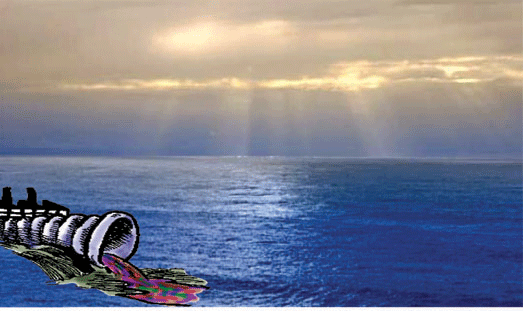 TV: Fukushima radioactive releases into ocean can continue thousands of more years, says nuclear expert — Japan gov’t concerned with tracking radioactive waste in Pacific as it returns to Fukushima from U.S. West Coast after several decades (VIDEO) http://enenews.com/tv-radioactive-releases-pacific-thousands-years-fukushima-melted-fuel-be-removed-nuclear-expert-japan-govt-concerned-radioactive-waste-ocean-coming-fukushima-several-decades-after-being-west-coast?utm_source=feedburner&utm_medium=email&utm_campaign=Feed%3A+ENENews+%28Energy+News%29
American Chemical Society — Environmental Science & Technology (pdf),Apr. 29, 2014 (emphasis added): 135Cs/137Cs Isotopic Ratio as a New Tracer of Radiocesium Released from the Fukushima Nuclear Accident […] many important issues with respect to its atmospheric transport, deposition processes, and distributions in terrestrial and marine environments remain to be investigated. It has been estimated that ∼80% of the atmospherically released 137Cs was deposited in the western North Pacific Ocean, in addition to […] 137Cs directly discharged into the ocean […] continuous input of 137Cs into the ocean due to river runoff of the 137Cs deposited in heavily contaminated Fukushima forest soil can be expected. Recent studies have revealed the start of the transport of the Fukushima accident-sourced 137Cs into the ocean interior […] it is predicted that in 30 years the Fukushima accident-derived 137Cs will come back to the ocean surface in the western North Pacific Ocean off the Fukushima coast through its transport by the Kuroshio current. Thus, to understand the environmental behavior and the fate of Fukushima accident-sourced radionuclides in the environment, a powerful Cs tracer is strongly required, because the currently widely used 134Cs/137Cs activity ratio tracer will become unavailable in several years because of the rapid decay of 134Cs […] 135Cs has a half-life of 2 × 10^6 [2.3 million] years; therefore, we are confident that the 135Cs/137Cs isotopic ratio can be considered as a new powerful tracer for long-term source identification and environmental behavior studies. […] This study was supported […] partially by the Agency for Natural Resources and Energy, the Ministry of Economy, Trade and Industry (METI), Japan [7 of study’s 8 authors are from Japan’s National Institute of Radiological Sciences]
Nuclear analyst John Large, July 9, 2014: The cores remain active for hundreds, if not thousands, of years, so there’s a commitment to keep either the ice wall technology in place or to replace it with an alternate technology by some future generation. […] Water is coming off the escarpment above the three reactors, it’s then percolating through the ground — there’s hydrostatic pressures pushing the water up toward the sea level — it’s then collecting the fission products and radioactive products from the melted-down cores and taken out to sea. […] What I think they should now have a plan to tackle the root cause… How do you control, manage and eventually remove the reactor cores? […] If the reactor cores remain in there, it’s going to be a constant leachate (water that percolates through a solid and leaches out some of the constituents) of radioactivity.
No comments yet.
1 This Month


Tell the Ukrainian Government to Drop Prosecution of Peace Activist Yurii Sheliazhenko

Petition to revoke the licensing of the Near Surface Nuclear Disposal Facility (NSDF) at Chalk River. https://www.ourcommons.ca/petitions/en/Petition/Details?Petition=e-7247


of the week – STOP SMALL MODULAR REACTORS IN CANADA
To see nuclear-related stories in greater depth and intensity – go to https://nuclearinformation.wordpress.com
-
Archives
- March 2026 (212)
- February 2026 (268)
- January 2026 (308)
- December 2025 (358)
- November 2025 (359)
- October 2025 (376)
- September 2025 (258)
- August 2025 (319)
- July 2025 (230)
- June 2025 (348)
- May 2025 (261)
- April 2025 (305)
-
Categories
- 1
- 1 NUCLEAR ISSUES
- business and costs
- climate change
- culture and arts
- ENERGY
- environment
- health
- history
- indigenous issues
- Legal
- marketing of nuclear
- media
- opposition to nuclear
- PERSONAL STORIES
- politics
- politics international
- Religion and ethics
- safety
- secrets,lies and civil liberties
- spinbuster
- technology
- Uranium
- wastes
- weapons and war
- Women
- 2 WORLD
- ACTION
- AFRICA
- Atrocities
- AUSTRALIA
- Christina's notes
- Christina's themes
- culture and arts
- Events
- Fuk 2022
- Fuk 2023
- Fukushima 2017
- Fukushima 2018
- fukushima 2019
- Fukushima 2020
- Fukushima 2021
- general
- global warming
- Humour (God we need it)
- Nuclear
- RARE EARTHS
- Reference
- resources – print
- Resources -audiovicual
- Weekly Newsletter
- World
- World Nuclear
- YouTube
-
RSS
Entries RSS
Comments RSS
 nuclear-news
Leave a comment