Freezing ducts very slowly built for Fukushima’s ice wall 90 built. 1460 more to go
TEPCO: 90 out of 1,550 freezing ducts built so far http://the-japan-news.com/news/article/0001411769 The Yomiuri Shimbun 10 July 14 Tokyo Electric Power Co. unveiled on Tuesday the construction site of the ice wall at the crippled Fukushima No. 1 nuclear power plant for the first time since work began last month.
As a measure to halt the increase of contaminated water, the ice walls are aimed at freezing the ground around the Nos. 1 to 4 reactor buildings of the plant to block groundwater from flowing into reactor buildings and becoming contaminated.
Contaminated water at the nuclear plant currently amounts to about 500,000 tons. The government and TEPCO have been working on the construction in the hope of completing it early next fiscal year.
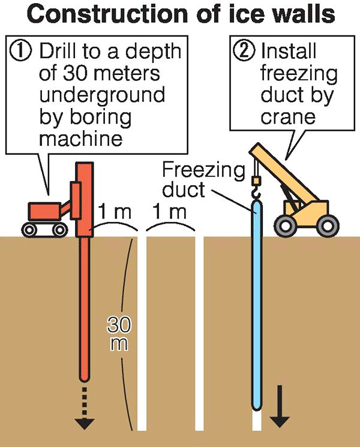
On Tuesday evening, about 30 workers drilled small holes about 30 meters deep around the No. 4 reactor building. Ducts to freeze underground soil are to be installed in the holes.
A total of 1,550 freezing ducts must be installed to surround the Nos. 1 to 4 reactor building area, measuring about 1.5 kilometers. However, TEPCO said only about 90 freezing ducts have been installed so far.
Due to heat exhaustion concerns during summer, workers at the construction site wear vests containing blue ice.
Meanwhile, the task of freezing tunnels filled with contaminated water using the same method involving the construction of an ice wall has been facing difficulties. The Nuclear Regulation Authority has therefore been calling on TEPCO to fundamentally revise construction plans.
Akira Ono, the chief of Fukushima No. 1 nuclear power plant, said: “We’ve already confirmed the effectiveness of ice walls through an on-site experiment. We will push ahead with the construction work forward as fast as we can.”
No comments yet.
1 This Month


Tell the Ukrainian Government to Drop Prosecution of Peace Activist Yurii Sheliazhenko

Petition to revoke the licensing of the Near Surface Nuclear Disposal Facility (NSDF) at Chalk River. https://www.ourcommons.ca/petitions/en/Petition/Details?Petition=e-7247


of the week – STOP SMALL MODULAR REACTORS IN CANADA
To see nuclear-related stories in greater depth and intensity – go to https://nuclearinformation.wordpress.com
-
Archives
- March 2026 (212)
- February 2026 (268)
- January 2026 (308)
- December 2025 (358)
- November 2025 (359)
- October 2025 (376)
- September 2025 (258)
- August 2025 (319)
- July 2025 (230)
- June 2025 (348)
- May 2025 (261)
- April 2025 (305)
-
Categories
- 1
- 1 NUCLEAR ISSUES
- business and costs
- climate change
- culture and arts
- ENERGY
- environment
- health
- history
- indigenous issues
- Legal
- marketing of nuclear
- media
- opposition to nuclear
- PERSONAL STORIES
- politics
- politics international
- Religion and ethics
- safety
- secrets,lies and civil liberties
- spinbuster
- technology
- Uranium
- wastes
- weapons and war
- Women
- 2 WORLD
- ACTION
- AFRICA
- Atrocities
- AUSTRALIA
- Christina's notes
- Christina's themes
- culture and arts
- Events
- Fuk 2022
- Fuk 2023
- Fukushima 2017
- Fukushima 2018
- fukushima 2019
- Fukushima 2020
- Fukushima 2021
- general
- global warming
- Humour (God we need it)
- Nuclear
- RARE EARTHS
- Reference
- resources – print
- Resources -audiovicual
- Weekly Newsletter
- World
- World Nuclear
- YouTube
-
RSS
Entries RSS
Comments RSS
 nuclear-news
Leave a comment