High proportion of deformities in migratory birds in Japan
Emergency research underway in Japan after birds found with perplexing deformities — “Something unusual occurring inside their bodies” — Never reported in 500,000 exams done before 3/11 — Now observed at every site across country, some over 1,000 km from Fukushima (PHOTO) http://enenews.com/emergency-surveys-in-japan-after-birds-found-with-perplexing-deformities-something-unusual-occurring-inside-their-bodies-never-reported-in-500000-exams-done-before-311-now-its-see?utm_source=feedburner&utm_medium=email&utm_campaign=Feed%3A+ENENews+%28Energy+News%29
 Asahi Shimbun, June 25, 2014: [Noboru Nakamura, a researcher at the Yamashina Institute for Ornithology] has visited the riverbed [in Fukushima] 20 times […] looking into whether the earthquake or the accident at the Fukushima No. 1 nuclear power plant caused abnormal changes among wild birds. […] [Researchers] first verified abnormal change [200 kilometers from Fukushima Daiichi] in Niigata Prefecture […] Oct. 24, 2011, a common reed bunting, a small migratory bird, was found with uneven tail feathers that had a moth-eaten appearance. The institute started emergency surveys […] The most perplexing thing was the overly long feathers […] Its feathers very reliably grow to a certain length […] [Kiyoaki Ozaki, Yamashina Institute for Ornithology deputy director-general,] could not imagine a reason for them to be longer. By March 2012, the same abnormality was identified at all research sites across Japan, such as Tochigi, Ibaraki, Tokyo, Shizuoka, Shimane, Kagawa and Fukuoka [over 1,000 kilometers from Fukushima]. The proportion of birds with the abnormality was 13.8 percent. In at least one place, the ratio exceeded 25 percent. Birds born in 2011 account for 97.3 percent of the specimens with the abnormality. […] Researchers have found feathers that already appear moth-eaten when they split open the sheath. Some birds even grew back feathers with the same deformity after the researchers plucked out older, misshapen feathers. […] One thing is certain: The common reed […] pass through or stop in the Tohoku region during their migration.
Noboru Nakamura, a researcher at the Yamashina Institute for Ornithology: “In Iitate, I caught a Japanese bush warbler in the net yesterday. It had feathers missing from the back of its head, and its skin was dark on that part. I found the same thing last year and the year before in Minami-Soma. I don’t know the reason.”
Kiyoaki Ozaki, Yamashina Institute for Ornithology deputy director-general: “Bird banding surveys of the common reed bunting began in 1961, and nearly 480,000 of the birds have been examined […] we monitor [their tail feathers] closely. But this sort of abnormality hasn’t been reported before. I’ve seen thousands of the birds, but it was the first time for me to see tail feathers like these. […] There is something unusual occurring inside the birds’ bodies, perhaps with their genes or hormone secretion. [It’s] in the realm of possibility [that it could be the effect of radioactive substances].”
Fukushima: Record high radiation levels at 18 locations between reactors and Pacific
 TV: New concerns at Fukushima; Radioactive material “spilling into ocean” from layer 80 feet deep, officials suspect — Jiji: Record high radiation levels at 18 locations between reactors and Pacific; Crisis far from under control (VIDEO) http://enenews.com/tv-new-concerns-at-fukushima-radioactive-material-spilling-into-ocean-from-layer-80-feet-deep-officials-suspect-jiji-new-record-high-radiation-levels-at-18-locations-near-pacific-problems?utm_source=feedburner&utm_m
Jiji Press, June 18, 2014: Radioactive contamination of groundwater at [Fukushima Daiichi] is far from being under control […] the source of contamination remains unclear and new record levels of radioactive substances have been detected in groundwater taken at a number of measuring points on the ocean side of the plant’s No. 1 to No. 4 reactors. Radioactivity levels in groundwater have hit new record highs at 18 of 32 measuring points on the ocean side since April, according to TEPCO. At the most polluted well, located east of the No. 2 reactor [there’s] 860,000 becquerels of beta ray-emitting radioactive substances such as strontium-90.
NHK WORLD, June 25, 2014: [TEPCO] has found that radioactive water can now easily spread in a deep layer of groundwater. It says it will speed up construction work on a barrier aimed at preventing contaminated water from leaking into the ocean. The deep layer of water is about 25 meters [82 feet] below the surface. […] water pressure in the [deep] layer was lower […] this makes it easier for contaminated water to spread [..] They suspect the radioactive water could be spilling into the ocean. TEPCO officials say the ongoing construction of the barrier may be to blame for the lower pressure. The work involves drilling into the deep layer. […] TEPCO officials say they will take more action to keep radioactive water from spreading in the deep layer. This will involve fortifying holes in an underground frozen-soil wall. Those holes go through the layer and are filled with pipes. […]
See also: Japan Nuclear Expert: Fukushima’s fuel could be about 100 ft. underground in 2 years (AUDIO)
France’s energy plan boosts renewables, drops nuclear power down
 Renewables Up, Nuclear Flat in French Energy Plan IEEE Spectrum, By Peter Fairley 24 Jun 2014 After months of negotiation, the French government has unveiled a long-awaited energy plan that is remarkably true to its election promises. The legislation’s cornerstone is the one-third reduction in the role of nuclear power that President François Hollande proposed on the campaign trail in 2012.
Under the plan, nuclear’s share of the nation’s power generation is to drop from 75 percent to 50 percent by 2025, as renewable energy’s role rises from 15 percent today to 40 percent to make up the difference. That is a dramatic statement for France, which is the world’s second largest generator of nuclear energy, after the United States. France has a globally-competitive nuclear industry led by state-owned utility Electricité de France (EDF) and nuclear technology and services giant Areva…….http://spectrum.ieee.org/energywise/energy/nuclear/renewables-up-nuclear-down-in-french-energy-plan
USA’s EPA carbon plan makes coal the loser, but nuclear power loses out, too
 The EPA carbon plan: Coal loses, but nuclear doesn’t win, Bulletin of the Atomic Scientists Mark Cooper. 19 June 14 MARK COOPER The claims and counterclaims about EPA’s proposed carbon pollution standards have filled the air: It will boost nuclear. It will expand renewables. It promotes energy efficiency. It will kill coal. It changes everything. It accomplishes almost nothing.
Evaluating the impact of the so-called Clean Power Plan requires a clear view of how the new rule will work. The plan centers on performance standards, which have yielded effective outcomes in other energy areas—such as appliance efficiency standards and fuel economy standards for light-duty vehicles. It sets a moderate, mid-term target for carbon reductions, but allows for flexibility because it does not dictate the use of specific technologies or products. States are allowed to design programs in response to local conditions.
The EPA plan picks a loser: coal. It does not, however, pick winners among the low-carbon options available. It does not offer much in the way of sweeteners for any specific technology. Assuming that states generally adhere to the prime directive of public utility resource acquisition—choosing the lowest-cost approach—the proposed rule will not alter the dismal prospects of nuclear power, which will therefore play no role in the reduction of carbon emissions from power plants.
EPA’s analysis of the proposed carbon pollution guidelines reflects this reality. EPA forecasts for nuclear power are flat-lined, which means that other resources—including energy efficiency, natural gas, wind, and solar—will carry the full weight of carbon reductions.
It is unlikely that the states will act irrationally enough to make the EPA analysis miss the mark by a wide margin. The marketplace and 48 of the 50 states have declined to embrace nuclear energy during the past decade, despite the incentives included in the Energy Policy Act of 2005……….http://thebulletin.org/epa-carbon-plan-coal-loses-nuclear-doesnt-win7253
The health toll of India’s uranium mining
India’s uranium mines expose villages to radiation, DW 25 June 14 India plans to source a quarter of its energy from nuclear power by 2050. But this ambitious goal could come at a cost. Radioactive waste from uranium mines in the country’s east is contaminating nearby communities…….Local activist Kavita Birulee says the villagers here are terrified of the radioactive waste. In Jadugoda, rates of cancer, miscarriages and birth defects are climbing…….
Health-related deformities
Just 40 years ago, Jadugoda was a quiet and lush green locality with no dust or radiation pollution. The people here lived a quiet rural life. But things changed when the Indian government started mining operations here in 1967.
Radioactive waste generated by three nearby government-owned mines has caused serious health-related problems in Jadugoda. The mines belong to Uranium Corporation of India Limited – or UCIL. They employ 5,000 people and are an important source of income for villagers in this relatively remote area. But the waste has put 50,000 people, mostly from tribal communities, at risk.
A recent study of about 9,000 people in villages near the mines has documented cases of congenital deformities, infertility, cancer, respiratory problems and miscarriages.
Nuclear scientist Sanghmitra Gadekar, who was responsible for conducting the survey on radioactive pollution in villages near the mines, says there was a higher incidence of miscarriages and still births.
“Also, laborers were given only one uniform a week. They had to keep on wearing it and then take it home. There, the wives or daughters wash it in a contaminated pond, exposing them to radiation. It’s a vicious circle of radioactive pollution in Jadugoda,” he said…….
Grim future
The mines are on the doorstep of the area’s largest city, Jamshedpur. If radiation pollution isn’t controlled, more people will be affected in the future. Local officials, however, are proud of their role in India’s nuclear defense industry.
Anti-nuclear pollution activist Xavier Dias has been trying to alert locals about the dangers presented by the mines.
“When you are talking about Jamshedpur, you are talking about a thousand ancillary industries, a huge population,” he said. “These are dust particles that fly around. They enter the water, the fauna, flora, the food system. And they are killers, but they are slow killers. They kill over generations.” http://www.dw.de/indias-uranium-mines-expose-villages-to-radiation/a-17730703
USA coastal communiities monitoring sea-borne Fukushima radiation plume
Fukushima radiation concerns coastal communities Tracy Loew, Statesman Journal 25 June 14, Talk in the Oregon coast town of Bandon often turns to the approaching plume of sea-borne radiation from Japan’s crippled Fukushima nuclear power plant.
“We’ve been worried about it and worried about it,” said Zac Adams, owner of Bandon Designsconstruction company. “We’re really concerned about it affecting the fisheries, the wildlife, the tourism, and most importantly our health.”…….
The radiation is expected to hit the U.S. this year at very low levels that wouldn’t harm humans or the environment. But no federal agency is monitoring it.
So Adams joined a citizen-science project, crowd-sourcing funds in his community to test a sample of seawater that he will soon collect.
Four hours north, the Tillamook Estuaries Partnership has funded two collection sites, in Tillamook and Pacific City.
“Over the last year-and-a-half, it’s been an issue that’s been raising in prominence along the coastline,” said Lisa Phipps, executive director of the partnership. “In our area, there have been groups that have been coming together to talk about what is happening in the ocean.”
And fund-raising is underway for two more sites, in Newport and Winchester Bay.
Altogether about 30 sites, from Alaska to Baja, Calif., have been funded, said Ken Buesseler, a chemical oceanographer at the Woods Hole Oceanographic Institution who put together the project, called “How Radioactive is Our Ocean?”
It uses crowd-sourced money and volunteers to collect water samples along the Pacific Coast, then ship them to Buesseler in Massachusetts to be analyzed on an $80,000 instrument………
Buesseler is looking for increased levels of Cesium-137, which already is in all oceans from previous nuclear testing and accidents; and for Cesium-134, a “fingerprint” of Fukushima.
Because of its short, two-year half-life, any Cesium-134 could only have come from the plant, he said.
So far, Buesseler said, no samples have indicated that the plume has reached the West Coast.
Buesseler posts results on the project’s website. They show Cesium-134 and increased levels of Cesium-137 off the coast of Japan and across the ocean.
“We know it’s out there,” Buesseler said. “We’ve seen it more than halfway across the Pacific.”
Northwest of Hawaii, for example, Buesseler has found Cesium-134 at concentrations as high as 3.8 becquerels per cubic meter.
But to put that in context, he said, the U.S. drinking water limit is 7,400 of those units.
“Every additional radiation exposure causes additional risks for cancer,” he said. “But when the numbers are in the one to 10 range, that’s a very small additional risk.”
That’s the range that is expected to hit our shores, with lower levels coming first.
“As the contamination arrives, we expect the concentrations to go up over the next two years,” Buesseler said……..http://www.statesmanjournal.com/story/tech/science/environment/2014/06/25/fukushima-radiation-concerns-coastal-communities/11377463/
Hanford nuclear workers scared to speak out on safety issues
 Survey finds employees at contaminated nuclear site wary of challenging managers Times Colonist, Nicholas K. Geranios / The Associated Press June 24, 2014 SPOKANE, Wash. – Few of the U.S. Department of Energy workers who are helping build a plant to treat the most dangerous radioactive wastes at a nuclear site in Washington state feel they can openly challenge decisions made by management, according to a report obtained Tuesday by The Associated Press.
The survey conducted by the department shows only 30 per cent of its employees at the Hanford Nuclear Reservation feel they can question their bosses……..
Democratic Sen. Ron Wyden of Oregon said the study shows recent allegations of retaliation against Hanford workers who raised safety concerns made other employees less likely to come forward.
Hanford, near Richland in south central Washington, is engaged in a multi-decade cleanup of the nation’s largest collection of nuclear waste.
Two people who recently raised concerns about the design and safety of the unfinished Waste Treatment Plant at Hanford lost their jobs. Donna Busche was fired earlier this year, while Walter Tamosaitis, a 40-year Hanford employee, was laid off last year.
The U.S. Department of Energy has asked its Office of Inspector General to investigate Busche’s firing.
USA bipartisan climate report predicts economic costs of climate change
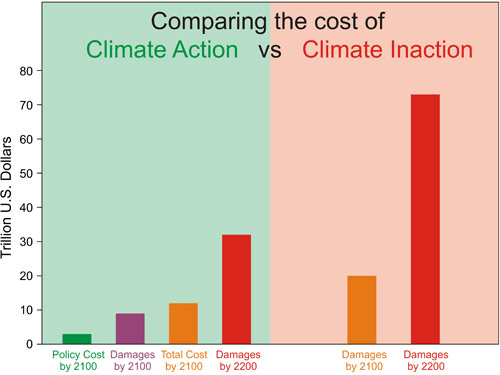
These and other risks from climate change are spelled out in a new bipartisan report that attempts to tally the potential toll on the economy and to push what has been a highly politicised issue into corporate boardrooms for serious consideration.
The report, titled “Risky Business: The Economic Risks of Climate Change to the United States,” comes from a coalition of high-powered business and political figures, including three former Treasury secretaries.
Hampton Bays, NY state, during and after Sandy.Photo: Reuters
The money men who backed the project are Risky Business Project co-chairs Henry M. Paulson Jr., Treasury secretary under President George W. Bush; former New York Mayor Michael R. Bloomberg; and Thomas F. Steyer, a hedge fund manager and big Democratic donor. The trio commissioned the Rhodium Group, an economic research firm, to study the economic impact of global warming.
A key conclusion of the report is that the risks vary, sometimes widely, by region and industry sector. By 2050, it warns, Americans could face double or triple the number of extremely hot days (temperatures exceeding 35 degrees celsius) compared with the annual average in the past 30 years.
The study estimates that communities in the Eastern Seaboard and Gulf Coast could see storm-related property damage jump by as much as $US3.5 billion ($3.74 billion) a year by 2030 and possibly more than double that given likely hurricane conditions.
New design nuclear reactors will not need much uranium
New nuclear reactors ‘to need much less uranium’ The world’s nuclear watchdog has been told that new generation nuclear reactors will need much less uranium than those currently in service. SBS, Kerry Skyring and Zara Zaher World News Radio 25 JUN 2014
The comments came at a symposium on uranium and the nuclear fuel cycle which the IAEA is holding in Vienna. http://www.sbs.com.au/news/article/2014/06/25/new-nuclear-reactors-need-much-less-uranium
Amazing portable solar power unit
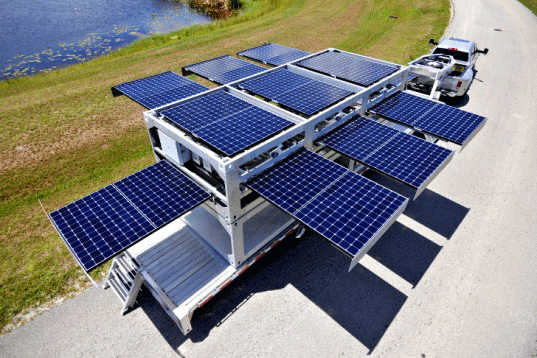
Amazing Pop-Up Solar Power Station Delivers Energy Anywhere it’s Needed, Inhabitat, by Beverley Mitchell, 06/24/14 Ecosphere Technologies’ latest product combines several of our very favorite things in one easy-to-transport package: shipping containers, off-the-grid solar power, and clean drinking water generation. With their new Ecos PowerCube, the company can deliver a shipping-container-sized, self-sustaining solar power station by air, sea, rail or road to anywhere in the world it is needed.
New nuclear power, especially Small Modular Reactors, are the most costly of the low carbon energy options
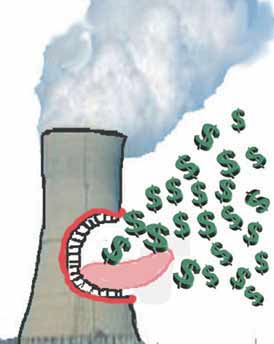 The EPA carbon plan: Coal loses, but nuclear doesn’t win , Bulletin of the Atomic Scientists Mark Cooper. 19 June 14 “………New nuclear capacity would be expensive. The day before the EPA carbon plan was proposed, efficiency was the least costly way to meet the need for electricity. Gas and onshore wind were next. The cost of solar was dropping like a rock, and load factors for wind and solar—the so-called intermittent resources—were rising dramatically, due to technological improvements, the rapidly falling cost of energy storage, and information and control technologies that make it possible to manage fluctuating energy sources on a minute-by-minute basis. The EPA plan does nothing to change the fundamental economics of low-carbon resources in the mid- and long term.
As a result of this economic reality, a boatload of independent analysts—including Lazard, Citi, Credit Suisse, McKinsey & Company, Sanford C. Bernstein, The Motley Fool, Morningstar, and Barclays—not only had concluded that efficiency, renewables, and natural gas would account for the vast majority of resources deployed to meet the need for electricity over the next decade, but also that the model of the electric utility that dominated the 20th century has become obsolete.
The adoption of the climate change rule is likely to reinforce the pressure to modernize the electricity system and, to the extent that it requires more low-carbon resources, it will accelerate this process. In the short term, this might have the effect of raising the cost of electricity slightly, because resources with slightly higher costs will be pulled into the market. On the other hand, because many of the alternative energy sources have not been dominant in the past, accelerating their adoption might actually lower electricity costs, because these energy sources are still at the stage of development where innovation, learning by doing, and increases in economies of scale are dramatically cutting the price.
As I have shown in a number of reports over the past five years, most recently a May 2014 report on small modular reactors, nuclear power in not one of the technologies that will benefit from the emergence of an integrated, two-way electricity system that accommodates decentralized energy production. It remains among the most costly of the low-carbon options and will become relatively more costly as the other technologies develop. The target reduction in carbon emissions under the EPA plan is well within the capacity of the lower-cost alternatives……http://thebulletin.org/epa-carbon-plan-coal-loses-nuclear-doesnt-win7253
1 This Month


Tell the Ukrainian Government to Drop Prosecution of Peace Activist Yurii Sheliazhenko

Petition to revoke the licensing of the Near Surface Nuclear Disposal Facility (NSDF) at Chalk River. https://www.ourcommons.ca/petitions/en/Petition/Details?Petition=e-7247


of the week – STOP SMALL MODULAR REACTORS IN CANADA
To see nuclear-related stories in greater depth and intensity – go to https://nuclearinformation.wordpress.com
-
Archives
- March 2026 (204)
- February 2026 (268)
- January 2026 (308)
- December 2025 (358)
- November 2025 (359)
- October 2025 (376)
- September 2025 (258)
- August 2025 (319)
- July 2025 (230)
- June 2025 (348)
- May 2025 (261)
- April 2025 (305)
-
Categories
- 1
- 1 NUCLEAR ISSUES
- business and costs
- climate change
- culture and arts
- ENERGY
- environment
- health
- history
- indigenous issues
- Legal
- marketing of nuclear
- media
- opposition to nuclear
- PERSONAL STORIES
- politics
- politics international
- Religion and ethics
- safety
- secrets,lies and civil liberties
- spinbuster
- technology
- Uranium
- wastes
- weapons and war
- Women
- 2 WORLD
- ACTION
- AFRICA
- Atrocities
- AUSTRALIA
- Christina's notes
- Christina's themes
- culture and arts
- Events
- Fuk 2022
- Fuk 2023
- Fukushima 2017
- Fukushima 2018
- fukushima 2019
- Fukushima 2020
- Fukushima 2021
- general
- global warming
- Humour (God we need it)
- Nuclear
- RARE EARTHS
- Reference
- resources – print
- Resources -audiovicual
- Weekly Newsletter
- World
- World Nuclear
- YouTube
-
RSS
Entries RSS
Comments RSS
 nuclear-news