Near nuclear sites a high rate of babies born without brains
TV: 8 times more babies than usual born without brain near U.S. nuclear site; Much higher rate than anywhere else in country — “It’s scary the cause is such a mystery” — CNN: Experts speak out over failure of officials to conduct proper investigation — “The lamest excuse I’ve ever heard” (VIDEO) http://enenews.com/tv-8-times-more-babies-than-usual-born-without-brain-near-u-s-nuclear-site-much-highest-rate-than-anywhere-else-in-country-cnn-experts-speak-out-over-failure-of-govt-to-conduct-proper-investi
KEPR, May 14, 2014 (Emphasis Added): Serious and sometimes fatal birth defects are much more prevalent right here than anywhere else in the country. Benton, Franklin and Yakima Counties are being hit the hardest by neural tube defects, from spina bifida to anencephaly [fatal defect where large part of brain/skull is missing]. “it’s scary that the cause of this is such a mystery,” said Candelaria Murillo. […] Rate of babies being born without a brainin our part of the state is eight times the national average.
AP and other media outlets put the figure at “at least four times the national rate”. However, theYakima Herald reports: “[Officials] issued a news release Jan. 30 announcing that eight cases of anencephaly had occurred in Yakima County in 2012. Typically [they] expect only one all year.”
NBC News, June 17, 2014: Health officials, scientists and other experts gathered to discuss the cause of an alarming local spike in the disorder […] [Local residents] wanted to know exactly how long the problem had been going on, whether it could be linked to diet, occupation, geography — or the Hanford nuclear plant in nearby Richland. State officials reiterated their previous answers — no, no, no and no […] “The next step is to interview the mothers and fathers of these babies,” [Allison Ashley-Koch, an anencephaly expert at the Duke University Medical Center for Human Genetics] said. “The challenge at this point is that many of these conceptions happened four years ago. So for parents to try and remember particular eating habits, environmental exposures and such is challenging.” […] “I believe it is an ongoing problem and I believe that the environment might have something to do with it,” Don Dufault said.
Oregon Public Broadcasting, June 16, 2014: Health officials have discounted several possible causes including: pesticide exposure, nitrates in water wells, and radiation from the Hanford Nuclear Reservation.
Obstetrician Anita Showalter: “First thing I ask […] what environmental thing might have happened […] that we don’t know or understand yet?” […] She wonders if there might be chemicals present […]
CNN, June 1, 2014: Nearly two years after the state of Washington was alerted to a possible cluster of babies born with severe birth defects, experts are speaking out, criticizing the state health department for not doing enough to save babies’ lives. […] TheWashington Department of Health has steadfastly refused to interview the parents of these babies and has failed to accept offers of help from world-renowned anencephaly experts. “It really looks like they’re dragging their feet,” said Richard Finnell, a pediatric geneticist and birth defect expert at the University of Texas. He said that to find the cause of the cluster, state investigators need to speak with the parents of children with birth defects […] Butthe state has not contacted these parents. […] A team of experts […] offered help to Washington investigators back in February but hasn’t received a response. “We’re frustrated that they’re not moving more quickly to find the cause,” said Janee Gelineau-van Waes […] an associate professor of pharmacology at the Creighton University School of Medicine […] “It’s very intrusive to start knocking on doors of people who’ve had a pretty major trauma in their lives,” [state epidemiologist, Juliet VanEenwyk] said. “That’s the lamest excuse I’ve ever heard,” said Billy Petersen, reflecting the viewpoint of several families interviewed by CNN whose children have neural tube defects. “We want to talk to them,” he said. “We’d do anything to help find out why our baby died and help other families. We don’t want anyone else to go through what we’ve been through.”
Should China be designing, owning, and running Britain’s nuclear power stations?
MPs’ concerns mount over deals with China to run British nuclear power stations, THE INDEPENDENT 24 June 14, MARK LEFTLY Monday 23 June 2014 The Government has been accused in Parliament of “accepting money tainted with blood”, after agreeing a deal that will allow Chinese firms to design, own and run British nuclear power stations.
The Chinese premier Li Keqiang struck the bargain as part of a three-day trade visit to the UK last week, which also included an £11.8bn contract for BP to supply gas to China National Offshore Corporation over 20 years. The state-owned China Development Bank wants to fund new nuclear plants directly, as well as the no-less-controversial £42.7bn London-to-the North High Speed Two rail link.
But campaigners are furious the Government has been wooing China without demanding improvements to the country’s notoriously poor human rights record. Mr Li’s Government was accused of placing “arbitrary curbs on expression, association, assembly, and religion” by Human Rights Watch in a recent report.

Paul Flynn, the anti-nuclear power Labour MP for Newport West, motioned in the House of Commons last week for the Coalition to cancel any proposed nuclear agreements with China. “This House… believes, in light of appalling human rights violations, that accepting money from the Chinese State Investment Bank to invest in UK new nuclear is accepting money tainted with blood,” said the motion.
This echoes concerns of union leaders, who said last year that giving the Chinese access to UK power plants meant they had the power to “turn the lights on and off” and so put national security at risk. …..http://www.independent.co.uk/news/business/comment/mps-
Britain’s nuclear waste cleanup spirals above £110 billion
Britain’s nuclear clean-up bill soars to £110bn http://www.telegraph.co.uk/finance/newsbysector/energy/10921309/Britains-nuclear-clean-up-bill-soars-to-110bn.html Spiralling costs at Sellafield site in Cumbria contribute to £6.6bn increase in bill for tackling Britain’s nuclear waste By Emily Gosden
8:16PM BST 23 Jun 2014 The bill for cleaning up Britain’s nuclear waste has topped £110bn, after a £6.6bn increase in the cost estimate for work required over the next 120 years
The Nuclear Decommissioning Authority said that the biggest increase derived from a fresh assessment of the work required at Sellafield, the country’s biggest and most toxic nuclear site.
Sellafield, in Cumbria, is now estimated to cost £79.1bn to clean up, but the NDA warned that the total would “increase significantly next year” once it had fully assessed a new “performance plan” for the site.

The NDA controversially renewed a contract with Nuclear Management Partners to manage Sellafield despite fierce criticism from MPs on the Public Accounts Committee and the National Audit Office of the company’s performance.
The NDA’s annual report and accounts make clear the huge scale of uncertainty that exists over the ultimate bill for Britain’s civil and military nuclear waste.
It says it has “reviewed a number of scenarios with a range of possible outcomes” and found that “the estimated cost could have a potential range from £88bn to £218bn”.
The figure of £110bn is on an “undiscounted” basis. Once discounted, the total is £65bn.
Doubts about Fukushima’s ice wall against radioactive water leaks
 Fukushima ‘ice wall’ looking more like a dirt Slurpee http://america.aljazeera.com/blogs/scrutineer/2014/6/18/fukushima-ice-walllookingmorelikeadirtslurpee.html by Gregg Levine Skeptics of the plan to build a massive ice wall around Japan’s crippled Fukushima Daiichi nuclear facility didn’t have to wait particularly long for their first “I told you so.”
TEPCO, the nominal operator of the battered plant, announced Tuesday that while construction on the network of pipes, pumps, and compressors has begun on what is intended to be a huge ice barrier to prevent mountain runoff from mixing with radioactive water inside the facility, attempts to form a smaller ice wall around already-contaminated water are failing.
“We have yet to form the ice stopper because we can’t make the temperature low enough to freeze water,” a TEPCO spokesman said.
The project is already behind schedule and over budget, and engineers are adding more cooling pipes in hopes they can complete this first small step next month.
While the ground freezing procedure has been used to construct tunnels near waterways, it has never been used for nuclear cleanup and has never been done on such a massive scale. Estimates of the project’s success can best be termed “hopeful.” But freezing the ground around the plant is not strictly a “Why the hell not?” proposition. As previously noted, the plan comes with a list of concerns:
What if freezing causes the ground to sink? What if the ice and the ensuing expansion and contraction interrupts or further damages drainage in the reactor buildings? What if a heat wave or heat from the plant causes parts of the wall to melt? And, what if there is a prolonged loss of power to this cooling system?
The ice wall is only intended to help with the problem of irradiated runoff — the question of what to do with the thousands upon thousands of gallons of water contaminated in the daily fight to cool the melted cores of the damaged reactors and the stored rods in the spent fuel pools remains largely unanswered.
Last month TEPCO began diverting what they say is only moderately radioactive water into the ocean after assuring local fishermen that the levels were safe. Last summer, it was revealed that 300 tons of contaminated water was seeping from the nuclear site into the Pacific every day.
While freezing parts of the ground surrounding the disaster site may or may not be an effective part of the final cleanup and decommissioning, problems continue to outpace response at Fukushima. TEPCO’s experiment around the margins does nothing to address the hot mess at the core (as it were) of the crisis, and is cold comfort to those people still displaced or a country and hemisphere facing generations of radiologic contamination.
Netherlands reveal facts on US use of depleted uranium weapons in civilian areas
 US fired depleted uranium rounds in civilian areas during 2003 Iraq campaign – report http://rt.com/news/167220-depleted-uranium-us-iraq/ June 20, 2014 US-led forces in Iraq used depleted uranium weapons in civilian-populated areas during the 2003 military campaign, according to a new Dutch NGO study that also exposes a lack of adequate cleanup efforts by the invading troops.
Depleted uranium used by US forces blamed for birth defects and cancer in Iraq
For the first time the location of several sites where the invaders fired some 10,000 depleted uranium rounds were released by the Dutch Defense Ministry, and published in a study by Dutch peace group PAX.
Most of the DU rounds fired by the US-led coalition were in heavily populated areas, the group says. Samawah, Nasiriyah and Basrah are just some urban areas where ammunition was deployed – with around 1,500 anti-armor rounds fired directly at Saddam Hussein’s infantry forces. The GPS coordinates of DU rounds were initially handed over to the Dutch Defense Ministry because the Netherlands was worried about the potential contamination of its own troops in the country. The ministry later shared the information with PAX under a freedom of information law.
Most of the firing locations remain unknown, as more than 300,000 DU rounds are believed to have been fired by US-led coalition.
NGO says that the health risks of more than 440,000 kg of DU fired by Western forces remains unclear, as “neither coalition forces nor the Iraqi government have supported health research into civilian DU exposure.”
“Coalition forces were aware of the potential health and environmental impact of DU munitions, yet refrained from undertaking the necessary clean-up of DU outside their own bases,” a summary of the report reads.
Wim Zwijnenburg, the author of the report, said the US Air Force knew of the consequences of using DU ammunition.
“The use of DU against these targets questions the adherence of coalition forces to their own principles and guidelines. They should be held accountable for the consequences,” Zwijnenburg said, citing a 1975 memo from the Air Force Office of the Judge Advocate that restricted the use of such ammunition.
“Use of this munition solely against personnel is prohibited if alternative weapons are available,” the memo said, because of “unnecessary suffering and poison.”
According to an earlier PAX report, more than 300 sites in Iraq are currently contaminated with depleted uranium and it would cost at least $30 million to clean up.
Hanford nuclear facility hiding health effects of radiation
 Hanford nuclear site employees not allowed to speak out about chemical exposure, brain damage, Monday, June 23, 2014 by: Ethan A. Huff, (NaturalNews) Workers at a large nuclear waste storage facility in south-central Washington are falling gravely ill from exposure to radiation, according to new reports. But a former company insider says they are too afraid to come out about it for fear of losing their jobs.
NBC Right Now in the Tri-Cities reports that Lonnie Poteet, a former truck driver at the federal government’s Hanford Site, suffered major injuries after encountering leaked radiation earlier in the spring. Poteet says site managers failed to notify him that there had been a spill upon arriving to deliver fuel.
“I was already burning from my glove line to my t-shirt line and the side of my face and I was already starting to lose a little bit of vision in my right eye,” recalled Poteet about arriving at the site just hours following the spill.
Rather than post a notice or warn workers directly that a spill had occurred, Poteet says Hanford officials did nothing. Consequently, he and others continued to access the site, even though some crews had been notified to stay home that day while the spill was addressed…….
Meanwhile, other former workers harmed by nuclear exposure at Hanford are having trouble getting compensation for their injuries. According to KING5 News in Seattle, a government audit found that claims for compensation sometimes take up to seven years to get processed, and many valid applications are being denied.
http://www.naturalnews.com/045684_Hanford_Site_chemical_exposure_brain_damage.html##ixzz35by5vlm6
Nuclear and Coal plants at increasing risk from climate change impacts
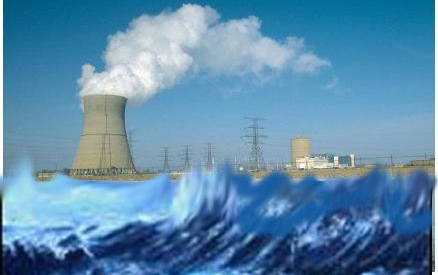 World’s energy systems vulnerable to climate impacts, report warns Generators from nuclear reactors to coal-fired power plants will feel the brunt of the weather changes Fiona Harvey, environment correspondent theguardian.com, Wednesday 18 June 2014 Rising sea levels, extremes of weather and an increase in the frequency of droughts and floods will all play havoc with the world’s energy systems as climate change takes hold, a new report has found
 Many large plants are particularly at risk from droughts, because they need water to cool their facilities, and floods, because they lack protection from sudden storms. Electricity distribution networks are also likely to be affected.
The vulnerability of energy systems to natural shocks was shown starkly when the Fukushima nuclear plant in Japan had to be closed down following the 2011 tsunami, which prompted governments around the world to review their nuclear policies.
The World Energy Council (WEC), which compiled the study along with Cambridge University and the European Climate Foundation, urged generators to examine their vulnerability to climate change……http://www.theguardian.com/environment/2014/jun/18/world-energy-systems-vulnerable-climate-impacts-report
More delays, more costs for Georgia’s new nuclear power plants
 Monitor warns of delays building Ga. nuclear plant Seattle Pi By RAY HENRY, Associated Press , June 23, 2014 ATLANTA (AP) — The companies building one of the first U.S. nuclear plants in a generation have missed project deadlines, and government monitors questioned in reports released Monday whether those delays could grow.
Southern Co. subsidiary Georgia Power and its partners are building two more nuclear reactors at Plant Vogtle (VOH’-gohl) southeast of Augusta using a first-of-its-kind technology. The construction project was originally estimated to cost $14 billion, but the final price tag is likely to rise.
The plant in Georgia and an identical facility under construction in South Carolina are widely viewed as tests of whether the nuclear industry can build new power plants without the big delays and cost overruns common decades ago. Total project costs could jump $2 million every day there is a delay, according to estimates released by state analysts. Utility customers ultimately pay those costs unless regulators intervene………http://www.seattlepi.com/business/energy/article/Monitor-warns-of-delays-building-Ga-nuclear-plant-5573404.php
USA Tea Party types created Tony Abbott the world’s new warrior on behalf of the fossil fuel industries
 How Rupert Murdoch created the world’s newest climate change villain, Salon Australia was once a leader on climate action. Thanks to American conservative powerhouses, that’s no longer true ALEXANDER WHITE 21 June 14, Australia, the sunburned country, is uniquely vulnerable to the dangers and risks of global warming. Whether it is the severe effects of flooding, unseasonal heat waves, devastating bush fires or decade-long droughts, Australia’s people, economy and natural environment have all keenly felt the impact of extreme weather and climate change.
Australia’s national scientific organizations have been raising the alarm for more than a decade, and the previous government accepted that scientific consensus and enacted a cap-and-trade scheme in 2012. But after a divisive election last year — one that saw native-born Rupert Murdoch exercise his considerable influence in Australian media markets to disastrous effect — the country is now governed by a deeply unpopular Liberal-National government, crafted in the image of the most climate-denying elements of the Tea Party. And its position on climate change has significant impacts on global efforts to reduce carbon emissions: Australia is not only the chair of the G-20 group of nations, but also holds a place on the U.N. Security Council.
The rest of the world saw this ideology on full, embarrassing display with the recent visit by Prime Minister Tony Abbott to Canada and the United States. Continue reading
Canada’s nuclear watchdog recommends iodine pills for communities near nuclear reactors
Nuclear watchdog recommends distributing iodine pills to residents near reactors Canadian Nuclear Safety Commission is proposing that those within 10 kilometres of reactor sites — about a quarter-million people in the GTA — be given thyroid blocking pills as a precaution.The Star, By: Jennifer Ditchburn The Canadian Press, Jun 23 2014
OTTAWA—Canada’s nuclear watchdog is proposing for the first time that people living near reactors be given a precautionary stock of radiation-fighting pills in case of an accident.
But at a consultation meeting Monday in Ottawa, sources in the room said the nuclear power producers expressed reservations about the plan, and how it would be implemented.
The Canadian Nuclear Safety Commission has been reviewing the country’s emergency preparedness and response regulations in the wake of the meltdown at Japan’s Fukushima reactor in 2011. Many countries have already adopted a system whereby residents near nuclear reactors are given iodine thyroid-blocking tablets to store in their homes.
The thyroid glands, especially in younger children, are the most susceptible to absorbing radiation that is ingested or inhaled. The pills are supposed to be taken immediately before or after a major radiation leak.
Mass distribution has occurred in New Brunswick and in Quebec, but not in Ontario, where the major reactors are located. Pills are available to residents at local pharmacies and stockpiled at schools.
A 2013 focus group conducted for Ontario Power Generation said that among residents surveyed around the Darlington and Pickering nuclear plants, “almost none had obtained free pills that have been advertised in regional communications or pamphlets.”
The safety commission has been consulting with various groups, including environmentalists and nuclear licence holders, on its latest regulatory drafts.
It is proposing the tablets be pre-distributed within the “plume” area of radiation — about 10 kilometres — for a selective portion of the population. In the Greater Toronto Area, that means about a quarter-million people……..
Groups such as Greenpeace and the Canadian Environmental Law Association are supportive of the commission’s work — a somewhat rare occurrence.
“This is a good step towards catching up with other countries, Canadians deserve protection on par with international best practices,” said Shawn-Patrick Stensil, a nuclear analyst with Greenpeace. “The way it’s written right now, it doesn’t meet international best practices, but it’s a good step towards that.”
The groups emphasize that leaving it up to people to pick up pills on their own has obviously not worked, and in the aftermath and chaos of a nuclear accident and evacuation, people might not have the ability to get the pills in time.
“Our response is that we’ve had 30-plus years of making the pills available … for people to pick up at pharmacies, and there’s very low awareness by people that they should do so and that it matters to their health,” said Theresa McClenaghan, executive director and counsel of the Canadian Environmental Law Association.
“Instead, the messaging that people have had is that the plants are safe and there’s nothing to worry about.” http://www.thestar.com/news/canada/2014/06/23/nuclear_watchdog_wants_iodine_pill_stockpiles_near_reactors.html
Hungary to borrow $13.7 billion from Russia, to expand nuclear power
 Hungary approves multi-billion nuclear loan ENCA 23 June 2014 – BUDAPEST – Hungarian lawmakers on Monday approved a multi-billion-euro loan from Russia for an upgrade of the country’s only nuclear power plant, a deal critics say increases Hungary’s dependence on Moscow.
In January, Prime Minister Viktor Orban struck an agreement with Russian President Vladimir Putin for Russia’s atomic energy corporation Rosatom to build two new reactors at the Paks plant — located about 100 kilometres south of Budapest.
The loan agreement, which was signed in March but required approval by Hungary’s parliament, stipulated that Moscow would lend Budapest up to 10 billion euros ($13.7 billion) — around 80 percent of the estimated cost.Parliament gave the loan the green light by 100 votes for, 29 against with 19 abstentions.
Details of the deal were not published nor was any formal bidding process for the plant’s expansion ever launched, prompting an ongoing enquiry from the European Commission into possible breaches of EU law. http://www.enca.com/hungary-approves-multi-billion-nuclear-loan
Indian officials deny covert expansion of India’s nuclear weaponry
Indian officials trash U.S. think-tank report THE HINDU, ATUL ANEJA 21 JUNE 14, Indian officials have trashed the report published by a military intelligence think tank based in the United States, which, citing satellite imagery alleged that New Delhi was covertly expanding its nuclear weapons programme.
The report is “mischievously timed,” ahead of a meeting on Monday of the Nuclear Suppliers Group (NSG) in Buenos Aires, and is intended to divert focus from the real culprits of proliferation, said an official source, who did not wish to be named. “It is interesting that such reports questioning India’s nuclear credentials are planted at regular intervals,” he observed.
The Hindu carried a news report based on the findings published by the IHS Jane’s group that satellite imagery had revealed extension of the Mysore nuclear centrifuge plant, which could “substantially” expand India’s nuclear submarine fleet and support development of thermonuclear weapons…….
Defence officials told The Hindu, on conditions of anonymity, that India’s indigenously designed nuclear submarine Arihant has concluded “harbour trials” and final preparations are underway for an imminent commencement of “sea trials,” ahead of formal induction of the platform into the naval fleet. The nuclear submarine – which has a long undersea endurance – is central to India’s “second strike” capability, and its induction in the navy’s stables would complete the triad of nuclear delivery systems.
The Defence Research and Development Organisation (DRDO), that steers India’s weapons development programme is developing a string of submarine launched ballistic missiles including the K-4 which has a 2,000 kilometer range. http://www.thehindu.com/news/national/indian-officials-trash-us-thinktank-report/article6136856.ece
1 This Month



Tell the Ukrainian Government to Drop Prosecution of Peace Activist Yurii Sheliazhenko

Petition to revoke the licensing of the Near Surface Nuclear Disposal Facility (NSDF) at Chalk River. https://www.ourcommons.ca/petitions/en/Petition/Details?Petition=e-7247


of the week – STOP SMALL MODULAR REACTORS IN CANADA
To see nuclear-related stories in greater depth and intensity – go to https://nuclearinformation.wordpress.com
-
Archives
- March 2026 (222)
- February 2026 (268)
- January 2026 (308)
- December 2025 (358)
- November 2025 (359)
- October 2025 (376)
- September 2025 (258)
- August 2025 (319)
- July 2025 (230)
- June 2025 (348)
- May 2025 (261)
- April 2025 (305)
-
Categories
- 1
- 1 NUCLEAR ISSUES
- business and costs
- climate change
- culture and arts
- ENERGY
- environment
- health
- history
- indigenous issues
- Legal
- marketing of nuclear
- media
- opposition to nuclear
- PERSONAL STORIES
- politics
- politics international
- Religion and ethics
- safety
- secrets,lies and civil liberties
- spinbuster
- technology
- Uranium
- wastes
- weapons and war
- Women
- 2 WORLD
- ACTION
- AFRICA
- Atrocities
- AUSTRALIA
- Christina's notes
- Christina's themes
- culture and arts
- Events
- Fuk 2022
- Fuk 2023
- Fukushima 2017
- Fukushima 2018
- fukushima 2019
- Fukushima 2020
- Fukushima 2021
- general
- global warming
- Humour (God we need it)
- Nuclear
- RARE EARTHS
- Reference
- resources – print
- Resources -audiovicual
- Weekly Newsletter
- World
- World Nuclear
- YouTube
-
RSS
Entries RSS
Comments RSS
 nuclear-news