Total costs of nuclear power make it uneconomic for South Africa
Long time frames and dodgy numbers justify worry about nuclear power’s cost, Business Report, South
Africa June 10 2014 By Yvette Abraam
“………My chief objection to nuclear power is precisely on the cost issue……….from 2008 to early 2010 nuclear costs were stated to be twice as much by nuclear power vendors than by the state. By early 2011, after a multitude of submissions by civil society, even the state admitted that it had undercosted nuclear power by about 40 percent and included a new estimate. The new estimate remained substantially lower than the two tenders submitted by suppliers.
Yet the amount of nuclear energy planned in the IRP II remains unchanged, despite the variation in costs. International experience rates the cost of constructing nuclear plants at about $6 000 (R63 500) per kilowatt hour.
The South African energy planning process calculated this cost as $3 000 in 2010 and $4 300 in 2011 – on what basis remains a mystery.
The second problem with assembling a budget for nuclear procurement is that the costs of waste disposal and decommissioning are of the same order as the cost of construction, but are beset by large uncertainties. For example, in the 2007/08 annual report and accounts of nuclear power generator British Energy, it was estimated the cost of decommissioning its eight plants was £9.4 billion (R167bn) and the cost of disposing of the spent fuel was £5.5bn.
Although we can estimate the order of magnitude, the actual costs are affected by the choice of technology. As such, it is important to include these costs in a tender since they deeply affect the final choice of bidder. So far these costs have not been included in South African energy planning.
As far as the cost of waste disposal is concerned, it has to be borne in mind that these costs have to be borne for a minimum of two and a half centuries before the waste can safely be neglected. Even a very small error in calculation can lead to very large divergences across this timespan. Under conventional accounting procedure, liabilities that must be met in the future should be discounted.

Effectively, this means that a sum of money (or assets of that value) is set aside now and it is assumed that money will earn interest and grow to meet the liability……..What happens if, as is the case in Germany and Japan, the interest rate is negative? It would mean we have to set aside more money now than will be required in the future.
This example demonstrates the point that the really difficult part of nuclear energy planning is that the amount it is going to cost is not knowable. Calculating the net present value of a 250-year expenditure would require that we could foresee the interest rate and the inflation rate for the next 250 years. But we are citizens, not soothsayers. Anybody who tells you they can predict these costs is talking through their hat. To any suggestion that we should give the approval anyway and trust officials to prevent any unreasonable cost overruns, I have but one word: Nkandla.
* Dr Yvette Abrahams works in the department of women and gender studies at University of the Western Cape and with Electricity Governance Initiative South Africa. http://www.iol.co.za/business/opinion/long-time-frames-and-dodgy-numbers-justify-worry-about-nuclear-power-s-cost-1.1700897#.U5oL1HJdUnk
No comments yet.
1 This Month
To see nuclear-related stories in greater depth and intensity – go to https://nuclearinformation.wordpress.com/
Now until to February 10, 2026 Radioactive waste storage in France: the debate is finally open! How to participate?
12 February – Webinar The Big Push: New Nuclear Projects in Canada
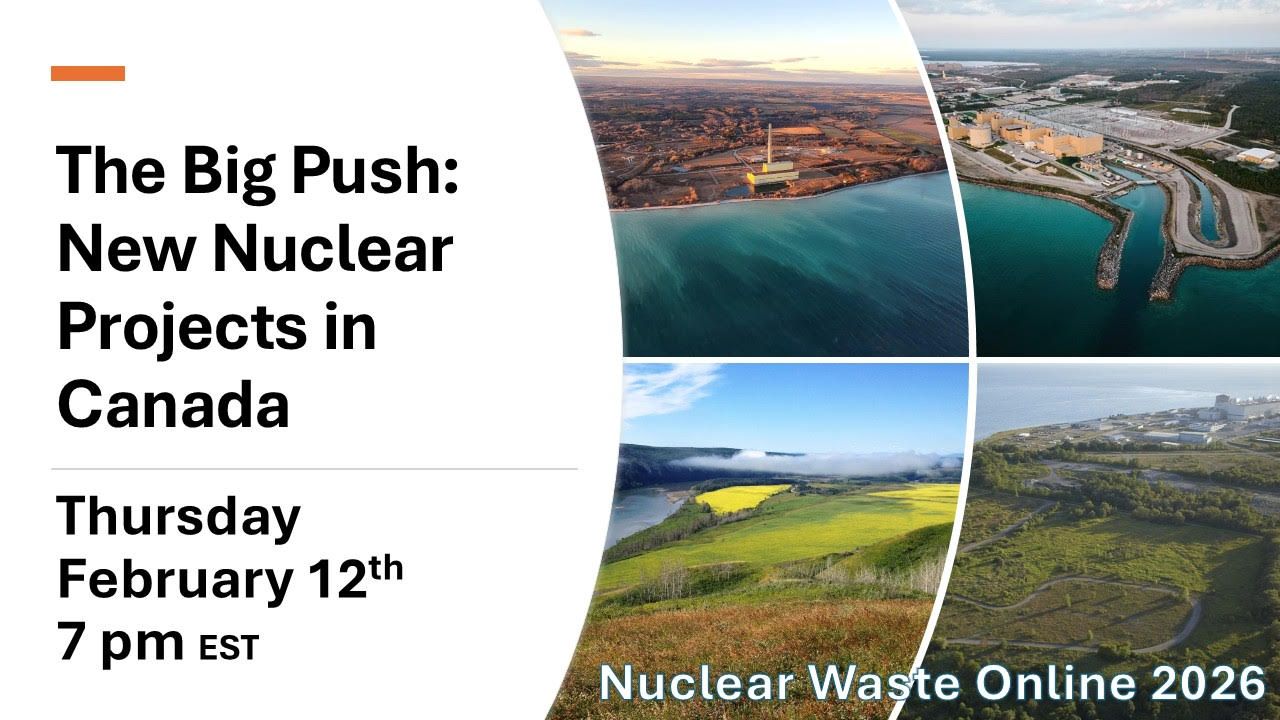
Thursday, February 12, 7 pm Eastern | 2nd of 4 sessions in the 2026 Nuclear Waste Online webinar series.
Join a webinar on the push for new nuclear generation in Canada. Go to Northwatch.org to register or use the registration link https://us02web.zoom.us/webinar/register/WN_ZfWOf1GITqSRIZX8CB-A9w
-
Archives
- February 2026 (76)
- January 2026 (308)
- December 2025 (358)
- November 2025 (359)
- October 2025 (376)
- September 2025 (258)
- August 2025 (319)
- July 2025 (230)
- June 2025 (348)
- May 2025 (261)
- April 2025 (305)
- March 2025 (319)
-
Categories
- 1
- 1 NUCLEAR ISSUES
- business and costs
- climate change
- culture and arts
- ENERGY
- environment
- health
- history
- indigenous issues
- Legal
- marketing of nuclear
- media
- opposition to nuclear
- PERSONAL STORIES
- politics
- politics international
- Religion and ethics
- safety
- secrets,lies and civil liberties
- spinbuster
- technology
- Uranium
- wastes
- weapons and war
- Women
- 2 WORLD
- ACTION
- AFRICA
- Atrocities
- AUSTRALIA
- Christina's notes
- Christina's themes
- culture and arts
- Events
- Fuk 2022
- Fuk 2023
- Fukushima 2017
- Fukushima 2018
- fukushima 2019
- Fukushima 2020
- Fukushima 2021
- general
- global warming
- Humour (God we need it)
- Nuclear
- RARE EARTHS
- Reference
- resources – print
- Resources -audiovicual
- Weekly Newsletter
- World
- World Nuclear
- YouTube
-
RSS
Entries RSS
Comments RSS
 nuclear-news
Leave a comment