Melted reactor cores might now be exposed, as water levels fall in Fukushima nuclear reactors

 Japan TV ‘News Flash’: Officials fear melted reactor fuel is now exposed at Fukushima — Tepco: We don’t know at this point if fuel is uncovered — Large drop in water level — Experts ‘struggling’ to find condition of nuclear cores, http://enenews.com/tv-officials-fear-melted-fuel-from-reactor-2-is-now-exposed-at-fukushima-tepco-we-dont-know-at-this-point-if-fuel-is-uncovered-water-level-drops-dramatically-experts-struggling-to-fin?utm_source=feedburner&utm_medium=email&utm_campaign=Feed%3A+ENENews+%28Energy+News%29nothing is known for all 3 reactors (VIDEO)
NHK WORLD, June 9, 2014: TEPCO: Water in reactor half expected level— Officials with the operator of the damaged Fukushima Daiichi nuclear plant say the water level inside the No.2 reactor’s containment vessel is about half what they had estimated. […] They found the water was around 30 centimeters [11.8 inches] deep. TEPCO officials […] say they don’t know whether the fuel is entirely submerged. […] They believe then flowing out of the reactor building through holes in the chamber.
NHK WORLD, June 10, 2014: TEPCO officials are struggling to find […] the condition of the melted fuel […] Officials believe that at reactor number 2, water is leaking […] at the bottom of the containment vessel, but do not know exactly from where. [At] reactors 1 and 3, the utility has found the sources of some leaks, but suspects there are other breaches […] Nothing is known about the condition of the melted fuel in all 3 reactors. TEPCO is considering various forms of surveys, including a plan to send a camera-mounted robot […]
Kyodo News, June 9, 2014: TEPCO confirms water level of Fukushima No. 2 reactor container […] A TEPCO official [said] the detailed condition of the melted fuel remains unknown.
NHK Transcript, June 9, 2014:
- Officials at Tepco are facing another setback.
- They don’t know whether [the water] even covers all of the nuclear fuel.
- Officials don’t know about the condition of the melted fuel.
- Officials believe the water level at another reactor is 10 times deeper.
- Teruaki Kobayashi, Tepco official: “We cannot tell at this point if the fuel is entirely submerged or if part of it’s above the water.”
- They believe it’s flowing through the chamber then out of the reactor building.
Pro nuclear commissioner to replace safety conscious one in Japan’s Nuclear Regulatory Agency
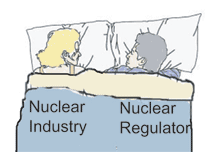 Independence of Japan’s nuclear regulator questioned after shakeup BY MARI SAITO AND KENTARO HAMADA TOKYO Tue Jun 10, 2014 (Reuters) – Japanese legislators approved a reshuffle at the nuclear safety regulator including appointing a commissioner who has received nearly $100,000 from nuclear-related entities over the past decade to fund his academic research.
Among the two commissioners stepping down from the five-member panel at the Nuclear Regulation Authority (NRA), one is a fierce critic of safety practices in the industry.
Opponents said the changes, which were approved on Tuesday, undermined Prime Minister Shinzo Abe’s commitment to an independent watchdog at a time when utilities are pushing to restart their idled reactors.
The NRA’s independence is under scrutiny as it reviews applications to restart reactors, all 48 of which were shut in the wake of the 2011 Fukushima disaster…….Japan’s lower house of parliament, where Abe has a majority, approved his government’s nomination of Satoru Tanaka, a nuclear engineering professor at the University of Tokyo and a proponent of nuclear power……
“Bringing someone like (Tanaka) on as a regulator changes the fundamental role of the NRA,” said Tomoko Abe, an independent anti-nuclear lawmaker not related to the prime minister.
“This nomination could undermine the very role of the regulator.”……..
Eight months after Fukushima, Tanaka was one of the first experts to say it may be safe to consider atomic energy again, according to remarks he made to a government panel on energy.
Between the 2004 and 2010 fiscal years, Tanaka received 6 million yen ($58,500 at current exchange rates) for research from three firms according to disclosures made by Tokyo University in response to a public information request from Reuters: Electric Power Development Co Ltd, known as J-Power, which is building a nuclear plant in northern Japan; reactor maker Hitachi Ltd’s nuclear division; and Hitachi GE Nuclear Energy Ltd.
Japan’s Jiji news service said Tanaka also received around 3 million yen over five years to March 31, 2012 from the Tepco Memorial Foundation, an organisation set up by the predecessor company to Fukushima operator Tokyo Electric Power, or Tepco. A foundation spokesman said Tanaka had been paid for judging research grants but declined to give an amount…….
None of the original NRA commissioners received funds from a utility or nuclear plant operator for their research in the three years leading up to their appointment, according to disclosures made when the NRA was set up……
CRITICAL VOICE The NRA’s most critical voice, seismologist Kazuhiko Shimazaki, will retire in September after two years as its deputy, a period in which he angered the industry with safety demands that in one case effectively scuttled a reactor restart………
“The main objective of this shuffle is to remove commissioner Shimazaki,” said Tetsunari Iida, executive director of Japan’s Institute for Sustainable Energy Policies, an anti-nuclear group. “The industry would never be satisfied if he wasn’t replaced.”…….http://uk.reuters.com/article/2014/06/10/uk-japan-nuclear-regulator-idUKKBN0EL0K020140610
Stark difference between President Obama and Prime Minister Abbott, on climate change
 Climate change gulf looms between Barack Obama and Tony Abbott, Guardian, 11 June 14 US president’s call for action in US TV interview stands in stark contrast to the attitude of the Australian prime minister Climate change may be the most significant long-term challenge facing the planet, Barack Obama has said in a newly aired TV interview, emphasising the growing differences with Tony Abbott who insists it is certainly not the most important issue facing the world.
As Obama and Abbott prepare for their first formal meeting in Washington on Thursday, the differences between their positions on global warming are clearer than ever, and according to diplomatic sources the president will not seek to downplay them.
Obama’s remarks in an interview broadcast on US television on Tuesday night come as his administration increases its diplomatic push to achieve a successful new international agreement on greenhouse reduction efforts next year and unveils the detail of tough new rules to force reductions in emissions from US power stations……….
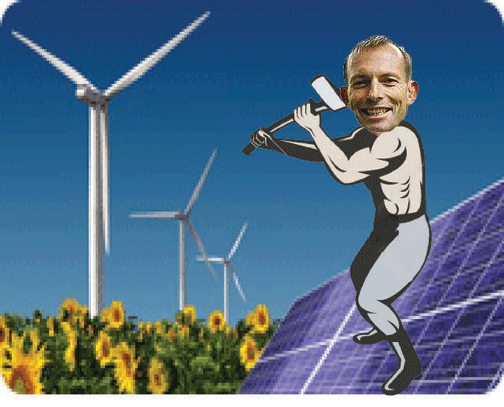 Abbott has downplayed the link between climate change and extreme weather events. For example during severe bushfires last year he said: “Climate change is real, as I’ve often said, and we should take strong action against it … but these fires are certainly not a function of climate change – they’re just a function of life in Australia.” When the executive secretary of the UN Framework Convention on Climate Change, Christiana Figueres, said the fires showed the world is “already paying the price of carbon”, Abbott said “the official in question is talking through her hat”……….
The Coalition’s Direct Action policy is designed to meet only the minimum target of a 5% reduction by 2020 – despite advice from the independent Climate Change Authority that preconditions for a higher target, which previously had bipartisan agreement, have been met. The Coalition has said it will participate in the Paris meeting but has not given any indication of what Australia’s post-2020 target will be, or how it will be determined.
Australia’s policy is entirely voluntary. Companies can choose to bid into a series of “reverse auctions” for government funding. The new US policy requires power generation to reduce emissions by 30%, with states determining the mechanism by which they achieve this. States such as California which have emissions trading schemes will use them to achieve the goal……..http://www.theguardian.com/environment/2014/jun/11/climate-change-gulf-looms-between-barack-obama-and-tony-abbott
The most radioactively poisoned site in America – Hanford
25 years on at America’s most contaminated nuclear waste site BBC News, Washington 10 June 2014 By Taylor Kate Brown The town of Hanford, Washington, has long been the most contaminated nuclear waste site in the US. But critics say poor management has put the site in further danger.
When Susan Leckband moved to eastern Washington state to take a job 30 years ago, radioactive contamination was not on her mind.
“I loved my job,” she says.
But it was only a handful of years before the place she worked, Hanford, turned from a plutonium production complex to a massive environmental clean-up site.
For Leckband, the question is not about the past, but the progress made on cleaning contaminated buildings and soil.
“It’s important to the entire Pacific North-West… the food crops, the salmon, the Indian tribes – it’s a huge, huge obligation,” she says.
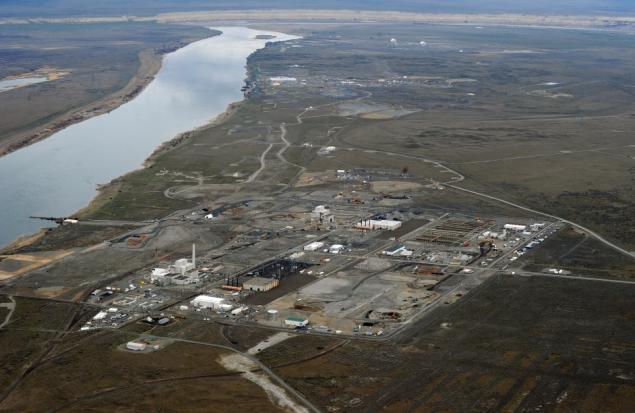
Situated on a plain along the Columbia River, the Hanford site is where the US produced plutonium used in the Manhattan Project, for the bomb that destroyed Nagasaki, and for a Cold War stockpile………despite some progress, the site’s most complicated and potentially dangerous waste issue – 56 million gallons (255 million litres) of high-level radioactive waste sitting inside tanks at the centre of the site – is facing more problems.
In the mid-1980s, activists and reporters began to unwind Hanford’s history, detailing safety lapses and environmental hazards across the site. ………
Hanford’s daunting clean-up problem in 1989
100 sq miles (259 sq km) of contaminated groundwater
56 million gallons (254 million litres) of liquid waste, in tanks buried just below ground
More than 1,000 ad hoc burial sites of waste
Hundreds of contaminated buildings
450 billion gallons of contaminated water released at ground level……..http://www.bbc.com/news/magazine-26658719
A risky situation – conflict in Ukraine and Ukraine’s nuclear reactors
 Ukraine crisis raises risk for nuclear reactors, DW 10 June 14, Ukraine’s volatility exacerbates the risk for the country’s 15 Soviet-style nuclear reactors, warn German experts. They demand more attention for the country where the world’s worst nuclear accident took place The recent news of a water shortage due to a broken pipeline affecting thousands in
strife ravaged Eastern Ukraine spells trouble for the safety of the country’s nuclear power plants.
That’s because the security and reliability of a country’s critical infrastructure like its electrical power and water grid is essential to safely run nuclear reactors.
“Once you have decided to operate a nuclear power plant or like in this case a nuclear reactor park, you must guarantee you don’t have unstable social situations and you definitely can’t have a war,” Michael Sailer, chairman of the German Nuclear Waste Management Commission and member of the German Reactor Safety Commission, told DW.
Potential for human error “We are talking about nuclear power plants that have a high risk even when they are constructed well and properly maintained,” Sailer who also heads Freiburg-based environmental think tank Öko-Institut added. “And in the Ukraine we are talking about the additional problem that there is an increased potential for human error due to less motivated nuclear operators than elsewhere and the fact that the security features of these reactors are a lot weaker than those of modern reactors.”
Ukraine currently has four nuclear power plants with 15 reactors online providing roughly half of the country’s energy needs which makes it practically impossible to shut them down during the crisis. All of the reactors stem from the Soviet era, went on the grid in the 1980s and are similar to the Chernobyl reactor that blew in 1986 causing the worst nuclear accident in history. Ukraine’s largest plant in Zaporizhia is located about 200 kilometers from Donetsk, the epicenter of the clash between pro-Russian militants and the Kyiv government.
Danger of sabotage But it’s not just the maintenance of the technical infrastructure and the motivation of the engineers operating the reactors that has the experts worried. The continued fighting between government and pro-Russian forces including the seizure of buildings raises the risk that the country’s nuclear plants could also be drawn into the mix…….
More attention The Chernobyl ruin serves as a reminder of the danger of nuclear energy
That the command structures particularly in the east of the country are already tenuous and embattled is evidenced by the ongoing fighting, the hostage taking of OSCE observers and the seizures of public buildings. And that this can easily affect critical infrastructure is highlighted by the recent news of a broken water pipeline in Eastern Ukraine.
That’s why – notwithstanding NATO’s assistance – not enough attention is being paid to the security of nuclear power plants in Ukraine, argue the experts.
“It’s really a problem, because only very few people think about this,” said Sailer. Nuclear experts usually don’t focus on such instable situations and the people who are concerned with instable situations like diplomats usually don’t realize how sensitive a nuclear power plant is.”http://www.dw.de/ukraine-crisis-raises-risk-for-nuclear-reactors/a-17694776
Borth Carolina had a close shave with a nuclear bomb
 Nuclear bomb nearly detonated after falling on North Carolina, declassified report says June 11, 2014 SMH, Dan Lamothe and Walter Russell Mead There are few things in this world that can change the course of history faster than a nuclear bomb exploding. The devastation is immediate and lasts for years.
That makes the latest details to emerge about a January 24, 1961, incident involving two nuclear bombs all the more jarring.
A B-52 bomber broke up in the sky over North Carolina, and one of the two bombs on board was in the “armed” setting by the time it hit the ground near Goldsboro, North Carolina, according to a newly declassified report published on Monday by the National Security Archive. f the switch had not been damaged by the impact of the crash, the weapon could have detonated, the report said……..
That incident, which led to an anti-nuclear movement in Britain, where the plane was bound, is one of many stories Eric Schlosser, the author of Fast Food Nation, tells in Command and Control.
During the cold war, nuclear bombs fell out of the sky, burned up in plane crashes and were lost at sea. In the incident Schlosser describes in greatest detail, “the Damascus accident” of September 18, 1980, the warhead from a Titan II missile was ejected after a series of mishaps that began when a repairman dropped a socket wrench and pierced a fuel tank.
Tactical nuclear weapons scattered across Europe had minimal security; misplaced tools and failed repairs triggered serious accidents; inadequate safety procedures and poor oversight led to dozens of close brushes with nuclear explosions.
People have died in these accidents, sometimes as a result of their own carelessness or bad luck, but often while doing their best to protect the rest of us from an accidental nuclear blast.: http://www.smh.com.au/world/nuclear-bomb-nearly-detonated-after-falling-on-north-carolina-declassified-report-says-20140611-zs3en.html#ixzz34OSCZMvQ
India’s nuclear liability law poses a challenge to Russia-India nuclear power agreement

 Russia agrees on India’s nuclear liability law http://economictimes.indiatimes.com/industry/energy/power/russia-agrees-on-indias-nuclear-liability-law/articleshow/36359852.cms MOSCOW: Russia has in principle agreed on the Indian nuclear liability law, paving the way for signing a contract for unit 3 and 4 of the Kudankulam Nuclear Power Plant in July, Russian officials said today. “The (liability) law enacted is certainly challenging. We are working with our colleagues (counterparts) in India and the issue has been resolved,” said Kirill Komarov, Deputy Director General on Development and International business, Rosatom State Corporation. “We have just signed the protocol. The approvals will take some time. We have are awaiting nod from the Indian side. The India’s over view authority (Atomic energy Regulatory Board) is yet to give its nod. “They are also checking seismic activity in the area. So by July we should be ready with a roadmap after which we can start implementing the General Framework Agreement signed between the two countries,” said told a press conference. Unit 1 of the KKNPP has attained 100 per cent capacity of 1000 MW while the second unit should start generating power from this year. Units 1 and 2 of Tamil Nadu-based Kudankulam Nuclear Power Plant (KKNPP) have been built with the help of Russian assistance at the cost of Rs 17,200 crore. Insuring nuclear power plants is a daunting task because of its high cost and there is no single governmental insurance entity in the country that can insure these installations .. .. http://economictimes.indiatimes.com/articleshow/36359852.cms?utm_source=contentofinterest&utm_medium=text&utm_campaign=cppst
Fracking brings instability and anxiety to the area around USA’s Waste Isolation Pilot Project (WIPP)

 Will Fracking Cause Our Next Nuclear Disaster? 09 June 2014 By Dahr Jamail, Truthout | The idea of storing radioactive nuclear waste inside a hollowed-out salt cavern might look good on paper. The concept is to carve out the insides of the caverns, deep underground, then carefully move in the waste. Over time, the logic goes, the salt will move in and insulate the containers for thousands of generations. “The whole game is to engineer something that can contain those contaminants on the order of tens of thousands of years,” Tim Judson, the executive director of the Nuclear Information Resource Service(NIRS), told Truthout. NIRS is intended to be a national information and networking center for citizens and environmental activists concerned about nuclear power, radioactive waste, radiation and sustainable energy issues, according to Judson.
Salt-cavern storage was the plan for the Waste Isolation Pilot Project (WIPP), the world’s third-deepest geological repository, constructed and licensed to permanently dispose of radioactive waste for 10,000 years. The repository sits approximately 26 miles east of the town of Carlsbad in southeastern New Mexico.
Since shipments began in 1999, more than 80,000 cubic meters and 11,000 shipments of waste have been transferred to WIPP.
But at the moment, there are several ongoing critical problems at the site, which has been closed and unable to accept shipments of radioactive waste ever since a fire and radiation release in February. Dozens of barrels of radioactive waste from Los Alamos National Lab, like the one that caused the radiation leak, now pose an “imminent” or “substantial” threat to public health and the environment.
Yet, these problems could pale in comparison to what might happen at the site if an earthquake were to strike, or if the protective salt layer were compromised by nearby drilling for oil and gas, and in particular, hydraulic fracturing, commonly known as fracking.
Fracking is a technique used in obtaining gas and petroleum, in which water is mixed with sand and toxic chemicals, and the mixture is injected at extremely high pressure into a wellbore to create small fractures.
Thus, one would logically deduce that fracking should never be done anywhere near WIPP. However, it is being done there, and experts expect it to increase.
“In the last three years, a dozen fracking wells have become operational within five miles of the site [WIPP],” Don Hancock, the director of the Nuclear Waste Safety Program at Southwest Research and Information Center, told Truthout.
Given that it is already well known that fracking causes earthquakes, it is clear that the nuclear waste storage site is now in danger of having its structural integrity compromised.
“These are the major concerns,” Hancock warned. “There is clearly a possibility that the deep fracking can affect the stability, but even more likely is fracking liquids nearing or entering the waste beds – which would be a very bad thing.”
“They Are Drilling All Around It”
Truthout spoke with a state of New Mexico employee who is intimately familiar with the permitting and drilling processes related to WIPP. The employee spoke on condition of strict anonymity, due to a fear of reprisals from the pro-drilling administration of radical right-wing Tea Party Governor Susana Martinez.
“There is so much drilling coming online down there now,” the employee explained. “They are going back into existing fields and drilling horizontally, and the WIPP siteis located right in the middle of all these fields, so they are drilling all around it.”
The source said that the oil and gas companies who are drilling and fracking near WIPP “have permission to go under the [WIPP] boundary to target the reservoirs there, so it appears as though most of the wells are horizontal, and that is a concern.”
According to the employee, “The fracking fluids they are injecting are very unstable, and if it continues like this there could be big problems…. There was a 5.2 [earthquake] in West Texas from fracking, and that’s a big concern given the sensitivity of the WIPP site and what the possible consequences could be.”…….http://www.truth-out.org/news/item/24201-will-fracking-cause-our-next-nuclear-disaster
Whistleblowers fired, as Hanford leaking radioactive waste problem continues
 25 years on at America’s most contaminated nuclear waste site BBC News, Washington 10 June 2014 By Taylor Kate Brown “…….In February, Oregon Senator Ron Wyden accused the DOE of a “never-ending pattern of failing to disclose what it actually knows about conditions at Hanford”. Wyden is most recently concerned about the tanks holding by-products of plutonium production, buried just below the surface at the centre of the site.
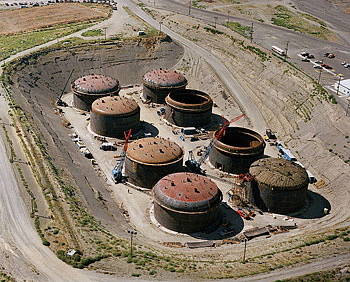
The original containers, single-shell tanks built in the 1940s and 1950s, had already leaked at least 1 million gallons of liquid waste into the ground. Hanford officials built double-shell tanks in the 1970s and 1980s and began transferring the radioactive waste into the newer vessels.
But in October 2012, the energy department announced one of the double-shell tanks was leaking into the space between the two shells. Waste in that tank has not entered the environment.
Wyden released an engineering review that said six other double-shells had similar construction flaws. He accused the agency of hiding what they knew, as the report had been made months after the initial leak announcement, but no other warnings from the DOE had followed.
Meanwhile, Hanford officials have recently submitted a plan to start emptying the leaking tank in two years.
Then, in late March, two dozen workers fell ill because of chemical vapours near the tanks. Workers again noticed vapours around the tanks in May. The composition of the waste in the leaking tank makes it more likely to corrode, Fletcher says. No other double-shell tank holds such a mixture and full inspections on the tanks will now be done more frequently,
But in general, the double-shells must do their job for several more decades until a waste treatment plant – currently under construction – immobilises in glass all 56 million gallons of waste in the tanks.
The treatment plant was scheduled to become operational by 2019, but construction has been slowed or entirely halted on two key parts of the plant for additional testing. Once the treatment plant goes into operation, parts of it must be run entirely by robotics because of the high radioactivity of the waste. Regulators call it a “black-box” system.
Hanford Challenge represents two whistleblowers, Walt Tamosaitis and Donna Busche, who say they have been punished for expressing concerns about the treatment plant’s design.
Carpenter says the whistleblowers are speaking up now because once the plant begins operations, there will be no chance to fix potentially dangerous errors.
Both Tamosaitis and Busche have been fired by URS, one of the contractors at Hanford.
The energy department says it has asked its inspector general to “review the circumstances surrounding the termination of Ms Busche”, a safety manager who alleged continuing harassment since she first brought up concerns in 2011. Meanwhile the waste remains in the aging tanks. http://www.bbc.com/news/magazine-26658719
Analyst’s gloom on future of uranium market
Making the price collapse even worse, Uranium recently slumped to $28 per pound — the lowest level since June 2005.
This very low market price is significant because the vast majority of uranium mining operations around the world require a $60 per pound market price to continue mining profitably.
Evidence of how poor the outlook for uranium prices actually is…….
Uranium: The Green Metal Has Lost its Glow,Uncommon Wisdom Daily, James DiGeorgia | June 10, 2014…….Japan Wants More Power … Just Not Nuclear The Japanese public, more than three years after Fukushima, is STILL massively against re-opening ANY nuclear power plants. Japanese fears over nuclear power are well-founded, and shouldn’t be dismissed.
The panic and chaos of 160,000 Japanese as a result of the meltdown of three units of Fukushima Dai-Ichi Nuclear Reactor has only fanned their fears of nuclear power. These fears understandably linger after the devastation of Hiroshima and Nagasaki, which brought an end to the Second World War.
But that’s not all. The reality is, all of Japan is at risk for earthquakes and many of Japan’s reactors have been built with substandard designs and materials — all of which is frequently reinforced by Japan’s media……..
The Japanese government hasn’t helped to bolster public confidence, especially after a long series of egregious missteps it made in the aftermath of the Fukushima crisis.
As Reuters recently noted, a March survey shows that roughly 80% of the people in Japan would prefer to see the country move away from nuclear power……..
As for uranium … It’s become clear in the last 30 days that Uranium prices aren’t going anywhere.. Continue reading
Top Israeli intelligence official is optimistic about nuclear talks with Iran
Israel: General Has Hopeful View About the Nuclear Talks With Iran http://www.nytimes.com/2014/06/10/world/middleeast/israel-general-has-hopeful-view-about-the-nuclear-talks-with-iran.html?_r=0 By ISABEL KERSHNERJUNE 9, 2014 As Iran and the United States began two days of talks in Geneva on Monday to advance the stalled negotiations over Iran’s disputed nuclear activities, a top Israeli intelligence official said he believed that Iran was serious about ensuring the success of the negotiations.
The assessment of the official, Brig. Gen. Itai Brun, the chief analyst of Israeli military intelligence, appeared more optimistic than that of Prime Minister Benjamin Netanyahu of Israel, who has persistently warned against what he has called a bad nuclear deal with Iran. General Brun, speaking at Israel’s annualHerzliya Conference on policy and security, said that Iran was abiding by a temporary agreement with major powers, and that economic pressures on the country “are leading it toward a dialogue, which we view as serious, on a permanent agreement.” The temporary accord expires on July 20, and diplomats have said significant obstacles remain in achieving a permanent agreement to guarantee that Iran’s nuclear program is for peaceful purposes.
Control rod malfunction causes shutdown of Korean nuclear reactor
Nuclear reactor shut down in S. Korea after rod malfunction RT.com 9 June 14, The world’s fifth-ranked in nuclear power generation shut down a reactor due to a control rod malfunction. This brings the number of offline reactors in South Korea to five.”We are looking into the exact cause of the shutdown,” the state-run nuclear utility Korea Hydro and Nuclear Power Co Ltd (KHNP) said.
The spokesman said it was not known when the 950-megawatt Reactor No.1 at the Hanul Nuclear Power Plant, the Gyeongsangbuk-do province on the country’s eastern coast, would be restarted. The plant’s other five reactors remain operational so far.
The number of South Korean reactors offline now stands at five out of a total 23, which cover around one-third of the country’s electricity needs……….
The country’s nuclear watchdog also wants to expand its probe of reactor parts certified or made by foreign companies since 2008 to pin down other possible fake safety certificates. http://rt.com/news/164812-korea-nuclear-shutdown-energy/
High levels of tritium near Indian Point nuclear plant
Report: Elevated Levels Of Tritium Found Near Indian Point Nuclear Power Plant June 10, 2014 NEW YORK (CBSNewYork) – There’s been a spike in radioactive material discovered in groundwater beneath the Indian Point nuclear power plant, WCBS 880 reported.
The Nuclear Regulatory Commission and Entergy, which operates the plant, are trying to locate the source of the tritium.
Two monitoring wells picked up a spike in levels of the isotope in groundwater and bedrock under the plant in March, WCBS 880′s Sean Adams reported……http://newyork.cbslocal.com/2014/06/10/report-elevated-levels-of-tritium-found-in-ground-water-bedrock-near-indian-point-nuclear-power-plant/
A Growing Number of Problems at Waste Isolation Pilot Project (WIPP)
Will Fracking Cause Our Next Nuclear Disaster? 09 June 2014 By Dahr Jamail, Truthout “…….Due to the ongoing problems at WIPP, the federal government’s Department of Energy (DOE) recently notified the state of New Mexico that it would be unable to meet a June 30 deadline to remove 3,706 cubic meters of nuclear waste from the mesa at Los Alamos National Lab where it is stored.
“As we work to assess the conditions of the transuranic waste program at the lab, we have decided to halt further shipments until we can reassure the public that it is safe to do so,” DOE Deputy Under Secretary David Klaus said.
As a result of the February radiation leak and fire within the facility, WIPP officials at the site discounted any effect of the current leak on human health, saying no radiation escaped to the surface. But they did not speak about the extent of the problem or how it eventually would be cleaned up.
“Officials at WIPP continue to monitor the situation,” DOE spokeswoman Deb Gillsaid at the time of the leak. “We are emphasizing there is no threat to human health and the environment.”
Contradicting Gill’s assurances, plutonium readings were detected at a DOE field office half a mile from the site. Joe Franco, the manager of the DOE field office, confirmed the readings……… Continue reading
USA Energy Dept broke laws to help uraniumcompany
GAO: Feds broke laws to help uranium company By Steven Mufson, The Washington Post June 9, 2014 WASHINGTON – The Energy Department, in an effort to prop up a troubled uranium enrichment company, arranged for uranium transfers that failed to comply with laws about fair pricing, national security determinations and limits to prevent the department from flooding the domestic uranium market, the Government Accountability Office said in a report released to the public Monday.
The company, USEC, ceased enrichment activities in May 2013 and declared bankruptcy in March 2014, battered by weak demand from nuclear plants, its outdated enrichment facility in Kentucky and a shortage of capital to invest in new technology and a plant in Ohio.
The GAO examined four transfers of uranium by the Energy Department in 2012 and 2013 that indirectly provided USEC with operating cash. ……….
“Our government has kept this uranium company on life support, wasting money and flouting the law, even though it was clear that it would end up in bankruptcy,” said Sen. Edward Markey, D-Mass., who sits on the Senate Environment and Public Works Committee and who requested the study with Rep. Michael Burgess, R-Texas. “This is the kind of government waste that Americans just don’t understand. It’s time to commit this junk technology to the junk bin.”……..
the company has struggled. Its Paducah plant consumes as much electricity as the city of Memphis, and work on its new American Centrifuge technology at a plant in Ohio has stalled.
The entire Ohio congressional delegation and the Energy Department have defended USEC, saying it provides jobs and that it is needed as the only American-owned enrichment company to supply material to make tritium for U.S. weapons. Many experts dispute this, saying that the military has enough tritium to last a couple of decades.
USEC closed at $3.45 a share Monday, less than 1 percent of its May 2007 peak. The company is valued at $17 million……..http://www.courier-journal.com/story/news/local/2014/06/09/gao-feds-broke-laws-help-uranium-company/10266125/
1 This Month
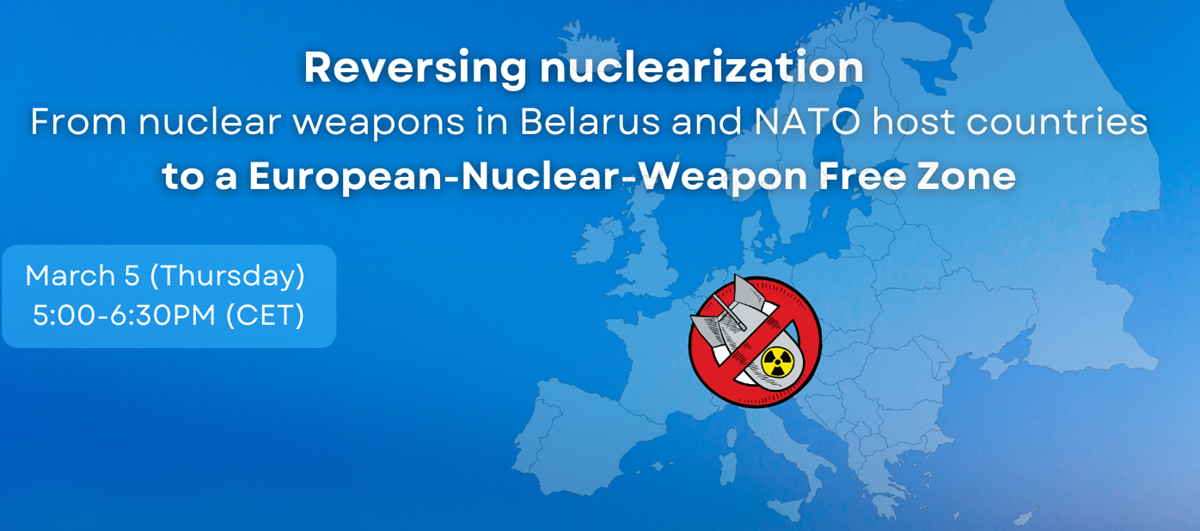
5 March -Online – Reversing nuclearization:
From nuclear weapons in Belarus and NATO host countries to a European-Nuclear-Weapon Free Zone
11am-12:30pm Eastern Time USA / 5pm-6:30pm CET

of the week – Advocating for a
nuclear free beach – https://www.samuellawrencefoundation.org/
The Samuel Lawrence Foundation advocates for a Nuclear Waste Free Beach at San Onofre, join us and take action!

10 March A LIVE WEBINAR THE REAL EFFECTS OF NUCLEAR POWER
What the Industry Isn’t Telling Us
1:00 PM Mountain, 2 pm Central, 3 pm Eastern. Live on the Keepers of the Water Facebook page


18 March Webinar @ 1 PM EST: An Assessment of SMR Projects: The Case of Canada
register for the zoom:
https://us02web.zoom.us/webinar/register/WN_o8BIIOUvQ2ONJR1nta65DQ#/registration

of the week – STOP SMALL MODULAR REACTORS IN CANADA
To see nuclear-related stories in greater depth and intensity – go to https://nuclearinformation.wordpress.com
-
Archives
- March 2026 (38)
- February 2026 (268)
- January 2026 (308)
- December 2025 (358)
- November 2025 (359)
- October 2025 (376)
- September 2025 (258)
- August 2025 (319)
- July 2025 (230)
- June 2025 (348)
- May 2025 (261)
- April 2025 (305)
-
Categories
- 1
- 1 NUCLEAR ISSUES
- business and costs
- climate change
- culture and arts
- ENERGY
- environment
- health
- history
- indigenous issues
- Legal
- marketing of nuclear
- media
- opposition to nuclear
- PERSONAL STORIES
- politics
- politics international
- Religion and ethics
- safety
- secrets,lies and civil liberties
- spinbuster
- technology
- Uranium
- wastes
- weapons and war
- Women
- 2 WORLD
- ACTION
- AFRICA
- Atrocities
- AUSTRALIA
- Christina's notes
- Christina's themes
- culture and arts
- Events
- Fuk 2022
- Fuk 2023
- Fukushima 2017
- Fukushima 2018
- fukushima 2019
- Fukushima 2020
- Fukushima 2021
- general
- global warming
- Humour (God we need it)
- Nuclear
- RARE EARTHS
- Reference
- resources – print
- Resources -audiovicual
- Weekly Newsletter
- World
- World Nuclear
- YouTube
-
RSS
Entries RSS
Comments RSS
 nuclear-news