Birth and death of the Global Nuclear Energy Partnership
Failed Nuclear Weapons Recycling Program Could Put Us All in Danger io9, Mark Strauss, 7 June 14 “……..Thinking outside the MOX
When George W. Bush arrived in the White House, his administration had an ambitious plan to revive the nuclear power industry in the U.S. while limiting the proliferation of nuclear weapons abroad.
It was called the Global Nuclear Energy Partnership (GNEP). The plan envisioned an international nuclear cartel in which the United States and other fuel supplier nations—such as Russia, Britain, France, and Japan—would operate a fuel-leasing program. These supplier nations would provide fresh fuel to conventional nuclear plants in return for user nations agreeing to forego building their own fuel production facilities—which could also be used to make weapons-grade material.
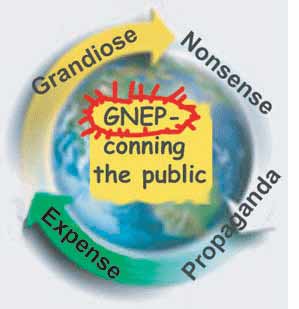
A central component of the GNEP proposal would be the construction of breeder reactors in the United States. Like the Russians, the Bush administration now wanted to use MOX as feedstock. The White House promised, however, that America’s breeder reactors would not produce plutonium that could be used for nukes. These reactors would use a new, super-awesome process to produce plutonium that could only be used as fuel. The process had been successfully tested on a laboratory scale, and the White House had confidence that it could be made to work in the real world. It just needed further development, at the cost of $1.06 billion.
Meanwhile, Russia—which the Bush administration envisioned as part of the GNEP cartel—was having second thoughts about its 2000 agreement with the United States. An investigative report published by the Center for Public Integrity describes what happened next:
………..Moscow wanted the Russian MOX plant, financed by Washington, to make fuel not for standard reactors, but for a full-scale breeder program…The Bush administration agreed— with little public notice— to let Russia renege on its original promise and burn its plutonium in two breeders—breeders that could produce more plutonium.
In November 2007, the U.S. and Russia signed a revised pact, which the Department of Energyextolled as “measurable progress towards disposing of a significant amount of weapon-grade plutonium in Russia.”
At around the same time, construction of the MOX facility began at the Savannah River Site.
And GNEP? An increasingly skeptical Congress cut its funding, especially after nuclear energy experts warned that the final price tag could climb as high as $100 billion. The program was declared dead in 2009…….. http://io9.com/failed-nuclear-weapons-recycling-program-could-put-us-a-1586851270
No comments yet.
1 This Month


Tell the Ukrainian Government to Drop Prosecution of Peace Activist Yurii Sheliazhenko

Petition to revoke the licensing of the Near Surface Nuclear Disposal Facility (NSDF) at Chalk River. https://www.ourcommons.ca/petitions/en/Petition/Details?Petition=e-7247


of the week – STOP SMALL MODULAR REACTORS IN CANADA
To see nuclear-related stories in greater depth and intensity – go to https://nuclearinformation.wordpress.com
-
Archives
- March 2026 (212)
- February 2026 (268)
- January 2026 (308)
- December 2025 (358)
- November 2025 (359)
- October 2025 (376)
- September 2025 (258)
- August 2025 (319)
- July 2025 (230)
- June 2025 (348)
- May 2025 (261)
- April 2025 (305)
-
Categories
- 1
- 1 NUCLEAR ISSUES
- business and costs
- climate change
- culture and arts
- ENERGY
- environment
- health
- history
- indigenous issues
- Legal
- marketing of nuclear
- media
- opposition to nuclear
- PERSONAL STORIES
- politics
- politics international
- Religion and ethics
- safety
- secrets,lies and civil liberties
- spinbuster
- technology
- Uranium
- wastes
- weapons and war
- Women
- 2 WORLD
- ACTION
- AFRICA
- Atrocities
- AUSTRALIA
- Christina's notes
- Christina's themes
- culture and arts
- Events
- Fuk 2022
- Fuk 2023
- Fukushima 2017
- Fukushima 2018
- fukushima 2019
- Fukushima 2020
- Fukushima 2021
- general
- global warming
- Humour (God we need it)
- Nuclear
- RARE EARTHS
- Reference
- resources – print
- Resources -audiovicual
- Weekly Newsletter
- World
- World Nuclear
- YouTube
-
RSS
Entries RSS
Comments RSS
 nuclear-news
Leave a comment